Lina Irawan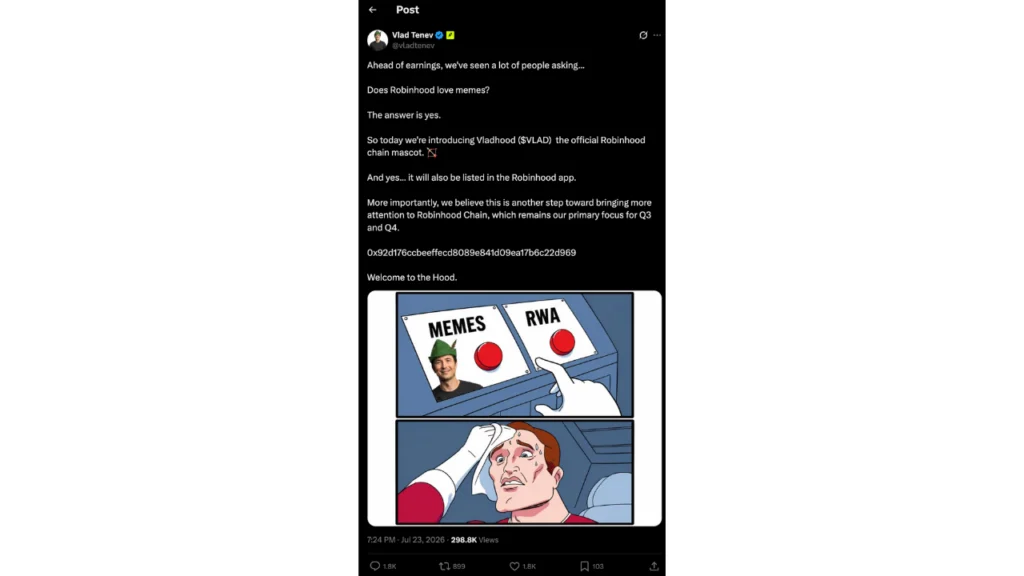
The cryptocurrency industry has once again been targeted by sophisticated social media hacks, with the verified X account of Robinhood CEO Vlad Tenev falling victim on Thursday. Attackers leveraged the platform to promote a fraudulent meme coin, dubbed Vladhood (VLAD), falsely presenting it as an official initiative of Robinhood Chain. This incident highlights the persistent threat of social engineering attacks in the digital asset space, exploiting the credibility of high-profile figures to drive speculative trading.
The deceptive post, which was rapidly removed once Robinhood regained control of the account, claimed that Vladhood was the "official mascot of Robinhood Chain" and that the token would soon be listed on the Robinhood trading application. Crucially, the message included a smart contract address, enticing users to purchase the meme coin by associating it with Tenev’s personal brand and Robinhood’s recently launched blockchain network. Robinhood swiftly confirmed the unauthorized nature of the post and urged its user base to disregard the fraudulent promotion, emphasizing that Vladhood had no affiliation with the company or its crypto services.
Robinhood Confirms CEO’s Account Breach and Fraudulent Token Promotion
The security lapse occurred on July 24, when cryptocurrency enthusiasts and followers of Tenev’s X account, which boasts nearly 800,000 followers, noticed an unusual and alarming post. The fraudulent message specifically promoted VLAD as an officially sanctioned meme coin by Robinhood, positioning it as the mascot for Robinhood Chain, the company’s new Ethereum Layer-2 network. The claim of an impending listing on the Robinhood app was entirely fabricated, designed to capitalize on the trust users place in the trading platform.
Following the discovery of the compromised post, Robinhood issued a statement through its official communications X account. "Heads up: Our CEO Vlad Tenev’s X account was compromised and posted a fake promotion for a meme coin," the company stated. "We’re working with X to restore access and the post has been removed." Robinhood reiterated its stance, unequivocally stating that Vladhood had no official connection to Robinhood or Robinhood Crypto and advising users against treating the token as an endorsed project. In a proactive measure, blockchain explorer tools associated with Robinhood Chain quickly flagged the token’s smart contract as a "potential scam," providing an additional layer of warning to traders before significant funds could be lost.

Rapid Surge and Subsequent Collapse of the Fraudulent Token
Despite the clear fraudulent nature of the post and Robinhood’s immediate disclaimer, the market reacted with swift, albeit misguided, enthusiasm. Within hours of the deceptive announcement, VLAD’s market capitalization reportedly surged to an estimated range of $4 million to $10 million. This rapid valuation was almost entirely driven by investors who believed the token possessed official backing from Robinhood’s CEO.
However, on-chain analytics soon revealed several red flags indicative of a pump-and-dump scheme. Researchers observed that approximately 70% of the token’s supply was concentrated in a few early wallets, pointing to a highly centralized control of the project. Furthermore, the liquidity pool for the token had not been permanently locked or burned, and the deployer’s wallets continued to collect fees from ongoing transactions. Ultimately, the developer wallet cashed out approximately 690 ETH, valued at around $1.3 million at the time, before the token’s price plummeted by over 80%. Thousands of retail investors were left holding devalued tokens in the wake of this rapid sell-off. Efforts by some community members to revive the project through a community takeover (CTO) were met with continued disavowal from Robinhood, which maintained that the token remained entirely unrelated to the company.
The Growing Meme Coin Ecosystem on Robinhood Chain
This latest security incident occurred less than a month after Robinhood officially launched Robinhood Chain on July 1. Built using Arbitrum Orbit technology, this Ethereum Layer-2 network was initially envisioned as infrastructure for tokenized stocks, real-world assets (RWAs), and other regulated financial products. Robinhood has positioned the blockchain as a pivotal element in its long-term strategy to transcend traditional brokerage services and enter the burgeoning field of tokenized finance.
However, the early activity on Robinhood Chain has been significantly dominated by speculative meme coin trading rather than the intended regulated financial products. According to data from Dune Analytics, the network has rapidly attracted hundreds of millions of dollars in on-chain assets, processed millions of daily transactions, and recorded hundreds of thousands of active wallet addresses shortly after its debut. This influx of traders has fueled an explosion of unofficial meme coins seeking to leverage Robinhood’s brand recognition.
One prominent example is CashCat, a meme coin that quickly became one of the chain’s most actively traded assets. Earlier in July, reports emerged of significant losses incurred by users who interacted with a compromised smart contract linked to the CashCat project, underscoring the inherent risks associated with newly launched tokens on the network. The Vladhood incident further exemplifies how quickly malicious actors attempt to exploit the attention surrounding nascent blockchain ecosystems.

Social Media Hacks: A Persistent and Evolving Threat in Crypto
The compromise of Tenev’s X account is not an isolated incident but rather follows a well-established pattern that has plagued the cryptocurrency industry for years. Scammers are increasingly shifting their focus from directly attacking blockchain protocols to targeting verified social media accounts of executives, celebrities, and public figures. Once access is gained, attackers disseminate fraudulent token launches or fake investment opportunities, preying on the trust and influence associated with these high-profile accounts.
During the pronounced meme coin boom of 2024, verified X accounts belonging to prominent figures such as actress Sydney Sweeney, musician Doja Cat, and rapper 50 Cent were all compromised to promote fictitious meme coins before the posts could be retracted. This strategy heavily relies on generating a sense of fear of missing out (FOMO), compelling traders to impulsively purchase newly promoted tokens without adequate verification of the legitimacy of the announcements. Unlike sophisticated smart contract exploits that require deep technical knowledge, these attacks primarily exploit human psychology and the perceived credibility of influential online presences.
A Crucial Security Reminder for Crypto Investors
The Vladhood incident serves as a potent reminder that security risks within the cryptocurrency space extend far beyond the vulnerabilities of blockchain technology itself. Robinhood Chain remained secure and uncompromised during this attack; the breach was confined to Tenev’s X account. This distinction highlights how a single compromised social media login can precipitate millions of dollars in speculative trading within minutes, demonstrating the interconnectedness of digital security.
In light of these ongoing threats, cybersecurity experts continue to strongly advise crypto investors to verify announcements through multiple official channels before engaging with newly promoted tokens or transferring funds to contract addresses shared on social media platforms. This due diligence is critical to differentiating legitimate projects from fraudulent schemes.
As Robinhood continues to expand its ambitious blockchain initiatives, the company is likely to face intensified scrutiny regarding both the security of its platform and the proliferation of unofficial projects attempting to capitalize on its brand. The Vladhood incident underscores the agility of scammers in adapting to major cryptocurrency launches, readily employing trusted identities to ensnare unsuspecting traders in fraudulent schemes. The incident serves as a critical moment for investors to reinforce their vigilance and prioritize verification in an increasingly complex and often deceptive digital asset landscape.