James Watt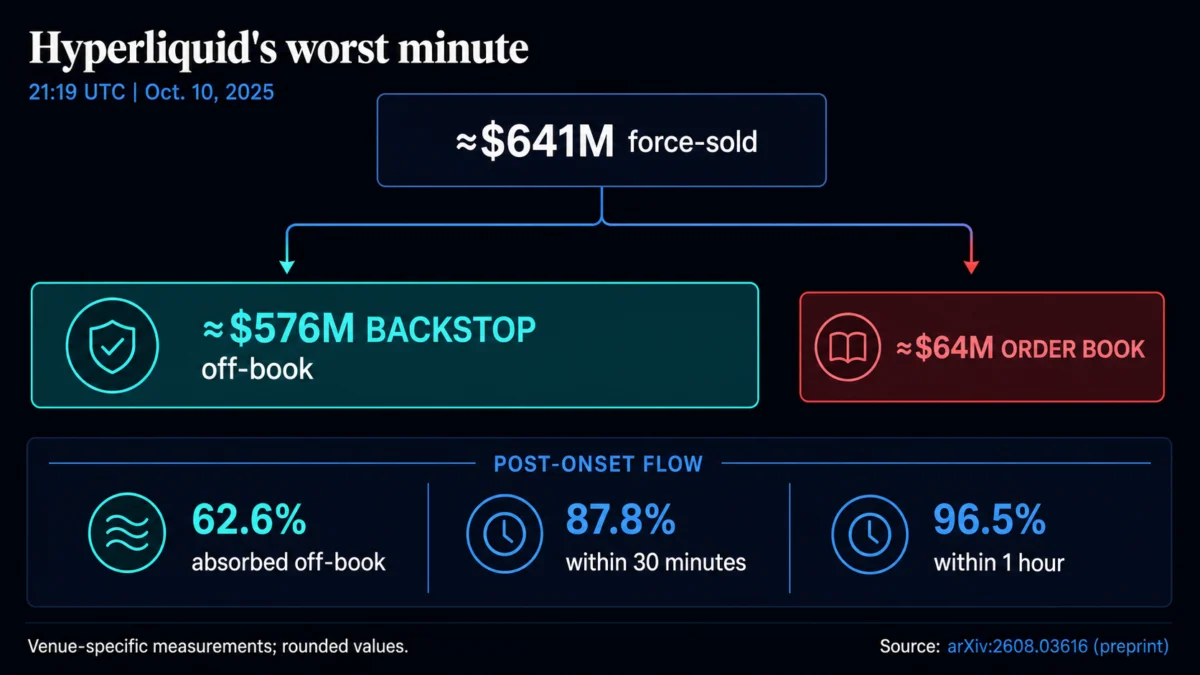
This strategic diversion of selling pressure proved critical in preventing a "liquidation feedback loop," a phenomenon where forced sales drive prices down so rapidly that they trigger a subsequent wave of liquidations, potentially leading to a total market vacuum. By utilizing its internal liquidity vaults to shoulder 89.8% of the immediate selling volume during that peak minute, Hyperliquid managed to maintain price integrity within its venue, even as the broader global cryptocurrency market experienced one of its most severe contractions in years.
The Mechanics of the Hyperliquid Backstop
To understand how Hyperliquid survived the October 2025 event, it is necessary to examine the platform’s unique liquidation architecture. Unlike traditional decentralized exchanges that rely solely on automated market makers (AMMs) or public limit order books (CLOBs) to clear bad debt, Hyperliquid employs a multi-tiered approach designed to protect market stability.
Under standard operating procedures, Hyperliquid’s liquidation rules first attempt to close a distressed position through market orders on the public book. However, when market conditions meet specific "stress" criteria—such as extreme volatility or a lack of depth in the order book—the system triggers a protocol-level intervention. In these instances, a specialized "liquidator vault" takes over the position. This vault is a core component of the Hyperliquidity Provider (HLP) protocol vault, a community-backed liquidity pool that acts as a perpetual market maker and backstop for the entire ecosystem.
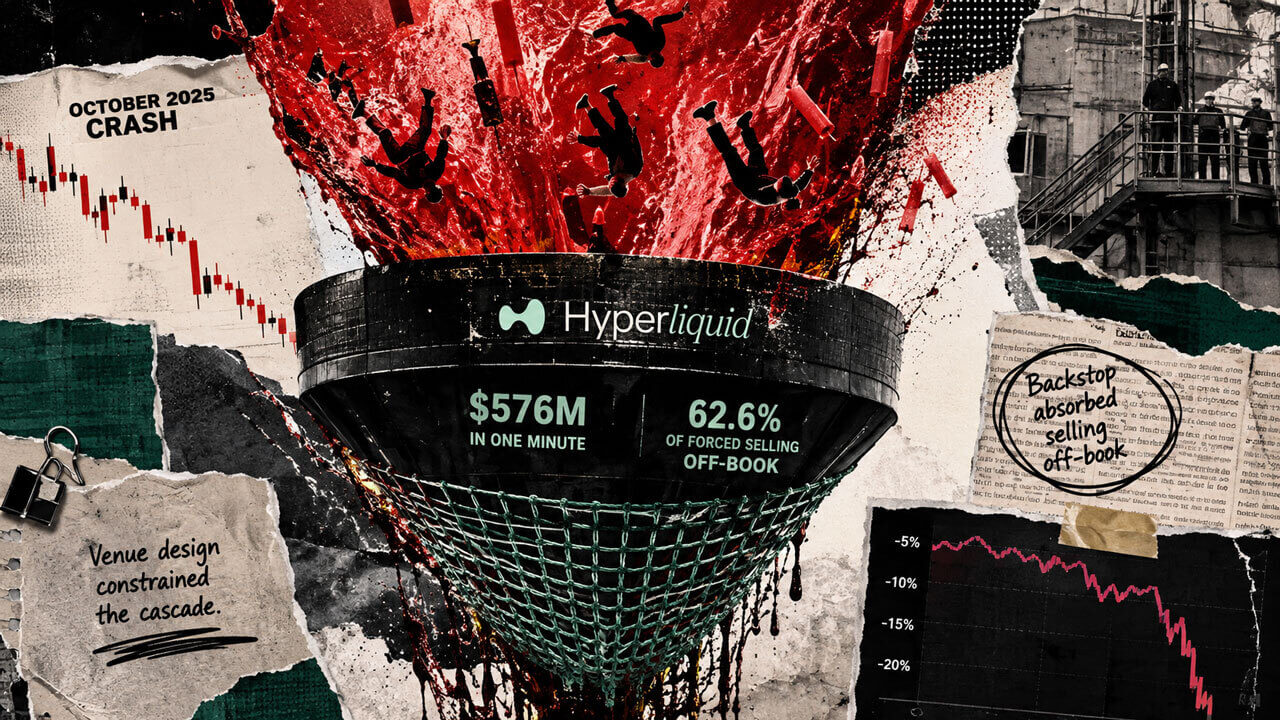
The research preprint highlights that this off-book routing damped the feedback loop that typically characterizes crypto "flash crashes." When liquidations hit a public book, they consume the available bids, pushing the mark price lower. This lower price then breaches the maintenance margin of other leveraged traders, creating a domino effect. By absorbing $576 million into the HLP vault, Hyperliquid effectively "hid" the selling pressure from the public price discovery mechanism, allowing the venue to provide a buffer against the external market’s irrationality.
Chronology of the October 10, 2025, Crash
The October 2025 crash was not a slow decline but a highly compressed "volatility event" that tested the limits of blockchain infrastructure. The research paper tracked the event over a 15.7-hour window, but the most significant damage occurred in a matter of minutes.
- Pre-Onset (20:00 – 21:15 UTC): Market sentiment shifted rapidly following a series of external macroeconomic shocks and liquidity withdrawals across major centralized exchanges.
- The Nucleation Phase (21:16 – 21:18 UTC): Liquidations began to mount. The study reported $644 million in book-directed forced-sale value during this initial phase as the market sought a floor.
- The Peak Minute (21:19 UTC): The "worst minute" of the crash saw $641 million in forced selling on Hyperliquid alone. It was during this sixty-second window that the backstop mechanism performed its most critical function, absorbing 90% of the volume off-book.
- The Compression Phase (21:20 – 21:50 UTC): The event was remarkably concentrated. The study found that 87.8% of all forced selling following the onset occurred within just 30 minutes.
- The Stabilization Phase (22:20 UTC onward): By the one-hour mark, 96.5% of the liquidation event had been processed. While the broader market remained in a state of shock, Hyperliquid’s internal metrics began to stabilize.
Throughout the 15.7-hour window, the paper tracked a total of $733 million in forced-sale value that was eventually directed toward the public book. However, the 62.6% share absorbed by the backstop across the entire duration of the event was what prevented the venue from experiencing the "death spiral" seen in previous decentralized finance (DeFi) crises.
Data Analysis: The Branching Ratio and Systemic Stability
The researchers employed a sophisticated mathematical model to determine the "branching ratio" of the liquidation cascade. In financial modeling, a branching ratio represents the average number of additional liquidations triggered by a single forced sale. A ratio of 1.0 or higher indicates a self-sustaining chain reaction where the system can no longer clear debt without external intervention or a total halt in trading.
Remarkably, Hyperliquid’s structural estimate for its branching ratio remained significantly below the danger zone throughout the crisis.
- During the Nucleation Phase: The ratio stood at 0.195.
- At the Peak of Panic: The ratio actually eased to 0.140.
- Overall Amplification Calculation: The data implied a final ratio of 0.122.
These figures suggest that for every $1 million in forced sales, only about $122,000 to $195,000 of subsequent liquidations were triggered within the Hyperliquid ecosystem. This low "contagion" rate is a testament to the efficacy of the off-book backstop. In contrast, venues without such mechanisms often see branching ratios spike toward 0.8 or 0.9 during similar events, leading to massive price slippage and "wicking" that wipes out even low-leverage traders.
Comparative Context: Seven Major Cascades
The preprint places the October 2025 event within the context of a larger longitudinal study of Bitcoin perpetual futures cascades from 2022 through 2025. This latest paper is "Part II" of a series; "Part I" previously established that there is no "universal" early-warning signal that can predict an individual crash across different exchanges.
However, Part II shifts the focus from prediction to mitigation. By comparing Hyperliquid’s performance with historical data from other major cascades, the authors hypothesize that the presence of a robust, protocol-level backstop is the single most important factor in determining whether a venue survives a "black swan" event.

Because Hyperliquid’s fill-log archives only began in May 2025, the October event serves as the first major "in-flight" case study for this specific architecture. The authors frame the success of this backstop as a potential blueprint for future decentralized exchange (DEX) designs, suggesting that "higher realized branching" on other venues is likely due to the lack of a comparable off-book absorption layer.
Market Reaction and Broader Implications
The findings of the research paper have sparked a wider discussion regarding the maturity of on-chain trading. For years, critics of DeFi argued that decentralized venues could not handle the "peak panic" volume that centralized exchanges (CEXs) like Binance or OKX manage through internal market-making desks. The Hyperliquid data challenges this narrative, showing that a transparent, code-based backstop can perform as well as, if not better than, the opaque "liquidation desks" of centralized entities.
While the preprint has not yet completed a formal peer review, its data-driven approach provides a rare look into the internal plumbing of a DEX during a crisis. It should be noted, however, that the study’s scope is limited to Hyperliquid. The authors concede that while feedback was damped inside the venue, the shared nature of crypto prices means that Hyperliquid’s stability could not entirely prevent liquidations triggered by price drops on other exchanges.
In the wake of the report’s release, market sentiment surrounding Hyperliquid has turned decidedly bullish. As of August 2026, the Hyperliquid token has seen a 17.29% increase in value over a 24-hour period, propelling it to the rank of #9 by total market capitalization. With a market cap of $18.34 billion and a 24-hour trading volume of $1.6 billion (up 288%), investors appear to be pricing in the platform’s demonstrated resilience.
Conclusion: A New Standard for DeFi Resilience?
The October 2025 crash will likely be remembered as a turning point for on-chain derivatives. The ability of Hyperliquid to absorb over half a billion dollars in forced selling in a single minute without a systemic failure marks a significant milestone in the evolution of financial technology.
By shifting the burden of liquidations from the public order book to the HLP backstop, Hyperliquid successfully decoupled its internal price discovery from the chaotic feedback loops of the broader market. As the industry moves forward, the "branching ratio" and "off-book absorption rate" may become standard metrics for evaluating the safety and solvency of both decentralized and centralized trading platforms. For now, the data suggests that in the face of peak panic, Hyperliquid’s structural innovations provided the "giant backstop" necessary to catch a falling market.