Lina Irawan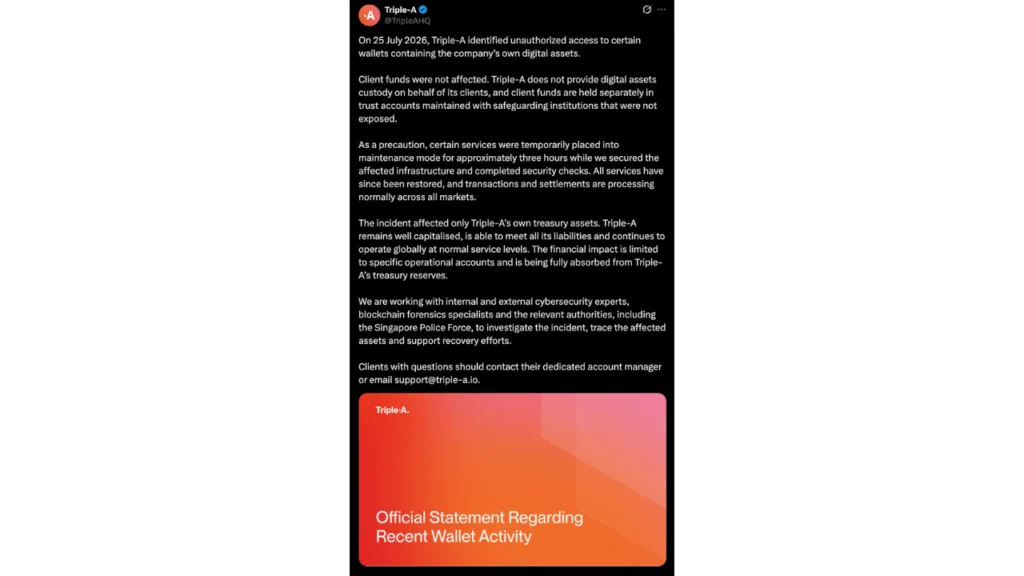
Singapore-based cryptocurrency payments company Triple-A has announced that it remains fully capitalized and capable of meeting all its financial obligations following an unauthorized access incident affecting its company-owned digital assets. The firm emphasized that customer funds were never at risk due to its robust segregated custody model, a critical distinction in the wake of the breach.
The incident, identified on July 25, 2026, involved unauthorized access exclusively to Triple-A’s treasury wallets. While the company has not officially disclosed the precise financial loss, blockchain security researchers have estimated the stolen digital assets to be approximately $11.8 million. This event underscores the persistent cybersecurity challenges faced by even well-established players in the rapidly evolving digital asset ecosystem.
Treasury Wallets Breached: A Closer Look at the Incident
In an official statement released through its newsroom, Triple-A confirmed the unauthorized access to wallets holding its proprietary digital assets. The company was unequivocal in stating that the breach was strictly confined to wallets operated by Triple A Technologies Pte. Ltd., its Singaporean entity, and did not extend to any other operational segments of the business. This specificity is crucial for understanding the scope of the security lapse.
According to Triple-A’s account, the financial repercussions of the breach were limited to specific operational accounts. The company affirmed its commitment to absorbing these losses entirely through its existing treasury reserves. This proactive stance aims to reassure stakeholders of the company’s financial resilience. "The financial impact is limited to specific operational accounts and is being fully absorbed from Triple-A’s treasury reserves," the company stated, reinforcing its financial stability. Furthermore, Triple-A reiterated its strong capital position, asserting that it remains "well capitalized and able to meet all its liabilities," despite the undisclosed value of the stolen assets.
The incident, though concerning, highlights a fundamental security advantage inherent in Triple-A’s operational framework. By segregating company assets from client holdings, the firm has effectively insulated its customers from the direct consequences of this particular security incident.
Client Assets Remained Protected: The Segregated Custody Model
A core tenet of Triple-A’s reassurance stems from its unwavering commitment to protecting client assets. The company emphatically stressed that no customer funds were compromised, attributing this security to its operational policy of not directly custodying clients’ digital assets. This approach inherently minimizes the attack surface for client funds.

Instead, Triple-A facilitates client transactions by holding client funds separately in safeguarded trust accounts. These accounts are maintained with regulated financial institutions, which were reportedly not exposed to the security breach. This layered security approach ensures that even if a payment processor’s operational wallets are compromised, the client funds entrusted to them remain in an entirely separate and secure environment.
During the immediate aftermath of the incident, Triple-A implemented a temporary maintenance mode for certain services. This precautionary measure lasted approximately three hours, during which engineers worked diligently to secure the affected infrastructure. Following this brief interruption, normal payment processing and settlement operations have since been fully restored across all markets where Triple-A operates. This swift resolution demonstrates the company’s capacity to respond effectively to security threats and minimize service disruption.
On-Chain Investigators Estimate $11.8 Million Loss: Tracing the Digital Trail
While Triple-A has elected not to publicly disclose the exact value of the stolen assets, the transparency of blockchain technology has enabled external security researchers to provide estimated figures. Blockchain security researchers, leveraging on-chain analysis, have tracked suspicious fund movements originating from wallets associated with Triple-A.
On-chain analyst Specter was reportedly the first to identify unusual fund transfers. Subsequently, the prominent blockchain security firm PeckShield expanded upon this analysis, estimating the total losses to be in the vicinity of $11.8 million. This figure represents a significant, albeit not catastrophic, amount for a company operating in the digital asset space.
The stolen assets were reportedly siphoned across multiple blockchain networks, including Ethereum, TRON, Polygon, Arbitrum, Solana, and TON. This multi-chain nature of the exploit suggests a sophisticated attacker capable of navigating different blockchain ecosystems. The researchers further detailed the attacker’s apparent money laundering strategy: the perpetrator is said to have swapped the stolen stablecoins and other liquid assets through decentralized exchanges. Following these swaps, the proceeds were then bridged to the Ethereum network and consolidated into a single wallet holding approximately 5,227 ETH. This pattern of activity – swapping, bridging, and consolidating into a large ETH holding – is a laundering technique that has become increasingly common in recent cryptocurrency exploits, offering a degree of predictability for investigators.
The swiftness with which these estimations were made and the detailed analysis provided by security firms underscore the growing sophistication of on-chain forensic capabilities within the cryptocurrency industry. These capabilities are vital for not only understanding the scope of breaches but also for aiding law enforcement and companies in asset recovery efforts.
Investigation Continues: A Multi-Agency Effort
Triple-A has confirmed that it is actively engaged in a comprehensive investigation into the breach. The company is collaborating with its internal cybersecurity teams, engaging external security specialists, and working with blockchain forensic experts. Crucially, the Singapore Police Force has also been involved, indicating the seriousness with which the incident is being treated by regulatory and law enforcement authorities in the region.

The primary objectives of this ongoing investigation are to thoroughly understand the nature of the breach, trace the flow of the stolen assets, and explore all avenues for their recovery. However, as of the latest updates, Triple-A has not divulged critical details such as the specific attack vector that facilitated the unauthorized access, the precise number of compromised wallets, or any progress made in recovering the misappropriated funds. The lack of these details is common in the early stages of such investigations, as authorities work to preserve the integrity of the inquiry.
The collaboration with law enforcement is a positive indicator, suggesting a commitment to accountability and justice. The Singaporean regulatory environment for digital asset service providers has been progressively strengthening, and such incidents are likely to further inform and shape these policies.
Broader Implications for Stablecoin Payment Providers and Enterprise Clients
The recent incident involving Triple-A serves as a potent reminder of the inherent cybersecurity risks that persist within the digital asset payments sector. It unequivocally highlights the critical importance of maintaining a clear and robust segregation between customer assets and a company’s own operational treasury funds. Triple-A’s segregated custody structure proved to be a vital safeguard, preventing a breach of its treasury wallets from escalating into a client-loss event. This scenario effectively demonstrates how meticulous fund segregation can significantly mitigate the broader impact of security incidents.
While regulatory licensing, such as that held by Triple-A, establishes essential safeguards around customer funds and operational conduct, it does not entirely eliminate the cyber risks that can target a company’s internal operational assets. This distinction is crucial for businesses and individuals interacting with crypto payment providers.
For enterprise customers who rely on stablecoin payment infrastructure for their global operations, this incident reinforces the necessity of conducting thorough due diligence. Beyond merely assessing a provider’s regulatory status, clients must also evaluate the robustness of their wallet security protocols, the sophistication of their treasury management strategies, and the overall strength of their financial reserves. Understanding these operational aspects provides a more holistic view of a payment provider’s resilience and reliability.
As Triple-A’s investigation progresses, the broader cryptocurrency industry will be keenly observing for further disclosures. Key areas of interest include the specific methods employed by the attackers to gain access, any potential for the recovery of the stolen assets, and the additional security measures Triple-A will implement in response to this exploit. Such insights will undoubtedly contribute to the collective understanding of best practices in digital asset security and risk management. The incident, while unfortunate, offers valuable learning opportunities for the entire ecosystem, particularly for other payment providers and their clientele. The resilience and transparency displayed by Triple-A in the face of this challenge will be a significant factor in maintaining confidence within the market.