admin
admin
The Solana network has reached a significant milestone in its economic evolution as validators officially approved a proposal to double the network’s annual disinflation rate. This decision, known as Solana Governance Proposal 0002 (SGP-0002) or "Double Disinflation," marks a pivotal shift in the blockchain’s monetary policy, aimed at reducing the long-term issuance of SOL tokens and addressing concerns regarding token dilution. By increasing the rate at which inflation decreases, the Solana community has signaled a move toward a more aggressive scarcity model, aligning the network’s economic incentives with those of long-term holders while navigating the complex requirements of validator sustainability.
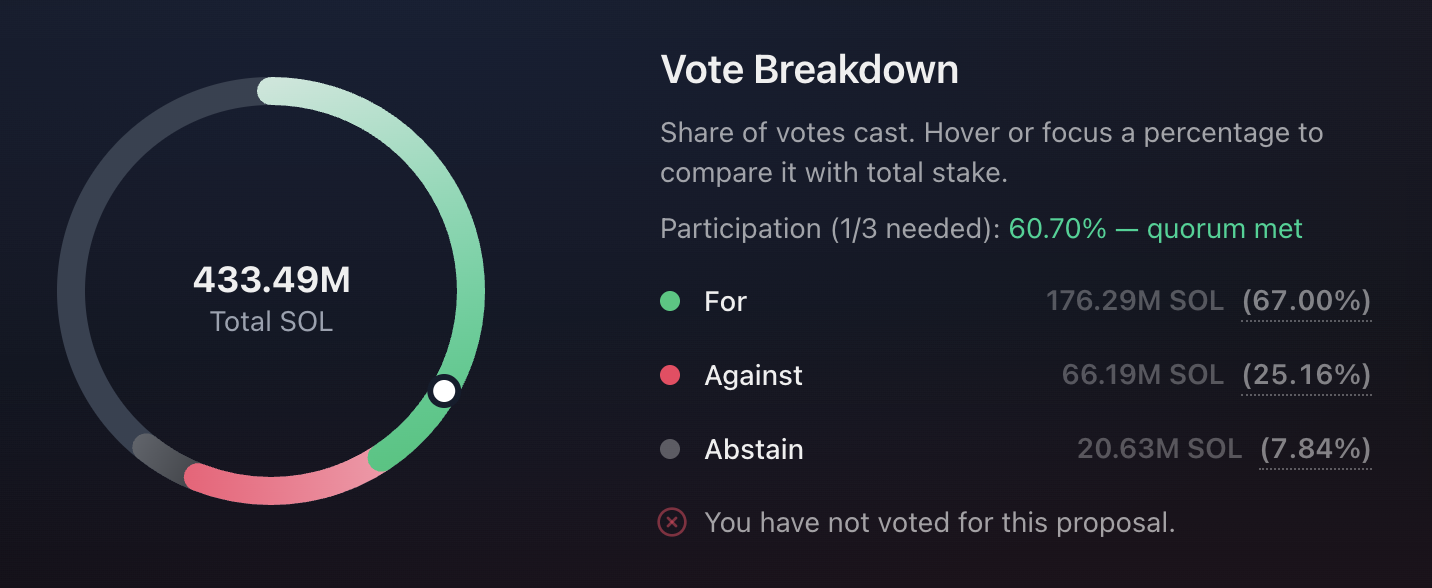
According to finalized voting results from the Solana governance platform, the proposal secured 67% support from the participating voting stake. The opposition was notable, with 25.16% of the stake voting against the measure, while 7.84% chose to abstain. Total participation reached 60.7% of the eligible voting stake, meeting the necessary thresholds for a binding governance decision. This vote was part of Solana’s inaugural binding governance process, which also saw the approval of a formal Solana Constitution and the rejection of a separate proposal concerning resource and inclusion fees.
The Mechanics of SGP-0002: Understanding Double Disinflation
To understand the impact of SGP-0002, it is essential to distinguish between inflation and disinflation within the Solana ecosystem. Solana’s monetary policy is designed with a "Inflation Schedule" that features three primary parameters: the initial inflation rate, the disinflation rate, and the terminal inflation rate. Prior to this vote, the network operated under a schedule where the annual inflation rate decreased by 15% each year (the disinflation rate) until it reached a floor of 1.5% (the terminal rate).
The approval of SGP-0002 effectively doubles that annual reduction. The disinflation rate has been adjusted from 15% to 30%. Crucially, the long-term terminal inflation target of 1.5% remains unchanged. The primary difference lies in the velocity at which the network reaches that floor. Under the previous 15% regime, Solana was projected to reach its 1.5% terminal inflation rate in approximately 5.7 years. Under the newly adopted 30% rate, that timeline is truncated to roughly 2.8 years.
This acceleration has immediate and long-term consequences for the supply of SOL. Projections from Solana Compass suggest that this change will result in approximately 18.9 million fewer SOL tokens being issued over the next six years. For investors and token holders, this represents a significant reduction in supply-side pressure and a decrease in the dilution of their holdings. However, because new SOL issuance is the primary source of staking rewards, the move also implies a faster reduction in the yield earned by validators and delegators.

A Chronology of the Governance Milestone
The passage of SGP-0002 was not without drama, as the voting period revealed deep divisions among the network’s largest stakeholders. The vote was conducted through Solana’s recently formalized on-chain governance system, which seeks to decentralize decision-making power by allowing validators to vote with their staked SOL.
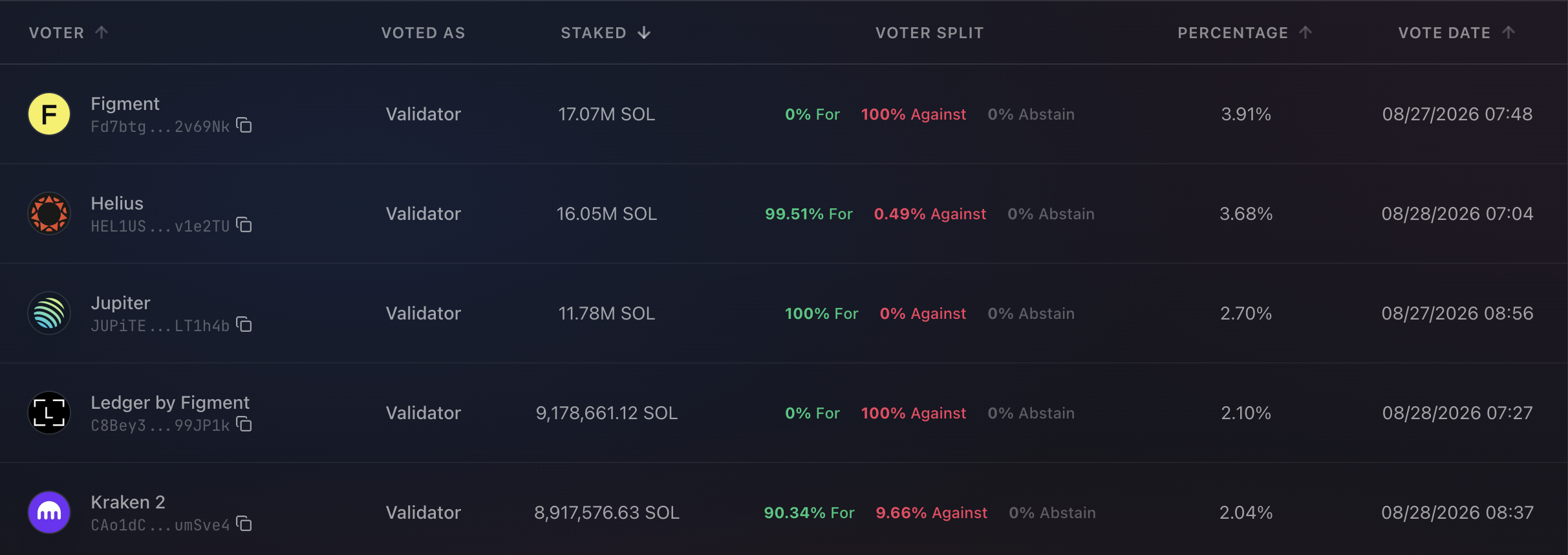
The timeline of the vote highlighted the influence of major institutional validators. Early in the process, the proposal appeared to have a clear path to victory. However, the momentum shifted when Kraken, a major U.S.-based cryptocurrency exchange and a significant validator, initially cast a "No" vote at approximately 12:33 UTC during the voting window. This move temporarily pushed the "Yes" support below the required threshold, casting doubt on whether the proposal would pass.
As the deadline approached, Kraken’s position shifted. By the conclusion of the voting period, more than 90% of Kraken’s approximately 8.9 million SOL voting stake had transitioned to support the proposal. This late-stage pivot was instrumental in securing the 67% majority needed for approval.
Other major participants remained split. Figment, currently the largest voter in the finalized data with 17.1 million SOL staked, maintained a firm "No" position throughout the process. Conversely, other ecosystem giants such as Helius and Jupiter were vocal and consistent backers of the measure, arguing that the long-term benefits of reduced supply outweighed the short-term reduction in staking yields.
Economic Implications: Scarcity vs. Security
The debate surrounding SGP-0002 touches on a fundamental tension in blockchain economics: the balance between asset scarcity and network security. Staking rewards are the primary incentive for validators to dedicate high-performance hardware and bandwidth to secure the network. By accelerating the reduction of these rewards, some critics—including those within the validator community—expressed concerns that the move could marginalize smaller validators who operate on thinner margins.
The 18.9 million SOL reduction in issuance over the next six years represents a significant shift in value. At current market prices, this equates to billions of dollars in "saved" dilution for SOL holders. Proponents of the proposal argue that a more predictable and rapidly stabilizing monetary policy makes SOL more attractive as a "store of value" asset, potentially leading to higher price appreciation that could offset the lower nominal staking yields.
Furthermore, the acceleration to a 1.5% terminal rate brings Solana closer to the economic profiles of other major Layer 1 blockchains like Ethereum, which transitioned to a low-issuance model following "The Merge." By reaching its terminal inflation rate in less than three years, Solana aims to establish itself as a mature, economically stable ecosystem capable of supporting large-scale institutional finance.
The Context of Institutional Adoption and Solana ETFs
The timing of this governance shift coincides with a period of unprecedented institutional interest in Solana. While the network’s price performance saw volatility earlier in the year, investment products tracking SOL have continued to attract significant capital.
A major milestone was reached recently when Bitwise’s Solana ETF officially surpassed $1 billion in assets under management (AUM). This makes it the first Solana-based exchange-traded fund to hit the billion-dollar mark. According to data shared by Bloomberg ETF analyst Eric Balchunas, U.S.-listed Solana ETFs have collectively attracted approximately $1.7 billion in cumulative net inflows since their inception.
The steady influx of institutional capital suggests that professional investors are looking past short-term price fluctuations and focusing on the network’s underlying utility and growing adoption. A more disciplined monetary policy, as established by SGP-0002, is likely to be viewed favorably by these institutional players, who often prioritize long-term supply predictability and "sound money" characteristics when allocating capital to digital assets.
Broader Impact on Solana’s Decentralized Governance
Beyond the economic changes, the approval of SGP-0002 is a landmark event for Solana’s governance maturity. This was the first time the network utilized a binding on-chain voting mechanism to decide on core economic parameters. Historically, many blockchain networks have struggled with governance, often relying on "soft signaling" or centralized foundations to implement changes.
The rejection of a separate proposal regarding resource and inclusion fees during the same voting cycle demonstrates that the validator community is exercising independent judgment rather than simply rubber-stamping all proposed changes. The approval of the Solana Constitution further solidifies the "rules of the road" for the network, providing a framework for how future disputes and technical upgrades will be handled.
The high participation rate of over 60% of the eligible stake indicates a highly engaged validator set. This engagement is crucial for a network that prides itself on high throughput and performance, as the validators are not just passive participants but active stakeholders in the network’s long-term roadmap.
Conclusion and Future Outlook
The adoption of the Double Disinflation proposal marks the beginning of a new economic era for Solana. By choosing to reach its terminal inflation rate of 1.5% in 2.8 years rather than 5.7 years, the network is prioritizing the reduction of token dilution and the enhancement of SOL’s scarcity.
In the coming months, the ecosystem will monitor how this change affects validator economics. If the price of SOL continues to reflect the increased scarcity and growing institutional demand, the reduction in nominal staking rewards may be viewed as a necessary trade-off for a more valuable underlying asset. Conversely, the community will remain vigilant to ensure that the lower reward environment does not lead to validator centralization or a decrease in network security.
With the Solana Constitution now in place and the first major economic hurdle cleared through a binding vote, the network has demonstrated a capacity for self-governance that rivals its technical performance. As Solana continues to break records—recently hitting a milestone of 4.2 billion transactions—its ability to balance the needs of developers, validators, and institutional investors will be the ultimate test of its longevity in the competitive blockchain landscape.