Nila Kartika Wati
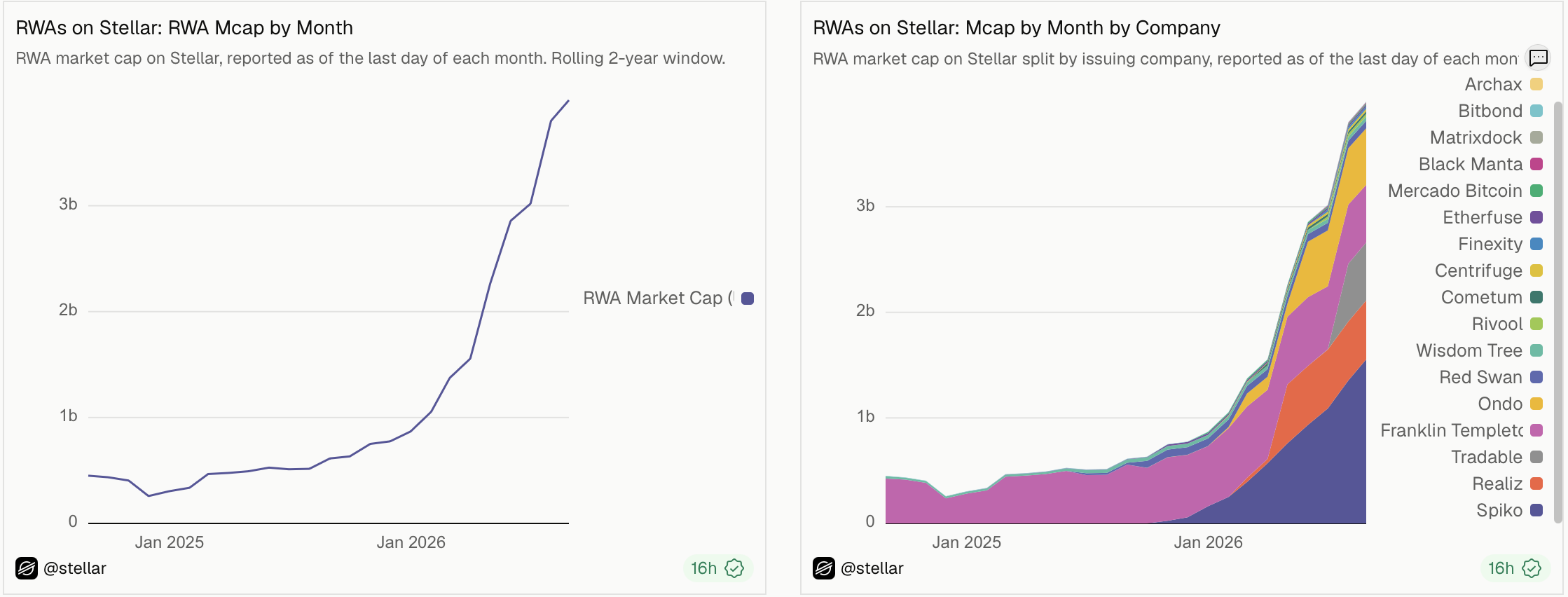
The value of tokenized real-world assets (RWAs) on the Stellar blockchain has experienced an extraordinary surge in 2026, climbing approximately 360% to reach nearly $4 billion. This marks a substantial increase from $868.8 million recorded at the close of the previous year, according to comprehensive data compiled on a Dune Analytics dashboard maintained by the Stellar ecosystem. As of August 29, the network’s RWA market capitalization stood precisely at $3.996 billion, underscoring a rapid expansion across diverse asset classes, including US Treasurys, private and public credit, and non-US government debt, alongside other emerging tokenized categories.
Understanding the Real-World Asset Revolution on Blockchain
The tokenization of real-world assets represents a transformative shift in how traditional financial instruments are managed, traded, and accessed. By converting tangible and intangible assets—ranging from real estate and commodities to government bonds and private equity—into digital tokens on a blockchain, the RWA sector aims to enhance liquidity, transparency, and fractional ownership while reducing intermediaries and operational costs. Stellar, an open-source blockchain network designed for payments and digital asset issuance, has strategically positioned itself as a key player in this evolving landscape. Its architecture, characterized by fast transaction speeds, low fees, and a strong emphasis on regulatory compliance, makes it particularly appealing for institutions looking to bridge the gap between traditional finance (TradFi) and decentralized finance (DeFi). The significant growth observed on Stellar is indicative of a broader industry trend where established financial entities are increasingly exploring blockchain technology to modernize their operations and offerings. This surge on Stellar highlights a growing confidence among institutional participants in the network’s capabilities for secure and efficient asset tokenization.
A Year of Exponential Growth: Stellar’s RWA Trajectory
The journey to nearly $4 billion in tokenized assets on Stellar in 2026 has been marked by consistent and accelerated growth. Beginning the year with a respectable, though comparatively modest, $868.8 million in total value, the network’s RWA market capitalization began its upward trajectory, fueled by strategic partnerships and an increasing array of tokenization initiatives. This growth culminated in the impressive $3.996 billion valuation by late August, representing a compounded monthly growth rate that has caught the attention of market analysts and investors alike. The types of assets being tokenized are diverse, reflecting the versatility of Stellar’s platform. US Treasurys, long considered a safe haven asset, have found a new digital home on Stellar, offering enhanced accessibility and potentially lower entry barriers for investors. Private and public credit assets, traditionally less liquid, are gaining fractional ownership and broader distribution through tokenization. Furthermore, the network has made notable inroads into non-US government debt, signaling its global aspirations and ability to cater to international markets.
Key Issuers Driving Stellar’s RWA Market Concentration
The current RWA market on Stellar, while rapidly expanding, exhibits a concentration among a select group of prominent issuers. These entities have played a pivotal role in accumulating the substantial value now residing on the network. As of August 27, Spiko emerged as the dominant force, accounting for a significant $1.55 billion of Stellar’s total RWA value. This substantial contribution highlights Spiko’s leading position in leveraging Stellar for its tokenization endeavors. Following Spiko, Realiz contributed $559 million, showcasing its strong presence in the nascent market. Tradable, another key player, held $548 million in tokenized assets, demonstrating its commitment to bringing traditional financial products onto the blockchain. Traditional asset management giants are also making their mark, with Franklin Templeton holding $546 million. Franklin Templeton’s involvement is particularly noteworthy as it signifies the embrace of tokenization by established financial institutions, validating the technology’s potential within mainstream finance. Ondo, a well-known entity in the decentralized finance space focusing on tokenized real-world assets, contributed $535 million, reinforcing the convergence of DeFi principles with TradFi assets on Stellar. This concentration among a few major issuers suggests that while the market is growing, it is currently being driven by large-scale institutional adoption and significant capital flows from these specialized platforms.
Expanding Horizons: Non-US Government Debt and Global Reach
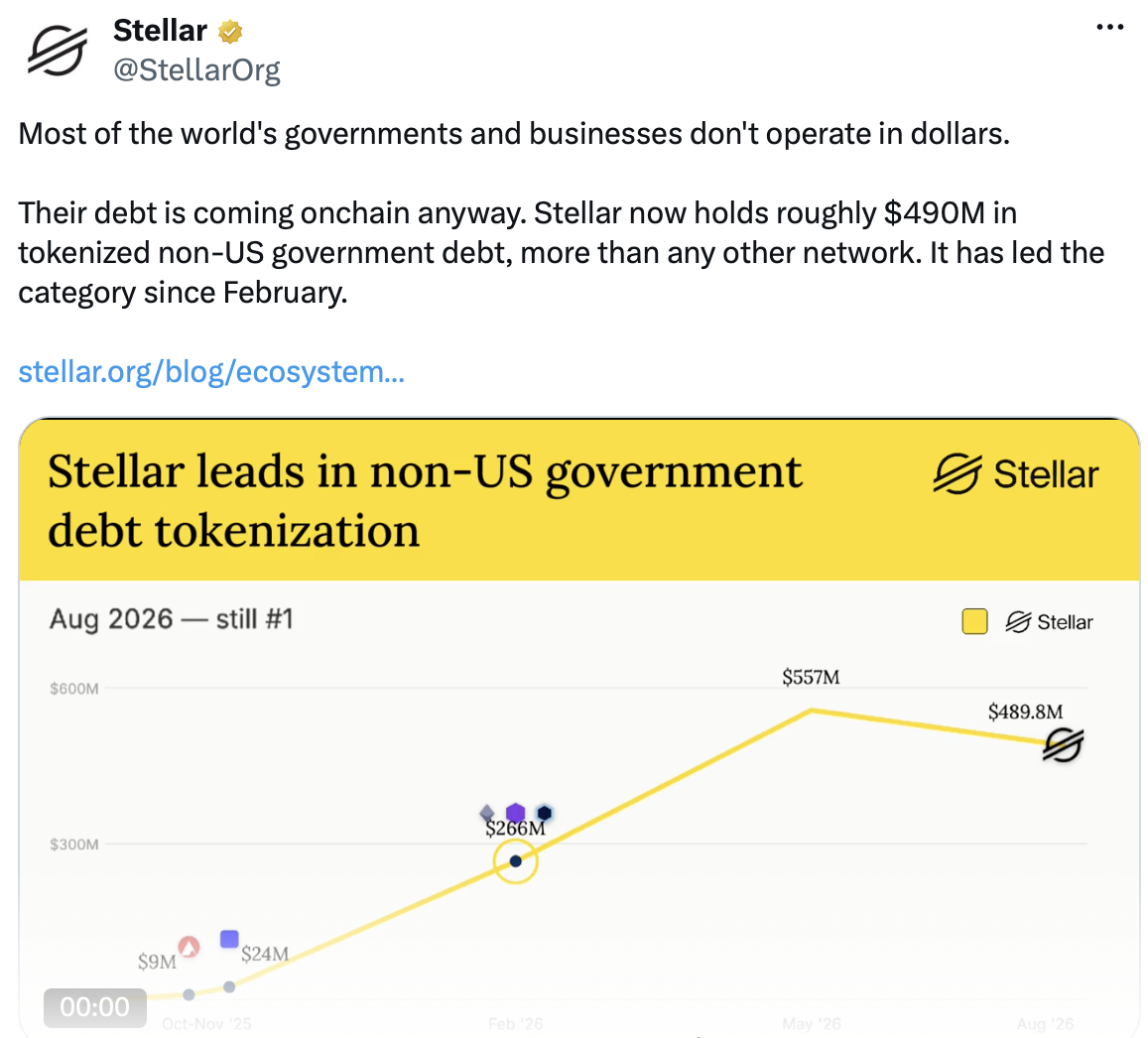
Stellar’s strategic focus on expanding its global footprint is particularly evident in its significant gains within the non-US government debt sector. According to RWA.xyz data cited by the Stellar Development Foundation (SDF), the network held approximately $490 million in this asset class as of August 20. This includes groundbreaking initiatives such as the tokenization of Mexican CETES (Certificados de la Tesorería de la Federación) and Brazilian government bonds. These assets are being issued through platforms like Etherfuse, which leverages Stellar’s infrastructure to bring sovereign debt instruments from emerging markets onto the blockchain. This move not only diversifies the RWA offerings on Stellar but also unlocks new investment opportunities for a global investor base, potentially lowering the barriers to entry for participating in international bond markets. The tokenization of such assets can offer greater liquidity, transparency, and operational efficiency compared to traditional methods, appealing to both institutional and qualified retail investors seeking exposure to diversified sovereign debt portfolios. The SDF has consistently articulated its vision for Stellar as a global network for financial inclusion and cross-border payments, and the successful tokenization of non-US government debt aligns perfectly with this strategic imperative, demonstrating the network’s capability to handle complex financial instruments from diverse jurisdictions.
Institutional Adoption as a Catalyst for Growth
The remarkable expansion of Stellar’s RWA market cap is intrinsically linked to a series of high-profile institutional adoptions and strategic partnerships throughout 2026. These collaborations underscore a growing confidence in Stellar’s robust and compliant infrastructure among major financial players.
One of the most significant announcements came in May when the Depository Trust & Clearing Corporation (DTCC), a critical pillar of global financial market infrastructure, revealed its plans to integrate its tokenization service with Stellar. The DTCC, which provides clearing, settlement, and information services for equities, corporate and municipal bonds, and other securities, is a central figure in ensuring the integrity of the US financial system. Its decision to connect its tokenization service to Stellar is a monumental step towards mainstream adoption of blockchain technology for traditional securities. The integration is projected to make DTC-tokenized assets available on the Stellar network in the first half of 2027. This ambitious initiative could eventually support the tokenization of a broad spectrum of assets, including US Treasurys, major index Exchange Traded Funds (ETFs), and even stocks listed in the Russell 1000. The implications of this partnership are profound, potentially ushering in an era where trillions of dollars in traditional securities could be represented and transacted on a blockchain, with Stellar serving as a foundational layer.
This institutional momentum continued into July with a major announcement from Tradable, a leading tokenization platform. Tradable unveiled plans to bring up to $1 billion in private credit assets onto the Stellar blockchain. This initiative builds upon Tradable’s existing success, having already tokenized $1.7 billion in private credit across nearly 30 positions on other platforms. The integration with Stellar is designed to enhance critical aspects of private credit management, including compliance, investor onboarding, and comprehensive asset lifecycle management. Private credit, an increasingly important asset class, often suffers from illiquidity and opaque processes. Tokenization on Stellar offers a pathway to fractionalization, improved liquidity, and greater transparency, making these assets more accessible to a wider pool of qualified investors. Tradable’s choice of Stellar underscores the network’s suitability for handling complex, high-value financial instruments that require stringent compliance and robust technical capabilities.
Stellar’s Expanding Role in Digital Payments and Stablecoins
Beyond RWAs, Stellar has also solidified its position in the realm of digital payments and stablecoins, further contributing to its ecosystem’s overall utility and value proposition. In June, MoneyGram, a global leader in cross-border peer-to-peer payments, launched its MGUSD dollar stablecoin on the Stellar network. This development is a significant step towards enabling users to hold dollar-denominated balances directly on-chain and facilitate seamless, efficient fund transfers through MoneyGram’s extensive global payments network. The MGUSD stablecoin provides a stable, blockchain-native representation of the US dollar, leveraging Stellar’s low-cost and high-speed infrastructure for remittances and international transactions. This move aligns with Stellar’s original mission of fostering financial inclusion by making cross-border payments faster and more affordable.
The MGUSD stablecoin joins a robust ecosystem of reserve-verified stablecoins already issued on Stellar. According to the same Dune dashboard, these stablecoins collectively represent approximately $438 million in market capitalization. This substantial volume of stablecoins underscores Stellar’s role as a reliable platform for digital currency issuance and transfer, providing essential liquidity and a stable medium of exchange within its ecosystem. The presence of well-audited, reserve-backed stablecoins is crucial for institutional participation, as it offers the stability required for large-value transactions and serves as a vital on-ramp and off-ramp for the tokenized real-world assets on the network. The combined growth in RWAs and stablecoins positions Stellar as a comprehensive blockchain solution for both asset tokenization and digital payments, fostering a holistic financial ecosystem.
Stellar’s Strategic Advantages in the Tokenization Race
Several inherent characteristics of the Stellar network contribute to its appeal for tokenized real-world assets and institutional adoption. Its federated Byzantine agreement (FBA) consensus mechanism allows for fast transaction finality, often within a few seconds, which is crucial for high-frequency trading and time-sensitive financial operations. The network’s low transaction fees make it economically viable for large-scale operations and micro-transactions alike, contrasting with some other blockchain platforms that face scalability and cost challenges.
Furthermore, Stellar’s built-in compliance features, including support for Know Your Customer (KYC) and Anti-Money Laundering (AML) requirements, are particularly attractive to regulated financial institutions. The ability to issue compliant tokens and manage access controls directly on the blockchain is a significant differentiator. Stellar’s focus on interoperability and its established connections with various financial institutions also provide a ready framework for integration, reducing the friction typically associated with adopting new technologies. The Stellar Development Foundation actively supports ecosystem growth through grants, partnerships, and educational initiatives, fostering a vibrant developer community and encouraging innovation in the RWA space. This strategic approach, combining technical prowess with a strong emphasis on regulatory adherence and ecosystem development, positions Stellar as a frontrunner in the race to tokenize the world’s assets.
The Broader RWA Landscape and Future Implications
The exponential growth of tokenized RWAs on Stellar is not an isolated phenomenon but rather a microcosm of a much larger, global trend reshaping the financial industry. Analysts widely predict that the RWA market on blockchain will burgeon into a multi-trillion-dollar sector in the coming decade. Institutions are increasingly recognizing the efficiency gains, increased liquidity, and broader investor access that tokenization offers. The convergence of TradFi and DeFi, often termed "DeFi meets TradFi" or "hybrid finance," is accelerating, with blockchains like Stellar acting as crucial bridges.
The implications are far-reaching. For investors, tokenized RWAs could unlock access to previously illiquid or inaccessible asset classes, from fractional ownership of high-value real estate to private equity funds. For issuers, it offers new avenues for capital formation, reduced administrative overhead, and expanded investor bases. However, challenges remain, primarily in the areas of regulatory clarity, legal frameworks for digital ownership, and technological standardization across different blockchains. As regulatory bodies globally work to establish comprehensive guidelines for digital assets, platforms like Stellar that prioritize compliance are likely to gain a competitive edge. The successful tokenization of complex assets like government bonds and private credit on Stellar serves as a powerful proof-of-concept for the viability and scalability of this emerging financial paradigm.
XLM Token Performance: A Disconnect?
Despite the monumental growth in the value of tokenized real-world assets on its network, Stellar’s native cryptocurrency, XLM, has not mirrored this success in its price performance. According to CoinGecko data, XLM is down approximately 11% year-to-date in 2026, trading near $0.18. This apparent disconnect between significant network utility and underlying token value is a phenomenon observed across various blockchain ecosystems.
Several factors could contribute to this divergence. Firstly, the utility of a network’s native token is not always directly correlated with the total value locked or transacted on the chain, especially in the short term. While XLM is used for transaction fees and maintaining network security, the value of the tokenized assets themselves does not necessarily accrue directly to XLM’s market capitalization in a proportional manner. The primary users of tokenized RWAs are often institutions focused on the underlying asset’s value and returns, rather than speculating on the native token. Secondly, broader cryptocurrency market sentiment and macroeconomic factors can significantly influence token prices, often overshadowing specific network developments. If the overall crypto market is in a bearish or sideways trend, even strong fundamental growth in a particular ecosystem may not translate into immediate price appreciation for its native asset. Thirdly, the long-term nature of institutional adoption and RWA growth means that the full impact on XLM’s utility and demand might materialize over extended periods, rather than immediate surges. As the ecosystem matures and more complex use cases requiring XLM as a bridge asset or for staking emerge, the correlation between network value and token price may strengthen. For now, XLM’s price action appears to be more influenced by broader market dynamics and investor sentiment than the impressive, underlying growth of tokenized assets on Stellar.
In conclusion, Stellar’s journey in 2026 has been nothing short of remarkable, transforming it into a formidable platform for tokenized real-world assets. The dramatic 360% increase in RWA value to nearly $4 billion, spearheaded by key issuers and bolstered by significant institutional partnerships like the DTCC and Tradable, firmly establishes Stellar at the forefront of the blockchain-enabled financial revolution. While the price performance of its native XLM token has yet to fully reflect this ecosystem expansion, the underlying fundamentals of Stellar’s RWA growth suggest a robust and strategically positioned network poised for continued influence in the evolving landscape of global finance.