Reza Arap Oktovian
In a pivotal moment for the cryptocurrency landscape, Ethereum, the second-largest blockchain by market capitalization and the backbone for hundreds of billions of dollars in digital assets, is on the cusp of a monumental transition. Mid-year, the network will execute "The Merge," a complex procedure that will shift its consensus mechanism from the energy-intensive Proof-of-Work (PoW) to the more sustainable Proof-of-Stake (PoS). This undertaking, often likened to overhauling an airplane’s engine mid-flight, requires Ethereum to maintain continuous operation, producing valid blocks without interruption.

Unlike many other blockchain networks, such as Bitcoin, Ethereum’s development community, bolstered by the Ethereum Foundation and prominent figures, has committed to a multi-client strategy for its Proof-of-Stake implementation, commonly referred to as Ethereum 2.0. This approach involves the development of several distinct client software versions, each developed by different teams and potentially written in various programming languages. The rationale behind this diversity is to enhance network resilience; a vulnerability or bug in one client should not compromise the entire network, as they are not built on identical codebases.
The Mechanics of The Merge: A Separation of Duties
The Merge itself is not a fusion of two separate chains into one. Instead, it represents a critical juncture where the current Ethereum network nodes will cease their validation responsibilities. These duties will be transferred to a dedicated set of nodes running the "beacon chain," which has been operational since December 2020. This transition signifies a fundamental restructuring of node responsibilities. Currently, Ethereum nodes perform both the execution of transactions and their subsequent validation. Post-Merge, this will bifurcate into two distinct roles:

- Execution Nodes: These nodes will continue to interface with users and smart contracts, manage the Ethereum Virtual Machine (EVM), and execute transactions. However, their primary function will be to forward these executed transactions to validator nodes for validation. Essentially, execution nodes will retain much of their current functionality, with the validation aspect being delegated.
- Validator Nodes (Consensus Chain): Operating on the beacon chain, these nodes will be responsible for validating the transactions received from execution nodes. This separation of duties is a core tenet of improving the network’s robustness and security.
While execution and validator clients will share some code, particularly if developed in the same programming language, the execution clients will undergo minor modifications to integrate with the new consensus layer. The EVM, a core component of the execution layer, is expected to be largely reusable with minimal adjustments. It is anticipated that, over time, execution clients may shed the code responsible for Proof-of-Work validation entirely.
The Criticality of Client Diversity: A Matter of Network Security
The multi-client strategy is a deliberate design choice to mitigate systemic risk. The underlying principle is that by employing diverse implementations, the network becomes less susceptible to a single point of failure. If a bug or exploit targets one client, other clients, with their unique codebases, should remain unaffected, allowing the network to continue functioning.
This contrasts with the development of Bitcoin, where the protocol and its primary implementation (Bitcoin Core) are significantly less complex. Ethereum’s inherent complexity, driven by its smart contract capabilities and vast ecosystem, necessitates a more sophisticated approach to security and resilience.
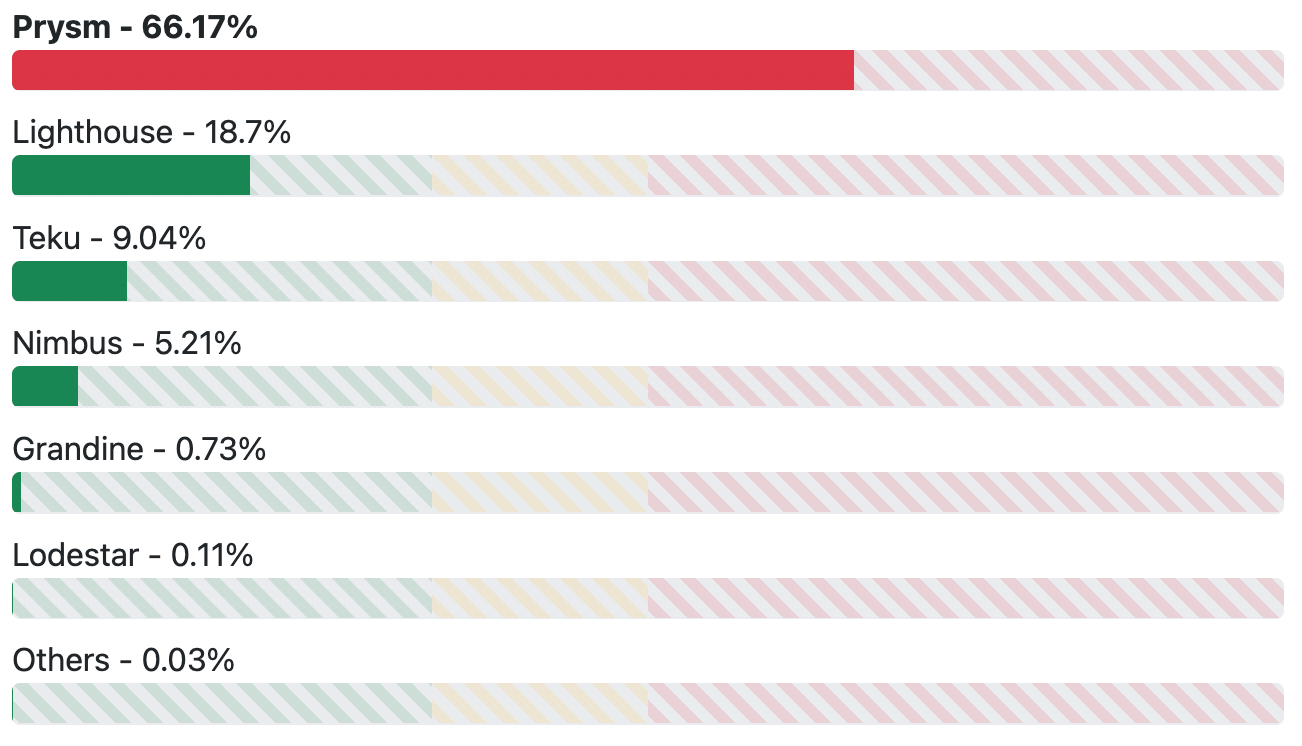
The success of this strategy hinges on maintaining a balanced distribution of client usage. The Ethereum community has identified critical thresholds for client adoption. If a single client accounts for more than one-third (33%) of the network’s staking power, a bug within that client could pose a significant risk. If a client garners more than two-thirds (66%) of the staking power, the implications become even more severe.
- Below 33% Staking Power: A bug in a client used by less than one-third of stakers would likely have minimal impact. The network would continue to operate smoothly, and the bug could be addressed without major disruption.
- Between 33% and 50% Staking Power: A bug in this range would be more serious, but automatic network mechanisms are expected to mitigate the impact, with users likely remaining unaware of any issues.
- Above 50% Staking Power: A bug affecting a client with over half of the staking power would trigger automatic recovery mechanisms, but these would likely involve complications and disturbances, potentially affecting users.
- Above 66% Staking Power (Supermajority): This scenario represents a critical risk, potentially leading to a "game over" situation. A client with such a dominant share could, if compromised by a bug, effectively dictate the network’s finality. The non-buggy clients would face the stark choice of either permanently splitting the chain, creating two Ethereums, or aligning with the compromised chain and accepting the consequences of the bug.
The Dominance of Prysm: A Cause for Concern
As of the original reporting period, a significant concern within the Ethereum community has been the overwhelming dominance of the Prysm client, developed by Prysmatic Labs. Approximately one-third of the network’s staking power has been running on Prysm, a concentration that hovers precariously close to the critical 33% threshold. While this is not yet a supermajority, it represents a substantial risk if a critical vulnerability were to be discovered and exploited in the Prysm client.
Several other clients are available, including Lighthouse, Teku, and Nimbus. However, Grandine and Loadstar have negligible market shares. The Prysm client’s widespread adoption is attributed to several factors, including a first-mover advantage, comprehensive tooling, and its development in Go (Golang). Go is favored for its performance, ease of development, and readability, making it accessible to developers familiar with Go-ethereum, the primary Proof-of-Work execution client.
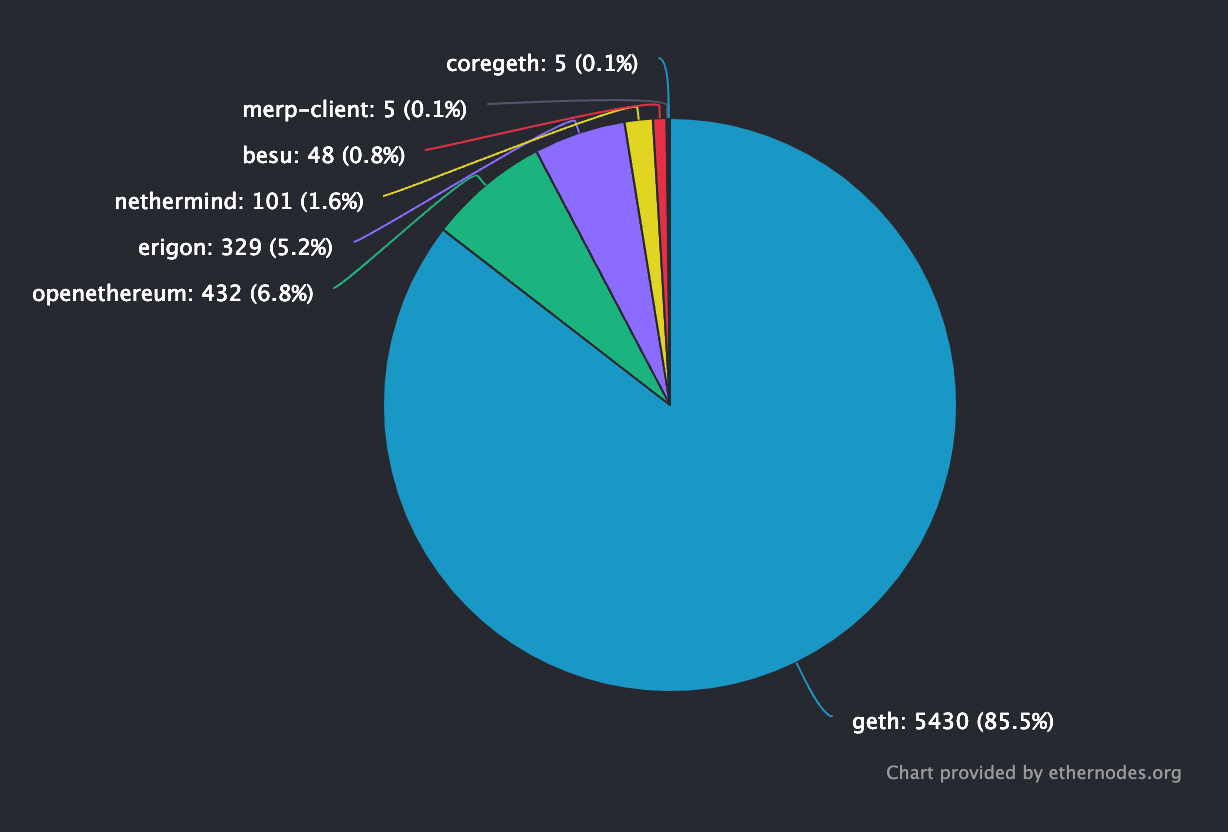
It is important to note that the distribution of Proof-of-Work execution clients also exhibits a degree of centralization, with Go-ethereum commanding a significant majority (over 85% at the time). However, in the post-Merge era, the security implications of this concentration are less pronounced, as execution nodes will not be directly responsible for network security.
Major Staking Services and the Prysm Concentration
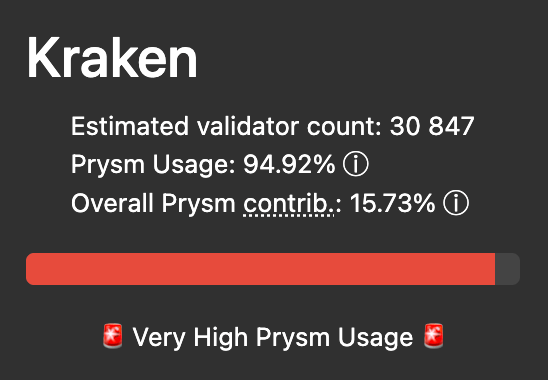
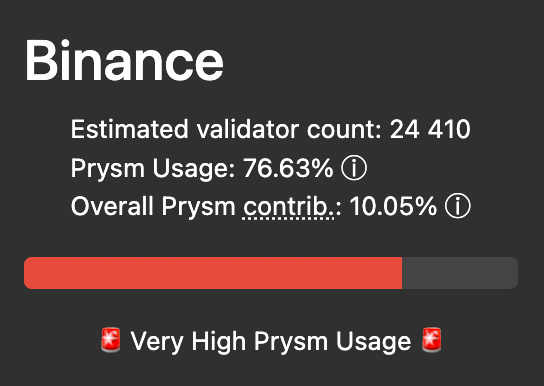
The concentration of staking power on Prysm is not solely driven by individual validators. Large staking services and pools, which allow users to stake Ether without holding the full 32 ETH requirement, are significant contributors to this trend. Major players such as Coinbase, Kraken, and Binance, all significant staking service providers, have historically leaned heavily on the Prysm client.
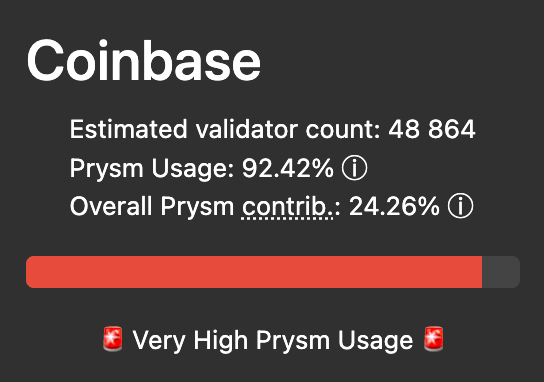
Coinbase, for instance, with a substantial portion of its validators running Prysm, contributes significantly to the overall Prysm dominance. The company has cited security as a primary driver for this choice, particularly the Prysm client’s early support for remote signers. Remote signers allow for the generation and storage of validator keys in isolated environments, enhancing security by preventing keys from being stored directly on the validator hardware. This feature, along with double-signing protection capabilities, was a key consideration for Coinbase.
Kraken has also acknowledged the initial maturity and stability of Prysm, while also indicating a move towards diversifying its client usage by incorporating Teku. Binance, another major exchange, did not provide a comment regarding its client distribution strategy.
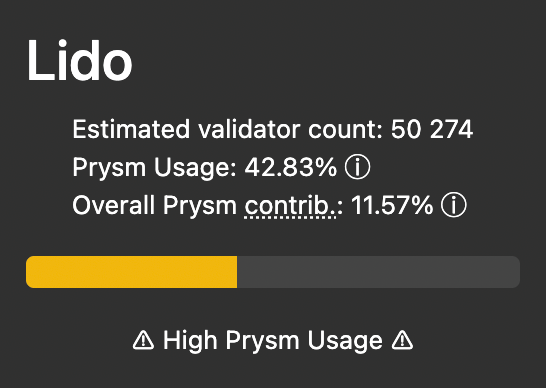
Lido, a prominent liquid staking solution, also holds a significant portion of validators. While its Prysm usage is lower than some of the centralized exchanges, it still represents a considerable contribution to the overall concentration.
Decentralized Alternatives and Ongoing Discussions
In contrast, decentralized staking pools like Rocket Pool demonstrate a much more diversified client distribution, with a minimal contribution to Prysm’s dominance. This highlights the potential for more distributed client adoption within the ecosystem.
The Ethereum Foundation and core developers are actively engaged in discussions with these major staking services to address the client diversity issue. The aim is to encourage a more even distribution of staking power across different clients. While switching client software can involve technical complexities for large operators due to API differences and infrastructure updates, the process is generally considered manageable for individual node operators.
The Path Forward: A Calculated Risk
Despite the challenges posed by client distribution, the Ethereum community remains committed to executing The Merge. Core developers express confidence in the robustness of their testing and fuzzing infrastructure, which continuously works to identify discrepancies between clients. Even in the unlikely event of a consensus failure, the community believes it possesses the capability to rapidly deploy updates and resolve any resulting forks.
Furthermore, there is a strong consensus that stakers running a majority client will not be bailed out if their chosen client misbehaves. This reinforces the responsibility of node operators to ensure their client choices contribute to network health and security.
As The Merge approaches, the Ethereum community will likely have to accept a less-than-ideal client distribution. The probability of Prysm’s dominance falling below the critical 33% threshold before the transition is considered low. Nevertheless, the ongoing dialogue, the commitment of developers, and the inherent resilience designed into Ethereum’s multi-client architecture provide a degree of confidence that the transition can be navigated successfully, ushering in a new era for the world’s leading smart contract platform. The success of this monumental upgrade will not only redefine Ethereum’s operational efficiency and environmental impact but will also serve as a significant case study in managing complex, decentralized system upgrades under immense scrutiny.