
 James Watt
The interface of a modern decentralized exchange aggregator like Jupiter presents a deceptive simplicity: a user selects a pair, such as Solana (SOL) for USD Coin (USDC), reviews a price, and executes the trade. To the casual observer, the transaction appears to take place within a single, unified pool of liquidity. However, beneath this streamlined user experience lies a complex and rapidly evolving market architecture that is fundamentally shifting away from the original "vending machine" model of decentralized finance (DeFi) toward a system dominated by professional, high-frequency market makers.
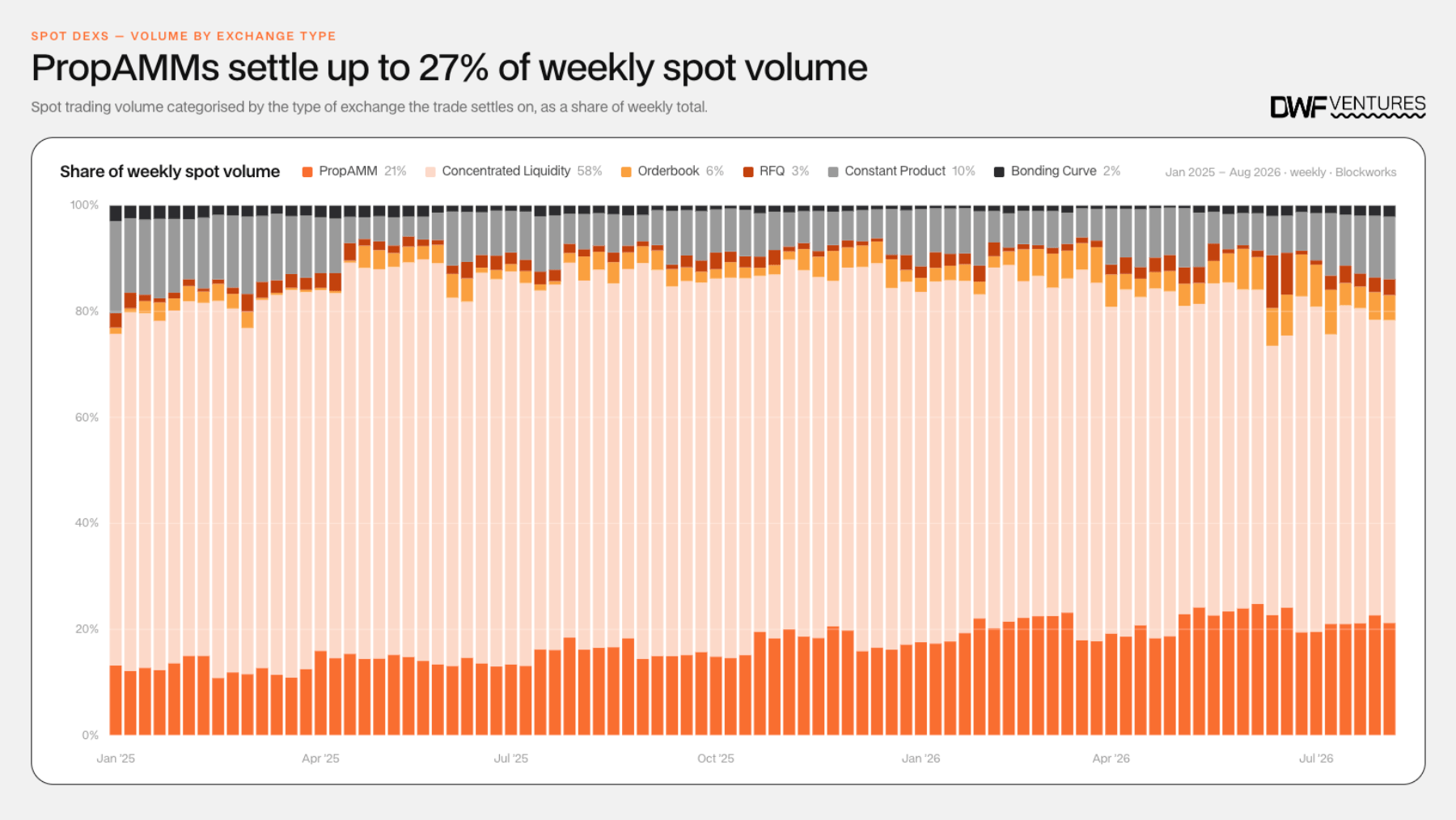
Recent data suggests that the "proprietary automated market maker" (propAMM) has emerged as a cornerstone of on-chain trading. Unlike traditional AMMs, which rely on public liquidity pools funded by thousands of individual users, propAMMs utilize private capital and sophisticated internal pricing algorithms. A new analysis from DWF Ventures indicates that these professional entities now account for between 15% and 27% of daily on-chain decentralized exchange (DEX) volume. In specific high-liquidity corridors, such as SOL-to-stablecoin trades routed through the Jupiter aggregator, their market share reportedly exceeds 90%.
From Public Pools to Professional Dealers
The early era of DeFi was defined by the constant product market maker (CPMM) model, popularized by protocols like Uniswap. This structure allowed anyone to deposit tokens into a smart contract, providing the liquidity necessary for others to trade. In exchange for their capital, these "liquidity providers" (LPs) earned a portion of the trading fees. This was a revolutionary solution to the "cold start" problem of financial markets, as it did not require the permission or presence of professional market-making firms.
However, the passive nature of these public pools created significant inefficiencies, most notably "loss-versus-rebalancing" (LVR). Because these pools rely on external arbitrageurs to move their internal price to match the broader market, they often sell assets too cheaply or buy them too dearly when prices move rapidly on centralized exchanges. This "stale price" problem essentially functions as a tax on passive liquidity providers, often exceeding the fees they earn.
PropAMMs address this inefficiency by reversing the traditional DeFi logic. Instead of a passive pool waiting to be "corrected" by the market, a propAMM is an active participant. It is a professional trading operation that uses its own inventory and private software to track global market prices in real-time. When a user requests a trade via an aggregator, the propAMM provides a quote that reflects the most current global price, often beating the prices available in public, passive pools.
The Quantitative Dominance of Professional Liquidity
The shift toward professionalization is backed by significant transaction data. Jump Crypto, a leading quantitative trading firm, conducted an extensive study of approximately 20 million propAMM fills on the Solana network. The research found that the median SOL-USDC transaction executed within 0.72 basis points of the benchmark midpoint on major centralized exchanges such as Binance and Coinbase.
Perhaps more significantly, Jump Crypto’s analysis revealed that 91.9% of these propAMM fills were more cost-effective for the user than the lowest institutional fee tier at a centralized exchange. This efficiency explains why aggregators—software engines that search for the best price across multiple venues—increasingly route volume toward these professional dealers rather than traditional decentralized exchanges.
This trend is particularly pronounced on the Solana blockchain due to its high-speed infrastructure. On August 28, 2024, Solana reached its 300-millisecond slot time target, a technical milestone that allows market makers to update their quotes with minimal latency. For a professional firm, the ability to update a price every few hundred milliseconds is critical for managing risk and preventing "sniping" by high-frequency arbitrageurs.
The Institutional Convergence: Nasdaq and the London Stock Exchange
The professionalization of DeFi market structure is occurring just as traditional financial institutions prepare to migrate legacy assets onto blockchain rails. The divide between "crypto-native" trading and "Wall Street" infrastructure is narrowing, as evidenced by a series of high-profile partnerships and investments.
In September 2024, Nasdaq’s venture arm announced a $100 million investment in Payward, the parent company of the Kraken exchange. This investment is part of a broader strategic initiative to develop "Nasdaq Equity Tokens," a framework designed to bring tokenized public equities to the market by the second quarter of 2027. Similarly, the London Stock Exchange Group (LSEG) recently partnered with Payward to explore tokenized equity structures, with plans to list these assets on its planned "LSE 24" venue.
These institutional players are not looking to rely on the passive, public liquidity pools of early DeFi. Instead, they are adopting the "request-for-quote" (RFQ) and propAMM models that have proven successful on networks like Solana. Robinhood, for instance, has already integrated tokenized stocks into its Robinhood Chain, utilizing the 0x RFQ network to connect users with professional market makers like Tokka Labs. In this model, the blockchain serves as a transparent settlement layer, while the actual price discovery and execution happen through private, professional competition.
A Chronology of Market Structure Evolution
The transition from decentralized experiments to institutional-grade infrastructure can be viewed through four distinct phases:
- The Order Book Era (2017–2018): Early attempts to build DEXs tried to replicate the limit order books of centralized exchanges. These were largely unsuccessful due to high gas costs and slow block times on early networks.
- The AMM Revolution (2019–2021): The rise of Uniswap and the "vending machine" model allowed for permissionless trading and liquidity provision, sparking the "DeFi Summer."
- The Aggregator Dominance (2022–2023): Platforms like Jupiter and 1inch became the primary entry points for users, shifting the focus from individual exchanges to "best execution" across multiple venues.
- The Professionalization Phase (2024–Present): Professional market makers (propAMMs and RFQ networks) begin to capture the majority of high-volume trade flow, offering tighter spreads and better execution than public pools.
The Transparency Trade-off
The rise of professional dealers introduces a nuanced debate regarding the core tenets of decentralization. In the original DeFi vision, "openness" meant that every part of the market—the code, the liquidity, and the pricing formula—was public and inspectable.
With propAMMs, the market structure becomes more "permissioned." Aggregators must often approve which professional firms can provide quotes, and the pricing algorithms used by these firms are proprietary trade secrets. While the final settlement of the trade remains visible on the blockchain, the competitive process that determined the price occurs behind closed doors.
However, proponents argue that this is a necessary evolution for mass adoption. For a retail trader or an institutional investor, the primary concern is "best execution"—getting the most favorable price with the least amount of slippage. If a private, professional dealer can provide a better price than a public pool, the market will naturally gravitate toward that dealer.
This creates a new definition of transparency: a system where ownership and settlement are publicly verifiable on-chain, but the execution layer is a competitive, private arena. This mirrors the structure of traditional equity markets, where brokers route orders to various "dark pools" and market makers to find the best fill for their clients.
The Survival of the Long Tail
Despite the dominance of professional firms in major assets like SOL, ETH, and stablecoins, the original public AMM model is unlikely to disappear. Professional market makers thrive on assets with high volume and deep reference markets. They are less willing to provide liquidity for "long-tail" assets—newly created tokens, niche experimental projects, or assets without a reliable external price feed.
For these assets, the permissionless nature of public AMMs remains essential. A public pool does not need a sophisticated pricing model; it simply needs two sets of tokens and a mathematical formula. This ensures that even the smallest and most obscure tokens can have a functional market from the moment of their creation.
Implications for the Future of Finance
As tokenized finance matures, the industry is effectively "sorting" its assets. Highly liquid, institutional-grade assets will likely be traded through professional routers and private dealers, while the experimental fringe of the market will continue to utilize the decentralized pools of the early DeFi era.
The ultimate result of this evolution is a hybrid system. The blockchain provides the public "rails" for the movement of assets, ensuring that transactions are final, immutable, and verifiable. Meanwhile, the professional trading desk—once confined to the offices of Wall Street—has been re-engineered as a digital entity that plugs directly into these public rails.
The "future exchange" is emerging not as a single platform, but as a decentralized network of professional competitors vying to fill orders for users who may never see the machinery behind the screen. By separating the transparency of settlement from the complexity of execution, crypto is building a market structure that can support the trillions of dollars in traditional assets currently waiting on the sidelines.









