James Watt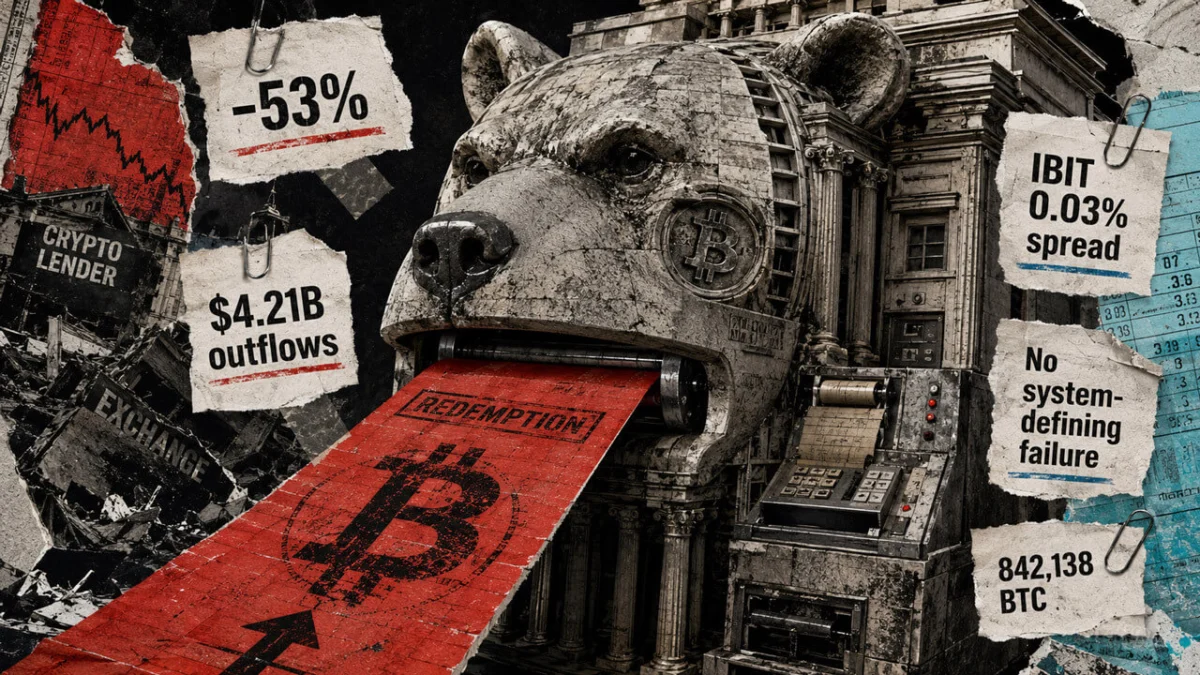
In an institutional bear market, the process of a Bitcoin exchange-traded fund (ETF) redemption has become an exercise in operational efficiency rather than a catalyst for systemic panic. When an investor chooses to divest from a fund, an authorized participant returns a substantial block of shares to the trust, which then facilitates the transfer of either cash or Bitcoin. Throughout this process, the fund’s assets may shrink, yet the shares continue to trade near their net asset value (NAV) while the custodian maintains normal operations. This marks a fundamental shift from the chaotic collapses that defined previous digital asset cycles, signaling the arrival of a mature, albeit painful, era for the world’s largest cryptocurrency.
The landscape of Bitcoin redemptions was fundamentally altered in July 2025, when the Securities and Exchange Commission (SEC) approved in-kind redemptions for crypto-based ETPs. This regulatory milestone allowed the underlying coins to leave the trust through direct transfers rather than forcing the fund to sell them on the open market. In contrast to the 2022 market contagion, which was characterized by disabled withdrawal pages and lengthy bankruptcy proceedings, the 2026 downturn has unfolded through portfolio rebalances and standard account statements. While the fund sizes decrease and a significant source of demand fades, the market machine continues to function even as investors absorb substantial losses.
The 2025-2026 Price Action and Market Context
The current bear market is the first to occur within a fully integrated institutional framework. Bitcoin reached a historic peak of $126,223 in October 2025, driven by massive ETF inflows and corporate treasury adoption. However, the momentum reversed sharply in early 2026. By June 5, 2026, Reuters calculated a 33% loss for the year, marking Bitcoin’s most difficult start to a calendar year in over a decade. The decline intensified on July 1, 2026, when the price dipped below the $59,000 threshold, representing a total drawdown of approximately 53% from the October high.
As of early August 2026, Bitcoin has staged a modest recovery to approximately $64,000, but the price remains nearly 50% below its peak. Despite the severity of this drop—which qualifies as a bear market by any standard definition—the infrastructure surrounding the asset has remained remarkably stable. Unlike the 2022 crash, which saw the total collapse of intermediaries like FTX and Celsius, the 2026 decline has left the largest investment products, custodians, and market makers functioning without interruption. This suggests that Wall Street has successfully distributed losses with enough efficiency to prevent any single failure from defining the broader market decline.
Comparative Analysis: 2018, 2022, and the Institutional 2026 Cycle
To understand the unique nature of the current market, it is necessary to examine the characteristics of previous bear cycles. The 2018 bear market followed the initial coin offering (ICO) boom, resulting in an 84% drawdown in a market dominated by retail speculation. The 2021–2022 cycle saw a 77% reduction in price, but its legacy was defined by the collapse of highly leveraged entities including Terra (LUNA), Three Arrows Capital (3AC), and several major lenders.
A Federal Reserve review of the 2022 collapse highlighted how the failure of the Terra ecosystem triggered a domino effect: defaults by 3AC struck the lenders that financed them, leading to margin calls, forced liquidations, and eventually, the freezing of customer withdrawals. In the current 2025–2026 cycle, the dynamics are notably different. Galaxy Research measured the drawdown at 51% by June 9, 2026, occurring just eight months from the peak. In contrast, previous cycles typically took 12 months to reach their bottom.
The following table highlights the structural differences across the three major bear markets:
| Metric | 2018 Bear Market | 2022 Bear Market | 2025–2026 Bear Market |
|---|---|---|---|
| Peak-to-Trough Drawdown | 84% | 77% | 53% (at July low) |
| Duration to Low | ~12 Months | ~12 Months | 8-10 Months (Ongoing) |
| Primary Failures | Small ICO Projects | Terra, FTX, 3AC, Celsius | No major intermediary failures |
| ETF Net Flows | N/A | N/A | $3.3B Outflows (through June) |
| Stablecoin Supply | Negligible | Broad Contraction | Moderate Growth/Stability |
| Volatility (Annualized) | 80%+ | 75% | 42% (Historical) |
The current cycle is shallower but is passing through significantly larger institutional channels. Spot Bitcoin ETFs have become the primary barometer for this shift. By June 3, 2026, these funds experienced $4.21 billion in outflows over a three-week period, the largest redemption run since their inception. Citi analysts subsequently revised their 12-month flow assumptions from $10 billion in net inflows to zero, reflecting a total reversal of the institutional "bid" that had previously supported the price.
The Role of Regulated Liquidity and ETF Mechanisms
The resilience of the 2026 market is largely attributed to the transparency and liquidity of regulated products. BlackRock’s iShares Bitcoin Trust (IBIT), for instance, maintained $47.48 billion in net assets as of August 4, 2026. Despite the price decline, the fund’s median bid-ask spread remained tight at 0.03%, allowing investors to enter and exit positions at prices very close to the value of the underlying Bitcoin.
This "institutionalized" exit route prevents the type of "bank run" behavior seen in previous cycles. In 2022, investors were trapped in insolvent platforms; in 2026, they can sell their ETF shares on the open market at any time. While the shareholders take the loss, the fund continues to operate. This allows the market to digest selling pressure through daily trading and redemptions rather than through sudden, catastrophic liquidations.
However, some analysts argue that this institutionalization may prolong the "pain" of a bear market. According to research from Charles Schwab, Bitcoin’s historical volatility in 2025 fell to 42%, roughly half the level seen in 2021. This puts Bitcoin’s volatility on par with megacap stocks like Tesla or Nvidia. While lower volatility is generally seen as a sign of maturity, it also means that the "cleansing" of the market takes longer.
In a retail-driven, highly leveraged market, crashes are often violent and brief, leading to a clear "capitulation" point followed by a sharp recovery. In an institutional market, an investment committee may choose to reduce its risk budget gradually over several months. An adviser might lower a client’s model allocation during a quarterly rebalance. This steady stream of selling can keep the market suppressed for a longer duration because the decisions are driven by internal allocation rules and risk limits rather than a single, urgent margin call.
On-Chain Reality and the Corporate Treasury Shift
Despite the orderly nature of the decline on Wall Street, on-chain data reveals significant distress among long-term holders. Glassnode reported that realized capitalization fell 1.45% over 90 days to $1.07 trillion by mid-June 2026, indicating that coins were being moved at prices lower than their acquisition cost. By July 8, long-term holders were realizing approximately $280 million in losses per day on a 30-day average—the highest level of realized loss since the aftermath of the FTX collapse in December 2022.
Furthermore, the "corporate bid" that once provided a floor for the market has transformed into a "corporate bill." Public companies that utilize Bitcoin as a treasury asset, such as the entity referred to as Strategy, have faced new pressures. During the bull market, these companies issued debt or equity to buy Bitcoin, a trade that worked as long as their stock traded at a premium to their Bitcoin holdings.
As the premium shrank in 2026, the loop reversed. An August 3, 2026, SEC filing from Strategy revealed the company sold ,1638 BTC for $104.73 million to fund preferred dividends and repurchase stock. While this sale was small relative to the company’s total holdings of 842,138 BTC, it signaled a shift in intent: Bitcoin was no longer just an asset to be accumulated; it was now being used to service the very securities that financed its acquisition. A separate filing recorded an $8.32 billion second-quarter loss on digital assets for the firm, highlighting the scale of the unrealized drawdown on corporate balance sheets.
Implications for the Future of the Digital Asset Market
The transition to an institutional bear market suggests that the "crypto winter" of the future may look more like a traditional equity bear market than a speculative bubble bursting. The presence of regulated custody and daily fund liquidity has successfully mitigated the risk of systemic runs among ETF holders. Common and preferred shareholders are now absorbing the losses that once fell on depositors at unregulated lending platforms.
However, the 2026 experience provides several warnings for the next cycle:
- The Absence of "V-Shaped" Recoveries: Without the massive liquidation cascades that force short-sellers to cover, the violent rallies that typically follow a crypto crash may become less frequent.
- The New Resistance: The average cost basis for ETF holders, currently estimated near $83,000, may act as a significant psychological and technical resistance level during future rallies, as investors look to "break even" and exit.
- The Fragility of Corporate Treasuries: The reliance on debt and preferred equity to fund Bitcoin purchases creates a structural need for companies to sell coins during downturns to meet dollar-denominated obligations.
Ultimately, Wall Street’s arrival has provided Bitcoin with two highly efficient machines. The first machine was capable of pulling capital into the ecosystem at an unprecedented scale throughout 2024 and 2025. The second machine is now demonstrating its ability to send that capital back out, one redemption, one rebalance, and one corporate payment at a time. The 2026 bear market proves that while the "machine" is now more robust, the losses remain just as real for those caught in its gears.