James Watt
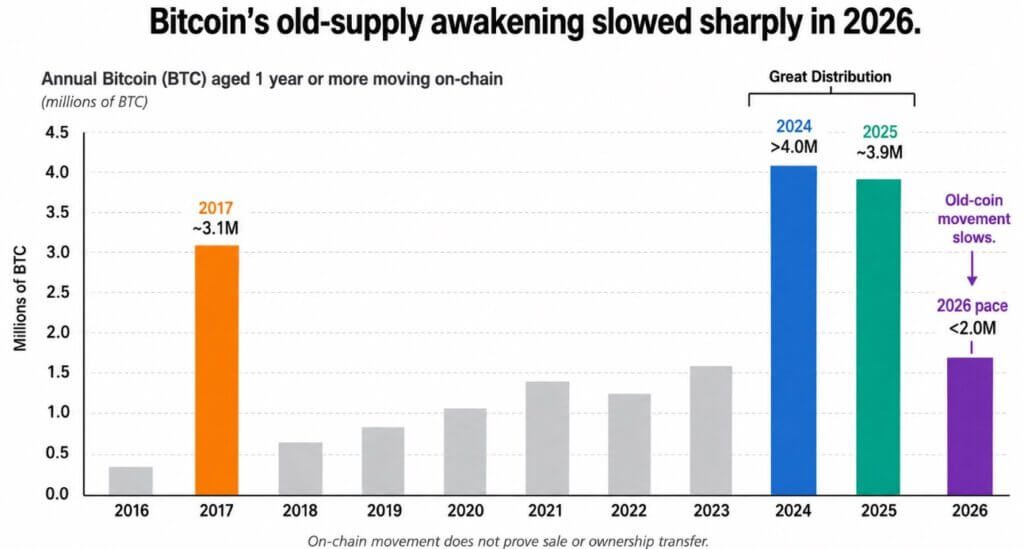
The landscape of Bitcoin ownership has undergone a seismic shift over the last three years, moving from a period of high-velocity distribution to what appears to be a phase of stabilization and exhaustion among long-term holders. According to recent data compiled by Galaxy Research and shared by lead analyst Alex Thorn, Bitcoin that had remained dormant for one year or more moved on-chain in extraordinary volumes throughout 2024 and 2025. However, as the market moves through 2026, this trend has hit a definitive wall. Current figures for 2026 show that the movement of these "aged" coins has fallen to less than half of the volume recorded in 2025, suggesting that the era of the "Great Distribution"—the massive transfer of wealth from long-term "HODLers" to newer market participants—has largely exhausted its momentum.
This slowdown marks a pivotal moment in the current market cycle. For the past two years, the industry watched as coins that had been tucked away in cold storage for years were suddenly awakened, typically moving toward exchanges or into the hands of institutional buyers following the proliferation of spot Bitcoin ETFs. While this movement often signals profit-taking during bull runs, the sheer scale of the 2024-2025 distribution was nearly unprecedented, rivaled only by the peak of the 2017 bull cycle. The current deceleration in 2026 suggests that the supply of "old" Bitcoin willing to be sold at current price levels is thinning, potentially setting the stage for a new phase of price discovery or prolonged consolidation.
The Chronology of the Great Distribution (2024–2026)
To understand the significance of the 2026 slowdown, one must look at the preceding 24 months of on-chain activity. The year 2024 began with a surge in the movement of coins aged one year or more. This "awakening" coincided with the historic approval of several spot Bitcoin Exchange-Traded Funds (ETFs) in the United States, which created a massive liquidity sink and provided long-term holders with an optimal exit window. Galaxy Research charts indicate that over 4 million BTC that had been stationary for at least a year moved on-chain during 2024.
By 2025, this trend continued as Bitcoin reached new valuation milestones. The "Great Distribution" was in full swing, characterized by older wallets—some dating back to the early 2010s—transferring assets. This period was defined by a transfer of beneficial ownership, where early adopters and long-term whales realized gains, handing the proverbial baton to a new cohort of institutional and retail investors.
However, the data for 2026 tells a different story. The total volume of one-year-plus supply moving on-chain has plummeted. If the current trajectory holds, the 2026 total will remain significantly lower than the 2 million BTC mark, representing a sharp contrast to the high-activity years of the mid-2020s. Alex Thorn and other analysts interpret this as evidence that the supply-side pressure from the oldest cohort of investors has reached a point of saturation. Those who intended to sell during the recent rally have likely already done so, leaving the remaining supply in the hands of "conviction holders" who are less sensitive to current price fluctuations.
Deciphering On-Chain Signals and the Coinbase Factor
While the Galaxy Research data provides a clear signal of slowing distribution, analysts caution that on-chain movement does not always equate to a direct sale on the open market. A significant caveat in analyzing "aged supply" is the distinction between a change in beneficial ownership (a sale) and a simple internal migration (custodial reshuffling).
A prime example of how raw data can be misinterpreted occurred with Coinbase’s internal wallet migration. In a massive administrative undertaking, Coinbase moved roughly $69.5 billion worth of Bitcoin between its internal cold storage units. To a raw on-chain tracker, this looked like a monumental "awakening" of old supply. However, because Galaxy’s filtering methodology excludes exchange and custodial churn, such distortions are minimized in their reporting.

The distinction is vital for investors: a sale requires the transfer of ownership to a new entity, an event that often happens off-chain in the books of major custodians or through "Over-the-Counter" (OTC) desks. On-chain data only confirms that a coin has moved; it cannot, by itself, verify the intent behind the move. Nevertheless, the broad trend captured by Galaxy—even when filtered for exchange noise—shows a definitive cooling of activity, suggesting that the massive reshuffling of the Bitcoin supply seen in the previous two years is nearing its conclusion.
The Convergence of Galaxy and Glassnode Metrics
To gain a more granular view of the market, analysts often compare Galaxy’s one-year-plus "awakening" chart with Glassnode’s "Long-Term Holder" (LTH) metrics. The two frameworks use different thresholds for what constitutes a "long-term" investor, leading to subtle but important differences in their conclusions.
Galaxy Research focuses on coins aged one year or more, a strict definition of dormancy. Glassnode, conversely, utilizes a statistical threshold of approximately 155 days. According to Glassnode’s research, once a coin has been held for longer than 155 days, the statistical likelihood of it being spent drops significantly, making it "long-term supply."
The 2026 data shows a fascinating overlap between these two metrics. Glassnode’s latest reports suggest that Bitcoin’s bottoming process is currently building, supported by three specific observations:
- Disappearance of Profit-Taking: The wave of LTHs selling for a profit has almost entirely subsided.
- Realized Loss Stabilization: The share of realized losses among long-term holders has stopped climbing, indicating that the most distressed sellers have already exited the market.
- Turnaround in Realized Losses: Entity-adjusted realized losses have turned downward from a cycle peak reached in early 2026.
The gap between Galaxy’s one-year threshold and Glassnode’s 155-day threshold reveals a new demographic of sellers. A buyer who purchased Bitcoin in late 2025 would cross the 155-day mark by early 2026. This investor would be classified as a "Long-Term Holder" by Glassnode but would not yet appear on Galaxy’s one-year-plus chart. This suggests that the selling pressure remaining in the market in 2026 is not coming from the "old guard" of the 2017 or 2020 cycles, but rather from 2025 buyers who are now exiting their positions at a loss.
The $69,000 Pivot: A Test of Market Conviction
As the supply from older holders dries up, the market’s focus has shifted to a critical technical and psychological level: $69,000. This figure represents the aggregate cost basis for Short-Term Holders (STHs)—those who have bought Bitcoin within the last 155 days.
In the current environment, Bitcoin has been trading in the mid-$60,000 range, keeping a large portion of recent buyers "underwater." Glassnode identifies the $69,000 level as the next key hurdle for the market. A convincing reclaim of this price point would move the majority of the short-term cohort back into a state of unrealized profit, likely cooling the urge to "panic sell" and allowing the market to stabilize.
Conversely, if the price rejects at the $69,000 level and slides back into a lower range, it could trigger a fresh round of capitulation among the 2025-2026 buyer cohort. While the one-year-plus supply remains quiet, the vulnerability of the market now rests with these newer participants. The "Great Distribution" may have ended for the old whales, but a "Secondary Distribution" could occur if newer institutional and retail buyers lose patience.
Broader Implications for the 2026 Market Cycle
The slowdown in the awakening of old supply has profound implications for Bitcoin’s volatility and price floor. When old supply moves in high volume, it typically creates a "supply overhang" that requires significant buy-side demand to absorb. In 2024 and 2025, the arrival of spot ETFs provided that demand. In 2026, however, ETF inflows have appeared only in scattered bursts, lacking the sustained momentum seen during the initial launch phase.
This creates a delicate balance. On one hand, the "supply side" is drying up as old holders stop selling. On the other hand, the "demand side" remains cautious. Glassnode’s analysis emphasizes that a reduction in selling is a different phenomenon than an increase in buying. For Bitcoin to enter a sustained uptrend, the market needs more than just the absence of sellers; it requires a resurgence of spot demand to clear the remaining coins hitting the market from distressed newer holders.
Furthermore, the unwind in derivatives positioning suggests a period of de-risking. Leveraged traders, who often exacerbate price swings, have largely stepped back, leaving the market to be driven by spot activity. This typically results in lower volatility but also means that any significant price movement will require "real" money entering the system rather than just liquidations.
Conclusion: A New Generation of Holders
The data from Galaxy Research and Glassnode paints a picture of a market in transition. The "Great Distribution" of 2024 and 2025 successfully transferred a massive portion of Bitcoin’s circulating supply from the hands of early adopters to a new class of investors, including public companies, pension funds, and ETF providers.
As of mid-2026, the "old" supply has largely returned to a state of dormancy. The frantic movement of coins aged one year or more has slowed to a crawl, suggesting that those who survived the volatility of the previous years are once again content to wait. The torch has been passed, and the market’s future now depends on the behavior of the 2025-2026 cohort.
If Bitcoin can reclaim the $69,000 cost basis and turn recent buyers into profitable holders, the handoff from the "Great Distribution" will be viewed as a successful foundation for the next stage of Bitcoin’s maturity. If not, the market may face a test of resolve from its newest participants, proving that while the coins have changed hands, the psychological battle of the "HODL" remains the same. For now, the charts suggest a period of relative calm, as the "awakening" of the past two years yields to a new era of quiet accumulation and strategic patience.