
 James Watt
The Bitcoin derivatives landscape has undergone a fundamental transformation over the last five years, evolving from a speculative arena dominated by simple dated futures into a sophisticated multi-tiered ecosystem. This structural shift has seen the near-total marginalization of traditional dated futures on crypto-native exchanges, replaced by a dual-engine market powered by perpetual swaps and options. According to recent data from Glassnode and Bybit, dated futures volume across offshore venues has plummeted by approximately 97% from its 2021 peak, signaling the end of an era for the product that originally helped build the crypto-native derivatives market.
This evolution is not merely a change in preferred trading instruments but reflects a deeper maturation of the digital asset class. As institutional participation has grown and trading infrastructure has become more robust, the market has bifurcated. Traders seeking directional leverage have migrated to perpetual futures, while those managing complex risk, volatility, and long-term portfolios have turned to the options market. This specialization has squeezed the once-dominant dated future into a niche role, primarily serving regulated institutional players on venues like the Chicago Mercantile Exchange (CME).
The Erosion of Dated Futures and the Rise of the Perpetual Swap
To understand the current state of the market, one must look at the technical limitations of the traditional dated future within the context of 24/7 crypto trading. In legacy finance, monthly and quarterly futures contracts are standard, requiring traders to "roll" their positions—closing an expiring contract and opening a new one in a further-out month. This process involves transaction costs, slippage, and the constant management of expiry dates.
In the fast-paced crypto environment, the "perpetual swap" or "perp" emerged as a more efficient alternative. By eliminating the expiry date and using a funding rate mechanism to keep the contract price tethered to the spot price, perpetuals allowed traders to maintain leveraged positions indefinitely without the administrative burden of rolling contracts.
The impact of this preference is starkly visible in exchange data. A recent snapshot of Binance, the world’s largest cryptocurrency exchange, illustrates the magnitude of the disparity. In late 2024, Binance’s BTC/USDT and BTC/USDC perpetual contracts held a combined open interest of approximately $9.93 billion. In contrast, the exchange’s quarterly dated contracts expiring in September and December carried a combined open interest of only $77 million. This represents a ratio where perpetual positions outnumber dated futures positions by more than 129 to 1.
A Chronology of the Derivatives Market Flip
The transition from futures-dominant to options-dominant open interest did not happen overnight; it was a multi-year progression tracked closely by market analysts.

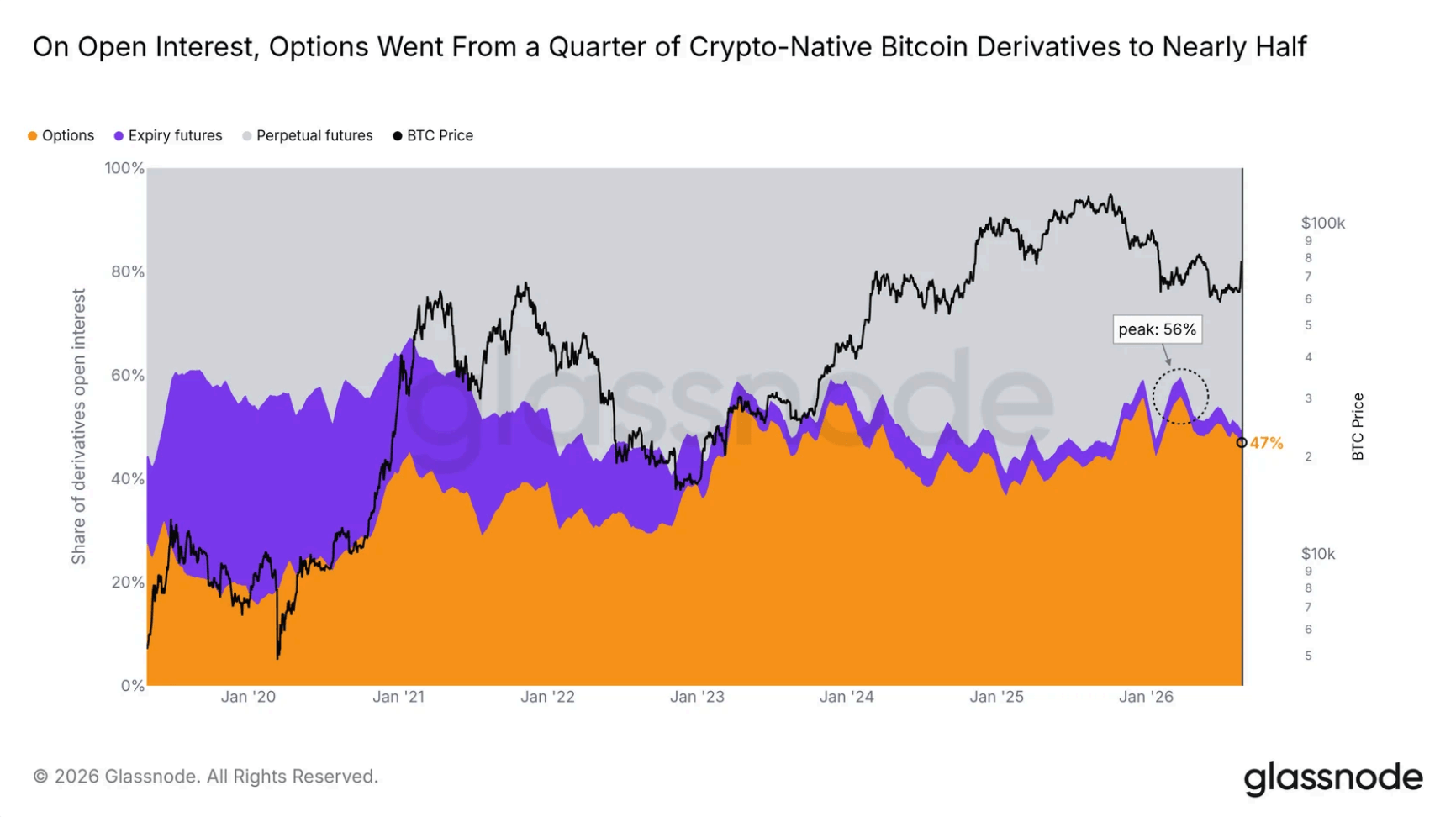
In 2019, options represented roughly one-quarter of the open interest on crypto-native platforms, with the vast majority of liquidity concentrated in dated futures. By 2021, during the height of the bull market, dated futures volume reached its zenith, fueled by retail speculation and the "basis trade," where traders exploited the price difference between spot and futures.
However, the subsequent bear market of 2022 and 2023 acted as a catalyst for sophistication. As retail speculators washed out, institutional desks began utilizing options more aggressively for downside protection. By March 2025, Bitcoin’s options-to-futures open interest ratio climbed from 57.8% to nearly 70% in a single week, a precursor to the definitive "flip."
The historic turning point arrived in January 2026. For the first time in the history of the digital asset market, Bitcoin options open interest surpassed that of futures. Data recorded at the time showed options carrying approximately $74.1 billion in position inventory, compared to $65.22 billion for futures. This flip confirmed that the "volatility regime" of Bitcoin had changed; the market was no longer just about betting on price direction, but about managing the complex Greeks—delta, gamma, and vega—associated with sophisticated portfolio management.
The Institutional Catalyst: Spot ETFs and Corporate Treasuries
The growth of the options market is inextricably linked to the changing profile of Bitcoin owners. The introduction of Spot Bitcoin ETFs in the United States and other jurisdictions brought a new class of investors who treat Bitcoin as a long-term capital asset rather than a speculative trade. These entities—alongside corporate treasuries like MicroStrategy and institutional hedge funds—rarely want to sell their underlying Bitcoin, even during periods of high volatility.
For these holders, options are the ideal tool. A fund manager worried about a 10% drawdown can purchase protective puts, effectively buying insurance for their portfolio without triggering a taxable event by selling the spot asset. Conversely, in a sideways market, these institutions can sell covered calls to generate yield on their "lazy" Bitcoin.
Furthermore, the depth of the options market has been bolstered by the emergence of professional market makers. On exchanges like Bybit, options volume has surged, with the exchange’s share of tracked Bitcoin options volume rising from under 10% to 28% in recent years. As these venues attract more liquidity, bid-ask spreads tighten, making it more cost-effective for large desks to execute complex strategies like straddles, strangles, and iron condors.
The Shift in Collateral Mechanics: From Coins to Stablecoins
Another critical factor in the maturation of the derivatives market is the shift in how trades are margined. In the early days of crypto trading, most derivatives were "inverse" contracts, meaning they were margined in Bitcoin itself. This created a dangerous feedback loop: during a price crash, a trader’s collateral (Bitcoin) would lose value at the same time their long position was losing money, leading to rapid, cascading liquidations.
Modern derivatives markets have largely moved toward stablecoin-margined or "linear" contracts. By using USDT or USDC as collateral, traders decouple the value of their margin from the volatility of the asset they are trading. Glassnode’s analysis highlights this transition as a stabilizing force for the market. It allows professional desks to manage risk with much greater precision, as they no longer have to worry about their "gas" (collateral) evaporating during a market move.
The CME and the Specialized Survival of Dated Futures
While dated futures have withered on offshore, crypto-native exchanges, they have found a sustainable—and even growing—home on regulated venues like the CME. This highlights a clear divide in the market’s architecture.
The CME serves a specific clientele: regulated asset managers, pension funds, and banks that are legally or operationally required to trade through established clearinghouses. For these participants, the dated future is not an outdated tool but a necessary one. It fits into existing risk management frameworks and allows for the "basis trade" (long spot, short futures) to be conducted in a highly regulated environment.
The survival of dated futures on the CME, contrasted with their decline on offshore exchanges, proves that the product has become a specialized institutional instrument rather than a general-purpose trading vehicle. The offshore market has moved on to perpetuals for efficiency, while the regulated market clings to dated contracts for compliance and standardization.
Implications for Market Volatility and Price Discovery
The dominance of options and perpetuals has profound implications for how Bitcoin’s price is discovered. Because options dealers must constantly hedge their exposure—a process known as delta-hedging—large clusters of options at specific strike prices can act as "magnets" or "anchors" for the spot price. This often leads to increased volatility around major monthly expiries, a phenomenon that was less pronounced when the market was driven purely by futures.
Moreover, the rise of the options market suggests that Bitcoin is increasingly being integrated into the broader world of "Vol-Targeting" and "Yield Enhancement" strategies common in equity markets. This transition marks the end of Bitcoin as a "wild west" speculative asset and its beginning as a mature financial instrument.
In conclusion, the near-disappearance of dated futures from the crypto-native landscape is not a sign of a shrinking market, but of a more efficient one. The market has effectively "unbundled" the dated future. Its role in providing leverage has been taken over by the perpetual swap, its role in risk management has been absorbed by the options market, and its role in regulated institutional finance has been consolidated within the CME. The result is a derivatives ecosystem that is larger, more liquid, and far more resilient than it was five years ago, providing a robust foundation for the next phase of Bitcoin’s institutional adoption.









