admin
admin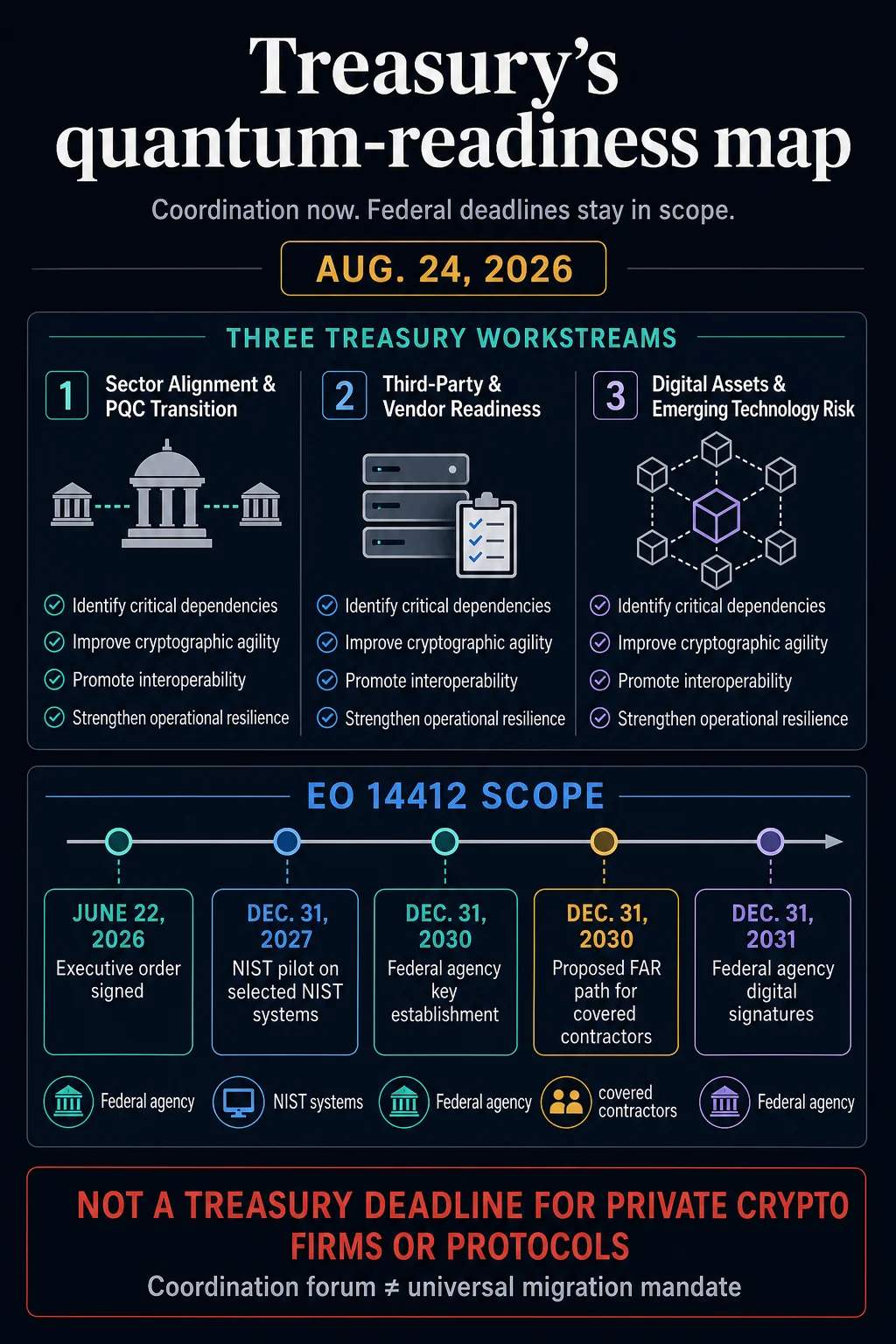
The US Treasury has officially brought digital assets into the financial sector’s strategic planning for the potential disruption posed by quantum computing. This significant development was marked by the launch of the Treasury’s Quantum-Readiness Task Force on August 24, which includes a dedicated workstream focusing on digital assets and the associated risks of emerging technologies. This initiative signifies a proactive governmental approach to addressing a future where current cryptographic standards may become insufficient to safeguard sensitive financial information.
Establishing a Collaborative Framework for Quantum Security
The newly formed Quantum-Readiness Task Force is structured around three key workstreams, with the digital asset and emerging technology track being a crucial component. The other two tracks are dedicated to the broader adoption of post-quantum cryptography (PQC) across government systems and ensuring the readiness of third-party vendors to transition to quantum-resistant solutions. This multi-faceted approach underscores the Treasury’s commitment to a comprehensive strategy for safeguarding the nation’s financial infrastructure against the advancements in quantum computing.
The core objective of this task force is to foster a collaborative environment between government agencies, financial institutions, and the burgeoning digital asset industry. By bringing together crypto custodians, infrastructure providers, and regulators, the initiative aims to facilitate coordinated efforts in migrating towards quantum-safe technologies. This public-private forum is designed to identify critical cryptographic dependencies within the digital asset ecosystem, enhance interoperability between different quantum-resistant systems, and proactively address the implementation challenges that will inevitably arise as current encryption methods become vulnerable to the superior processing power of quantum computers.
The implications for cryptocurrency companies are substantial. This task force presents an opportunity for these entities to critically examine the cryptographic underpinnings of their operations. This includes assessing how cryptography is integrated into custody systems, the mechanisms for transaction signing, user authentication protocols, and the broader third-party infrastructure that supports their services. The central question for these companies will be whether their existing systems can be upgraded or replaced to accommodate post-quantum cryptography without disrupting customer access, compromising transaction integrity, or hindering interoperability with the wider financial network.

Acknowledging the Quantum Threat to Digital Assets
The inclusion of digital assets in this task force acknowledges the unique vulnerabilities presented by the decentralized and cryptography-dependent nature of cryptocurrencies. While the Treasury has not imposed immediate migration deadlines on specific cryptocurrencies like Bitcoin or Ethereum, nor on private digital asset companies, the establishment of this forum signals a clear recognition of the long-term imperative for quantum-resistant solutions. Any fundamental changes to blockchain signature systems, for instance, would necessitate independent engineering efforts and governance decisions within each respective network.
This initiative by the US Treasury is a direct response to a growing global concern about the potential impact of quantum computing on cybersecurity. Quantum computers, with their ability to perform calculations at speeds far exceeding those of classical computers, pose a significant threat to many of the cryptographic algorithms that currently secure digital communications and transactions, including those used in blockchain technology. Algorithms like Shor’s algorithm, for example, can efficiently factor large numbers, which is the mathematical basis for widely used public-key cryptosystems like RSA and Elliptic Curve Cryptography (ECC). These are the very algorithms that underpin the security of most digital assets, including Bitcoin and Ethereum, for transaction authorization and wallet security.
Historical Context and Evolving Threats
The timeline leading to this Treasury initiative can be traced back to broader governmental and industry-wide discussions about quantum computing threats. President Donald Trump’s executive order in June, which aimed to accelerate the federal government’s transition to quantum-resistant cryptography, set a precedent for national-level action. This order established specific deadlines for federal systems to adopt post-quantum key establishment by December 31, 2030, and post-quantum digital signatures by December 31, 2031. While these deadlines are specifically for federal systems and do not directly apply to private blockchains, they underscore the urgency with which the US government views the quantum threat.
The cryptocurrency industry itself has not been entirely passive in the face of this looming challenge. Prior to the Treasury’s announcement, several key players within the crypto space had already begun to acknowledge and address the quantum risk. In June, Coinbase’s independent quantum advisory council issued a strong recommendation for blockchain developers to commence technical and governance planning for quantum-resistant solutions well in advance of any potential breakthroughs in quantum computing that could compromise current cryptography. This advisory council highlighted a specific concern regarding Bitcoin, estimating that approximately 7 million Bitcoin might be considered potentially vulnerable. This vulnerability stems from older address formats or the reuse of addresses, which can expose public keys, making them susceptible to decryption by future quantum computers.
Further underscoring the industry’s growing awareness, a month prior to the Treasury’s task force launch, a significant consortium of prominent financial institutions and cryptocurrency companies came together to form the Bitcoin Security Consortium. This group, which includes major players such as BlackRock and Coinbase, along with Strategy and six other institutions, pledged a combined $15 million over three years to bolster Bitcoin security research. A primary focus of this research is the development and implementation of post-quantum cryptography. While the members of this consortium direct their funding independently rather than through a pooled fund, their collective commitment signals a substantial industry-led effort to proactively address quantum threats.

Analysis of Implications and Broader Impact
The US Treasury’s Quantum-Readiness Task Force represents a significant escalation in the national approach to quantum security. By formally including digital assets within a broader federal coordination effort for quantum-safe finance, the government is moving beyond industry-led initiatives and establishing a more integrated strategy. This move is critical for several reasons:
- Enhanced Coordination: The task force provides a centralized platform for dialogue and collaboration, ensuring that the digital asset sector’s quantum-readiness efforts are aligned with broader national cybersecurity objectives.
- Risk Mitigation: By proactively addressing vulnerabilities, the Treasury aims to prevent potential systemic risks that could arise if a significant portion of the digital asset market were compromised by quantum attacks. This could include safeguarding the integrity of financial transactions, protecting user assets, and maintaining confidence in the digital economy.
- Technological Advancement: The initiative is expected to spur innovation in post-quantum cryptography within the digital asset space, encouraging the development and adoption of new, secure technologies.
- Regulatory Preparedness: While not imposing immediate deadlines, the Treasury’s engagement lays the groundwork for future regulatory considerations. As quantum computing capabilities advance, the government may introduce more specific requirements for the digital asset industry.
It is important to note that the Treasury’s current action focuses on establishing a coordination framework rather than imposing a private-sector countdown. Any binding migration timetables or specific mandates for crypto firms would necessitate the development of new rules or the utilization of existing regulatory authorities that specifically apply to them. This suggests a phased approach, starting with dialogue and preparation, and potentially evolving into more prescriptive measures as the threat landscape becomes clearer and post-quantum solutions mature.
The Road Ahead: Challenges and Opportunities
The transition to quantum-resistant cryptography is a complex undertaking. For the digital asset industry, it involves not only technical challenges but also significant governance hurdles. The decentralized nature of many cryptocurrencies means that implementing widespread cryptographic upgrades requires consensus among a diverse range of stakeholders, including miners, developers, validators, and users. This can be a slow and intricate process, especially for established blockchains with large market capitalizations.
Furthermore, the development of new quantum-resistant algorithms is an ongoing field of research. While organizations like the National Institute of Standards and Technology (NIST) are actively working on standardizing PQC algorithms, the practical implementation and widespread adoption of these new standards will take time. Interoperability between different post-quantum cryptographic systems will also be a crucial consideration, ensuring that the transition does not fragment the digital asset ecosystem.
Despite these challenges, the US Treasury’s proactive stance and the industry’s own nascent efforts signal a growing awareness and commitment to addressing the quantum computing threat. The establishment of the Quantum-Readiness Task Force represents a pivotal moment, bringing together critical stakeholders to collaboratively navigate the complexities of securing the future of finance in an era of advanced computing. This initiative is not just about mitigating a potential risk; it is also about fostering innovation and ensuring the long-term resilience and trustworthiness of the digital economy.