admin
admin
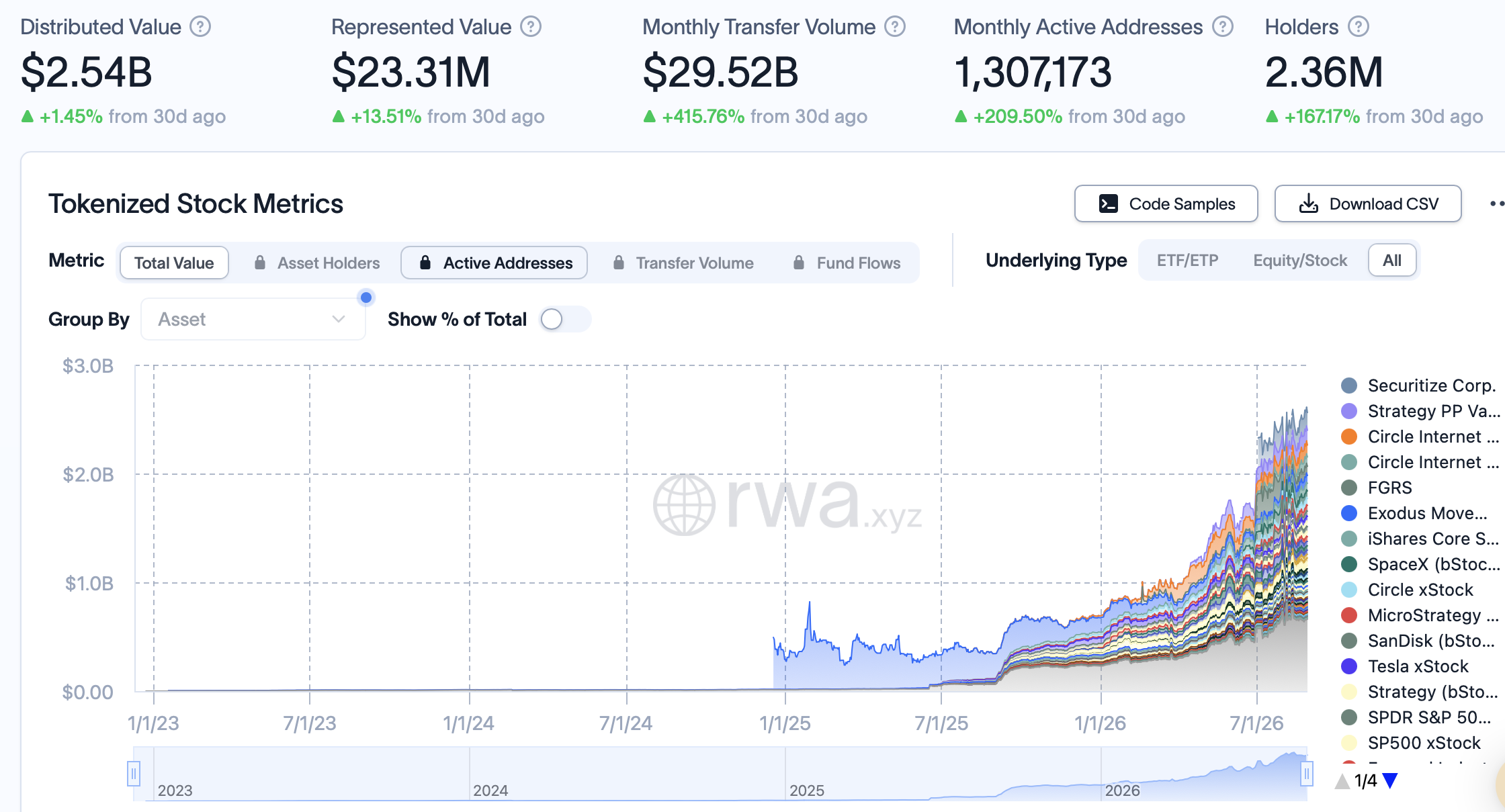
The landscape of decentralized finance (DeFi) is undergoing a profound transformation as traditional equities find a permanent home on the blockchain. According to the latest market data from RWA.xyz, a leading analytics platform for real-world assets (RWAs), the tokenized stock sector has experienced an unprecedented surge in activity over the past 30 days. Monthly transfer volume for these digital representations of traditional shares skyrocketed by more than 415%, reaching a staggering $29.5 billion. This surge highlights a growing appetite among global investors for onchain access to traditional financial markets, bridging the gap between legacy brokerage systems and the 24/7 liquidity of the crypto ecosystem.
This explosive growth is not limited to transaction volumes alone. The data indicates a broad-based expansion of the user base. Monthly active addresses associated with tokenized stocks rose by more than 209% to approximately 1.3 million, while the total number of tokenized stock holders climbed 167% to reach 2.36 million during the same period. Perhaps most telling of the sector’s long-term trajectory is the total value of tokenized stocks distributed onchain, which now stands at $2.54 billion. While this represents a modest 1.45% increase over the last 30 days, it marks a monumental 637% increase from the $344 million recorded just one year ago. This trajectory suggests that while the market is currently experiencing a period of intense transactional volatility, the underlying floor of locked value is rising steadily.
The Infrastructure of Onchain Equities: Key Players and Platforms
The concentration of the tokenized stock market reveals a competitive landscape dominated by a few major institutional and crypto-native entities. As of late August, Securitize Corp. emerged as the largest individual provider of tokenized stock tracked by RWA.xyz, managing approximately $163 million in assets. It was closely followed by Strategy PP Variable xStock at $136 million and an Ondo-tokenized version of Circle Internet Group, which accounts for $109 million.
When examining the market by platform distribution, the data shows a high degree of centralization among the top three providers. Ondo Finance leads the sector with $842.8 million in distributed value, leveraging its reputation for institutional-grade RWA products. Kraken’s xStocks and Binance’s bStocks follow closely, with $609.3 million and $599.9 million respectively. Together, these three platforms account for roughly 81% of the total market share. This dominance underscores the importance of exchange-backed ecosystems in providing the necessary trust and liquidity for investors to transition their equity holdings into a tokenized format.
The emergence of these platforms as market leaders reflects a broader shift in how digital asset service providers view their role in the financial hierarchy. Rather than merely facilitating the trade of volatile cryptocurrencies, these entities are increasingly positioning themselves as comprehensive wealth management hubs that offer a unified interface for both "crypto-native" and "real-world" assets.
A Chronology of Rapid Integration: July to August 2024
The recent surge in volume and user acquisition can be traced back to a series of strategic product launches and integrations that occurred throughout the summer of 2024. This timeline illustrates the accelerating pace at which major industry players are moving to capture the burgeoning RWA market.
In July, the exchange Bybit signaled a major shift in utility for tokenized equities by allowing shares of high-demand US companies, such as Nvidia, Apple, and Tesla, to be used as collateral for margin loans. This move effectively unlocked the capital efficiency of traditional stocks, allowing traders to hedge their positions or increase their market exposure without liquidating their core equity holdings. Simultaneously, the Robinhood-backed decentralized exchange (DEX) Arcus made a significant entry into the market by launching over 95 stock tokens and perpetual markets on the Robinhood Chain. This provided a decentralized alternative for traders seeking exposure to traditional markets with the added benefit of leverage.
The momentum continued into late August, which saw two of the most significant developments in the sector’s history. On August 24, Coinbase announced that its tokenized US stocks, issued as B20 tokens, had gone live on Base, its proprietary Ethereum Layer-2 network. These tokens, which represent shares in tech giants like Nvidia, Apple, Meta, and Alphabet, are available to eligible non-US users. The integration with Base allows these assets to be traded around the clock and, crucially, utilized within various DeFi applications, such as lending protocols and liquidity pools.
Just 24 hours later, on August 25, Bitwise Asset Management expanded the accessibility of these assets by launching automated portfolios built from Coinbase’s tokenized stocks. These portfolios allow investors to follow preset strategies—initially targeting sectors like the "Magnificent Seven" (the seven largest US tech companies), robotics, and artificial intelligence—while maintaining self-custody of the underlying assets.
Strategic Implications of 24/7 Onchain Trading
The migration of stocks to the blockchain addresses several structural limitations of the traditional financial system. Most notably, traditional stock exchanges operate on a rigid schedule, typically 9:30 AM to 4:00 PM Eastern Time, and are closed on weekends and holidays. In contrast, tokenized stocks on platforms like Base and Binance operate 24/7/365.
For global investors, particularly those in time zones that do not align with New York or London, this provides a level of accessibility previously reserved for institutional "dark pools" or after-hours trading desks. Furthermore, the settlement of these trades occurs almost instantaneously on the blockchain, bypassing the traditional T+1 or T+2 settlement cycles that can trap capital and create counterparty risk.
The ability to use tokenized stocks as collateral—as seen with Bybit’s recent initiative—is perhaps the most transformative implication for the DeFi sector. By allowing a user to hold an Apple stock token and use it to borrow stablecoins, the industry is creating a "composable" financial stack. This allows for complex financial maneuvers that were once the sole province of sophisticated hedge funds to be executed by individual retail investors through smart contracts.
Regulatory Realities and the Non-US Focus
Despite the technological advancements, the tokenized stock market remains heavily influenced by the global regulatory landscape. A notable commonality among the recent launches from Coinbase, Bitwise, and Bybit is the restriction of these services to "eligible non-US users."
The US Securities and Exchange Commission (SEC) maintains a strict stance on the registration of securities, and the legal framework for tokenizing publicly traded stocks within the United States remains complex and fraught with potential litigation. Consequently, the growth of this $2.54 billion market is being driven largely by international demand in jurisdictions with more flexible or clearer digital asset frameworks, such as parts of Europe, Asia, and the Middle East.
Market analysts suggest that the current surge in volume is a "proof of concept" phase. If the current infrastructure can handle $29.5 billion in monthly volume without significant security breaches or settlement failures, it may provide the necessary data for regulators in more restrictive jurisdictions to consider updating their guidelines.
Analysis: The "Magnificent Seven" as a Catalyst for Growth
The concentration of tokenized offerings around the "Magnificent Seven"—Nvidia, Apple, Microsoft, Amazon, Meta, Alphabet, and Tesla—is a strategic choice by issuers. These companies are not only the drivers of the current US bull market but also possess global brand recognition. For an investor in an emerging market, the ability to gain fractional, onchain exposure to Nvidia’s growth in the AI sector is a powerful value proposition.
By focusing on these high-liquidity, high-demand assets, tokenization platforms are ensuring that their initial offerings have the necessary "velocity" to sustain a liquid secondary market. The 415% increase in transfer volume is a direct reflection of this strategy; investors are not just buying and holding these assets; they are actively moving them between wallets, using them in DeFi protocols, and trading the volatility of the tech sector with the efficiency of a blockchain.
Future Outlook: Beyond Simple Tokenization
As the market for tokenized stocks matures, the industry is likely to move beyond simple "wrappers" of existing shares. The next phase of development will likely involve more complex financial instruments, such as tokenized derivatives, index products, and cross-border equity swaps.
The data from RWA.xyz serves as a clear indicator that the "tokenization of everything" is no longer a theoretical concept but a multi-billion dollar reality. With over 2.36 million holders and monthly volumes approaching $30 billion, the tokenized stock market has reached a level of scale that can no longer be ignored by traditional financial institutions. As infrastructure improves and more blue-chip equities are brought onchain, the distinction between a "crypto wallet" and a "brokerage account" will continue to blur, eventually leading to a unified global financial system built on transparent, decentralized ledgers.