James Watt
The digital asset market experienced a significant localized volatility event on Saturday, August 22, 2026, as the XRP/USD spot pair on the Bitstamp exchange underwent a dramatic "flash crash." During a brief window of intense selling pressure, the price of XRP on Bitstamp plummeted by more than 37%, a move that stood in stark contrast to the price action recorded on other major global exchanges. While social media platforms were quickly flooded with reports of a total market collapse for the Ripple-affiliated token, a closer examination of cross-venue data suggests the extreme dip was largely an isolated anomaly fueled by exchange-specific liquidity conditions rather than a fundamental shift in the asset’s valuation.
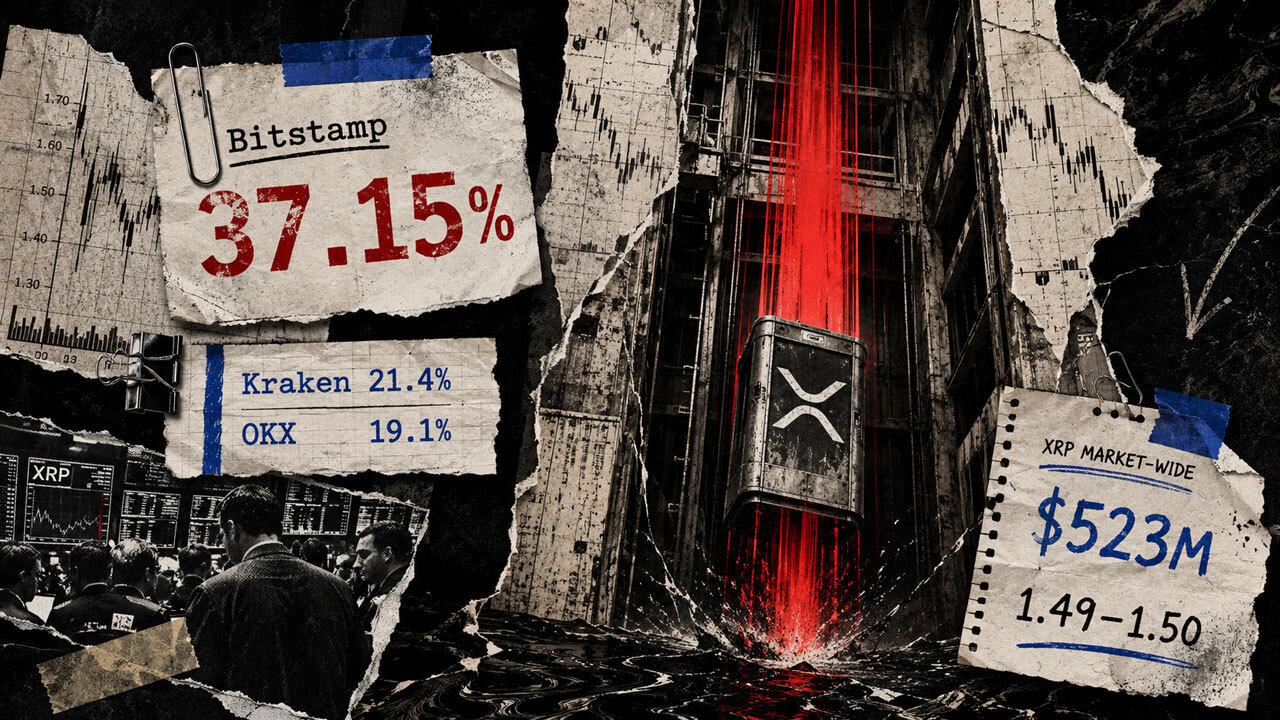
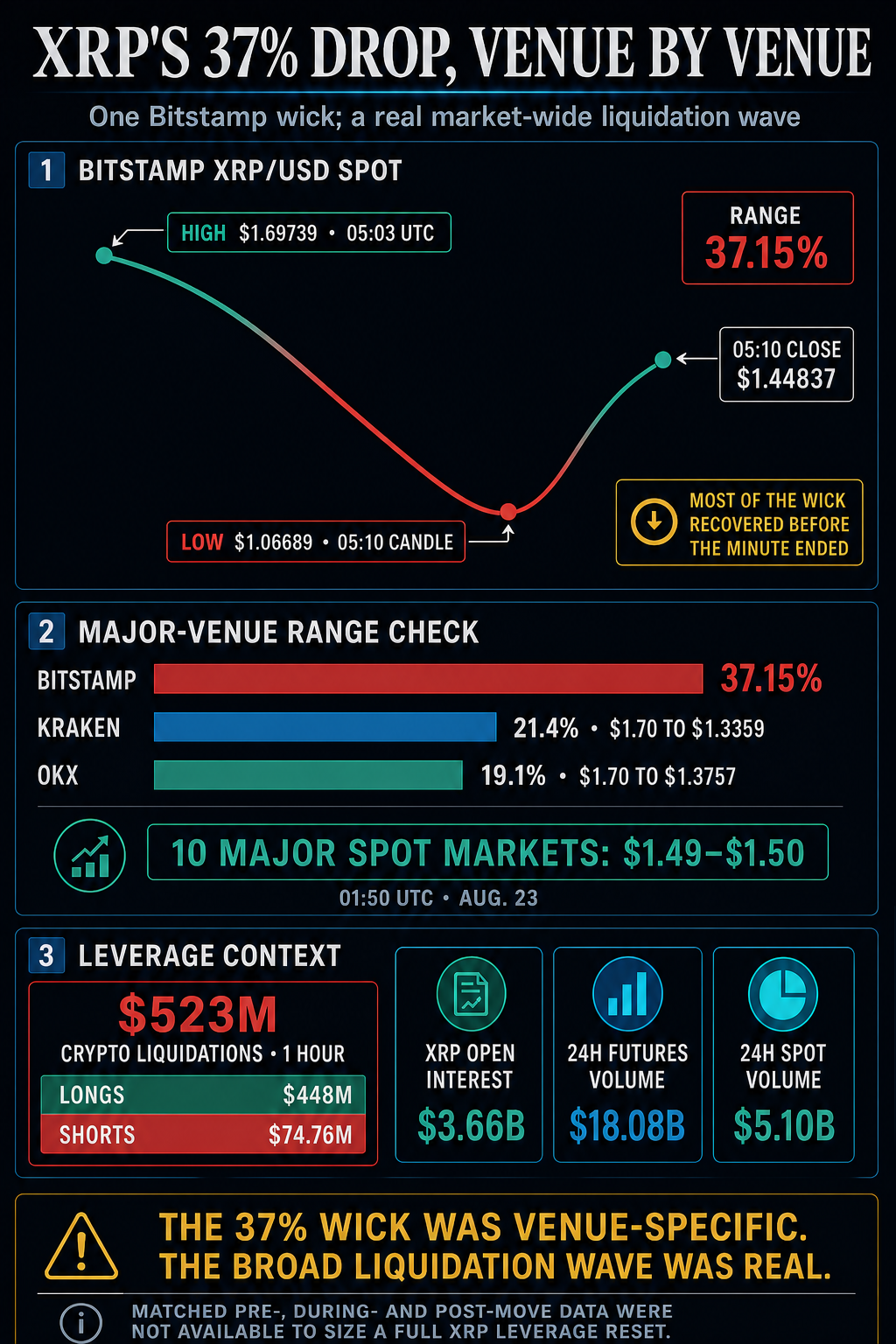
At the center of the volatility was Bitstamp’s XRP/USD order book. At 05:03 UTC, the pair was trading at a one-minute high of $1.69739. However, by the 05:10 UTC candle, the price had collapsed to a low of $1.06689, representing a 37.15% high-to-low move within a seven-minute timeframe. The recovery was nearly as rapid as the descent; the same 05:10 candle closed at $1.44837, retracing a significant portion of the losses before the minute had even concluded. In technical analysis, such a move is referred to as a "wick," characterized by a long vertical line on a price chart that indicates a temporary excursion to a price level that the market could not sustain.
Comparative Market Analysis: Bitstamp vs. Global Exchanges
The divergence between Bitstamp and its competitors provides critical context for the event. While Bitstamp saw a 37% drop, other high-volume exchanges reported much shallower troughs. Kraken’s XRP/USD ticker, for instance, recorded a 24-hour range with a high of $1.70 and a low of $1.3359. This represented a 21.4% range—significant, but far less severe than the Bitstamp outlier. Similarly, OKX’s XRP/USDT ticker showed a high of $1.70 and a low of $1.3757, a 19.1% range.
By approximately 01:50 UTC on August 23, market data showed that major spot markets had largely converged. XRP was trading in a tight cluster between $1.49 and $1.50 across ten major platforms. This convergence indicates that the Bitstamp "wick" was a temporary dislocation. In efficient markets, such gaps are typically closed by arbitrageurs who buy the asset on the lower-priced exchange and sell it on higher-priced venues, eventually equalizing the price. The depth of the Bitstamp wick suggests that, for a few moments, the selling pressure overwhelmed the available buy-side liquidity and the capacity of arbitrage bots to stabilize the pair.
The Mechanics of the $523 Million Liquidation Wave
The localized crash on Bitstamp occurred against the backdrop of a broader, market-wide leverage flush. Data from CoinGlass, cited in various market reports, revealed that the cryptocurrency market saw $523 million in liquidations within a single one-hour window surrounding the XRP event. Of this total, $448 million consisted of long positions—traders betting on price increases—while $74.76 million were short positions.
It is important to distinguish between the total market liquidations and XRP-specific losses. Early reports circulating on social media erroneously suggested that $500 million in XRP long positions were wiped out instantly. However, more granular data published later in the day by TechFlow indicated that XRP’s 24-hour liquidations were closer to $123 million. The $523 million figure represented a "rolling total" for the entire crypto market, including Bitcoin, Ethereum, and other major altcoins, which were also experiencing downward pressure.
Over a 24-hour period, the total liquidations across the industry reached as high as $1.801 billion, according to some data providers. The discrepancy in reported figures—ranging from $1.24 billion to $1.8 billion—is often attributed to the different "rolling windows" used by data aggregators and the specific times at which they captured their snapshots of the market.
Chronology of the XRP Volatility Event
To understand the sequence of events, one must look at the timeline of the morning of August 22, 2026:
- 05:00 – 05:03 UTC: XRP trades steadily near the $1.70 mark across most major exchanges. Market sentiment appears cautiously optimistic despite high leverage in the system.
- 05:04 – 05:09 UTC: Initial selling pressure begins. On Bitstamp, thin liquidity in the order book starts to show signs of strain as larger sell orders are executed.
- 05:10 UTC: The "Flash Crash" occurs on Bitstamp. The price drops from the $1.40 range down to $1.06689 in seconds. Automated stop-loss orders are triggered, creating a "waterfall effect" where selling begets more selling.
- 05:11 – 05:15 UTC: Bitstamp’s price begins a rapid ascent as "bottom fishers" and arbitrageurs enter the market, recognizing the price disparity with Kraken, Binance, and OKX.
- 05:32 UTC: Reports from KuCoin and CoinGlass confirm a massive liquidation event across the broader crypto market, totaling over $500 million in one hour.
- 12:00 UTC: Funding rates for XRP futures show a sharp division across venues. Some exchanges show neutral rates, while others remain skewed, suggesting that the leverage reset was not uniform across the industry.
- 01:50 UTC (Aug 23): XRP prices stabilize and converge around $1.50 across all major spot markets.
Analysis of Derivatives and Open Interest
Despite the aggressive liquidation of long positions, the XRP derivatives market remained substantial in the aftermath of the crash. CoinGlass data indicated that $3.66 billion in open interest (the total number of outstanding derivative contracts that have not been settled) remained at 01:50 UTC on August 23.

The volume of trading in the futures market significantly outpaced the spot market during this period. Over a 24-hour window, XRP saw $18.08 billion in futures volume compared to $5.10 billion in spot volume. This 3.5-to-1 ratio highlights the extent to which the XRP market is currently driven by speculative leverage rather than simple spot buying and selling. When such a high degree of leverage is present, even a minor price dip can trigger a chain reaction of liquidations, leading to the "wick" seen on Bitstamp.
The funding rates—the fees paid between long and short traders to keep the futures price aligned with the spot price—were notably fragmented following the move. Usually, after a major liquidation event, funding rates reset to neutral as over-leveraged longs are removed from the system. However, the divided nature of the funding table hours after the crash suggests that some traders immediately re-entered long positions, betting on a quick recovery to the $1.70 level.
Implications for Traders and Exchange Infrastructure
The Bitstamp incident serves as a stark reminder of the risks associated with exchange-specific liquidity. For institutional and professional traders, "slippage"—the difference between the expected price of a trade and the price at which the trade is executed—can be devastating during a flash crash. Traders who had stop-loss orders set on Bitstamp may have had their positions closed at the absolute bottom of the wick ($1.06), only to see the price return to $1.44 seconds later.
Furthermore, the event raises questions about the robustness of exchange matching engines and the role of market makers. In a healthy market, market makers provide liquidity by placing both buy and sell orders. When a flash crash occurs, it often indicates that market makers have "pulled" their quotes from the order book, either due to technical glitches or a desire to avoid losses during periods of extreme uncertainty.
For the broader XRP ecosystem, the event demonstrates the asset’s high ranking and market cap (currently #4 with a valuation of $93.77 billion) do not make it immune to localized volatility. While the market cap and circulating supply of 62.74 billion XRP provide a buffer against long-term manipulation, the short-term price discovery process remains vulnerable to the mechanics of leveraged trading.
Conclusion and Future Outlook
As of the latest data, XRP has shown resilience, trading up 0.32% over the last 24 hours and maintaining a 49.56% gain over the past seven days. The "Bitstamp Wick" is now viewed by analysts as a technical outlier—a "black swan" moment for a single exchange’s order book rather than a signal of a broader bear market.
However, the $3.66 billion in remaining open interest suggests that the "leverage problem" has not been fully resolved. Until the ratio of spot-to-futures volume shifts more toward spot buying, the potential for similar "wicking" events remains high. Market participants are advised to monitor funding rates and cross-exchange price spreads closely, as these metrics often provide the first warnings of an impending liquidity crunch. For now, the convergence of prices at the $1.50 level suggests that the market has found its new equilibrium, leaving the $1.06 low on Bitstamp as a historical footnote in XRP’s ongoing price journey.