
 admin
admin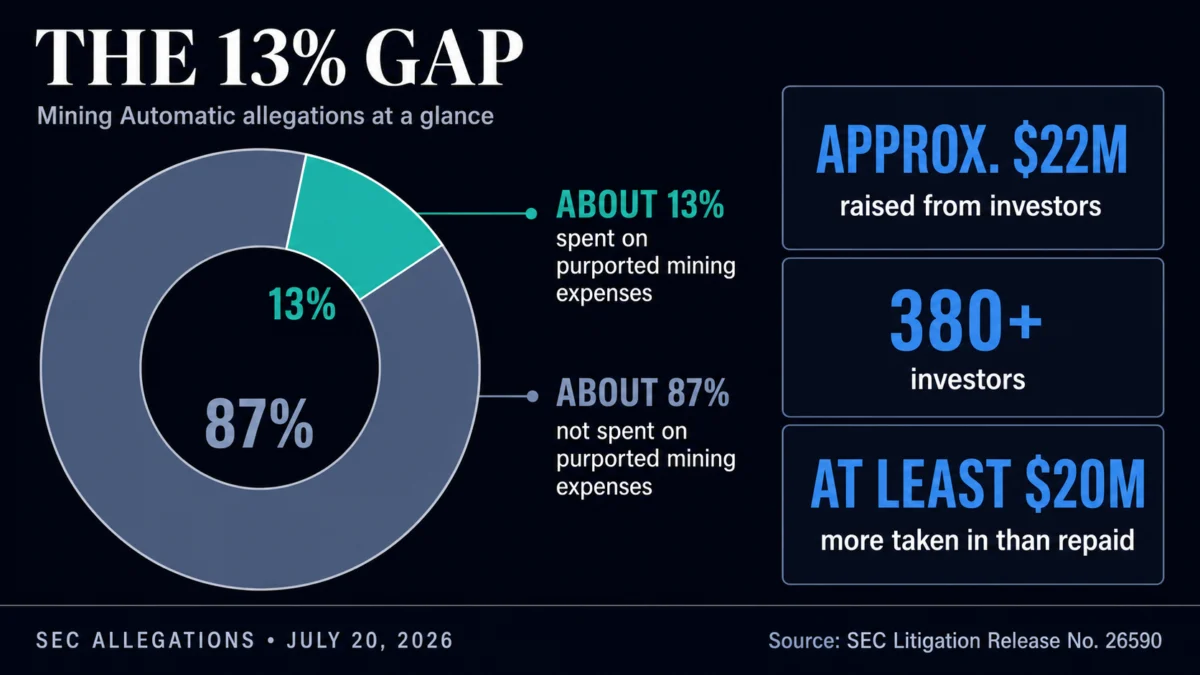
A US-based cryptocurrency mining venture, Bright Vision Distribution LLC, operating under the name Mining Automatic, has allegedly defrauded over 380 investors out of approximately $22 million. The Securities and Exchange Commission (SEC) filed partially settled charges on July 20, 2026, against the company and its principal, Zan Shaikh. The core of the SEC’s allegations centers on the scheme’s minimal allocation of investor funds towards its purported Bitcoin mining operations, with a staggering 87% of the raised capital allegedly diverted for marketing, personal expenses, and unrelated business ventures.
The SEC complaint details a period of alleged misconduct spanning from June 2023 to May 2025. During this time, Mining Automatic and Shaikh are accused of promising investors guaranteed monthly returns, a claim the regulator asserts was fundamentally misleading. The SEC contends that the mining infrastructure was never established in a manner capable of generating the promised returns, suggesting a deliberate misrepresentation to solicit investment. According to the regulator’s filings, the scheme took in at least $20 million more than it repaid to investors, highlighting a significant gap between incoming funds and outgoing payouts.
A Pattern of Deception: The Alleged Financial Mismanagement
The SEC’s investigation revealed a deeply concerning allocation of investor capital. Of the roughly $22 million raised, only an estimated 13% was purportedly directed towards the actual cryptocurrency mining operations. The remaining vast majority, the SEC alleges, was systematically siphoned off. This included substantial expenditures on marketing campaigns designed to attract new investors, thereby perpetuating the Ponzi-like nature of the alleged scheme. Furthermore, significant portions of the funds are said to have been used to cover Shaikh’s personal living expenses and other business activities entirely unrelated to the mining venture. This diversion of funds directly contradicts the promises made to investors who believed their capital was being actively deployed to generate profits through Bitcoin mining.
The gravity of these allegations is underscored by the potential financial devastation for the hundreds of individuals who entrusted their money to Mining Automatic. The discrepancy between the stated purpose of the investment and the alleged actual use of funds points to a calculated effort to enrich the operators at the expense of unsuspecting investors.
The Legal Ramifications: Partial Settlement and Unresolved Fates

In response to the SEC’s allegations, Zan Shaikh and Mining Automatic have agreed to proposed permanent injunctions, which are currently pending court approval. Shaikh has also consented to an officer-and-director bar, effectively preventing him from holding similar positions in publicly traded companies in the future, along with a conduct-based injunction.
However, the SEC’s action has not resulted in a full resolution of the financial repercussions. While the proposed settlements address the injunctive relief, key aspects such as disgorgement of ill-gotten gains, prejudgment interest, and civil penalties remain to be determined. These amounts will be decided later through an SEC motion to the court. Crucially, any potential recovery or distribution of funds back to the affected investors is currently unannounced and remains highly uncertain. The legal process is still in its early stages regarding the financial restitution, leaving the 380 investors in a state of limbo regarding the fate of their investments.
Expanding the Investigation: The FBI’s Call for Victims
Adding another layer to the unfolding situation, the Federal Bureau of Investigation (FBI) has initiated its own outreach to identify potential victims connected to Zan Shaikh and his associated companies. The FBI’s Boston Division has established a dedicated victim-information page, actively seeking individuals who may have invested in Bright Vision Distribution, Mining Automatic, YT Automatic, and RankOne Ecommerce. The inclusion of Replic8 among the affiliated entities, though the precise nature of the relationship is not detailed, further broadens the scope of the investigation.
This FBI initiative significantly expands the net beyond the SEC’s current case, which specifically addresses investors targeted between June 2023 and May 2025. The FBI’s outreach suggests the fraudulent activities may have commenced earlier, potentially from 2022, and involved a wider array of corporate structures or aliases. While the FBI is encouraging voluntary submissions of information to aid their investigation, they have not provided updated figures on the total number of potential victims identified through their efforts, nor have they offered any assurances of financial recovery.
The FBI emphasizes that submitting information is a voluntary step that can assist their ongoing inquiry and may lead to further requests for details. They also note that victims might be eligible for services, restitution, and rights under federal or state law. However, the FBI’s form is primarily an information-gathering tool, and the formal status of any individual as a victim entitled to specific remedies remains unspecified at this stage.
Chronology of Alleged Misconduct and Legal Actions

- Circa 2022: Allegations suggest that Zan Shaikh and associated entities began targeting investors, potentially for fraudulent schemes.
- June 2023 – May 2025: Mining Automatic and Shaikh allegedly solicit investments, promising guaranteed monthly returns from a cryptocurrency mining operation. During this period, the SEC claims a significant portion of the approximately $22 million raised was diverted from its stated purpose.
- July 20, 2026: The U.S. Securities and Exchange Commission (SEC) files partially settled charges against Zan Shaikh and Bright Vision Distribution LLC (doing business as Mining Automatic).
- July 21, 2026: CryptoSlate publishes an initial report on the SEC’s allegations.
- Ongoing: The FBI’s Boston Division actively seeks information from potential victims of Shaikh and his associated companies through a dedicated online form.
- Pending Court Approval: The proposed consent judgments between the SEC and the defendants are subject to review and approval by the court.
- Future SEC Motions: Following potential court approval of the injunctive relief, the SEC plans to file motions to determine disgorgement, prejudgment interest, and civil penalties.
Broader Implications for the Crypto and Investment Landscape
The Mining Automatic case serves as a stark reminder of the persistent risks associated with unregulated or loosely regulated investment opportunities, particularly within the rapidly evolving cryptocurrency sector. While the promise of high returns from innovative technologies like Bitcoin mining can be alluring, it also attracts bad actors seeking to exploit investor enthusiasm.
The alleged diversion of nearly 87% of investor funds highlights a critical failure in transparency and due diligence, both on the part of the operators and potentially on the part of investors who may not have conducted thorough research. The SEC’s intervention, while late for those who have already lost money, is crucial in protecting future investors and upholding market integrity.
The involvement of the FBI underscores the potential for criminal investigations to run parallel to regulatory actions. If criminal charges are pursued, the legal pathways for restitution and accountability could become more robust. However, the complex nature of cryptocurrency transactions and the global reach of some operations can present significant challenges in tracing and recovering defrauded assets.
The uncertainty surrounding investor recovery is a recurring theme in such cases. While regulatory bodies can impose penalties and seek disgorgement, the actual return of funds to victims is often a lengthy and arduous process, with no guarantee of full recovery. The outcome of the court’s review of the proposed judgments will be a significant determinant in the next steps towards potential restitution, but the immediate future for the 380 affected investors remains fraught with uncertainty. This case will likely contribute to ongoing discussions about investor protection and the need for enhanced vigilance within the digital asset investment space.








