admin
admin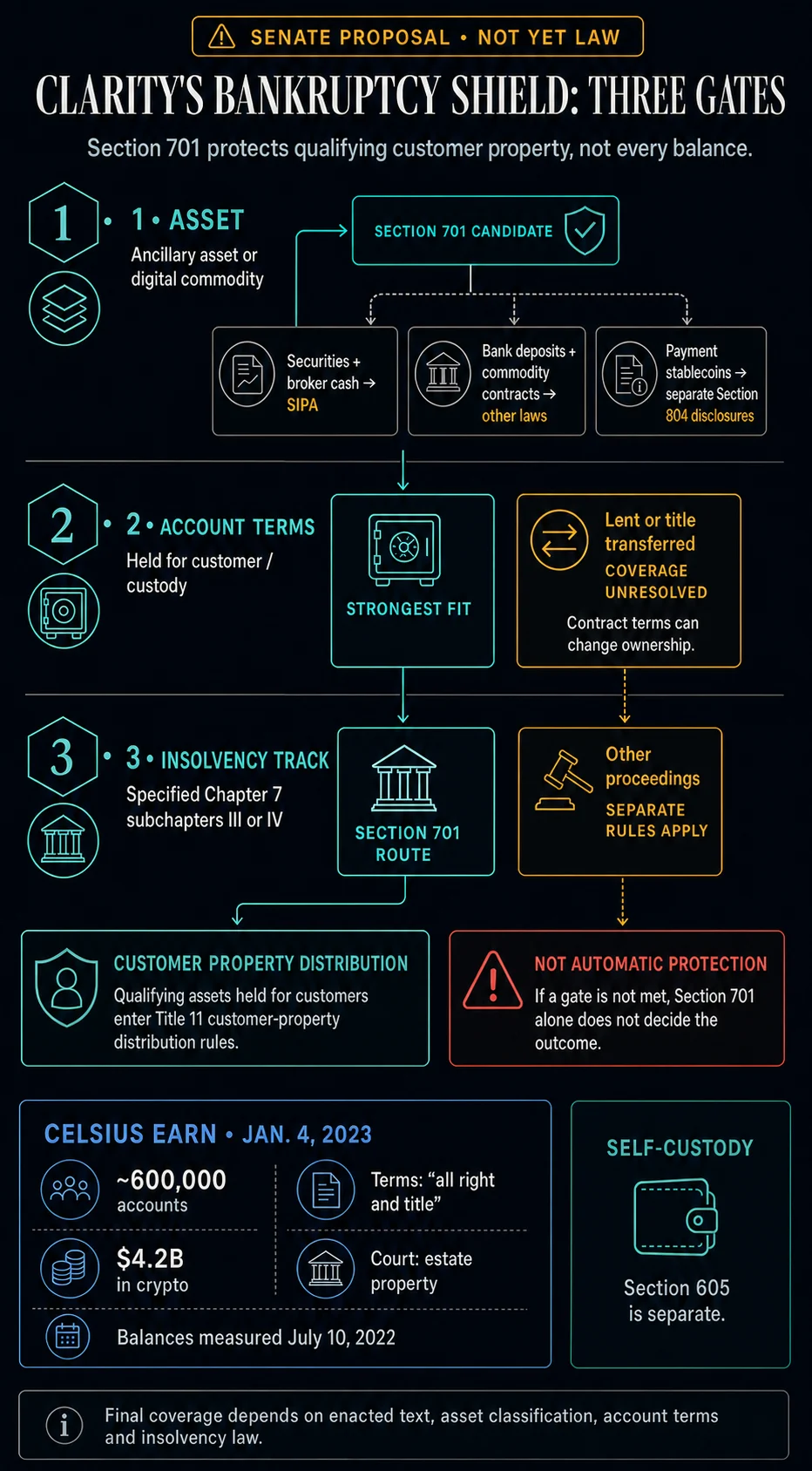
The collapse of prominent cryptocurrency lending platforms like Celsius and Voyager sent shockwaves through the digital asset industry, leaving countless customers to discover a harsh reality: the crypto they believed was theirs was, in fact, part of the bankruptcy estate. This unsettling revelation prompted Senator Cynthia Lummis to introduce the CLARITY Act, a legislative proposal aimed at fundamentally altering the outcome for consumers in such scenarios. With a clear and concise promise, Senator Lummis distilled the act’s core objective into a powerful four-word slogan: "Your crypto stays yours." This declaration, amplified through her X (formerly Twitter) post on July 20th, signaled a determined effort to rectify the perceived injustices experienced by those affected by the failures of Celsius and Voyager, with the Celsius case serving as a particularly potent legal precedent.
The Genesis of the CLARITY Act: Addressing the Celsius and Voyager Debacles
The downfall of Celsius Network, a cryptocurrency lending and investment platform, serves as a stark illustration of the ownership ambiguities that have plagued the crypto industry. In July 2022, Celsius filed for Chapter 11 bankruptcy protection, freezing customer withdrawals and igniting a fierce legal battle over the ownership of assets held on its platform. A subsequent ruling by the U.S. Bankruptcy Court for the Southern District of New York on January 4, 2023, delivered a significant blow to Celsius’s Earn account holders. The court determined that approximately 600,000 Earn accounts, collectively holding around $4.2 billion in crypto as of July 10, 2022, were not the property of the customers but rather belonged to the bankruptcy estate.
This ruling hinged on Celsius’s own terms of service, which the court interpreted as granting the company "all right and title" to the crypto deposited in its Earn program. Consequently, Earn users were relegated to the status of unsecured creditors, their potential recovery dependent on the distribution of assets within the bankruptcy proceedings. The court’s decision highlighted a critical disconnect: while Celsius’s app might have displayed a familiar balance to its users, the underlying legal reality was that they had exchanged ownership of their digital assets for a mere claim against the company. This outcome underscored the urgent need for legislative intervention to clarify ownership rights in the event of crypto platform insolvency.
Voyager Digital, another major player in the crypto lending space, faced a similar fate, filing for bankruptcy in July 2022. The platform’s bankruptcy proceedings also raised significant questions about customer asset ownership, further fueling the demand for regulatory clarity and consumer protection. The CLARITY Act, therefore, emerged as a direct response to these high-profile failures, aiming to prevent a recurrence of such customer losses.
Section 701: Rewriting Bankruptcy Rules for Digital Assets
The legislative centerpiece of Senator Lummis’s proposal, particularly concerning customer asset protection, is Section 701 of the proposed bill. This section aims to amend existing bankruptcy rules governing the liquidation of failed stockbrokers by incorporating ancillary assets and digital commodities into federal customer-property regulations. The proposed changes would mandate that, in specified Chapter 7 liquidations, these assets, when "held for customers," be treated as customer property. This classification would then subject them to the distribution rules outlined in Title 11 of the U.S. Code, effectively prioritizing customer claims over general estate assets.
The official section-by-section summary accompanying the May 12th Senate Banking Committee manager’s substitute bill explicitly states that Section 701 defines ancillary assets and digital commodities as customer property under Chapter 7. However, the operative text of the bill provides the granular details and boundaries that define the scope of this protection.
Key Conditions and Limitations of Section 701
While Section 701 offers a promising framework for protecting customer crypto, its application is contingent upon several critical factors. The protection is not absolute and may not extend to assets, account terms, or bankruptcy processes that fall outside the bill’s defined parameters.
-
Asset Classification: Section 701 specifically names "ancillary assets" and "digital commodities." This distinction is crucial. Assets traditionally held by broker-dealers, such as securities and cash, continue to be governed by the Securities Investor Protection Act (SIPA). Similarly, bank deposits and commodity contracts remain under their respective established legal frameworks. The bill’s intention is to bring a new class of digital assets under customer-protection rules, not to upend existing regulations for traditional financial instruments. Payment stablecoins, for instance, are addressed separately in Section 804, which mandates disclosures regarding their insolvency treatment. This structured approach suggests that Section 701, on its own, may not provide a single, uniform rule for all types of stablecoin balances.

-
The "Held for Customers" Clause: A central tenet of Section 701 is the phrase "held for customers." This language strongly implies a custodial relationship, where the platform acts as a custodian, and the customer retains beneficial ownership. This interpretation naturally aligns with situations where a platform simply holds a qualifying token for a customer. However, the protection becomes more complex when the customer engages in lending or transfers title of their assets to the platform.
-
Contractual Terms and Title Transfer: The distinction between custody and title transfer is paramount and was starkly illustrated by the Celsius case. When an account agreement involves the transfer of title to the platform, or when the platform essentially becomes a borrower of the customer’s assets, the customer’s claim may be reduced to that of an unsecured creditor. The wording of these contracts is therefore critical. If the contract explicitly states that the platform receives ownership of the deposited crypto, as was the case with Celsius’s Earn terms, then the customer might be left with only a claim for repayment, rather than direct ownership of the digital asset itself. The bill leaves this "lending boundary" open for further legislative refinement and judicial interpretation in future cases.
Navigating the Nuances: Custody vs. Lending
The proposed categories under Section 701 generate distinct risk profiles for customer assets, as detailed in the following analysis:
| Account Relationship | Section 701 Relevance | Main Limit |
|---|---|---|
| Qualifying Intermediary Custody | The clearest alignment when an ancillary asset or digital commodity is held for the customer in a covered Chapter 7 liquidation. | The asset, intermediary, and liquidation process must strictly fall within the provision’s definitions and scope. |
| Lending, Earn, or Yield Account | Coverage remains unresolved when the agreement transfers title or designates the platform as a borrower. | Contract language can transform the customer’s balance into an unsecured claim, a situation exemplified by the Celsius bankruptcy. |
| Independently Controlled Self-Custody | Section 605 separately governs this relationship by protecting lawful self-custody for defined covered users. | The provision preserves existing enforcement authorities related to illicit finance, anti-money laundering, terrorism financing, and sanctions. |
| Broker-Dealer Securities or Cash, Bank Deposits, and Commodity Contracts | Section 701 directs these categories to other established legal regimes. | Protection adheres to SIPA, banking law, commodities law, or other applicable regulatory frameworks. |
This table highlights the critical junctures where Section 701’s protections are most robust and where they become more uncertain. For instance, if a platform is merely holding qualifying crypto as a custodian for a customer, Section 701 is designed to place that asset within the customer-property pool during bankruptcy proceedings. However, loans and yield-generating products introduce a layer of complexity. Once a contract facilitates the transfer of ownership to the platform, the ultimate classification of the customer’s asset may necessitate a judicial determination of whether it remains their property or has become merely an IOU.
Self-Custody: A Separate Safeguard
Importantly, Section 701’s focus on intermediary relationships does not diminish the importance of self-custody. Section 605 of the proposed bill addresses this directly, providing separate protection for lawful self-custody arrangements. This section safeguards assets held in self-hosted wallets by defined covered users, while crucially preserving existing enforcement authorities related to illicit finance, anti-money laundering (AML), terrorism financing, and sanctions compliance. The inclusion of Section 605 reinforces the bill’s underlying principle: a clear distinction between assets directly controlled by their owner and those entrusted to a financial intermediary.
The Legislative Journey: From Proposal to Law
The CLARITY Act, encompassing Section 701 and other market structure reforms, has undergone significant legislative progression. On May 14th, the Senate Banking Committee advanced H.R. 3633, the broader legislative package containing the CLARITY Act, through a bipartisan vote of 15-9. This committee passage marked a crucial step, but the bill still requires Senate floor approval and subsequent legislative actions to become law.
As reported by CryptoSlate on July 14th, the comprehensive Senate package remained unfinished, with no floor vote yet scheduled. The customer-property provision, while central to consumer protection, is part of a larger market-structure initiative that also addresses critical issues such as token classification, stablecoin rewards, decentralized finance (DeFi), and banking powers. The full scope and impact of the CLARITY Act will depend on the final form it takes as it navigates the remaining legislative hurdles.
The immediate next step for Section 701 is to retain its current wording as the broader legislative package moves forward. The ultimate practical test, however, will lie in how cryptocurrency platforms adapt their contracts and disclosures. The clarity of whether balances are described as "custody," "lending," or another relationship, and whether platform terms explicitly state that the platform holds the asset for the customer or receives ownership of it, will be crucial in determining the real-world application of the CLARITY Act.
Senator Lummis’s concise promise, "Your crypto stays yours," effectively encapsulates the core intent of Section 701. By designating qualifying ancillary assets and digital commodities held as customer property for distribution under bankruptcy rules, the act aims to provide a much-needed layer of security. However, for balances generated through title-transferring loans or similar arrangements, the legal outcome will remain contingent on a complex interplay of asset classification, contractual terms, and the prevailing insolvency regime. The CLARITY Act represents a significant stride toward a more secure and transparent future for cryptocurrency users, but its full realization will depend on its successful passage and the diligent application of its provisions in practice. The legal battles and customer losses experienced with Celsius and Voyager have laid bare the vulnerabilities, and the CLARITY Act is Senator Lummis’s ambitious attempt to build a more robust safeguard against them.