
 James Watt
Cactus Custody, a prominent institutional digital asset custodian, has announced its full support for Lido V3 stVaults through its proprietary DeFi connector, Cactus Link. This integration marks a significant advancement for institutional participants seeking robust, customizable, and secure avenues into Ethereum liquid staking, enabling Cactus Custody clients to seamlessly create and manage their stVaults directly from their existing custody accounts. The move underscores the growing convergence of traditional institutional financial frameworks with the innovative capabilities of decentralized finance (DeFi), particularly within the burgeoning liquid staking sector.
Immediate Impact and Strategic Significance
The integration is poised to profoundly impact institutional engagement with Ethereum staking. Prior to this development, institutions often grappled with a critical trade-off between maintaining full control over their staking operations—including validator choice and fee structures—and accessing the liquidity inherent in pooled staking solutions. Lido V3 stVaults directly address this dilemma by introducing a single-operator architecture that allows large staking entities, such as investment funds, asset managers, Exchange Traded Funds (ETFs), and Exchange Traded Products (ETPs), to deploy dedicated, customizable vaults. These vaults offer granular control over critical parameters, including validator selection, fee terms, and infrastructure providers, while crucially retaining on-demand liquidity through optional stETH minting.
For Cactus Custody’s diverse clientele—which spans over 400 institutional entities including investment funds, asset managers, exchanges, OTC providers, payment platforms, mining pools, and institutional DeFi participants—this integration means a streamlined, secure, and compliant pathway to participate in one of the most significant and rapidly growing segments of the crypto economy. It builds upon Cactus Custody’s existing support for Lido’s liquid staking tokens, stETH and wstETH, allowing institutions to combine their existing holdings with sophisticated stVault operations and interact with other DeFi protocols accessible via Cactus Link.
A Deep Dive into Lido Protocol and stVaults
Lido Protocol has emerged as a dominant force in the liquid staking landscape, enabling users to stake their Ethereum (ETH) and receive stETH in return, which represents their staked ETH plus accumulated rewards. This innovative mechanism allows users to retain liquidity and participate in other DeFi activities while their ETH is locked in staking. The introduction of Lido V3 and its stVaults represents a significant evolution, specifically tailored to meet the exacting demands of institutional stakers.
The core innovation of stVaults lies in their modular staking infrastructure. Unlike traditional pooled staking, where institutional participants might feel a loss of granular control over their underlying assets and operational parameters, stVaults offer a paradigm shift. They empower stakers to:
- Choose their preferred validator counterparty: This is crucial for institutions with specific compliance requirements or established relationships.
- Define geographic or jurisdictional parameters: Allowing alignment with internal regulatory mandates.
- Configure MEV (Maximal Extractable Value) routing: Optimizing potential returns and aligning with ethical considerations.
- Mandate insurance provisions: Addressing specific risk management policies.
This level of customization is paramount for institutions accustomed to stringent risk management frameworks and operational oversight. It allows them to integrate Ethereum staking into their broader digital asset strategies without compromising on control or security, thereby bridging the gap between decentralized innovation and institutional best practices. The flexibility offered by stVaults directly counters the "control-versus-liquidity" trade-off that has historically hindered broader institutional adoption of staking services.
Cactus Custody: A Profile in Institutional Security and Compliance
Cactus Custody, the institutional digital asset custody solution arm of BIT (formerly Matrixport), has established itself as a leading provider of secure and compliant custody services since its founding in February 2019. Its robust infrastructure is designed to safeguard digital assets across more than 60 blockchain ecosystems, catering to a sophisticated institutional client base.
The platform’s commitment to security and regulatory compliance is evidenced by its comprehensive suite of certifications and licenses:
- Hong Kong Trust or Company Service Provider (TCSP) license: Demonstrating adherence to stringent regulatory standards in a key financial hub.
- Bhutan Gelephu Mindfulness City Authority (GMCA) Financial Services Licence (FSL): Expanding its jurisdictional reach and regulatory footprint.
- SOC 1 Type II and SOC 2 Type II attestations (Deloitte): These independent audits provide assurance regarding the effectiveness of Cactus Custody’s internal controls over financial reporting and security, availability, processing integrity, confidentiality, and privacy. This level of attestation is critical for institutional clients who require demonstrable proof of operational excellence and security.
Cactus Custody’s architecture is built on a hybrid model that combines Hardware Security Module (HSM)-backed cold storage with an institutional Multi-Party Computation (MPC) offering. This dual approach provides clients with a choice between qualified-custodian services—where assets are held by a regulated third party—and self-custody-style configurations, where clients retain greater direct control over their private keys while benefiting from Cactus Custody’s secure infrastructure. This flexibility is vital for institutions with varying internal policies and risk appetites.
The integration of Lido V3 stVaults positions Cactus Custody as one of the few "Qualified Custodians" supporting this advanced staking infrastructure, further solidifying its role as a trusted gateway for institutions navigating the complexities of DeFi.
The Significance of Cactus Link: Bridging Custody and DeFi
A crucial component of this integration is Cactus Link, Cactus Custody’s innovative DeFi connector. Operating as a browser extension, similar to a standard hot wallet, Cactus Link acts as a secure bridge between institutional custody accounts and decentralized applications. This mechanism allows institutions to interact with DeFi protocols without compromising the security or operational controls inherent in their custody solutions.
For institutional clients, Cactus Link streamlines the process of engaging with stVaults. The setup involves a simple two-step connection process:
- Wallet Selection: Choosing Cactus Link as the preferred wallet interface.
- Custodian Account Connection: Authorizing the connection to their Cactus Custody account.
Once connected, vault owners gain the ability to perform a comprehensive range of day-two operations, including supplying or withdrawing ETH, minting or repaying stETH, monitoring vault health, triggering rebalancing or closure procedures, and initiating emergency protocols. This level of operational control, seamlessly integrated with institutional custody, is a game-changer for entities seeking to leverage DeFi while adhering to strict internal governance and security policies. The full setup steps are meticulously detailed in the Cactus Custody user guide, ensuring transparency and ease of adoption for institutional clients. Furthermore, administrators must whitelist specific stVaults smart contract addresses before any interaction, a standard security practice that adds an additional layer of protection.
Inferred Statements and Strategic Perspectives
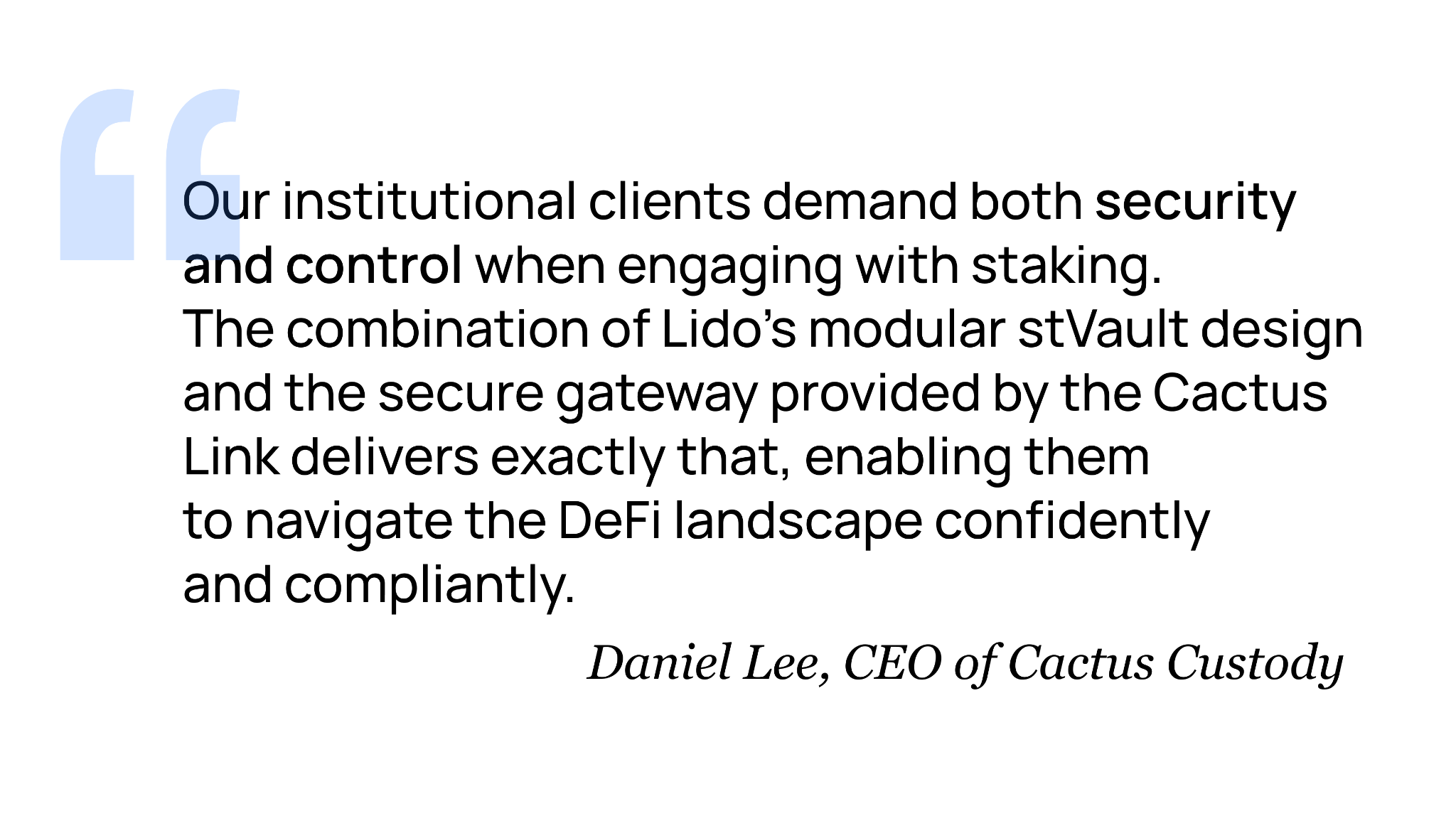
While specific new quotes were not provided in the original content, the strategic implications allow for inferred statements from key stakeholders. A representative from Cactus Custody, building on the initial announcement, might state: "Our integration of Lido V3 stVaults through Cactus Link is a testament to our commitment to providing institutional clients with secure, compliant, and cutting-edge access to the evolving digital asset landscape. We understand the unique needs of institutions for control, liquidity, and robust security, and stVaults perfectly align with these requirements. This partnership reinforces our position as a leading institutional custodian enabling sophisticated DeFi participation, further bridging the gap between traditional finance and the innovative potential of blockchain technology."
Similarly, a spokesperson from Lido Protocol could emphasize: "The collaboration with Cactus Custody is a pivotal moment for institutional adoption of liquid staking. Lido V3 stVaults were designed from the ground up to empower large-scale stakers with unprecedented control and customization. Partnering with a trusted, regulated custodian like Cactus Custody validates our vision and provides institutions with the secure on-ramp they need to confidently engage with Ethereum staking, knowing their assets are protected within a compliant framework." These statements would collectively highlight the mutual benefits and the shared vision for accelerating institutional engagement in DeFi.
Operational Mechanics: How Institutions Engage
The process for institutions to engage with Lido V3 stVaults via Cactus Custody is designed to be as familiar and secure as possible, mirroring traditional financial operations while leveraging blockchain’s advantages.
- Onboarding and Account Setup: Institutions first ensure their Cactus Custody account is fully onboarded and configured. Support may vary by jurisdiction and entity type, necessitating prior confirmation with a Cactus account manager.
- Cactus Link Installation: Clients install the Cactus Link browser extension, which acts as their secure interface.
- Connection and Authorization: The institution connects Cactus Link to their Cactus Custody account, authorizing it to interact with whitelisted smart contracts.
- Whitelisting Smart Contracts: A critical security step involves whitelisting the specific smart contract addresses for Lido V3 stVaults. This ensures that transactions can only occur with approved protocols, mitigating risks from unauthorized interactions.
- Vault Creation and Configuration: Once connected and authorized, vault owners can proceed to create their stVaults, configuring parameters such as validator choice, fee terms, MEV routing, and insurance mandates.
- Ongoing Operations: Post-creation, institutions can perform all necessary day-to-day operations, including depositing or withdrawing ETH, minting or repaying stETH, monitoring vault performance, and initiating rebalancing or emergency procedures.
This structured flow is specifically tailored for vault owners—institutions that wish to directly create and manage their own staking infrastructure.
Security and Risk Management for Institutions
While the integration offers significant benefits, institutions must remain cognizant of the inherent risks associated with Ethereum staking and DeFi. Standard Ethereum staking risks apply, including potential slashing penalties for validator misbehavior, smart contract risks, and market risks associated with stETH price fluctuations. Lido provides a comprehensive "Risk Assessment Framework for stVaults" to guide institutions through these considerations.
To mitigate these risks, several measures have been implemented:
- Audited Smart Contracts: Lido V3 contracts undergo rigorous security audits by independent third parties to identify and rectify vulnerabilities.
- Bug Bounty Programs: Continuous bug bounty programs incentivize security researchers to discover and report potential flaws, enhancing protocol robustness.
- Operational Controls: Strict operational controls are in place for both Lido Protocol and Cactus Custody to minimize human error and unauthorized access.
- Emergency Procedures: Clearly defined emergency procedures within the Lido V3 protocol allow for swift action in unforeseen circumstances, such as critical vulnerabilities or significant market events.
- Custody Gated Actions: Crucially for institutions, on-chain actions through Cactus Link are gated by their existing Cactus Custody policies. This means that multi-signature approvals, spending limits, and other governance controls established within Cactus Custody apply to stVault operations, providing a familiar and secure operational model.
Despite these measures, institutions are advised to conduct their own thorough due diligence on smart-contract, operational, and regulatory risks. Ensuring internal approvals and comprehensive monitoring systems are in place before going live is paramount. The integration significantly reduces operational complexity and enhances security for institutions, but it does not eliminate the need for robust internal risk management frameworks.
Broader Market Implications and Future Outlook
This partnership between Cactus Custody and Lido Protocol represents more than just a product integration; it signifies a maturing landscape for institutional digital asset adoption. The ability to access sophisticated liquid staking solutions within a regulated, secure, and customizable custody environment is a critical step towards mainstream institutional participation in DeFi.
The institutional liquid staking market is projected to grow substantially, driven by the attractive yield opportunities on Ethereum and the increasing comfort of traditional finance with digital assets. By providing a compliant and secure gateway, Cactus Custody and Lido are accelerating this trend, potentially unlocking billions, if not trillions, in institutional capital that has previously been hesitant to enter the decentralized space due to perceived risks and lack of suitable infrastructure.
This development could also spur further innovation among custodians and DeFi protocols, leading to more tailored solutions for institutional clients. It underscores a broader trend where traditional financial infrastructure is adapting to accommodate blockchain technology, moving beyond simple asset storage to enable active, governed participation in decentralized economies. The emphasis on control, customization, and compliance sets a new standard for institutional DeFi offerings, paving the way for ETFs, pension funds, and other large asset managers to integrate digital assets more deeply into their portfolios.
The collaboration highlights the increasing importance of "qualified custodians" in validating and facilitating institutional engagement with complex DeFi primitives. As regulatory clarity continues to evolve globally, partnerships like this will be instrumental in demonstrating the viability and security of digital asset investments to a wider institutional audience. The future of finance increasingly appears to be a hybrid model, where the security and regulatory adherence of traditional institutions merge with the innovation and efficiency of decentralized networks.
For institutions looking to explore these advanced capabilities further, direct engagement with the Lido Institutional team is recommended, allowing for detailed discussions on specific requirements and policy settings. This strategic integration by Cactus Custody and Lido Protocol marks a pivotal moment, ushering in an era of enhanced institutional confidence and participation in the rapidly evolving world of decentralized finance.









