
 James Watt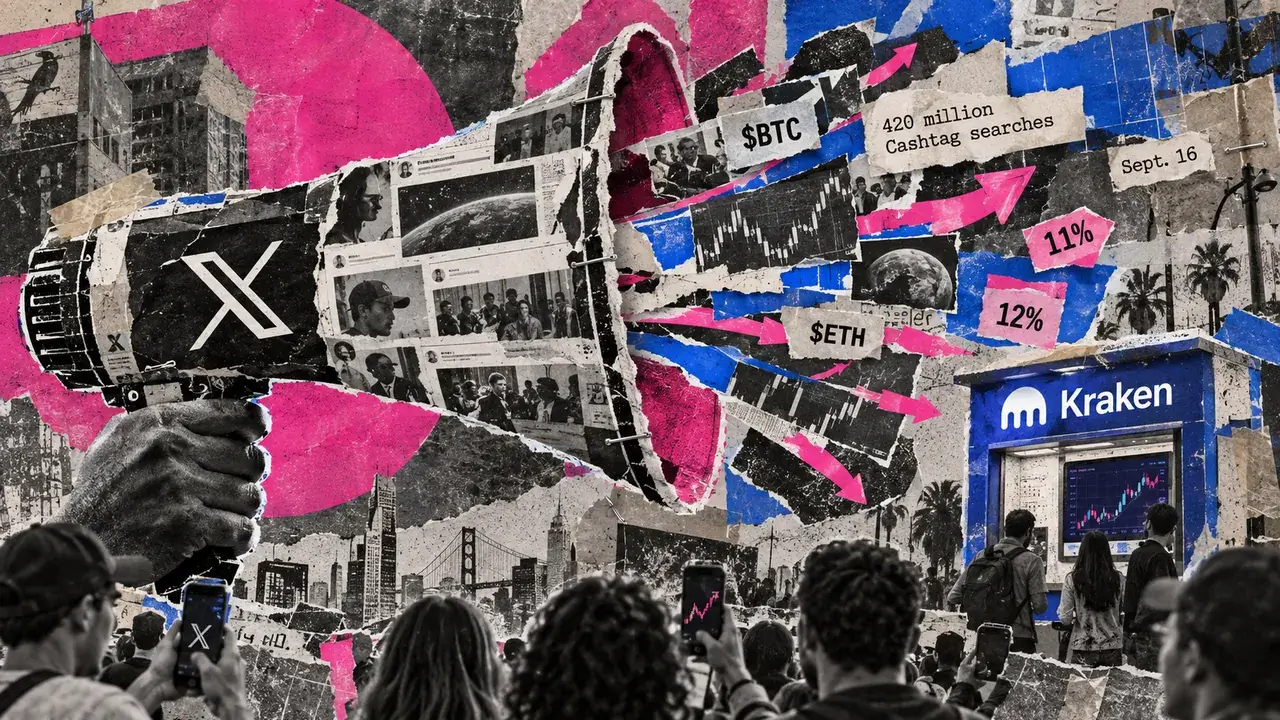
The global cryptocurrency exchange Kraken officially joined the United States Cashtag partner program on the social media platform X, formerly known as Twitter, on September 16, 2024. This integration allows users to transition directly from financial discussions and market tickers on the social media platform to the exchange’s trading interface. By tapping a Cashtag—a ticker symbol preceded by a dollar sign, such as $BTC or $ETH—users are presented with real-time price charts and a direct link to Kraken’s website or mobile application to facilitate immediate asset acquisition.
This partnership represents a significant step in the ongoing evolution of X into an "everything app," a vision championed by its owner, Elon Musk. While X does not function as the exchange itself, it is increasingly serving as the primary discovery layer for financial assets. The trade execution remains within Kraken’s regulated environment, but the distance between an investor’s initial interest and the final transaction has been dramatically shortened. This move highlights a broader industry trend where financial services are being embedded into the digital environments where users already spend their time.
The Evolution and Utility of the Cashtag
The concept of the Cashtag originated in 2012 when Twitter first formalized the use of ticker symbols as clickable links. Originally designed to help users aggregate financial news and discussions, the feature has evolved from a simple search tool into a high-value entry point for brokerage firms and digital asset exchanges. In early 2023, the social media platform expanded the utility of Cashtags by partnering with the multi-asset investment platform eToro. During the first three months of that year, eToro reported that there were more than 420 million searches for Cashtags on the platform, underscoring the massive volume of financial intent present within the X ecosystem.
For an exchange like Kraken, the value of these searches lies in the "high-intent" nature of the audience. Unlike traditional display advertising, which must capture the attention of passive users and convince them to care about a product, Cashtag traffic consists of users who are already actively researching a specific asset. They are often reading market analysis, following real-time price action, or participating in community discussions. By placing a "Trade" link at this specific moment in the user journey, Kraken is positioning itself to capture investors at the peak of their interest.
Technical Integration and User Experience
The technical implementation of the Kraken-X partnership focuses on reducing "friction"—the series of steps and potential hurdles an investor must navigate to complete a purchase. In the traditional crypto-adoption model, the path to investment was often fragmented. A user might discover a new token on X, leave the app to search for its current price on a third-party aggregator, research which exchanges list the token, download a new application, complete a multi-step registration process, fund the account, and finally execute the trade.
The Cashtag integration compresses this timeline. When a user clicks on a ticker like $BTC, X displays a price chart powered by TradingView. Alongside this data, a prominent link directs the user to Kraken. If the user already has the Kraken app installed and is logged in, the transition is nearly seamless. If they are a new user, the link serves as a direct referral to the registration page. This streamlined workflow is designed to prevent "drop-offs," where potential investors abandon the process due to technical complexity or the time required to switch between multiple platforms.
Kraken’s announcement characterized the deal as a way to become "easier to find inside applications people already use." This strategy acknowledges that the competitive landscape for crypto exchanges is shifting. While competitive trading fees, deep liquidity, and robust security remain essential, they are no longer the sole determinants of market share. Distribution—the ability to be present at the exact moment a consumer decides to buy—is becoming the new front line in the battle for retail investors.
The Role of "Crypto Twitter" in Financial Markets
The partnership leverages the unique cultural position of "Crypto Twitter," a subset of the platform where developers, venture capitalists, retail traders, and enthusiasts converge. Crypto Twitter has historically acted as a real-time news wire and sentiment gauge for the digital asset industry. Market-moving events, from protocol hacks to major institutional adoptions, often break on X before reaching mainstream financial news outlets.
Because crypto assets are often driven by social sentiment and community engagement, the proximity of the social feed to the trading desk is particularly impactful. Memes, viral threads, and "influencer" endorsements frequently precede significant price volatility. By formalizing the link between the conversation and the transaction, Kraken and X are acknowledging that for many investors, social media is not just a place to talk about finance—it is the interface through which they experience finance.
Behavioral Implications and Regulatory Oversight
The convergence of social media and financial execution has drawn the attention of behavioral economists and regulators. Research suggests that the design of financial interfaces can significantly influence investor behavior, sometimes encouraging higher turnover or increased risk-taking. In a 2024 experiment involving over 9,000 consumers, the United Kingdom’s Financial Conduct Authority (FCA) found that specific app-design features, such as push notifications and "gamified" elements like points or prize draws, could increase trading frequency by 11% to 12%.
While the X-Kraken integration is a referral system rather than a gamified trading app, it nonetheless alters the "choice architecture" of the investor. By making the transition to a trade faster and more convenient, the platform may reduce the "cooling-off" period that naturally occurs when a user has to navigate multiple steps. On X, an investor may be exposed to a "bullish" thread or a trending topic that creates a sense of urgency (often referred to in the industry as FOMO, or "fear of missing out"). When a trading link is immediately accessible, the impulse to buy can be acted upon before the user has performed independent due diligence.
Regulators in various jurisdictions have expressed concern over "finfluencers" and the potential for social media to facilitate market manipulation or the promotion of high-risk assets to unsophisticated investors. While Kraken is a regulated entity that performs Know Your Customer (KYC) and Anti-Money Laundering (AML) checks, the source of the investment "idea" remains the unregulated social feed.
Market Context and Competitive Strategy
Kraken’s decision to join the Cashtag program comes at a time of intensifying competition among global exchanges. Following the collapse of FTX in 2022, the remaining major players—including Coinbase, Binance, and Kraken—have been vying for the trust and deposits of retail and institutional users. Coinbase has focused heavily on regulatory compliance and its "Base" Layer 2 network, while Binance continues to leverage its massive global footprint.
Kraken, founded in 2011, has traditionally positioned itself as a platform for more experienced traders, emphasizing security and a wide array of listed assets. However, the X integration signals a push toward broader retail accessibility. By embedding itself into X, Kraken is attempting to capture the "next wave" of crypto adopters who may not be looking for a professional-grade trading terminal, but rather a simple way to gain exposure to the assets they see trending online.
Furthermore, this partnership aligns with X’s broader financial ambitions. Since acquiring the platform, Elon Musk has frequently discussed transforming X into a global marketplace and payment processor. Integrating with established financial players like eToro and Kraken allows X to build out its financial ecosystem without the immediate need to secure its own banking or exchange licenses in every jurisdiction—a process that is both time-consuming and subject to intense regulatory scrutiny.
The Future of Embedded Finance
The Kraken-X partnership is a prominent example of "embedded finance," a trend where financial services are integrated into non-financial platforms. This shift suggests a future where people do not necessarily visit a bank or an exchange as a destination. Instead, financial transactions become a native feature of the digital environments where people socialize, work, and consume media.
For the cryptocurrency industry, which has long struggled with user experience and technical barriers to entry, this integration could be a major catalyst for mainstream adoption. If the "boundary between media and financial distribution" continues to thin, the process of becoming a crypto investor will look less like a deliberate lifestyle change and more like an extension of ordinary internet usage.
However, the long-term success of such integrations will depend on how well they balance convenience with consumer protection. As the "feed" carries more weight in financial decision-making, the responsibility of the exchange to provide clear disclosures and risk warnings becomes even more critical. For now, the message from Kraken and X is clear: the era of the isolated trading platform is ending, and the era of the integrated financial social network has begun. Crypto Twitter spent a decade telling its audience what to buy; it is now providing the direct route to the checkout.









