
 James Watt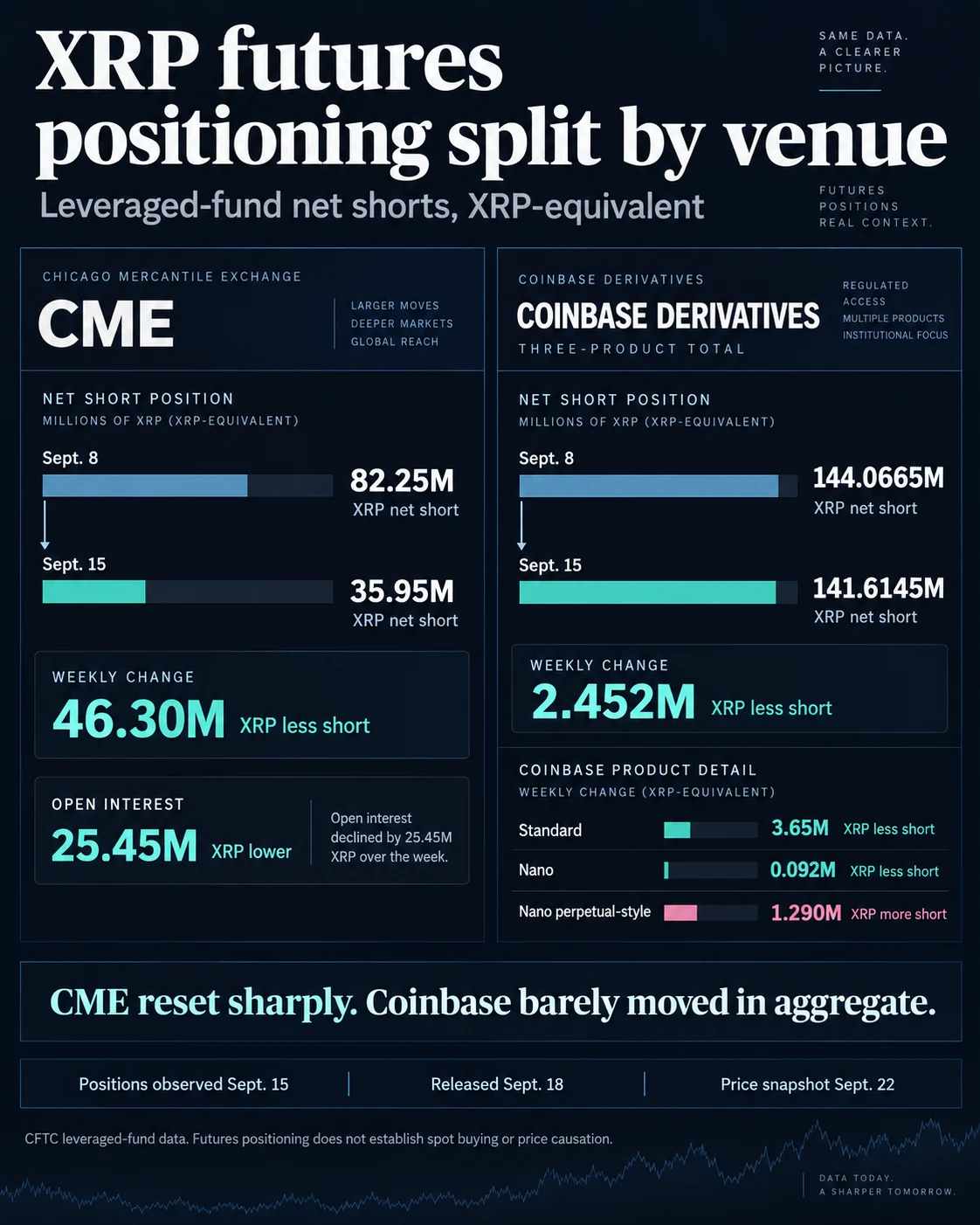
The digital asset market witnessed a significant period of volatility and repositioning during the mid-September window, culminating in XRP reaching an intraday high of $1.60 on September 22. This price action, supported by a robust 24-hour reported volume of approximately $7.4 billion, occurred against a backdrop of shifting institutional sentiment. However, a granular analysis of regulated futures data reveals a stark divergence in how professional traders approached the asset across different venues. While participants on the Chicago Mercantile Exchange (CME) aggressively reduced their bearish exposure, those utilizing Coinbase Derivatives maintained a largely static, short-leaning posture, suggesting a fragmented landscape of institutional strategies.
The primary source of this insight is the Commodity Futures Trading Commission’s (CFTC) Commitment of Traders (COT) report. The snapshot taken on September 15, and subsequently released on September 18, provides a critical window into the behavior of "leveraged funds"—a category typically comprising hedge funds and commodity trading advisors. During the week leading up to September 15, these funds executed a massive reduction in their net short positions on the CME, a move that predated the price surge of September 22. In contrast, data from Coinbase Derivatives indicated a much more cautious or entrenched positioning, raising questions about the drivers behind these differing institutional outlooks.
The CME Pivot: A Concentrated Shift in Sentiment
The CME’s XRP futures market, where each standard contract represents 50,000 XRP, served as the primary theater for a major positioning reset. According to the CFTC data for the week ending September 15, leveraged funds held 1,585 long contracts and 2,304 short contracts. This resulted in a net short position of 719 contracts, the equivalent of 35.95 million XRP.
To understand the magnitude of this shift, one must look at the figures from the preceding week. On September 8, the same group of traders held a significantly more bearish stance, with 1,280 longs against 2,925 shorts, resulting in a net short of 1,645 contracts, or 82.25 million XRP. The week-over-week change represents a reduction in net short exposure of 926 contracts, or 46.3 million XRP.
This reduction was not merely the result of traders closing out losing bets. The data shows a two-pronged adjustment: long positions increased by 305 contracts, while short positions were slashed by 621 contracts. While the reduction in shorts was the primary driver of the improving sentiment, the addition of new long exposure suggests that at least a portion of the institutional cohort was beginning to position for upside potential. Simultaneously, total open interest on the CME fell by 509 contracts (25.45 million XRP), indicating that the dominant trend was the closing of existing positions, likely as traders sought to realize profits or mitigate risks ahead of the anticipated volatility.
Coinbase Derivatives: An Entrenched Short Bias
In sharp contrast to the activity on the CME, Coinbase Derivatives saw only marginal changes in institutional positioning. Coinbase offers a more varied suite of products, including a standard future (10,000 XRP per contract), a "Nano" XRP future (500 XRP per contract), and a "Nano XRP Perpetual-Style" future (500 XRP per contract).
When these products are aggregated and adjusted for their respective contract sizes, the total net short position held by leveraged funds on Coinbase fell by only 2.452 million XRP over the same period. As of September 15, these traders remained net short by a substantial 141.6 million XRP across the three Coinbase products.
The breakdown of Coinbase’s figures reveals internal contradictions:
- Standard Futures: Leveraged funds reduced their net short by 3.65 million XRP, moving from a 132.17 million XRP net short to 128.52 million.
- Nano Futures: A minor reduction of 92,000 XRP was observed.
- Nano Perpetual-Style Futures: Conversely, traders actually increased their bearish exposure here, becoming 1.29 million XRP more net short.
This discrepancy highlights a significant disconnect. By September 15, the aggregate net short position on Coinbase was nearly four times larger than that on the CME. Furthermore, the rate of change on the CME was nearly twenty times greater than that on Coinbase. Such a divergence suggests that the participants on these two venues may be pursuing fundamentally different objectives, such as different types of arbitrage or hedging against varying spot market exposures.

Chronology of Market Events and Reporting Lags
To accurately interpret these findings, it is essential to establish the timeline of the data relative to XRP’s price performance. The CFTC’s reporting cycle involves a "Tuesday snapshot" that is typically released on the following Friday.
- September 8: Leveraged funds maintain a heavy net short on both CME and Coinbase.
- September 15: The "Snapshot Date." CME funds have already significantly reduced their shorts, while Coinbase funds remain heavily short.
- September 18: The CFTC releases the September 15 data to the public.
- September 22: XRP hits an intraday high of $1.60 with $7.4 billion in volume.
- September 25: The tentative date for the release of the September 22 snapshot.
The fact that the CME repositioning occurred a full week before the $1.60 price peak suggests that institutional "smart money" may have been anticipating a move or reacting to early signals that had not yet manifested in the spot price. However, the lack of a similar move on Coinbase prevents a definitive conclusion that a market-wide bullish consensus had formed.
Understanding the "Leveraged Funds" Category and Market Motives
The CFTC defines "leveraged funds" as those predominantly engaged in managing money on behalf of clients, including hedge funds and various types of investment advisors. While a "net short" position is often interpreted as a bearish bet, the reality in derivatives markets is frequently more nuanced. Professional traders use short positions for several strategic purposes:
- Directional Bearish Bets: A straightforward wager that the price of XRP will decline.
- Basis Trading: A common institutional strategy where a trader buys the underlying asset (spot XRP) and sells the future to capture the "basis"—the price difference between the two. This is a market-neutral strategy that appears as a short in CFTC reports.
- Hedging: Large holders of XRP may sell futures to protect the value of their portfolios against downside risk.
- Relative Value Trades: Selling XRP futures against a long position in another digital asset, such as Bitcoin or Ethereum, to bet on the relative performance of the assets.
The decline in open interest on the CME alongside the reduction in net shorts suggests an "unwinding" of positions. If many of these traders were involved in basis trades, the closing of shorts would coincide with the selling of spot XRP, which generally does not drive prices higher. The fact that the price surged shortly thereafter suggests that the reduction in shorts was likely driven by a genuine shift in sentiment or the closing of hedges in anticipation of a breakout.
The Significance of Regulated Perpetual-Style Futures
One of the more unique elements of this data set is the performance of Coinbase’s "Nano XRP Perpetual-Style" future. Unlike the perpetual swaps found on unregulated offshore exchanges, which have no expiry, this is a regulated, five-year cash-settled contract that utilizes funding adjustments to stay aligned with the spot price.
The increase in short positioning in this specific product—rising by 1.29 million XRP—suggests that a subset of traders was actively betting against the rally or using this specific instrument for sophisticated hedging. Because these contracts are structurally different from standard futures, they often attract a different demographic of traders, including retail-oriented algorithmic funds that may operate on different timeframes than the larger institutional players on the CME.
Broader Implications and Future Outlook
The divergence between CME and Coinbase data serves as a cautionary tale for analysts who rely on a single data source to gauge market sentiment. The massive reset on the CME could be viewed as a leading indicator of the September 22 rally, yet the stagnant positioning on Coinbase suggests that a significant portion of the professional market remained skeptical or was locked into long-term strategies that were not easily swayed by short-term price action.
For the market to confirm a sustainable bullish trend, observers will look for a "convergence" in the data. If the upcoming CFTC reports show that Coinbase’s net short position has also begun to decline materially, it would signal a broader, more unified institutional pivot toward XRP. Conversely, if Coinbase remains heavily short while the price continues to fluctuate, it would indicate that the market remains deeply divided.
As the industry moves toward the next reporting cycle, the focus will remain on whether the $1.60 high was a momentary peak driven by short covering or the beginning of a new phase of institutional accumulation. For now, the data confirms that while XRP found a way to rally, the institutional path toward that rally was anything but uniform. The signal lies in the divergence: a concentrated reset in one venue, a stubborn holding pattern in another, and a price that ultimately defied the aggregate bearishness of the reporting period.









