
 admin
admin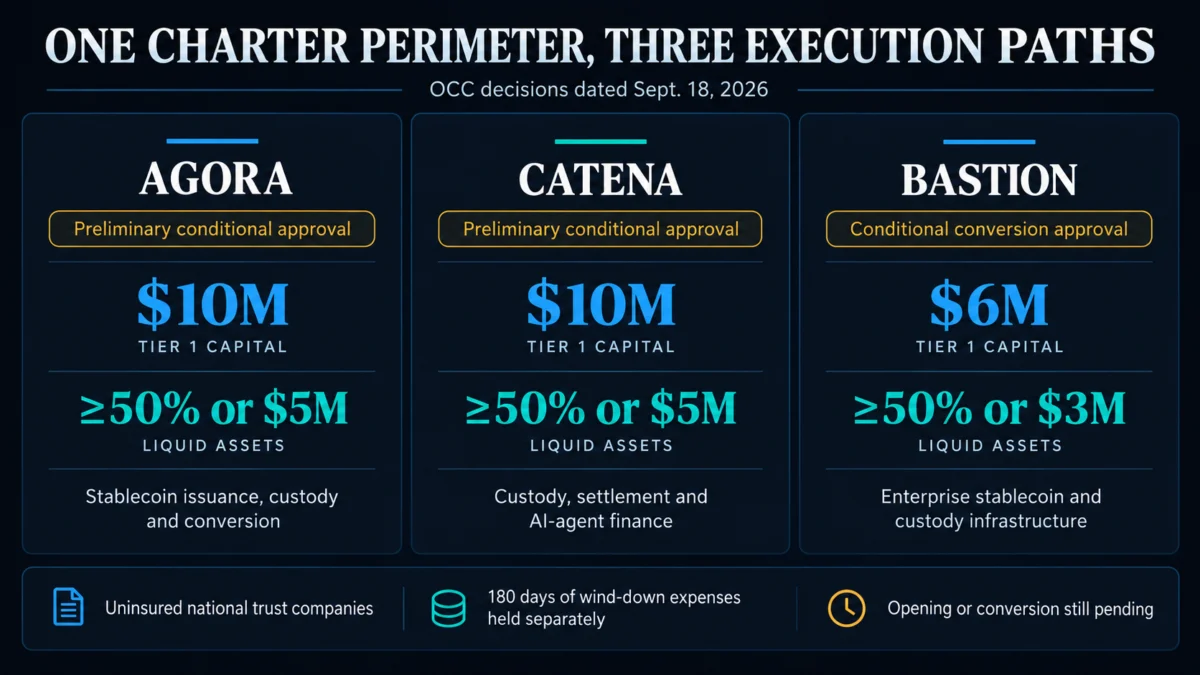
On September 18, the Office of the Comptroller of the Currency (OCC) marked a significant stride in the evolving landscape of digital asset regulation by granting preliminary conditional approval to three stablecoin-focused firms—Agora, Catena, and Bastion—for federal trust-bank status. These decisions, underpinned by a consistent regulatory framework, signal the OCC’s commitment to establishing a predictable and repeatable pathway for the chartering of narrow, uninsured trust banks. While this move offers a clearer route for such institutions, it also highlights the inherent execution and legal risks that remain. Agora and Catena are still awaiting final approval before commencing operations, Bastion must complete its conversion process, proposed stablecoin regulations are yet to be finalized, and state supervisors continue to express reservations regarding the OCC’s expansive regulatory approach.
The competitive implications of these approvals are substantial. Achieving federal trust status can streamline regulatory oversight by consolidating related services under a single federal supervisor and mitigating regulatory fragmentation. However, the repeated issuance of conditional approvals suggests that the federal charter itself may not be an insurmountable competitive moat. The ultimate success of these firms will hinge on their ability to navigate the more challenging tests of final approval, secure robust distribution channels, meet stringent capital and reserve requirements, and demonstrate consistent operational performance.
OCC’s Approval Framework: A Closer Look
The OCC’s recent actions involve distinct but coordinated approaches for each of the three firms. The decisions concerning Agora and Catena grant preliminary conditional approval for them to establish de novo national trust banks. This means both entities are currently in the organizational phase and must complete a series of pre-opening requirements before the OCC will issue final approval and grant permission to commence business operations.
In contrast, Bastion is pursuing a conversion rather than a de novo charter. Bastion Platforms Trust Company already operates under a New York state trust charter. The OCC’s conditional approval allows for its conversion into Bastion Platforms National Trust Company, contingent upon the fulfillment of specific conditions and acknowledgment of conversion completion before it can operate under the national charter.
This distinction is crucial as it differentiates between the establishment of entirely new federal institutions (Agora and Catena) and the transition of an existing state-regulated entity to the federal level (Bastion). The official documentation released by the OCC does not provide firm opening dates for any of these three companies.
Both Agora and Catena are mandated to notify OCC chartering staff in writing at least 60 days prior to their scheduled opening. Their preliminary approvals carry expiration dates: they will be invalidated if the firms fail to raise the required capital within 12 months or commence operations within 18 months. Bastion’s approval will automatically terminate if its conversion is not completed within six months, unless the OCC grants an extension under extenuating circumstances.
Across all three decisions, the OCC has applied a common framework for trust companies, rather than granting identical business permissions. Each institution is required to confine its operations strictly to trust-company activities and related services. Furthermore, they must operate in a manner that ensures they do not fall within the definition of a "bank" as defined by the Bank Holding Company Act.
The institutions emerging from these approvals are not conventional, insured commercial banks. The OCC’s decision for Bastion explicitly states that it will not accept deposits and will not be insured by the Federal Deposit Insurance Corporation (FDIC). Similarly, Agora’s submission indicates that its proposed bank will not be an insured depository institution. Catena’s approval treats its institution as an uninsured national bank, with the OCC clarifying that payment stablecoins are not considered deposits and cannot be presented as FDIC-insured.
Capital and Liquidity Requirements: A Tailored Approach
The capital requirements underscore both a shared foundational architecture and applicant-specific calibrations. Agora and Catena are each required to maintain a minimum of $10 million in Tier 1 capital. Additionally, they must hold liquid assets equivalent to the greater of 50% of their Tier 1 capital or $5 million. Bastion, on the other hand, must maintain at least $6 million in Tier 1 capital, with liquid assets totaling the greater of 50% of Tier 1 capital or $3 million. All three institutions are obligated to reassess their capital and liquidity positions quarterly and to augment these holdings if their risk profiles necessitate it.
A separate, overarching condition mandates that all three firms maintain eligible liquid assets equivalent to 180 days of fixed and variable operating expenses applicable to a distressed wind-down. These assets cannot be concurrently counted towards the liquidity supporting the capital condition. This requirement is in effect for the initial three years of operation under their respective federal charters.
| Applicant | OCC Action | Capital and Liquidity Floor | Proposed Focus | Status in Cited Materials |
|---|---|---|---|---|
| Agora | Preliminary conditional approval for a new national trust bank | $10 million Tier 1; greater of 50% or $5 million liquid | Stablecoin issuance and reserves, custody, payments, and advisory services | Final approval pending; no firm opening date stated |
| Catena | Preliminary conditional approval for a new national trust bank | $10 million Tier 1; greater of 50% or $5 million liquid | Custody, trust and investment management, plus linked conversion, clearing, and execution | Final approval pending; no firm opening date stated |
| Bastion | Conditional approval to convert a New York trust company | $6 million Tier 1; greater of 50% or $3 million liquid | Custodial wallets, conversion, white-label issuance, and issuer services | Conversion completion pending; no firm opening date stated |
The OCC also imposes a requirement for advance notice and a written determination of no objection before any significant alterations to each firm’s business plan can be implemented. Essential work in compliance, audit, information security, and governance remains a critical component of the path to opening or completing conversion.
The OCC’s Repeatable Chartering Framework
The September 18 decisions are not isolated events but rather fit within a broader pattern of the OCC’s engagement with digital asset firms seeking federal charters. The OCC’s comprehensive decision index meticulously records numerous actions related to digital asset trust banks, involving entities such as Bridge, Foris DAX, Coinbase, Laser Digital, Wise, and World Liberty, among others. Furthermore, the agency’s dedicated page for digital asset licensing applications reveals a substantial pipeline of additional prospective applicants.
In August, Comptroller Jonathan Gould reported that approximately 23 out of 40 new charter applications received over the preceding 18 months were related to digital assets. While this high volume does not guarantee final approval for any single applicant, it strongly indicates that the trio approved on September 18 represents a cohort of firms pursuing similar regulatory goals, rather than an isolated experimental endeavor.

The OCC’s 2026 trust bank rule, which became effective on April 1, further clarified the permissible activities for national trust banks. It explicitly states that these banks may engage in permissible non-fiduciary activities alongside their fiduciary services. Although the OCC continues to assess the statutory authority for proposed activities on a case-by-case basis, this established framework provides a recognizable pathway, even as individual decisions are applicant-specific.
The proposed rules implementing the GENIUS Act, which were still in proposed status as of September 22, point toward the potential for more standardized reserve, capital, and liquidity expectations for federal stablecoin issuers. These proposed rules outline a possible standardized federal regulatory layer rather than a fully operational regime.
The legal underpinnings of the OCC’s approach also remain a subject of contention. The Conference of State Bank Supervisors (CSBS) has formally challenged the breadth of the OCC’s trust charter and preemption strategy. The CSBS has indicated that it might pursue future litigation if state authorities conclude that these charters exceed the limits established by the National Bank Act. While this statement does not represent a filed lawsuit, it underscores why a repeatable administrative process should not be conflated with settled legal precedent.
The overarching thesis is comparative: the three recent decisions reinforce core regulatory boundaries, fundamental capital concepts, wind-down liquidity requirements, supervisory oversight protocols, and pre-opening controls. The growing body of OCC decisions and the active application pipeline demonstrate the agency’s consistent application of this framework to an increasing number of firms. While obtaining a federal trust charter remains an arduous and costly undertaking, the scope of permissible activities is increasingly coalescing into an infrastructure that multiple qualified applicants can pursue.
This standardized perimeter, however, leaves ample room for diverse business models and strategic approaches among applicants.
Diverse Business Models Within a Common Framework
Agora intends to integrate dollar-backed stablecoin issuance and reserve management with digital asset custody, custody-linked payments and settlement services, and fiduciary investment advice tailored for institutional and business custody clients. The OCC decision notes that Agora plans to transfer the issuance of its stablecoin, AUSD, from Agora Bermuda to the new national bank only after the bank is fully established. This transition would involve the transfer of underlying assets and accounts, with the bank assuming responsibility for reserve assets and associated liabilities. As of September 22, Agora’s AUSD product page still listed Agora Bermuda as the issuer, and the page details reserve management, custody, and partner relationships that define Agora’s distribution strategy. Agora’s own announcement confirms that final approval is still pending.
Catena is targeting a different client segment with its proposed bank. Its approved business plan encompasses fiduciary and non-fiduciary custody services, fiduciary investment management, and trust services. Additionally, it will offer non-fiduciary conversion, clearing, and execution services linked to assets held within these relationships. Catena’s company announcement positions its technological stack as particularly relevant for AI agents and the businesses deploying them. This AI focus represents Catena’s strategic differentiation rather than a characterization by the OCC.
Bastion’s model is centered on providing enterprise-level infrastructure. The approved conversion perimeter includes fiduciary custodial wallets, conversion services for custody clients, white-label stablecoin issuance capabilities, and technology and operational services for other authorized issuers. Bastion indicates that enterprise clients will be able to leverage its custody, payment, and issuance tools, while third-party firms can maintain their role as issuers of record. The company’s announcement describes the federal conversion as a means to consolidate capabilities currently delivered through its existing state trust charter, other licenses, and various partnerships.
These distinct business models highlight the remaining sources of competitive advantage. While a federal charter can confer national regulatory reach and consolidate supervisory oversight, it does not inherently guarantee customer acquisition, liquidity provision, strong reserve partnerships, successful enterprise integrations, or a smooth launch.
Previous analysis by CryptoSlate has explored the potential scarcity of federal trust charters as strategic assets. Coverage of Agora’s prior pending application and the emergence of "narrow crypto banks" emphasized both the advantages of national reach and the inherent limitations of these structures. A separate examination of the potential competitive effects of the GENIUS Act suggested that early access to federal charters could disproportionately benefit well-capitalized issuers.
The evidence presented by the three decisions on September 18 narrows the scarcity argument. The simultaneous approvals share a recognizable regulatory perimeter, a consistent supervisory architecture, and clearly defined pathways toward operational commencement or conversion completion. Crucially, they also preserve distinctions in capital calibration, target customer bases, and overall business models.
The critical factor moving forward is execution. Agora and Catena must successfully transition their preliminary approvals into the authority to open for business. Bastion faces the task of completing its conversion process. All three firms will be required to maintain robust capital levels and wind-down liquidity while simultaneously persuading potential customers that their specific combination of custody, issuance, settlement, and control services offers compelling value.
In this competitive landscape, the federal trust charter remains a valuable asset. However, its role is increasingly evolving into an entry requirement, with durable competitive moats needing to be constructed through effective distribution strategies, reliable liquidity management, and flawless execution.








