
 admin
admin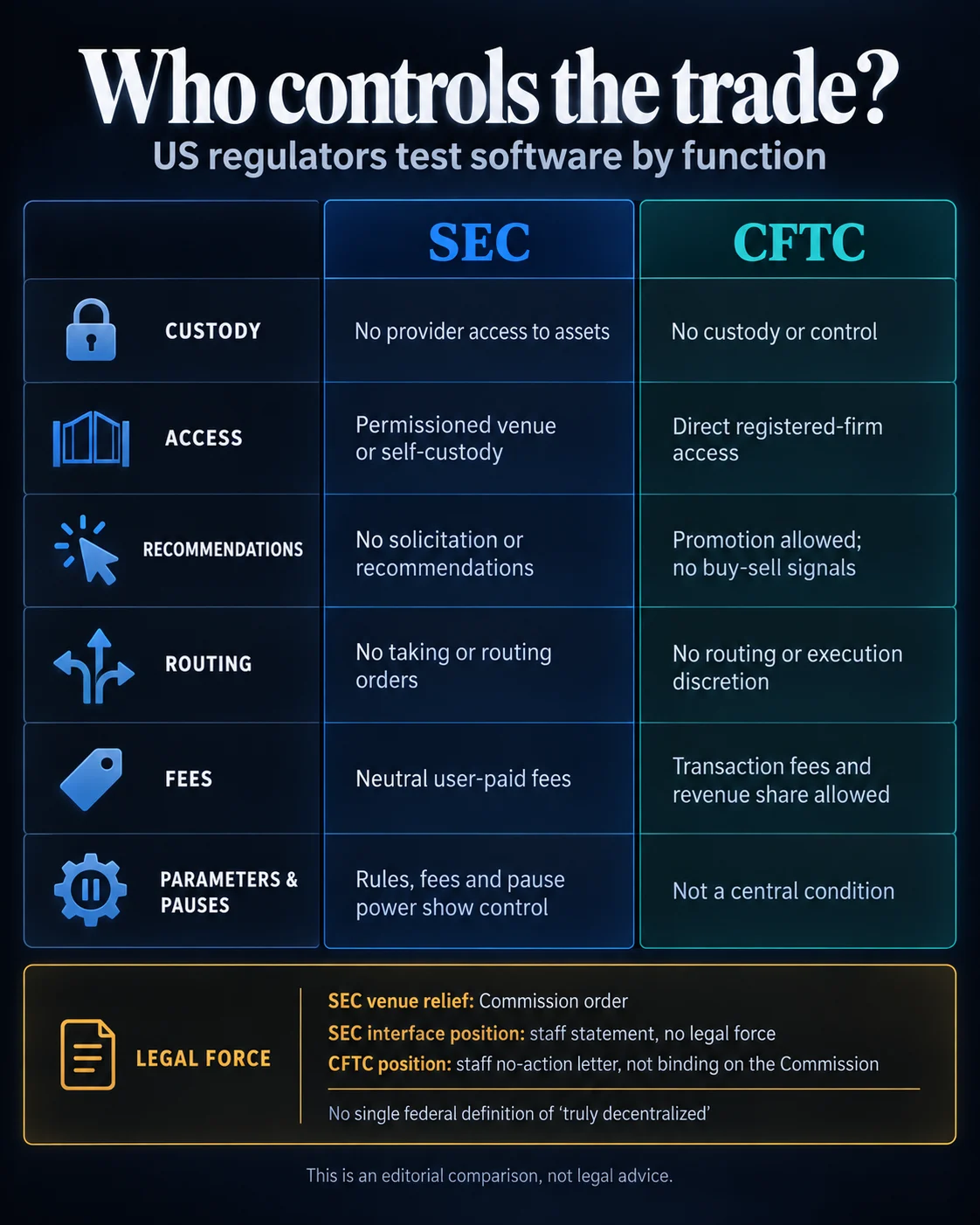
Securities and Exchange Commission (SEC) Commissioner Hester Peirce, often referred to as "Crypto Mom" for her generally more favorable stance on digital assets, articulated a clear boundary for decentralized finance (DeFi) on September 17th. In a statement that has sent ripples through the blockchain and cryptocurrency industries, Peirce asserted that investors should not require regulatory exemption to utilize permissionless smart contracts for peer-to-peer trading. This stance, however, exists in contrast to recent actions by both the SEC and the Commodity Futures Trading Commission (CFTC), which collectively appear to be drawing distinct lines around the extent of intermediary control permissible within evolving financial technologies. The central, unresolved question that looms large over the sector is precisely how much control a software provider can retain before its operations begin to functionally resemble a regulated financial intermediary, thereby triggering existing regulatory frameworks.
Peirce’s statement, published on the SEC’s official website, explicitly outlined her personal position. A binding definition or a formal regulatory framework from the SEC, she emphasized, would necessitate a vote and action by the full Commission. The SEC’s recent order concerning tokenized securities, alongside a separate staff statement on broker-dealer registration for user interfaces, leaves the critical phrase "truly decentralized" undefined. While these official pronouncements focus on specific operational aspects such as custody, access controls, software parameters, fee structures, recommendation protocols, and routing and execution mechanisms, they do not offer a universal definition of decentralization. Each of these regulatory actions operates under different statutory authorities and carries distinct legal implications. Taken together, however, they illuminate the growing efforts by federal regulators to scrutinize the degree of authority retained by identifiable providers in the digital asset space, even as a unified federal test for decentralization remains conspicuously absent.
The SEC’s Expanding Reach: Tracing Control from the Market to the Frontend
The SEC’s September 17th tokenized-securities order, a formal Commission action, provides temporary, conditional relief for a specifically defined Tokenized Securities Venue (TSV). This relief permits the use of automated market maker (AMM) pools for permissioned trading of Tokenized NMS Stocks. Under the terms of this order, a TSV is functionally defined by two core activities: it must provide one or more AMM pools for participants who have been granted permission to trade, and it must establish and enforce the standards that govern access to these pools.
The SEC’s interpretation of "provides" in this context is functional, meaning that the act of selecting and designating a specific AMM pool can be considered a form of provision. Furthermore, deploying a pool’s trading contract, modifying its operational rules or parameters, setting its associated fees, or retaining the authority to temporarily pause trading activities can all contribute to establishing a provider’s control or provision. Conversely, the order clarifies that the mere administrative task of encoding a pre-existing whitelist of authorized participants would fall outside this definition of control. This nuanced distinction highlights the SEC’s focus on active decision-making and operational oversight.
The automation inherent in smart contracts does not entirely remove human agency from financial transactions. Individuals may still be responsible for crucial decisions, such as selecting the trading venue, determining fee structures, initiating pauses in trading activity, or granting access to specific users. Commissioner Peirce strategically placed this particular order outside the realm of what she considers decentralized finance, describing genuinely permissionless software as a fundamentally different model. The permissioned venue, as illustrated by the TSV order, serves as a practical example of why operational powers remain significant even when smart contracts are executing the trades themselves.
Adding another layer to the SEC’s regulatory analysis is the role of the user interface, which can introduce an additional dimension of control. An April statement from the SEC’s Division of Trading and Markets addresses the circumstances under which staff would refrain from objecting to certain crypto asset securities interface providers operating without formal broker-dealer registration under Section 15 of the Securities Exchange Act of 1934. It is crucial to note that this statement carries limited legal force; it represents the staff’s current position, does not establish new legal obligations, and is subject to withdrawal five years after April 13, 2026, unless superseded by Commission action.
The interfaces covered by this staff position assist users in preparing transactions through self-custodial wallets, where the user retains control of their private keys. Users can select or customize transaction parameters, sign transactions themselves, and then transmit these instructions. The interfaces must display multiple execution routes and allow users to filter or sort these options based on objective criteria. When an interface presents a single route, users must have the ability to view alternatives if they exist. Crucially, any software used to prepare transaction instructions or display route information must operate based on pre-disclosed, objective, and independently verifiable parameters.
The staff’s position explicitly excludes functions that more closely resemble traditional brokerage activities. This includes providers that solicit specific crypto asset securities transactions, offer investment recommendations, hold or access user assets, execute or settle transactions, or take or route orders on behalf of users. The method by which the provider is compensated is also a significant factor. The staff indicated it would refrain from objecting to interfaces where users pay a flat fee or a percentage transaction charge that is objectively determined, consistently applied, and neutral across different products, routes, venues, and counterparties. Payments originating from another party, contingent on the size, value, or occurrence of a transaction, would fall outside this permissible scope. These conditions effectively integrate the frontend of the user experience into the broader regulatory analysis. Default settings, the ranking of displayed routes, preferred trading venues, and fee-based incentives can subtly steer user behavior, even when the user ultimately signs the transaction from their own self-custodial wallet.
The CFTC’s More Permissive Stance: Navigating Promotion within Narrower Registration Boundaries

In parallel, the CFTC’s September 17th announcement and accompanying Staff Letter 26-25 outline a staff no-action position. The Division of Market Participants stated that it would refrain from recommending enforcement actions against qualifying passive software providers for failing to register as introducing brokers, and against their associated personnel for failing to register as associated persons. This no-action relief is specifically applicable when users conduct transactions directly on a designated contract market (DCM) as members, or indirectly through a futures commission merchant (FCM) or introducing broker (IB) that is a member of the DCM. This position is fact-specific, does not impact the Commission’s inherent authority, and can be modified, suspended, or terminated by the Division.
The activities permitted under the CFTC’s no-action position allow for more promotional activities and varied compensation structures compared to the SEC’s interface position. A software provider operating under this relief may promote specific derivatives, direct users toward particular registered firms, charge users transaction-based fees, and even receive a share of a registered firm’s revenue.
However, the CFTC’s position imposes several critical restrictions to ensure the provider remains "hands-off" in key areas. Users must retain the ability to reach the registered firm directly. The provider is explicitly barred from taking custody or control of customer property, providing explicit buy or sell signals, affirmatively participating in the execution of a particular order, or exercising discretion over order routing or execution. The relief also hinges on adherence to stringent disclosure requirements, marketing controls, written undertakings with registered firms, robust recordkeeping practices, and timely notices to the CFTC’s Division. These requirements aim to preserve accountability while allowing the software provider to operate outside the formal introducing-broker registration framework.
The fundamental differences between the SEC and CFTC approaches can be distilled into six key areas of control: custody, access, recommendations, routing, fees, parameters and pause authority. While both agencies emphasize the separation from customer assets, their stances on how users access markets, receive recommendations, and how transactions are routed and compensated diverge significantly. The SEC’s order, for instance, focuses on the venue’s control over access and parameters, while the CFTC’s position centers on the user’s ability to direct transactions and the provider’s discretion over routing and execution. Fee structures are also treated differently, with the SEC emphasizing neutrality and objectivity, while the CFTC allows for more varied compensation models within its statutory context.
Each of these factors operates within the narrow confines of its respective source document. The SEC Commission order governs a specific securities venue model. The SEC staff’s position outlines its stance on Section 15 for covered interfaces. The CFTC staff’s no-action letter provides conditional enforcement forbearance within the regulated derivatives market. The interplay of technical design, disclosures, access arrangements, marketing limitations, recordkeeping, and retained authority creates a complex regulatory landscape. The relevant combination of these factors shifts depending on whether one is examining securities venues, crypto interfaces, or derivatives software.
The Elusive Definition: Who Decides What Counts as "Truly Decentralized"?
Commissioner Peirce’s core principle is that the removal of a trusted intermediary fundamentally weakens the regulatory rationale that has been built around such intermediaries. However, her individual statement, while influential, lacks the authority to establish a formal regulatory category for "truly decentralized" systems.
The authority to define and enforce these boundaries is currently divided across the various actions described. The SEC Commission itself defines the scope of its TSV order. The SEC’s Division of Trading and Markets articulates its non-binding position on Section 15 for interfaces. The CFTC’s Division of Market Participants determines whether specific factual scenarios align with its conditional enforcement posture. Each of these decisions represents an answer to a question arising under a particular statute and within a specific form of regulatory relief.
A blockchain protocol, its governance mechanisms, and its frontend user interface can all occupy different positions on the spectrum of control. While the core protocol might be difficult to alter, a frontend interface can remain curated, capable of charging fees, and designed to steer user behavior. Similarly, software can connect users to regulated firms while ensuring that orders, assets, and execution remain outside the provider’s direct discretion.
For developers and users operating in this space, the practical inquiry inevitably begins with specific questions of control: Who holds authority over access and assets? Who has the power to recommend, route, or execute a transaction? Who determines fee structures or has the ability to alter software parameters? Who possesses the authority to pause the system’s operations? The governing statute and the specific actor exercising these powers will then dictate which regulator and which legal standard are applicable.
Commissioner Peirce’s description of "truly decentralized" remains a conceptual ideal, as U.S. federal law currently provides no matching legal category. The recent SEC and CFTC actions, therefore, collectively produce a fact-specific map of retained authority, delineating separate boundaries for the Commission’s order and each distinct staff position. This ongoing regulatory evolution underscores the challenge of applying existing legal frameworks to innovative technologies and highlights the dynamic nature of the intersection between finance, technology, and regulation. The industry is left to navigate these evolving interpretations, seeking clarity on where the lines of control are drawn in the burgeoning world of decentralized finance.








