
 admin
admin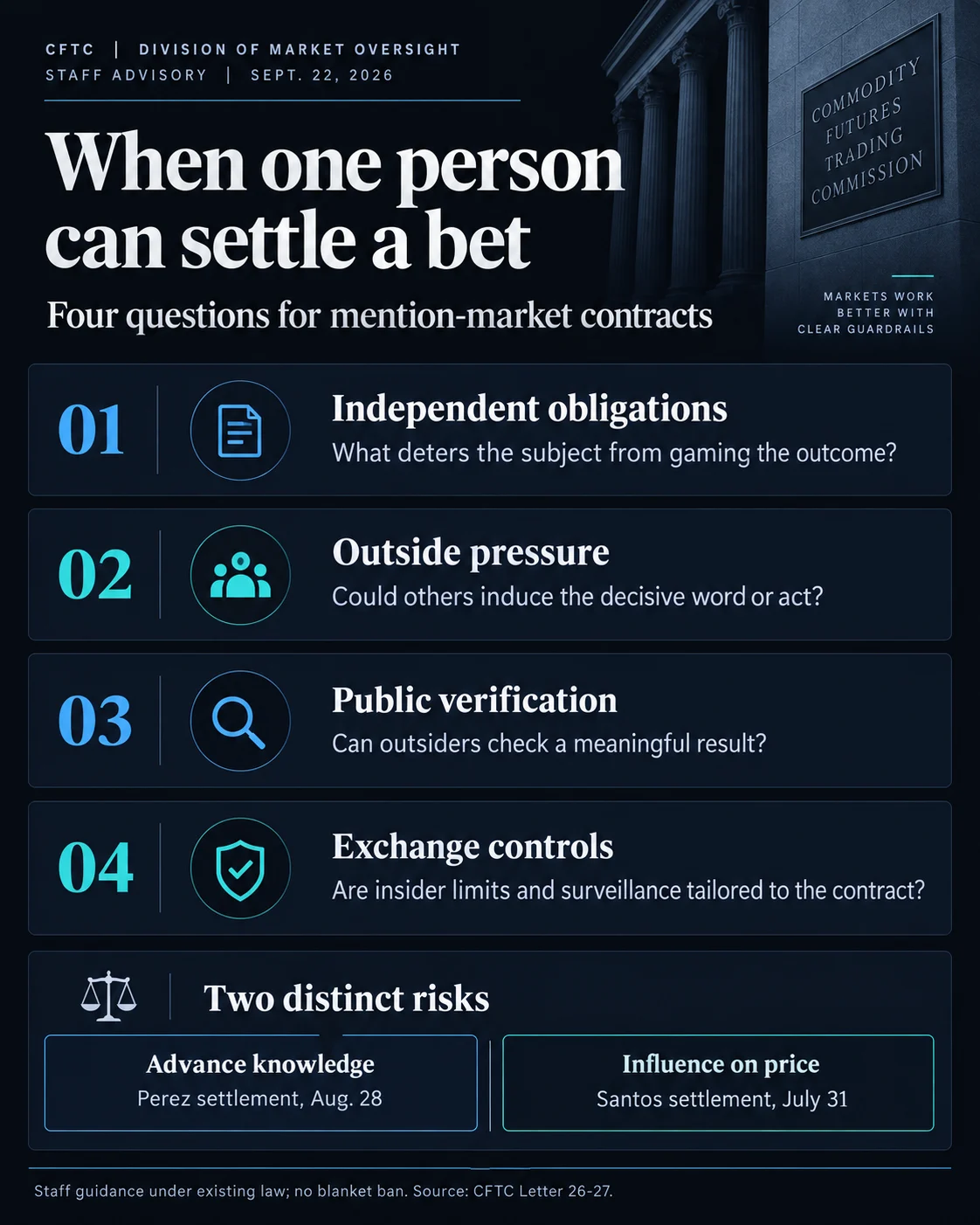
A clear video can settle whether a public figure said a particular word. It cannot show who knew the script beforehand or whether the speaker chose a word to affect a bet. That gap is at the center of a September 22 advisory on speech markets from staff at the Commodity Futures Trading Commission (CFTC). The advisory, issued by the CFTC’s Division of Market Oversight, targets prediction markets that base contract outcomes on statements, appearances, or interactions of named individuals. These markets, often referred to as "mention markets," have become a point of scrutiny for regulators concerned about potential manipulation and insider trading.
The CFTC staff’s position is that contracts tied to a named person’s words, appearance, or interaction carry heightened manipulation risk. Such contracts may be viewed as "presumptively readily susceptible to manipulation," a phrase directly drawn from the existing regulatory duty of registered exchanges to list contracts that are not readily susceptible to manipulation. This advisory, while representing a staff view and not creating a binding rule, signals increased regulatory attention and prompts exchanges to provide more robust explanations of their safeguards. As of the day following the advisory’s release, Kalshi, a prominent platform for such markets, continued to list speech-related contracts, indicating that the guidance had not yet led to an immediate delisting of the controversial products.
Regulatory Scrutiny and Exchange Obligations
The September 22 advisory outlines a series of questions that exchanges must address to demonstrate their commitment to preventing manipulation in speech markets. These questions are designed to elicit detailed explanations of contract-specific safeguards and are non-exhaustive, suggesting that the CFTC staff expects a thorough and proactive approach from regulated entities.
The core of the advisory revolves around four key areas:
-
Independence of Outcome Determinants: Exchanges are asked to explain whether the person or entity responsible for determining the outcome of a contract faces independent legal, professional, or other obligations that would actively deter them from gaming the market. This probes whether the "arbiter" of the contract’s outcome has any inherent incentives or duties that align with market integrity.
-
Vulnerability to Pressure or Inducement: The advisory questions whether individuals who determine contract outcomes could be subjected to pressure or inducement from external parties. This addresses the risk of collusion or coercion that could lead to manipulated outcomes.
-
Verifiability and Significance of Results: Exchanges must detail how the outcome of a contract can be verified under substantial public scrutiny. Furthermore, they need to demonstrate that the decisive word or act has genuine significance in its real-world setting, rather than being an arbitrary or fabricated event solely for market speculation.
-
Sufficiency of Exchange Controls: The final set of questions focuses on the adequacy of the exchange’s internal controls. This includes evaluating whether trading restrictions, surveillance mechanisms, and other operational safeguards are specifically tailored to address the unique risks presented by each particular speech market contract.
The advisory emphasizes that while public verification of what was said is a crucial element, it addresses only one facet of the manipulation risk. Staff explicitly stated that a speaker’s professional obligations, while potentially helpful, cannot serve as a complete substitute for robust exchange-level controls. Exchanges are expected to clearly articulate their measures for identifying individuals who control an outcome or possess privileged access to information that could influence it.
Kalshi’s Mention Markets Under the Microscope
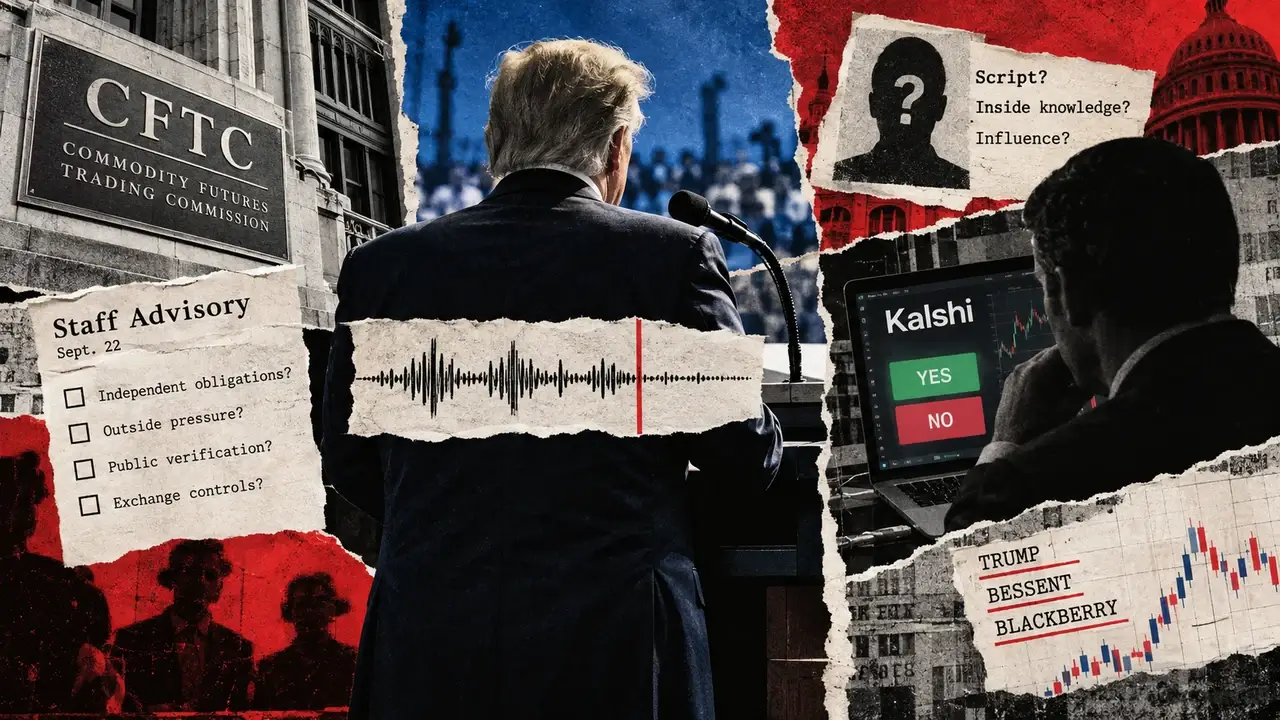
A recent examination of Kalshi’s mention markets revealed a range of contracts tied to public discourse and corporate events. These included a contract on Donald Trump’s remarks at Xi Jinping’s state arrival, a contract based on Treasury Secretary Scott Bessent’s television interview, and a contract linked to BlackBerry’s next earnings call.
During checks on September 23, these three markets showed varying levels of trading volume. The contract concerning Donald Trump’s potential use of the word "China" at least five times during his remarks had a volume of approximately $125,776. The contract for Treasury Secretary Scott Bessent’s television interview saw a volume of roughly $5,333, while the contract related to BlackBerry’s earnings call registered around $23,973. These figures are dynamic and subject to change as trading activity continues.
The specific rules for the Trump contract illustrate the complexity of defining verifiable outcomes. The contract offered a bet on whether Trump would say "China" at least five times. Its published rules stipulated that a live video feed or stream of the September 24 ceremony would be used to determine the outcome. In instances where Kalshi employees could not reach a consensus from the video, official transcripts would be consulted. Importantly, only Trump’s speech delivered in an official capacity was to be considered. The contract’s rules also explicitly barred employees of source agencies and any individuals holding material nonpublic information about the event from trading.
While these terms provide a mechanism for verifying what was said publicly and establish who should abstain from trading, they do not inherently detail how an exchange would detect a scenario where an individual with insider knowledge trades through an intermediary account or how to mitigate the risk of a speaker being pressured to utter a specific, market-moving word. The Bessent and BlackBerry listings highlight that the CFTC’s scrutiny extends beyond presidential remarks to encompass government interviews and corporate financial communications. The publicly available listing details for these contracts do not offer insight into the specific surveillance methods tailored to each event’s unique risk profile.
Kalshi, in response to inquiries, has stated that it implements a multi-layered approach to market integrity. This includes screening certain political figures and relevant government employees, restricting trading by individuals with inside information or influence over contract outcomes, and actively monitoring trading patterns. The company asserts that flagged accounts can be frozen, and suspicious cases can be referred to regulatory authorities. However, these are Kalshi’s stated controls, and the advisory suggests a need for independent assessments of their efficacy for specific contracts.
A spokesperson for Kalshi, Elisabeth Diana, commented on September 23, stating, "We’ve addressed this guidance based on a prior discussion with the CFTC." However, she did not specify whether any immediate changes had been made to the sampled markets in response to the new advisory.

The Distinction Between Knowing and Influencing Outcomes
The CFTC’s enforcement actions provide context for the risks associated with mention markets. A settlement reached in August with Gabriel Perez illustrates the problem of advance information. The CFTC’s order found that the White House teleprompter operator used his access to presidential speeches prior to their delivery to trade on mention contracts between December 2025 and February 2026, reportedly earning $107,539. The order does not allege that Perez altered the content of the speeches; rather, his advantage stemmed from possessing information that other traders did not have before the speeches were made public. This highlights the critical distinction between knowing an outcome and being able to influence it.
A separate settlement in July involving former Rep. George Santos offers a different perspective on potential manipulation. In this case, the CFTC found that Santos traded a contract related to his own attendance at the State of the Union address while simultaneously posting misleading statements about his intentions. The market prices moved in his favor. The issue here was the subject’s ability to control their attendance and to influence public perception and, consequently, market sentiment regarding their participation.
It is important to note that neither the Perez nor the Santos settlement directly implicates misconduct in the three specific contracts examined on Kalshi. However, they serve as crucial precedents and underscore the types of manipulative behavior that the CFTC is vigilant about.
For speech markets specifically, the advisory’s core question for exchanges is whether their verification processes, insider trading restrictions, and surveillance systems adequately address both the individual who can directly choose the outcome of an event and those who might possess privileged knowledge about it. Until exchanges can provide clear and compelling evidence that their safeguards are robust enough to mitigate these risks, any price derived from an optional word or statement in such a market should be approached with caution as an independent forecast. The potential for manipulation, whether through advance knowledge or direct influence, remains a significant concern for regulators aiming to maintain fair and orderly markets.
Broader Implications for Prediction Markets
The CFTC staff’s advisory represents a significant development in the regulatory landscape for prediction markets, particularly those that venture into the realm of political and public discourse. By highlighting "mention markets" as presumptively susceptible to manipulation, the CFTC is signaling a stricter stance and demanding greater accountability from exchanges.
The advisory’s focus on contract-specific safeguards implies that a one-size-fits-all approach to regulation will not suffice. Each market must be evaluated on its unique characteristics, the individuals involved, and the verifiability of its outcomes. This could lead to a more complex and potentially costly compliance environment for prediction market operators.
For investors and participants in these markets, the advisory serves as a warning. The potential for insider information and direct influence means that perceived market prices may not always reflect genuine, unbiased predictions. Increased regulatory scrutiny suggests that the era of largely unregulated prediction markets may be drawing to a close, with greater emphasis placed on market integrity and investor protection.
The long-term impact of this advisory remains to be seen. It could spur innovation in risk mitigation technologies and compliance protocols within the prediction market industry. Alternatively, it might lead to a contraction of the market for certain types of speech-based contracts if exchanges find it too challenging or costly to meet the heightened regulatory expectations. The CFTC’s continued engagement with these issues will be closely watched by both the industry and those interested in the evolving intersection of finance, information, and public discourse. The challenge lies in balancing the innovative potential of prediction markets with the fundamental need to prevent fraud and manipulation.








