
 admin
admin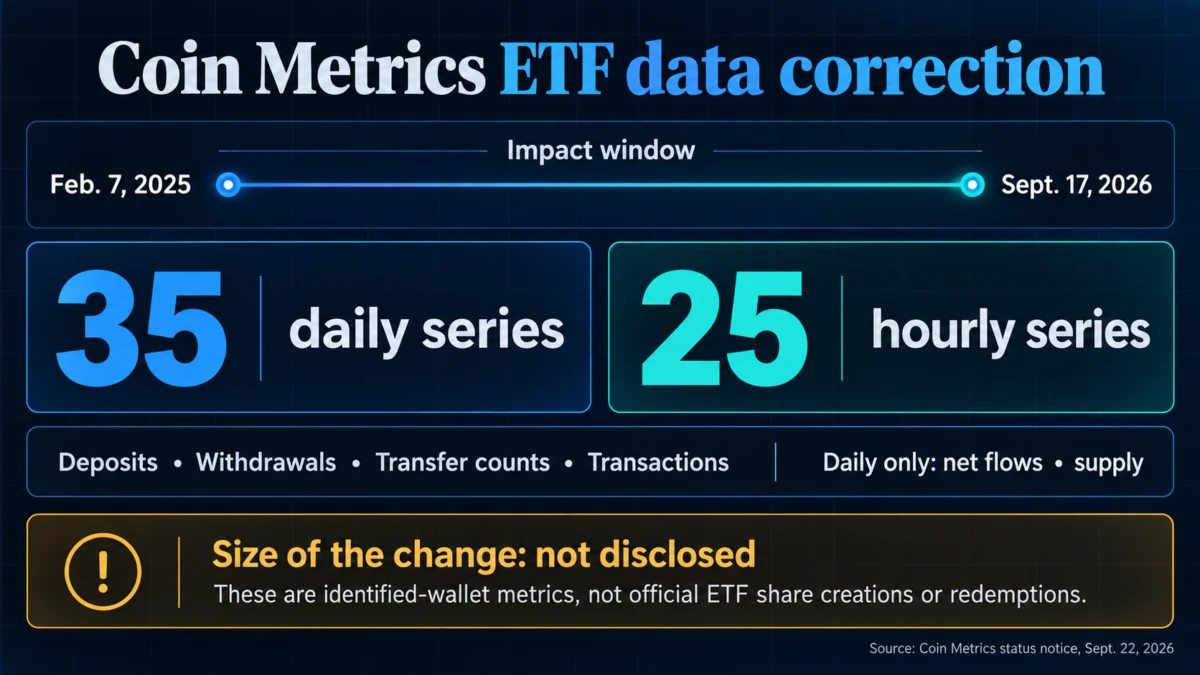
Coin Metrics has undertaken a significant revision of its on-chain data pertaining to Bitcoin Exchange-Traded Funds (ETFs), impacting a substantial period spanning over 19 months. The data provider announced on September 22nd that the corrections affect a range of metrics derived from identified ETF wallet addresses, including deposits, withdrawals, transfer counts, and transaction volumes. This recalibration, which commenced on February 7, 2025, and concluded on September 17, 2026, encompasses 35 daily and 25 hourly series. However, the exact nature, magnitude, and directional impact of these revisions have not been publicly disclosed, leading to a degree of uncertainty for analysts and researchers relying on this data.
The affected data series are provider-derived observations of activity involving blockchain addresses that Coin Metrics has identified as belonging to ETF issuers. It is crucial to distinguish these on-chain metrics from official ETF share creation and redemption records or internal fund accounting data, which are typically managed by the ETF issuers themselves and subject to regulatory oversight. The revisions suggest a potential need for users to reassess any analytical frameworks, models, or historical research built upon the previously reported Coin Metrics data for the specified period.
Unpacking the Scope of the Data Correction
Coin Metrics’ methodology for tracking ETF activity involves attributing on-chain transactions to specific wallet addresses believed to be controlled by ETF providers. For instance, their definition of an ETF deposit refers to assets transferred into these identified addresses within a given timeframe. The value of these deposits, when denominated in U.S. dollars, is calculated by applying their proprietary PriceUSD metric to the native cryptocurrency flows.
Similarly, the withdrawal methodology quantifies assets leaving the control of these identified ETF addresses. In the case of Bitcoin withdrawals, Coin Metrics’ approach excludes the impact of change outputs. This means that any Bitcoin returned to the same cluster of addresses associated with a fund is not classified as a separate inflow, aiming to provide a clearer picture of net asset movements.
The breadth of the correction is notable. The daily list of affected series includes not only direct deposit and withdrawal figures but also net-flow and supply measures, which are derived indicators of overall ETF asset changes and circulating supply held by these entities. The ETF transaction count metric, as defined by Coin Metrics, is explicitly stated to include only those ETFs and addresses that have been positively identified by the firm. This implies that the reported transaction counts represent a minimum potential value, as some ETF-related activity might fall outside their identification parameters. The revision also extends to their ETF supply series, which tracks the total amount of a cryptocurrency held within these identified ETF wallets.

The Discrepancy Between On-Chain Activity and Fund Operations
It is imperative to understand that on-chain wallet movements, as tracked by Coin Metrics, cannot be treated as a direct one-to-one proxy for the authorized participant (AP) creation and redemption processes that underpin ETF operations. Coin Metrics’ work focuses on attributing blockchain activity based on wallet identification. In contrast, the regulated ETF process involves the submission of orders for ETF shares by APs. These orders are then settled, often through an "in-kind" mechanism, where APs deliver a basket of underlying assets (in this case, Bitcoin) to the ETF issuer in exchange for newly created ETF shares, or vice versa for redemptions. This mechanism was further clarified and permitted under the U.S. Securities and Exchange Commission’s (SEC) July 2025 approval for in-kind creations and redemptions for crypto ETPs.
The correction announced by Coin Metrics pertains specifically to its Network Data product, not to the official records maintained by the ETF issuers themselves. This distinction is critical for understanding the practical implications of the revision. The impact is primarily confined to those who have utilized Coin Metrics’ specific daily or hourly ETF wallet data series in their analyses, financial modeling, charting, or research. Such users may need to backfill their historical data with the corrected figures and re-run their analyses to ensure accuracy. The notice does not suggest that broader, independent ETF analyses or market interpretations have been invalidated, but rather that specific datasets used for such purposes may require updating.
The Implication of Undisclosed Deltas
The lack of specific details regarding the cause, direction, or numerical magnitude of the revisions presents a significant challenge for users and observers of the cryptocurrency market. Without knowing whether the corrected figures generally increased or decreased the reported volumes, or what the largest individual adjustment was, it is difficult to fully grasp the implications for market sentiment or the perceived flow of capital into and out of Bitcoin ETFs.
The delay in providing these crucial details could stem from several factors. It might be an internal process to ensure the accuracy and integrity of the revised data before public dissemination. Alternatively, the complexity of the data correction across such a long period might necessitate a thorough review before a comprehensive explanation can be issued. However, in the absence of such information, the responsible conclusion remains that Coin Metrics has made a broad adjustment to its dataset, but the precise impact on the market’s understanding of ETF activity remains to be seen.
Historical Context and Market Significance of Bitcoin ETFs
The emergence of Bitcoin ETFs marked a pivotal moment for the cryptocurrency industry, offering traditional investors a regulated and accessible avenue to gain exposure to Bitcoin without the complexities of direct digital asset custody. The approval and subsequent launch of these ETFs in the United States, particularly in early 2025, led to a significant surge in institutional adoption and capital inflows into the Bitcoin market.
Data on Bitcoin ETF inflows has become a closely watched metric, serving as a barometer for institutional sentiment and demand for Bitcoin. Analysts often correlate these inflows with price movements, suggesting a strong link between the perceived success of these investment vehicles and the broader market trajectory of Bitcoin. Therefore, any revisions to the data used to track these flows carry considerable weight.

Coin Metrics, as a prominent provider of on-chain data and analytics, plays a crucial role in supplying the infrastructure for this analysis. Their datasets are frequently referenced by financial institutions, researchers, and media outlets. The accuracy and reliability of this data are paramount for maintaining confidence in the insights derived from it.
Potential Causes and User Impact
While Coin Metrics has not disclosed the specific reasons for the data correction, potential causes could include:
- Improved Wallet Identification Algorithms: Enhancements to their algorithms for identifying ETF-controlled addresses might have led to a more accurate classification of transactions. This could involve identifying previously unknown addresses or reclassifying incorrectly attributed ones.
- Correction of Data Inconsistencies: There might have been underlying data processing errors or inconsistencies within their historical data pipelines that have now been rectified.
- Adaptation to Evolving ETF Structures: As the landscape of Bitcoin ETFs evolves, with new issuers and varying operational structures, Coin Metrics may have needed to adapt its methodologies to capture this dynamic environment accurately.
- External Data Source Issues: In some cases, data corrections can be triggered by issues with upstream data providers or blockchain explorers that Coin Metrics relies upon.
For users of Coin Metrics’ data, the immediate impact is a need for diligence. Any research, reports, or automated trading strategies that relied on the affected historical data will need to be reviewed and potentially re-executed. This could involve:
- Revisiting Analytical Models: Models that incorporate ETF deposit and withdrawal data as key inputs may need to be recalibrated with the updated historical figures.
- Updating Charts and Dashboards: Visualizations and dashboards that display historical ETF activity will require updating to reflect the corrected data, ensuring accuracy in ongoing reporting.
- Re-evaluating Investment Strategies: Investment strategies that were informed by the previous data on ETF flows might need to be reassessed, considering how the revised figures alter the perceived trends.
Moving Forward: The Need for Transparency
The cryptocurrency market thrives on transparency and data integrity. While the revision of data is a necessary part of maintaining accuracy, the lack of detailed information surrounding Coin Metrics’ correction raises pertinent questions. The cryptocurrency community, particularly those in quantitative analysis and institutional finance, relies heavily on the clarity and precision of data provided by reputable sources like Coin Metrics.
Moving forward, a more detailed disclosure from Coin Metrics regarding the specific changes and their implications would be invaluable. This could include:
- A detailed explanation of the root cause: Understanding why the correction was necessary will help users avoid similar pitfalls in their own data handling.
- Quantifiable deltas: Providing aggregate figures or percentage changes for the affected series would allow users to gauge the significance of the revisions.
- Identification of the largest adjustments: Highlighting specific periods or metrics with substantial changes could help users prioritize their review efforts.
By offering greater transparency, Coin Metrics can reinforce the trust and confidence that the market places in its data products, ensuring that the insights derived from its analyses remain robust and reliable in the ever-evolving landscape of digital assets. The ongoing development and refinement of data infrastructure are critical for the maturation of the cryptocurrency market, and clear communication from data providers is an essential component of this progress.








