
 admin
admin
Paolo Ardoino’s ambitious vision to slash corporate capital-raising costs by an impressive 80% is encountering a critical real-world test through Bitfinex Securities. The platform’s own illustrative example of a $5 million, one-year bond reveals an issuer fee of $100,000, representing a substantial 2% of the total capital sought. This figure immediately raises questions about the accessibility of tokenized securities for businesses operating outside of established financial hubs, especially when compared to Ardoino’s five-year benchmark for the industry, which aims to significantly reduce such expenses.
Bitfinex Securities positions itself as a facilitator for raising capital via tokenized securities, a burgeoning sector of digital finance. An October 5th blog post from Bitfinex elaborated on Ardoino’s five-year industry benchmark, underscoring the platform’s commitment to this innovative approach. However, the practical implementation, as highlighted by the bond example, presents a significant hurdle: the substantial minimum charge associated with issuing a security, regardless of its tokenized nature, remains a considerable barrier for many businesses.
The economic realities of security issuance suggest two primary avenues for overcoming this initial cost barrier. First, companies capable of raising substantial capital can spread these fixed costs over a larger sum, effectively diminishing the percentage impact. Second, intermediaries can emerge to pool financing for smaller enterprises, aggregating their needs into larger issuances that are more economically viable.
ALTERNATIVE: A Working Model for Pooled Financing
The Luxembourg-based securitization fund, ALTERNATIVE, offers a compelling operational example of the latter strategy. While the fund’s bond records demonstrate successful funding and repayment cycles, the ultimate impact of its structure on the loan prices for its underlying borrowers remains an open question. ALTERNATIVE effectively acts as an intermediary, absorbing the initial issuance costs and then distributing capital to a portfolio of businesses. This approach allows smaller enterprises to access tokenized capital markets without the burden of navigating the complex and expensive issuance process individually.
Ardoino’s five-year benchmark encompasses the multifaceted costs associated with regulatory compliance, listing procedures, and the actual debt or equity raising process. This ambitious target reflects a broader industry aspiration to streamline and democratize access to capital. To illustrate the potential benefits, Ardoino often references a hypothetical farming business in Buenos Aires with an annual revenue of $50 million. The comparison he draws is between this business’s access to traditional capital markets and its potential access through tokenized avenues.
In a post on X (formerly Twitter) dated October 5th, Ardoino further articulated the fundamental purpose of tokenization: to empower companies and entrepreneurs in markets historically underserved by conventional financial institutions. This emphasis on the issuer’s experience is paramount to the success of the tokenization movement. While enhanced trading liquidity can undoubtedly improve the investor experience, it does not inherently guarantee that a business can secure expansion funding at an economically feasible total cost.
The Impact of Minimum Fees on Headline Rates
Bitfinex’s publicly available fee schedule, accessible on their website, starkly illustrates this challenge. For the aforementioned one-year bond example, a calculated fee based on a 0.4% formula would amount to $20,000 for a $5 million raise. However, the platform’s mandatory $100,000 minimum fee supersedes this calculation, making the actual payable charge five times the formula-derived amount. This minimum issuer platform fee is distinct from the bond coupon rate or the annual interest rate charged to a small business borrower.
The fee structure for equity offerings is progressive, commencing at 4%, while bond fees are contingent upon the time remaining until maturity. Consequently, the fee calculations for permanent equity and a one-year bond will naturally differ. The comprehensive capital-raising package offered by Bitfinex Securities includes essential services such as document review, the tokenization process itself, the creation of marketing materials, and secondary market listing, with no additional charges for listing. Furthermore, issuers successfully receiving proceeds are exempt from any withdrawal fees.
Economically, this fee floor significantly influences the perceived cost of capital. When a substantial minimum fee is in place, the amount of capital raised becomes a critical factor in determining the effective cost. A larger capital raise allows the fixed charge to be spread more thinly, thereby reducing the percentage cost for the issuer. This dynamic explains how a seemingly low percentage-based fee formula can coexist with a substantial entry cost for smaller-scale issuers.

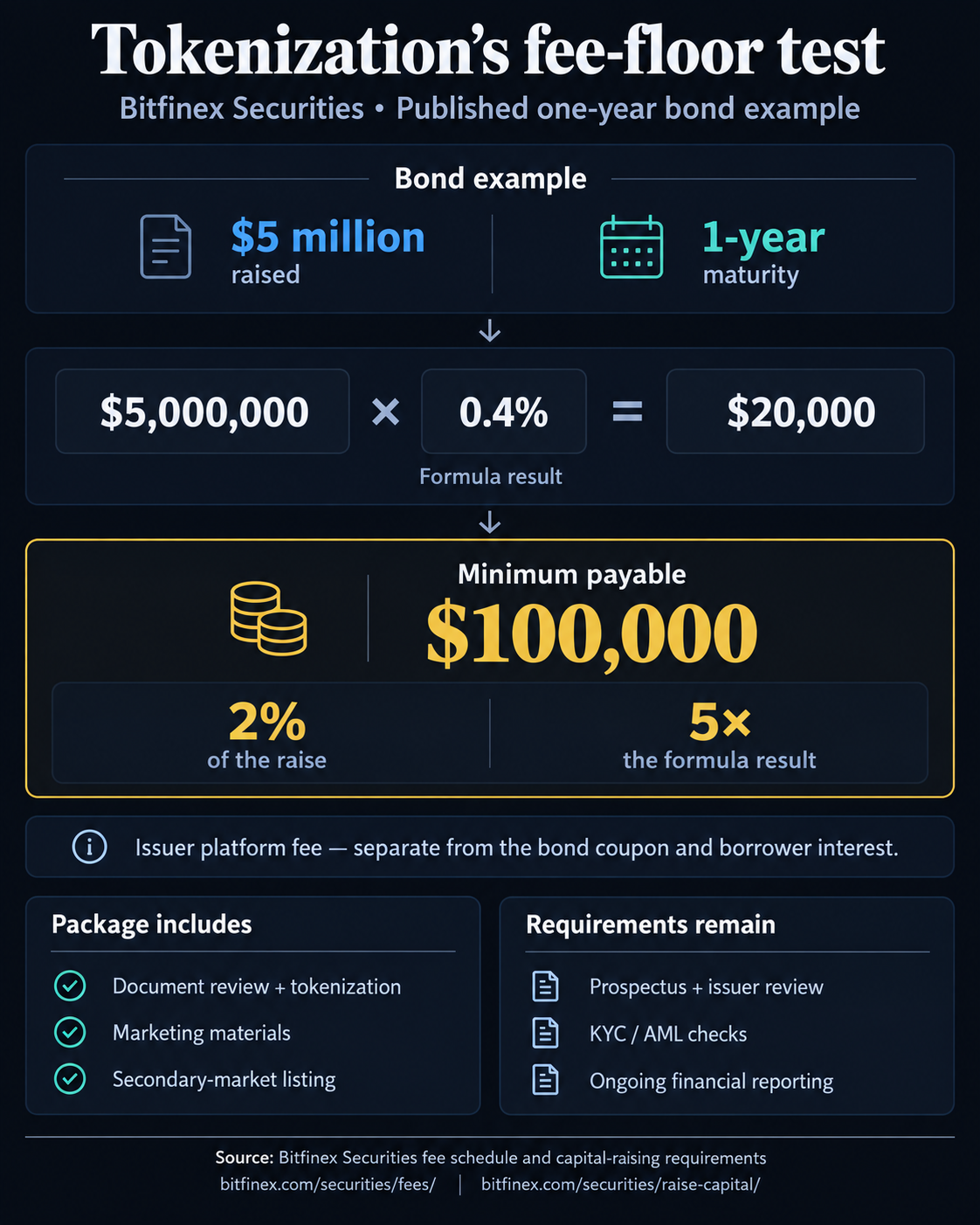
The process of launching a capital raise on Bitfinex Securities is still subject to rigorous issuer review and acceptance. This includes the preparation of an offering prospectus and supporting documentation, adherence to stringent Know Your Customer (KYC) and Anti-Money Laundering (AML) checks, and ongoing financial reporting obligations. The platform mandates quarterly financial statements for issuers, with a specific guide for offerings within the Astana International Financial Centre (AIFC) outlining requirements for quarterly or yearly statements, depending on market rules. Crucially, the transition of ownership records to a blockchain does not absolve issuers of these continuing reporting duties.
Investor participation guidelines vary based on the offering jurisdiction. For instance, individuals participating in AIFC offerings may need to meet minimum investment thresholds or accreditation requirements, as detailed in the investor guide. Offerings originating from El Salvador and corporate accounts operate under different provisions. Notably, the platform explicitly excludes U.S. persons and participation in jurisdictions where such an offer would be deemed unlawful.
For businesses in underserved markets, the true test of tokenization’s efficacy lies in whether it simplifies and reduces the cost of preparing an eligible offer and reaching eligible investors. While technological advancements in settlement are beneficial, they address only one facet of the overall capital-raising challenge. A meaningful comparison with traditional financing methods would necessitate evaluating identical issuers, instruments, maturities, and financing objectives, including the comprehensive effort involved in document preparation and ongoing reporting.
ALTERNATIVE’s Pooled Route in Operation
ALTERNATIVE’s operational model fundamentally shifts the interaction with the capital markets. Managed by MK Global Kapital, the fund solicits debt from investors and subsequently channels these funds to businesses through its investment portfolio. The fund’s stated objective is to support lending, leasing, and mobility initiatives, positioning itself as a crucial intermediary between securities investors and the entrepreneurs seeking capital. This structure enables smaller businesses to access the tokenized capital market without the necessity of preparing their own individual exchange issuances.
The potential for scale advantage is significant; a single issuance by ALTERNATIVE can facilitate financing for a diverse portfolio of businesses. However, the ultimate benefit to individual enterprises, in terms of achieving more favorable loan terms, remains contingent upon the specific conditions negotiated within the fund’s portfolio.
In a December 20, 2023, announcement, Bitfinex reported that ALT2612, a tokenized bond issued through ALTERNATIVE, had successfully raised over 5.2 million USDT (Tether) and closed earlier that week. This bond had a 36-month tenor and offered a 10% coupon. The program subsequently introduced microfinance bond offerings in 2024, further expanding its reach.
A lifecycle report published by the fund’s manager in July 2025 indicated that the Bitfinex program had facilitated four issuances totaling the equivalent of $6.2 million by July 1st. During this period, one matured issue, valued at $630,000 equivalent, had been fully repaid, accompanied by 15 coupon payments exceeding $850,000 equivalent.
By March 2, 2026, the reported total issuance figure remained at four bonds and $6.2 million equivalent. However, three matured bonds, totaling $1 million equivalent, had been fully repaid, and the reported coupon payments had increased to 20, exceeding $1.1 million equivalent. These announcements highlight varying reporting scopes, with the manager also referencing a broader tokenized program valued at over $10 million. A March announcement from Bitfinex indicated expectations for future issuances within this program to surpass $10 million.
The pooled financing route offers the potential to consolidate issuance-related efforts across financing for numerous businesses. Furthermore, it delegates the critical decisions regarding capital allocation and pricing to an intermediary. Consequently, the terms of loans, underwriting processes, and overall access to capital become the next critical metrics for evaluating whether the industry’s purported efficiency gains are indeed reaching entrepreneurs.
The next phase of meaningful evaluation would involve linking demonstrable reductions in issuance and compliance costs to comparable financing offers for businesses. This analysis should encompass total charges, the amount of capital available, loan maturities, and ongoing obligations. For pooled lending arrangements, a key indicator would be tangible improvements in the terms offered to the ultimate borrowers.
Ardoino’s benchmark sets a high economic standard for the inclusive promise of tokenization. Achieving this standard necessitates demonstrably cheaper capital access at the business level, irrespective of whether companies issue securities directly or secure financing through an intermediary fund. The journey from a theoretical 80% cost reduction to a practical reality for a broad spectrum of businesses hinges on overcoming the initial hurdles of significant fees and complex regulatory landscapes.








