
 admin
admin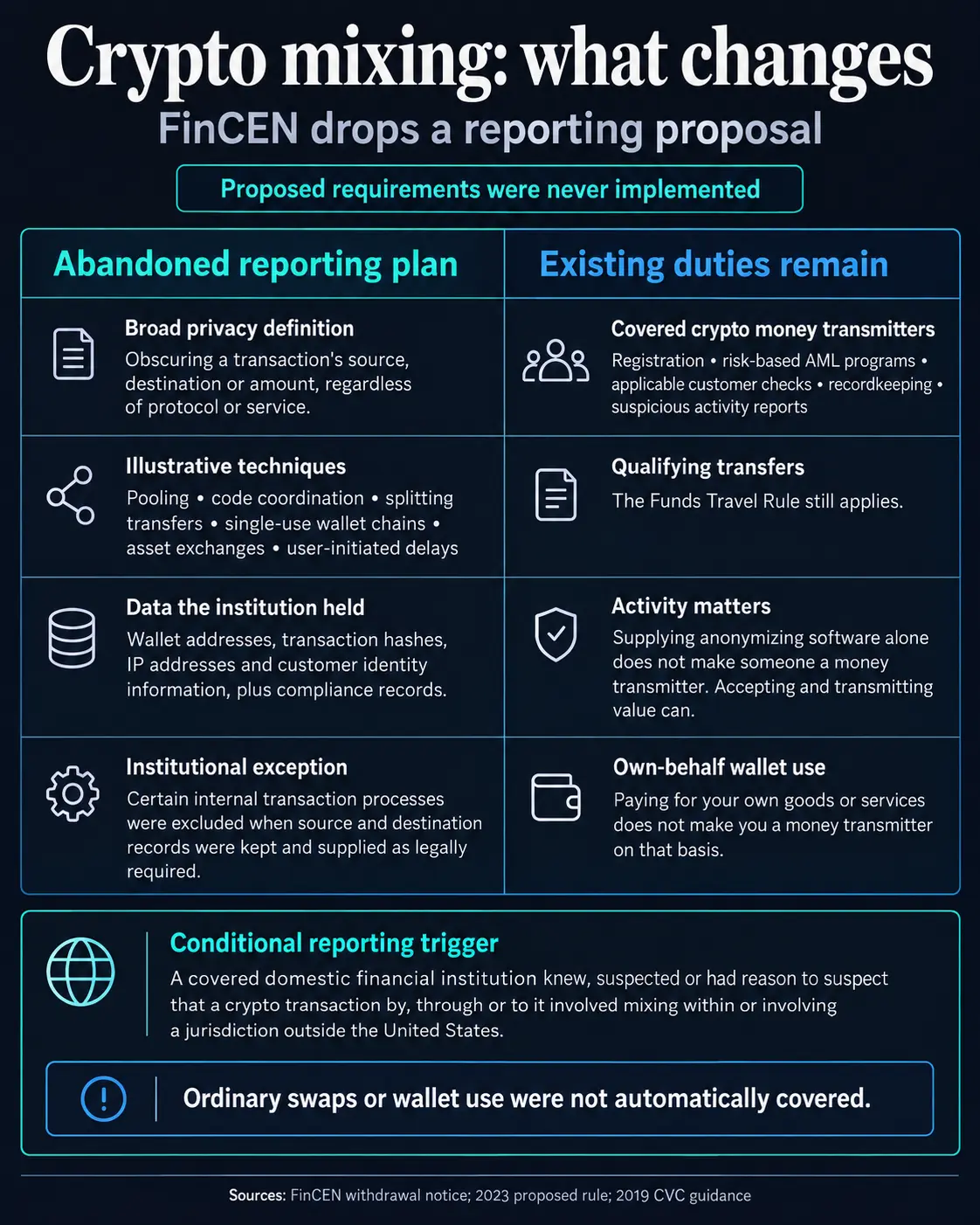
The U.S. Department of the Treasury’s Financial Crimes Enforcement Network (FinCEN) has officially withdrawn a controversial proposed rule that would have imposed significant reporting requirements on financial institutions regarding cryptocurrency mixing services and related transactions. The decision, announced on October 5th, marks a pivotal moment in the ongoing regulatory landscape of digital assets, signaling a shift in approach following considerable feedback from the industry. While the specific proposal targeting crypto mixing has been abandoned, FinCEN reiterated that existing anti-money laundering (AML) and suspicious activity reporting (SAR) obligations for cryptocurrency businesses remain firmly in place.
The withdrawn proposal stemmed from FinCEN’s 2023 designation of international cryptocurrency mixing as a class of transactions of primary money laundering concern. The agency had intended to implement a rule that would have mandated financial institutions to report information about covered transactions and their customers involved in such activities. This included a broad definition of "mixing" that encompassed various techniques used to obscure the source, destination, or amount of a cryptocurrency transaction. Such methods could include pooling funds, coordinating transactions through code, splitting transfers, routing funds through multiple single-use wallets, exchanging between different crypto assets, and introducing user-initiated delays. The proposed obligation would have been triggered when a covered domestic financial institution knew, suspected, or had reason to suspect that a crypto transaction involved mixing within or involving a jurisdiction outside the United States.
The withdrawal notice, scheduled for publication in the Federal Register on October 6th, explicitly cited concerns raised by commenters. These concerns largely revolved around the expansive definition of mixing, which many industry participants argued could inadvertently "chill" legitimate activities and impose an unduly large reporting burden on financial institutions. The broad scope of the proposed rule, as outlined in the Federal Register notice, extended beyond dedicated mixing services and aimed to capture a wide array of transaction patterns that could be used to obfuscate financial flows.
Background of the Proposal and Industry Reaction
The move by FinCEN to target crypto mixing services was part of a broader effort by regulatory bodies worldwide to combat illicit finance within the rapidly evolving digital asset ecosystem. Cryptocurrency mixers, also known as tumblers, are services that obfuscate the on-chain trail of cryptocurrencies by commingling funds from multiple users. While proponents argue they can offer legitimate privacy benefits for users, law enforcement agencies and financial regulators have frequently highlighted their use by malicious actors to launder funds obtained through ransomware attacks, darknet markets, and other criminal enterprises.
FinCEN’s initial finding in 2023 that international crypto mixing constitutes a primary money laundering concern was a significant step. This designation provided the legal basis for proposing the subsequent reporting and recordkeeping rule. The agency’s stated objective was to enhance its ability to track and investigate illicit financial flows involving digital assets.

However, the proposed rule quickly drew sharp criticism from various stakeholders within the cryptocurrency industry. Exchanges, wallet providers, and blockchain analytics firms expressed concerns that the broad definition of "mixing" could ensnare legitimate business operations and ordinary user activities. Many argued that the proposed reporting requirements were technically unfeasible to implement comprehensively and could lead to a chilling effect on innovation and user privacy. The sheer volume of transactions and the pseudonymous nature of blockchain technology presented significant challenges in accurately identifying and reporting all instances of mixing as defined by the proposal.
Timeline of Events
- 2020: FinCEN publishes a separate proposal concerning unhosted wallets, indicating a growing focus on user privacy and transaction traceability.
- 2023: FinCEN issues a finding that international crypto mixing is a class of transactions of primary money laundering concern.
- Late 2023 (Specific date not in original text but implied by "2023 finding"): FinCEN proposes a rule requiring financial institutions to report information about covered crypto mixing transactions and their customers.
- December 2023 (Implied by "proposed definition applied regardless of the protocol or service used"): The proposed definition of mixing, encompassing various obfuscation techniques, is made public.
- Early 2024 (Implied by "Spring 2024 regulatory agenda"): The separate unhosted wallet proposal is listed as withdrawn on April 12, 2024, in the Spring 2024 regulatory agenda.
- October 5, 2024: FinCEN announces the withdrawal of the proposed crypto mixing reporting rule.
- October 6, 2024: The withdrawal notice is scheduled for publication in the Federal Register, making the withdrawal effective upon publication.
Implications of the Withdrawal
The withdrawal of the crypto mixing proposal carries several important implications for the digital asset industry and regulatory landscape:
- Reduced Reporting Burden: Financial institutions involved in cryptocurrency transactions will not be subjected to the extensive reporting requirements related to mixing that were initially proposed. This alleviates concerns about operational complexity and compliance costs associated with a potentially broad and difficult-to-implement rule.
- Focus on Existing Obligations: FinCEN’s reaffirmation of existing AML and SAR obligations underscores that the agency is not backing away from regulating the crypto space. Covered entities, including cryptocurrency money transmitters, remain obligated to implement robust risk-based AML programs, conduct customer due diligence, maintain records, and file SARs when suspicious activity is detected. The Funds Travel Rule also continues to apply to qualifying transfers.
- Clarity on Software vs. Service: The existing guidance, which FinCEN has indicated remains relevant, differentiates between an anonymizing service that accepts and retransmits value and a supplier of anonymizing software. This distinction is crucial, as operating a transmission business can classify an entity as a money transmitter, whereas merely supplying a tool does not. This provides some clarity for software developers in the crypto space.
- Reiteration of Unhosted Wallet Stance: The withdrawal notice also addresses the separate unhosted wallet proposal from December 2020, confirming that FinCEN will take no further action on it. This indicates that the agency is not pursuing a direct reporting obligation on individual users interacting with their own wallets for personal transactions, such as purchasing goods or services.
- Continued Monitoring: Despite the withdrawal of this specific proposal, FinCEN stated its commitment to continuing to monitor cryptocurrency mixing for its use in money laundering, terrorist financing, and other illicit activities. The agency reserves the right to take further steps in the future if deemed necessary. This suggests that while the current approach has been altered, the underlying regulatory concern remains.
Analysis of the Proposed Definition and its Scope
The proposed definition of "mixing" was particularly broad, aiming to capture a wide range of activities. Examples provided in the original proposal illustrate this expansive approach:
- Pooling Funds: Combining assets from multiple sources before redistribution.
- Coordinating Transactions with Code: Utilizing scripts or smart contracts to automate and obscure transaction flows.
- Splitting Transfers: Breaking down larger amounts into smaller, more numerous transactions to evade detection.
- Routing through Single-Use Wallets: Utilizing temporary, one-time addresses to break the direct link between sender and receiver.
- Exchanging Between Crypto Assets: Swapping one cryptocurrency for another as an intermediary step to further obfuscate the original asset or its source.
- Introducing User-Initiated Delays: Adding intentional pauses in transaction processing to disrupt pattern recognition.
The proposed obligation would have applied when a covered domestic financial institution had knowledge or suspicion of such activity involving a foreign jurisdiction. This "foreign nexus" trigger was a key component, aiming to focus regulatory attention on cross-border illicit finance.

However, the proposal also contained exclusions for certain internal processes used by traditional financial institutions like banks, broker-dealers, and money services businesses, provided they maintained source and destination records and made them available when legally required. This acknowledged that legitimate internal transaction processing might resemble some mixing techniques but did not necessarily imply illicit intent.
The core of the reporting requirement for financial institutions would have involved submitting information such as wallet addresses, transaction hashes, IP addresses, and customer identity information in their possession. They would also have been required to document their compliance efforts related to these transactions.
Broader Regulatory Context and Future Outlook
The FinCEN withdrawal reflects a dynamic and evolving regulatory environment for digital assets. Governments globally are grappling with how to balance innovation, user privacy, and the need to prevent financial crime. The cryptocurrency industry has consistently advocated for clear, predictable, and risk-based regulations.
The backlash against the proposed mixing rule highlights the importance of collaboration and dialogue between regulators and industry participants. When proposed rules are perceived as overly broad, technically unfeasible, or disproportionately burdensome, they can lead to significant opposition. FinCEN’s decision to withdraw the rule, in response to these concerns, demonstrates a willingness to adapt its approach.
Looking ahead, it is highly probable that FinCEN and other regulatory bodies will continue to explore alternative strategies for addressing the illicit use of cryptocurrency mixing and other privacy-enhancing technologies. This could involve:
- Targeted Enforcement Actions: Focusing on specific entities or individuals known to be facilitating illicit financial activities through mixing services.
- International Cooperation: Working with global counterparts to share intelligence and coordinate efforts against cross-border illicit finance.
- Technological Solutions: Investing in and promoting the development of advanced blockchain analytics tools that can better identify and trace complex transaction patterns, even those involving mixers.
- Industry Best Practices: Encouraging the development and adoption of industry-led best practices for managing risks associated with privacy-enhancing technologies.
The withdrawal of this specific proposal does not signify an end to regulatory scrutiny of cryptocurrency mixing. Instead, it suggests a pause and a potential recalibration of how such concerns will be addressed. Financial institutions engaged in the digital asset space must remain vigilant, ensuring ongoing compliance with existing AML, KYC (Know Your Customer), and SAR requirements, while staying informed about potential future regulatory developments. The core mission of preventing financial crime remains paramount, and FinCEN’s commitment to this objective is unwavering. The agency’s statement that existing obligations remain relevant serves as a clear reminder that the regulatory framework for digital assets continues to evolve, demanding adaptability and diligence from all market participants.








