
 admin
admin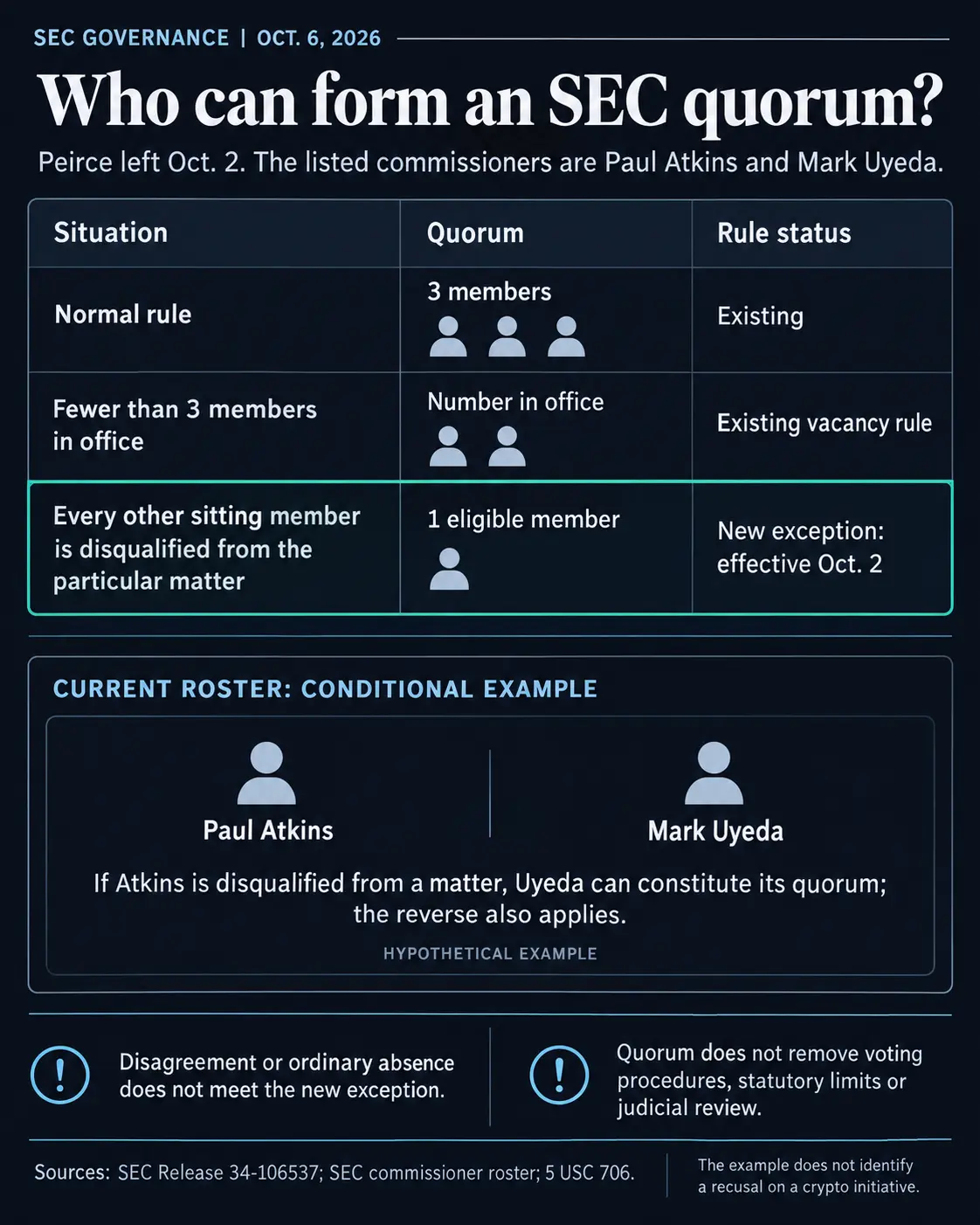
Hester Peirce’s departure from the U.S. Securities and Exchange Commission (SEC) on October 2, 2026, has reshaped the landscape of the agency’s decision-making, particularly concerning cryptocurrency policy. With her exit, the Commission is now comprised of only two listed commissioners: Chairman Paul Atkins and Commissioner Mark Uyeda. This reduced roster, coupled with a recently enacted rule amendment, introduces a significant shift in how the SEC can convene to address critical matters, potentially concentrating future authority over digital asset regulation into fewer hands. The new regulation allows a single eligible commissioner to constitute a quorum for a specific matter if all other sitting members are disqualified.
The implications of this altered quorum structure are particularly salient for the burgeoning crypto industry, which has been awaiting definitive regulatory clarity from the SEC on numerous fronts. Previously, the SEC’s operational capacity required a minimum number of commissioners to be eligible to conduct official business. While a rule already existed to allow a commission with fewer than three members to operate, the recent amendment, effective October 2, 2026, specifically addresses situations where disqualifications arise. This change, codified in 17 CFR 200.41, alters the threshold for a quorum when the usual consensus is hampered by conflicts of interest or other reasons for recusal.
The SEC’s published rule amendment, dated September 30, 2026, acknowledges the agency’s need to continue conducting business even when disqualifications occur. The stated rationale behind the change emphasizes promoting flexibility and finality in agency operations, framing it as a matter of internal management and organizational efficiency rather than a shift in substantive regulatory policy. However, the practical consequences for the pace and direction of crypto regulation are undeniable.
The Evolving SEC Roster and Quorum Dynamics
Hester Peirce, a vocal proponent of regulatory clarity and often seen as a voice for innovation within the SEC, officially concluded her tenure on October 2, 2026. Her resignation letter, dated September 21, 2026, marked the end of her service. As of October 3, 2026, the official SEC commissioner roster lists only Chairman Paul Atkins and Commissioner Mark Uyeda. Historical records confirm Peirce’s tenure ended on the aforementioned date.
The amended quorum rule, also effective October 2, 2026, specifically targets situations of commissioner disqualification. Prior to this amendment, a separate provision allowed for two eligible commissioners to form a quorum if others were disqualified. The new exception extends this capability to a single eligible commissioner, provided that every other member of the Commission is disqualified from participating in that particular matter. This means that in a scenario where Chairman Atkins is disqualified from a specific crypto policy decision, Commissioner Uyeda could, in theory, convene a quorum and make a determination on his own, and vice versa.
It is crucial to distinguish this new provision from situations involving simple vacancies, non-attendance, or recusal due to disagreement with a proposal. The rule is strictly tied to formal disqualification from a specific matter, meaning a commissioner’s differing opinion on a policy does not automatically trigger the one-member quorum exception. This nuance is vital, as it aims to prevent a single commissioner’s disagreement from paralyzing the agency’s ability to act on matters where they have a genuine conflict of interest.
Key Crypto Initiatives Facing a Streamlined Commission
Several significant regulatory initiatives impacting the cryptocurrency space are currently navigating the SEC’s review process, and these will now be subject to the new quorum dynamics. These include proposed rules on custody reform and new offering regimes, as well as a recently issued conditional exemptive order for tokenized-stock trading.
Custody Reform Proposal: One of the most closely watched proposals is the SEC’s Oct. 1, 2026, custody proposal. This rule aims to clarify how regulated investment companies can custody crypto securities and similar digital assets, how registered investment advisers can safeguard client crypto funds and securities, and mandates updated modernization and reporting requirements. Chairman Atkins, in an October statement, highlighted this custody reform alongside other ongoing initiatives, underscoring its importance in the agency’s approach to digital assets. The proposal is currently in the public comment phase, with the deadline for feedback extended to December 7, 2026. The existence of a smaller commission, or the new quorum exception, does not inherently transform this proposal into immediate regulatory permission; it still requires a formal rulemaking process. The SEC’s October voting record indicates that Atkins, Peirce, and Uyeda collectively approved the release of this custody rule for public comment on October 1, 2026, prior to Peirce’s resignation and the quorum amendment taking effect.

New Offering Regime: Another significant pending measure is the "Regulation Crypto Assets" proposal, initially issued on August 18, 2026, and published on August 21, 2026. This proposal seeks to establish offering exemptions for certain investment contracts involving crypto assets. It also introduces disclosure requirements and maintains existing anti-fraud and anti-manipulation obligations. Furthermore, it proposes a conditional safe harbor concerning the determination of investment-contract status for digital assets. The comment period for this proposal concludes on October 20, 2026, marking another critical juncture for industry feedback.
Tokenized-Stock Trading Relief: In contrast to the proposed rules, the SEC has already issued a conditional exemptive order for tokenized-stock trading. The Sept. 17, 2026, Innovation Exemption provides temporary relief for specified tokenized National Market System (NMS) stock trading venues and certain liquidity providers. This order, detailed in a fact sheet, offers five-year conditional relief with specific limitations on stock symbols and trading volume. It also mandates equivalent shareholder rights, publicly auditable smart contracts, and operating disclosures. For stocks tokenized by unaffiliated third parties, the issuer must also provide notice and an opportunity to object. While this relief is currently operational for qualifying participants, any future decisions regarding its extension or modification would fall under the new quorum arrangements, though the rule itself does not expand the scope of the exemption or remove its existing safeguards.
The Nuances of Quorum and Commission Authority
The SEC’s operational procedures are governed by several key rules that delineate how decisions are made. The seriatim rule (17 CFR 200.42) dictates that a matter is not considered final until each commissioner has reported their vote or intended non-participation to the secretary. Furthermore, any commissioner has the authority to request that a circulated matter be withdrawn and scheduled for joint deliberation, a mechanism that allows for discussion and potential consensus-building.
The determination of a commissioner’s qualification to participate in a matter rests with that individual commissioner, as outlined in 17 CFR 200.60. This regulation requires commissioners to carefully weigh their interests and relationships when considering their involvement. The newly amended quorum clause explicitly covers situations where members are otherwise disqualified, reinforcing the agency’s commitment to enabling action even in the face of potential conflicts.
It is important to note that the quorum amendment does not grant additional substantive authority to the Commission or its individual members. Decisions made under this new quorum structure remain subject to existing legal frameworks, including the Administrative Procedure Act (APA). The APA mandates notice-and-comment rulemaking for most regulatory actions, with specific exceptions. The SEC’s justification for the quorum amendment, that it pertains to internal management rather than substantive regulation, does not establish a broad exemption for future crypto-related rulemaking.
Moreover, judicial review remains a significant check on agency actions. Courts have the authority to set aside agency actions found to be unlawful, exceeding statutory authority, or procedurally flawed. Therefore, reducing the number of eligible commissioners does not insulate SEC decisions from scrutiny. The agency’s published October voting record, which includes the three-member vote on the custody proposal, suggests that official votes are generally posted only when a matter is final. This limited transparency means that while the new quorum rule offers a pathway for action, the specific details of future decisions, including the participating members and their legal basis, will be crucial indicators of the reduced Commission’s operational style.
Broader Implications for the Crypto Industry
The consolidation of decision-making power within a two-member commission, particularly with the added flexibility of a one-member quorum in disqualification scenarios, carries significant implications for the cryptocurrency industry. The industry has been actively seeking clear and predictable regulatory frameworks to foster innovation and investment. Any perceived concentration of power, even if intended to ensure operational continuity, could lead to increased scrutiny and potential concerns about the breadth of diverse perspectives informing critical policy decisions.
The SEC’s stated objective of promoting flexibility and finality is understandable in an environment where regulatory clarity is paramount. However, the crypto sector will be closely observing how this new quorum structure influences the timing and substance of future regulatory actions. The approaching deadlines for public comments on the custody and offering proposals, along with any potential future developments regarding tokenized-stock trading relief, will serve as early indicators of the SEC’s path forward under the revised leadership and quorum rules. The ability of the Commission to effectively balance innovation with investor protection under these new conditions will be a key determinant of its future impact on the digital asset landscape. The operational efficiency gained may come with the expectation of swift and decisive action, but the legal and procedural safeguards remain in place to ensure accountability and adherence to established administrative law principles.








