admin
admin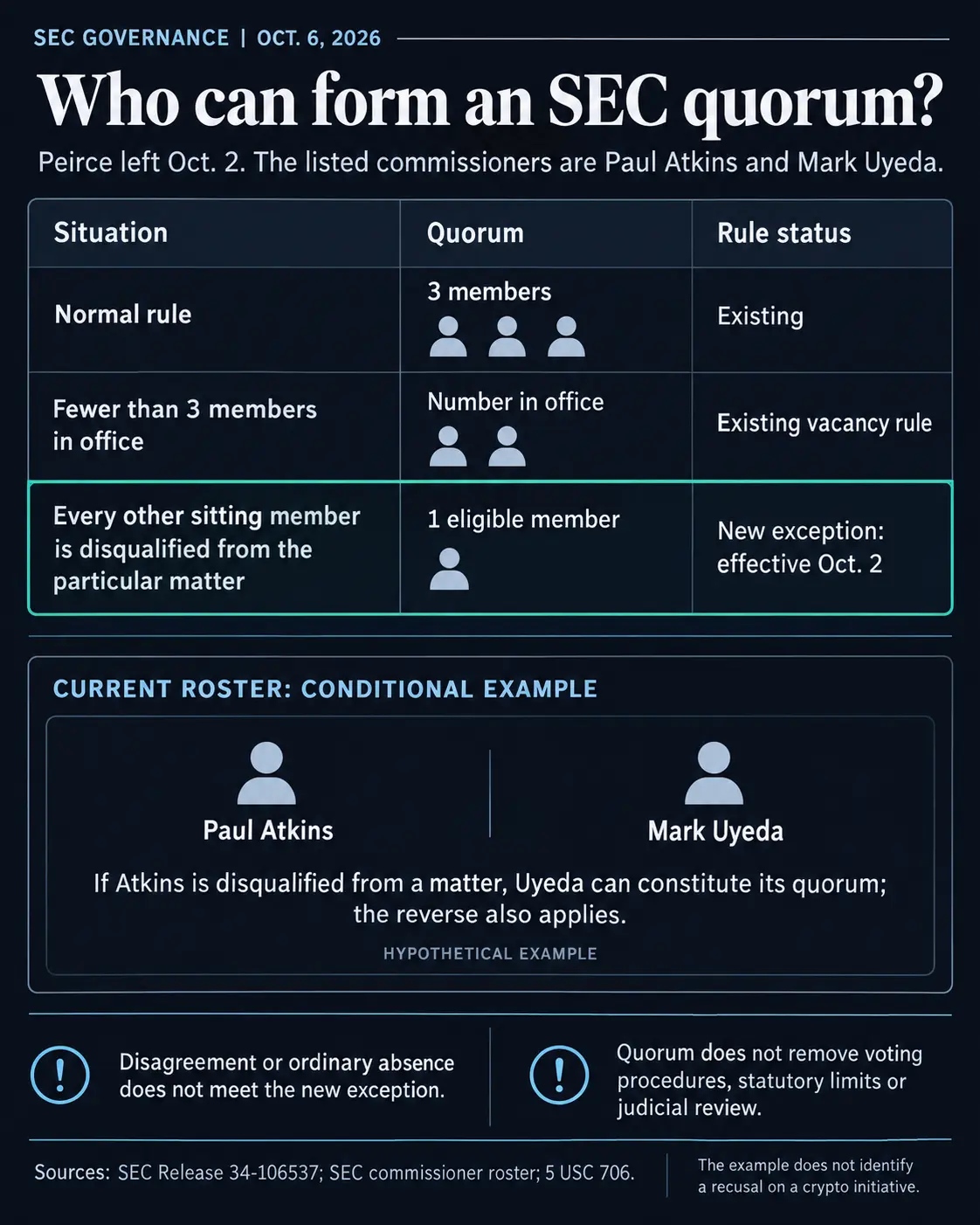
Hester Peirce’s departure from the Securities and Exchange Commission (SEC) on October 2, 2026, has significantly reshaped the agency’s leadership structure, leaving only two commissioners, Paul Atkins and Mark Uyeda, at the helm. Coinciding with this reduction in personnel, a new rule, effective the same day, permits a single eligible commissioner to constitute a quorum when all other sitting members are disqualified from a particular matter. This alteration to the SEC’s operational framework has immediate and potentially far-reaching implications for the future of cryptocurrency policy and other critical regulatory decisions, concentrating decision-making power in fewer hands under specific circumstances.
The revised rule, formally amending 17 CFR 200.41, addresses the practical necessity of maintaining agency functionality amidst potential conflicts of interest or recusals. While a prior exception already allowed for a quorum with fewer than three commissioners serving, the new amendment specifically addresses situations where disqualifications, rather than mere vacancies or absences, are the catalyst for a reduced eligible pool. This nuanced change means that if both Commissioners Atkins and Uyeda were to recuse themselves from a specific cryptocurrency-related issue due to a conflict of interest, one of them could still theoretically preside over a quorum for that particular matter, provided they are deemed eligible. This provision is designed to prevent regulatory paralysis, but it also sharpens the focus on the remaining commissioners’ individual judgments and potential biases.
Background: A Shift in Commission Composition and Regulatory Authority
Commissioner Peirce’s resignation, formally tendered in a letter dated September 21, 2026, and effective October 2, marked the end of a significant tenure characterized by her often distinct perspective on digital assets. The SEC’s official commissioner roster, updated on October 3, now lists Chairman Paul Atkins and Commissioner Mark Uyeda. This reduced roster is now operating under a modified quorum rule that allows for greater flexibility in certain, specific scenarios.
Historically, the SEC has operated with a quorum of three commissioners. The existing vacancy exception already provided a mechanism for the agency to function when fewer than the full complement of commissioners were in office. For instance, if only two commissioners were actively serving, they could constitute a quorum. However, the recent amendment takes this a step further. It introduces a specific provision for situations where disqualification, not just vacancy, leaves fewer than the usual number of commissioners able to participate in a given decision. Previously, a scenario involving two eligible commissioners after others were disqualified was covered. The amendment now explicitly extends this to a single eligible commissioner if all other sitting members are disqualified from a particular matter.
The distinction between vacancies, non-attendance, and recusal is critical. The new provision does not imply that a commissioner’s mere disagreement with a proposal constitutes a disqualification. Instead, it is targeted at situations where a commissioner has a legally recognized conflict of interest or other reason to step aside from a specific decision. This administrative amendment, published on September 30 and effective October 2, is framed by the SEC as an internal management and organizational adjustment, aimed at enhancing flexibility and ensuring finality in agency actions. However, its practical effect on who can make decisions, particularly on contentious issues like cryptocurrency regulation, is undeniable.
Chronology of Recent Regulatory Milestones and Personnel Changes
The SEC’s recent activity underscores the dynamic environment in which this quorum change occurs. Several key proposals and conditional approvals related to digital assets have been under consideration, highlighting the importance of the Commission’s decision-making capacity.
- October 1, 2026: The Commission voted to propose new rules concerning the custody of crypto assets. This significant proposal, released as IA-7023, addressed how regulated investment companies and registered advisers might handle client crypto funds and securities, alongside modernization and reporting requirements. Notably, this vote occurred with all three commissioners – Atkins, Peirce, and Uyeda – present and approving the release for public comment.
- September 21, 2026: Commissioner Hester Peirce formally submitted her resignation letter.
- September 30, 2026: The SEC published the amendment to its quorum rule (17 CFR 200.41).
- October 2, 2026: Commissioner Peirce’s resignation became effective. The quorum rule amendment also took effect on this date.
- October 3, 2026: The SEC updated its official commissioner roster to reflect the reduced membership.
- October 20, 2026: The deadline for public comments on the proposed crypto asset offering exemptions (Regulation Crypto Assets).
- December 7, 2026: The deadline for public comments on the proposed custody rules.
The timing of these events suggests a proactive approach by the agency to adapt its operational framework even as personnel changes were underway. Chairman Atkins, in a statement accompanying the custody proposal, explicitly linked custody reform to other ongoing initiatives, including the offering proposal, commission interpretations, and staff-level tokenization work. This comprehensive approach indicates that the SEC’s agenda for digital assets is multifaceted, involving various types of regulatory actions that require Commission approval at different stages.
Supporting Data and Analysis: The Practical Implications of a Reduced Quorum
The reduction in the number of sitting commissioners, coupled with the new quorum exception, brings several practical implications to the forefront, especially concerning the SEC’s ongoing engagement with the digital asset sector.

Custody Reform: The proposed custody rules, which aim to clarify how investment companies and advisors can safely manage cryptocurrency assets, represent a significant rulemaking effort. While the proposal itself was approved by the three-member Commission prior to Peirce’s departure, any subsequent actions, such as adopting final rules or addressing public comments, would now be subject to the two-member dynamic and the new quorum exception. The SEC’s statement accompanying the rule amendment emphasized flexibility and finality, suggesting an intent to streamline processes. However, the absence of a third voice in decision-making could, in some instances, lead to a more polarized debate or a quicker resolution depending on the commissioners’ alignment.
Crypto Asset Offering Exemptions: Regulation Crypto Assets, proposed in August 2026, seeks to create offering exemptions for certain crypto asset investments, accompanied by disclosure requirements and anti-fraud measures. This proposal, like the custody rules, requires a formal Commission vote for final adoption. The reduced commissioner pool means that any future votes on this regulation will involve only Atkins and Uyeda, potentially accelerating the process if they are in agreement, or leading to a deadlock if they diverge. The deadline for public comments on this rule is October 20, 2026, indicating that further Commission action is anticipated in the near future.
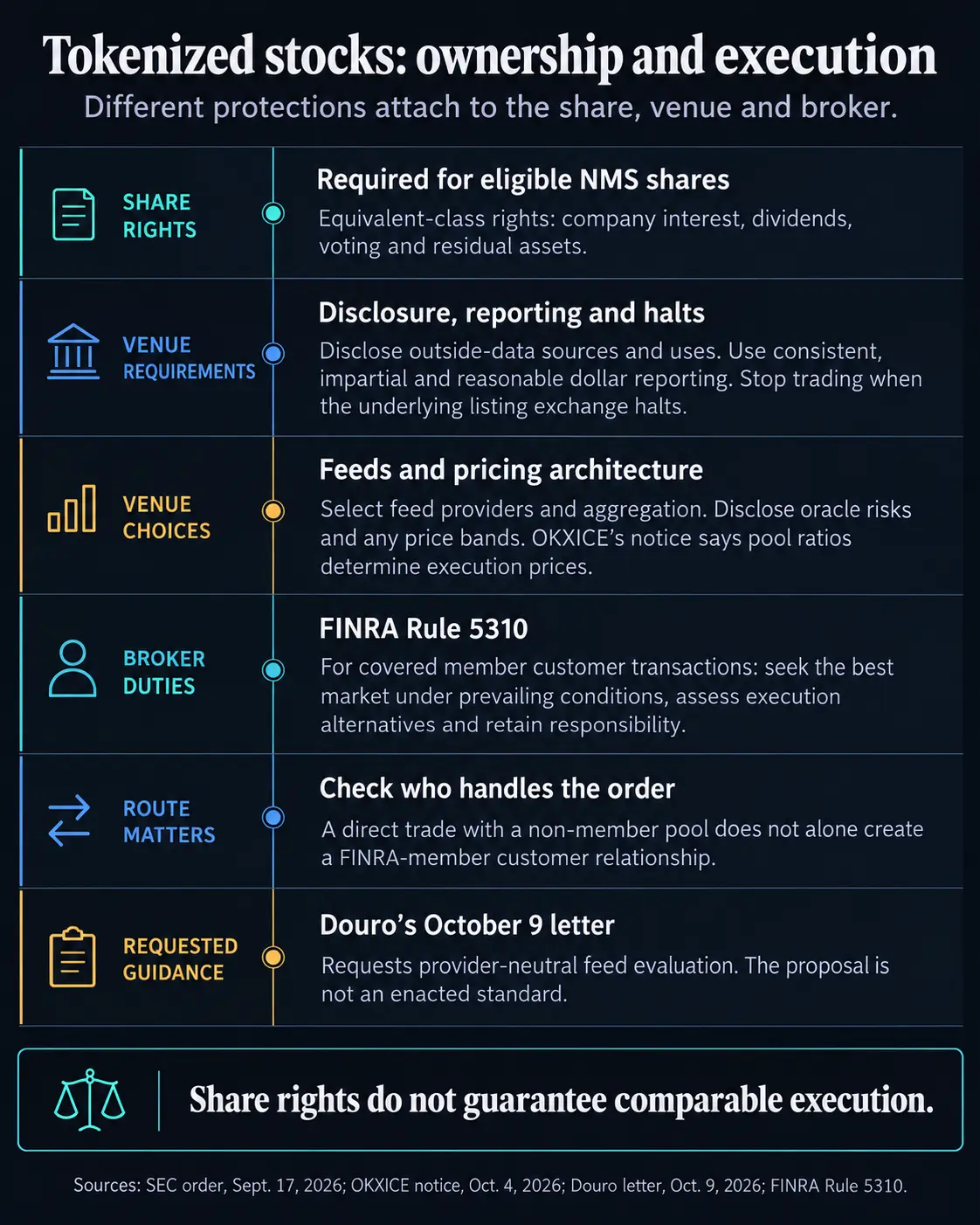
Tokenized-Stock Trading Relief: In contrast to proposed rules, the SEC has already issued conditional exemptive orders for certain aspects of tokenized stock trading. The September 17 Innovation Exemption, for example, provides temporary relief for specific tokenized National Market System (NMS) stock trading venues and liquidity providers. This order came with stringent conditions, including limitations on stock symbols and volume, requirements for equivalent shareholder rights, and publicly auditable smart contracts. While this represents a finalized action for now, any future modifications or extensions of such relief would also fall under the purview of the current two-member Commission. The new quorum rule does not expand the scope of this exemption or remove its existing safeguards.
The fact sheet accompanying the tokenized-stock relief order details a five-year conditional framework. This suggests a cautious, incremental approach to integrating tokenized securities into traditional markets. The conditions imposed reflect a desire to balance innovation with investor protection, a core mandate of the SEC. The reduced commission size might influence the speed at which such innovations are considered for broader application, but the underlying principles of investor protection and market integrity are expected to remain paramount.
Official Responses and Agency Rationale
The SEC’s justification for the quorum amendment, as published in the Federal Register, centers on the agency’s need to continue conducting business effectively, especially when disqualifications arise. The rule aims to promote "flexibility and finality" and is characterized as an internal organizational matter rather than a substantive regulatory change. This framing suggests the agency views the amendment as a procedural enhancement to ensure operational continuity.
In her resignation letter, Commissioner Peirce expressed confidence in the remaining commissioners and SEC staff to uphold the agency’s mission of balancing individual choice with sensible regulatory protections. This sentiment implies an expectation that the SEC’s core principles will guide future decisions, irrespective of the number of commissioners involved in specific votes. Chairman Atkins’ earlier statements also reflect a commitment to a balanced regulatory approach, emphasizing the need for clear rules and robust investor protections in the evolving digital asset landscape.
Broader Impact and Implications for the Crypto Industry
The implications of this structural shift for the cryptocurrency industry are significant, potentially influencing the pace and direction of regulatory developments.
- Concentration of Power: With only two commissioners, the decision-making process for crypto policy is inherently more concentrated. If both commissioners are in agreement, decisions could be made more swiftly. Conversely, a disagreement between Atkins and Uyeda on a critical crypto issue could lead to a stalemate, potentially stalling progress on important regulatory frameworks. The new quorum rule, in extreme cases of disqualification, could further amplify this concentration by allowing a single individual to cast a decisive vote.
- Potential for Expedited or Stalled Progress: The crypto industry, known for its rapid innovation and evolving challenges, often seeks regulatory clarity. A more streamlined decision-making process with two commissioners might lead to faster rulemakings and interpretations. However, the increased reliance on individual judgment and the potential for deadlock also pose risks of stalled progress.
- Increased Scrutiny on Individual Commissioners: As the number of decision-makers shrinks, the actions and pronouncements of Paul Atkins and Mark Uyeda will come under greater scrutiny from the industry, legal scholars, and the public. Their individual interpretations of securities law and their application to novel digital assets will carry significant weight.
- The Role of Staff and Delegated Authority: While the Commission’s decisions are paramount, the SEC’s statutory delegation provisions allow for certain actions to be delegated to staff. This mechanism, which excludes general rulemaking but permits Commission review of delegated actions, may become even more critical in ensuring the agency’s operational capacity. Staff no-action letters and interpretations, though not formal Commission rules, play a vital role in guiding market participants.
- Judicial Review Remains a Check: It is crucial to note that the amended quorum rule does not grant the SEC additional substantive authority or insulate its decisions from legal challenge. The Administrative Procedure Act and judicial review provisions remain in place, allowing courts to scrutinish agency actions for legality, adherence to statutory authority, and procedural fairness. The SEC’s own finding that the quorum amendment did not require notice and comment pertains to this specific organizational rule and does not exempt future substantive crypto rules from standard procedural requirements.
The SEC’s current posted October voting record, for instance, shows the three-member vote on custody proposals. While the agency generally posts votes only when a matter is final, this indicates that the reduced commission and new quorum rule have not yet resulted in a publicly documented one-member decision on a crypto matter. The upcoming deadlines for public comments on the offering and custody rules will be key indicators of how the agency, with its reduced leadership and adjusted quorum provisions, will proceed in shaping the future of cryptocurrency regulation. The industry will be closely watching these developments, as the legal status of proposed rules, recorded approvals, and the participating members will offer a clearer picture of the SEC’s operational dynamics in this critical sector.