admin
admin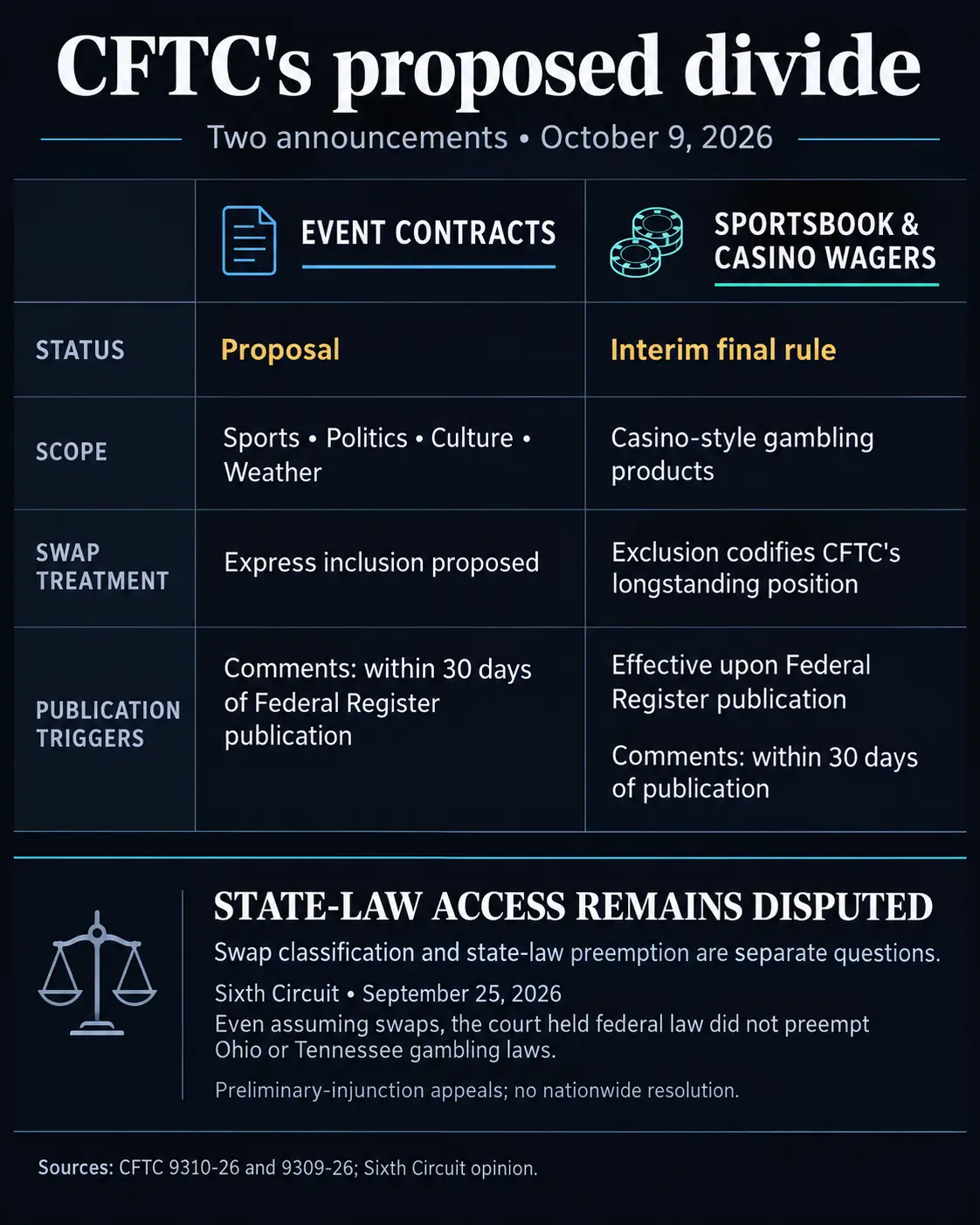
The Commodity Futures Trading Commission (CFTC) has taken a significant step to delineate the regulatory landscape between prediction markets and traditional gambling activities. On October 9th, the agency unveiled two key actions: a proposal to explicitly classify event contracts, including those related to sports, as swaps, and an interim final rule to codify the exclusion of sportsbook and casino wagers from this definition. This dual approach aims to clarify the federal regulatory boundary, though it leaves unresolved the complex interplay with state-level gambling laws and market access.
The proposed rule concerning event contracts signifies the CFTC’s assertion of exclusive jurisdiction under the Commodity Exchange Act (CEA) over products that allow participants to trade on the outcomes of future events. These events can span a wide spectrum, encompassing sports results, political elections, cultural milestones, and even weather patterns. CFTC Chairman Michael S. Selig articulated that such instruments, where traders can acquire positions with fixed payouts contingent on specific outcomes, are fundamentally financial derivatives and thus fall under the agency’s purview.
Understanding the nuances of these event contracts is crucial for grasping the CFTC’s regulatory stance. Typically, these contracts allow traders to purchase "yes" or "no" options on a future event, with a predetermined payout, often pegged at $1. The value of these contracts fluctuates directly with the perceived likelihood of the event occurring. This mechanism enables their use not only for speculation but also for hedging against potential financial risks associated with uncertain outcomes. Platforms offering these contracts, such as Polymarket, present a distinct trading experience compared to traditional sportsbooks like Cloudbet, which focus on odds-based wagering.
This proposed inclusion is not yet final. The CFTC has opened a 30-day public comment period, inviting stakeholders to submit written feedback through Regulations.gov following the proposal’s publication in the Federal Register. This engagement process is a standard procedure designed to gather diverse perspectives and ensure a thorough consideration of the potential impacts before any definitive regulatory action is taken.
In parallel, the CFTC announced a separate interim final rule aimed at solidifying its long-standing position that casino-style gambling products, including bets placed on sportsbooks and various casino games, are outside the scope of the swap definition. This rule seeks to formally codify this exclusion, providing greater regulatory certainty for operators and consumers engaged in these activities. Unlike the event-contract proposal, this interim final rule takes effect immediately upon its publication in the Federal Register, although it also includes a 30-day comment window for public input. The precise dates of Federal Register publication for both announcements have not yet been specified, meaning the October 9th date does not establish an immediate effective date or a concrete deadline for comments.
Historical Context and Regulatory Evolution
The CFTC’s involvement in regulating derivatives and commodities markets dates back decades, with the Commodity Exchange Act of 1936 establishing its foundational authority. The agency’s mandate has evolved to encompass a wide array of financial instruments, including futures, options, and swaps. The rise of prediction markets, particularly with the advent of blockchain technology enabling decentralized platforms, has presented new challenges for regulators. These platforms often mimic the structure of financial markets, allowing for the trading of contracts based on future events, which can blur the lines with traditional forms of wagering.

Historically, the CFTC has differentiated between financial derivatives and gambling. However, the increasing sophistication and market capitalization of prediction platforms have necessitated a more explicit regulatory framework. The agency’s concern lies in ensuring market integrity, preventing fraud, and protecting market participants. The distinction between a "swap" and a "wager" is therefore critical, as swaps fall under the CFTC’s direct oversight, while traditional gambling is largely governed by state laws.
The timeline leading up to these announcements has likely involved extensive internal deliberation and consultation. The Sixth Circuit’s recent ruling on preliminary injunction appeals involving Kalshi, a prediction market operator, served as a significant judicial development that likely informed the CFTC’s actions. In this case, the court questioned whether Kalshi’s sports-event contracts met the statutory definition of a swap. More importantly, the court’s alternative holding suggested that even if the contracts were deemed swaps, the CEA might not preempt state gambling laws. This judicial precedent underscores the complex legal terrain and the potential for state-level restrictions to limit the reach of federal regulations.
Supporting Data and Market Dynamics
The market for prediction markets, while still nascent compared to traditional financial markets, has seen considerable growth. Platforms like Kalshi have reported significant trading volumes in event contracts related to economic indicators, political outcomes, and, notably, sports events. For instance, during major sporting events, trading activity on these platforms can surge, reflecting a keen interest from participants to leverage their insights into sports outcomes.
The value proposition of prediction markets often lies in their ability to aggregate diverse information and market sentiment, potentially leading to more accurate forecasts than traditional polling methods. This is particularly true for complex events where expert opinions and public sentiment are fragmented. The ability to trade on these outcomes provides a financial incentive for individuals to research, analyze, and disseminate information, which can contribute to a more informed public discourse.
Conversely, sportsbooks and casinos operate on a different economic model. Their revenue is primarily derived from the vigorish or house edge embedded in the odds they offer. While they also rely on predicting outcomes to set their lines, their primary function is to facilitate wagers, managing risk through balancing their books rather than through direct participation in the market for underlying events. The distinction is often framed by whether the primary purpose is speculation and hedging on an underlying event’s outcome (prediction market) or placing a bet on a predetermined set of odds (sportsbook/casino).
Official Statements and Reactions
CFTC Chairman Michael S. Selig has been a vocal proponent of clarifying these regulatory distinctions. In his statements accompanying the recent announcements, Selig emphasized the agency’s commitment to fostering innovation while ensuring robust regulatory oversight. "These actions are designed to provide greater clarity and certainty for market participants," he stated, highlighting the importance of distinguishing between regulated financial instruments and traditional gambling.
The actions have predictably drawn attention from various stakeholders. Advocacy groups like Better Markets, which often champion stricter financial regulations, have weighed in. Benjamin Schiffrin, securities-policy director at Better Markets, voiced concerns that the CFTC’s proposal might inadvertently legitimize sports betting under the guise of financial derivatives. "The CFTC can’t tell the difference between sports betting and derivatives trading," Schiffrin argued in an October 9th statement, suggesting that sports event contracts are essentially a form of sports betting and should remain subject to existing state gambling laws. This perspective highlights the ongoing debate about the functional similarities between certain prediction market contracts and gambling.

Industry participants in the prediction market space are likely evaluating the implications of the proposed rules. While the explicit inclusion of event contracts as swaps could bring more clarity and potentially attract institutional investors, the ongoing interaction with state laws remains a critical factor. Companies that have been operating on the fringes of regulatory ambiguity may face new compliance requirements or operational challenges depending on the final classification and its interaction with state-level regulations.
Broader Impact and Implications
The CFTC’s move has significant implications for the future of prediction markets and their accessibility. By proposing to classify event contracts as swaps, the agency signals its intent to bring these markets under a more comprehensive regulatory framework. This could lead to increased transparency, enhanced consumer protections, and a more stable market environment. However, it also means that platforms offering such contracts would need to adhere to CFTC regulations, which can be extensive and costly.
The interim final rule on casino wagers, while seemingly straightforward, reinforces the existing regulatory divide. It confirms that traditional gambling operations will continue to be regulated primarily at the state level, avoiding direct CFTC oversight as swaps. This bifurcated approach acknowledges the distinct nature and historical regulatory treatment of these two types of activities.
A key unresolved issue remains the preemption of state gambling laws. The Sixth Circuit’s ruling in the Kalshi case is a stark reminder that even if a prediction market contract is classified as a swap, it does not automatically override state laws that prohibit or restrict gambling. This creates a complex patchwork where market operators may need to navigate both federal commodity regulations and a diverse array of state-specific gambling laws. For operators seeking nationwide access, winning a federal classification argument is only one part of the battle; securing the right to operate in individual states, often requiring specific licenses and adherence to state regulations, remains a formidable challenge.
The implications for innovation are also noteworthy. While regulatory clarity can foster legitimate growth, overly stringent rules could stifle nascent markets. The CFTC’s proposed approach appears to be a balancing act, seeking to define the boundaries of its jurisdiction without unduly hindering market development. However, the specifics of the final rules and their implementation will be critical in determining the long-term impact.
Furthermore, the CFTC’s actions could influence how other regulatory bodies, both domestic and international, approach the oversight of prediction markets and similar innovative financial products. As these markets continue to evolve, the CFTC’s stance will serve as an important precedent in the ongoing global conversation about regulating the intersection of finance, technology, and public interest. The comment period will be crucial in shaping how these proposals are finalized and how the prediction market landscape is ultimately shaped.