admin
admin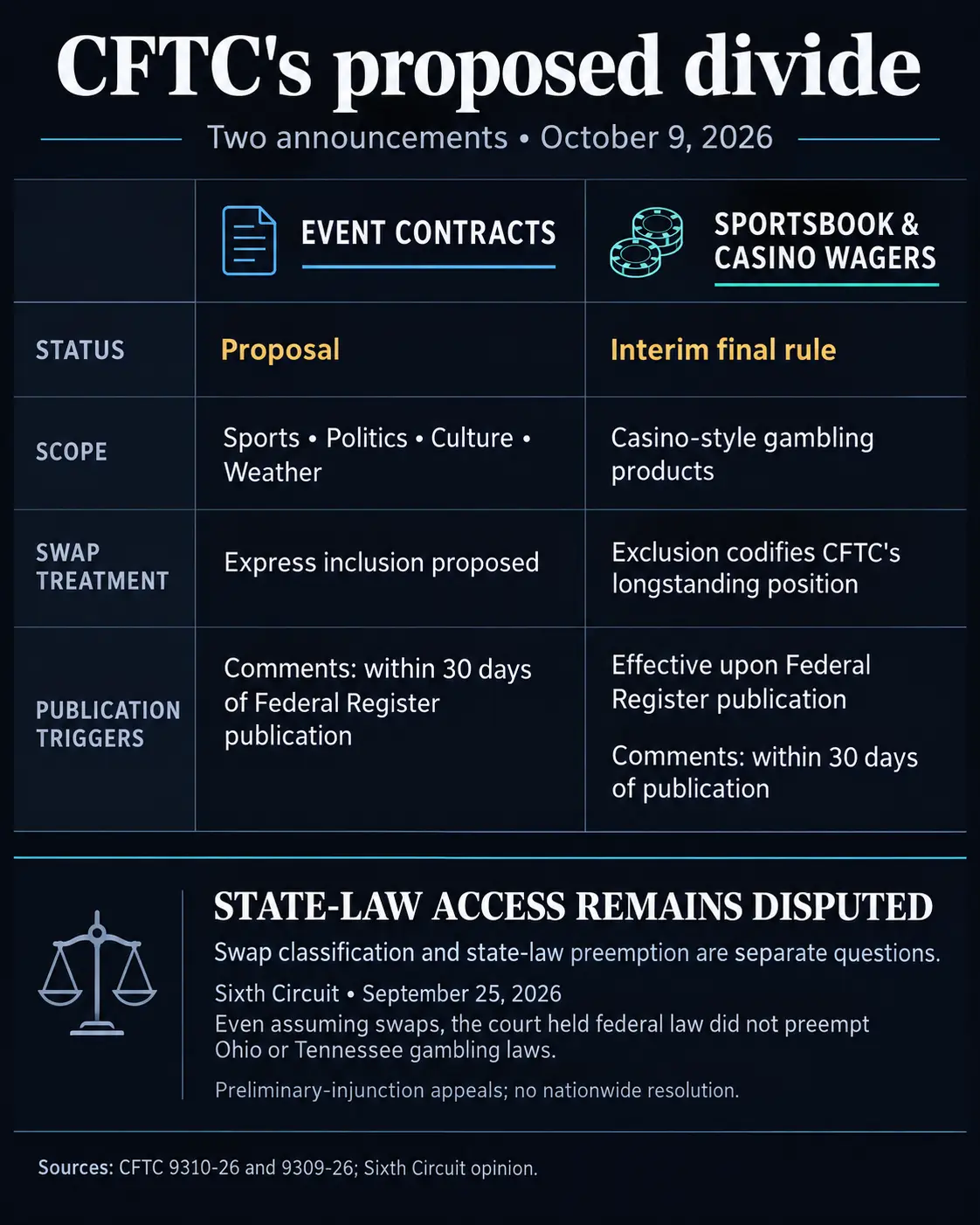
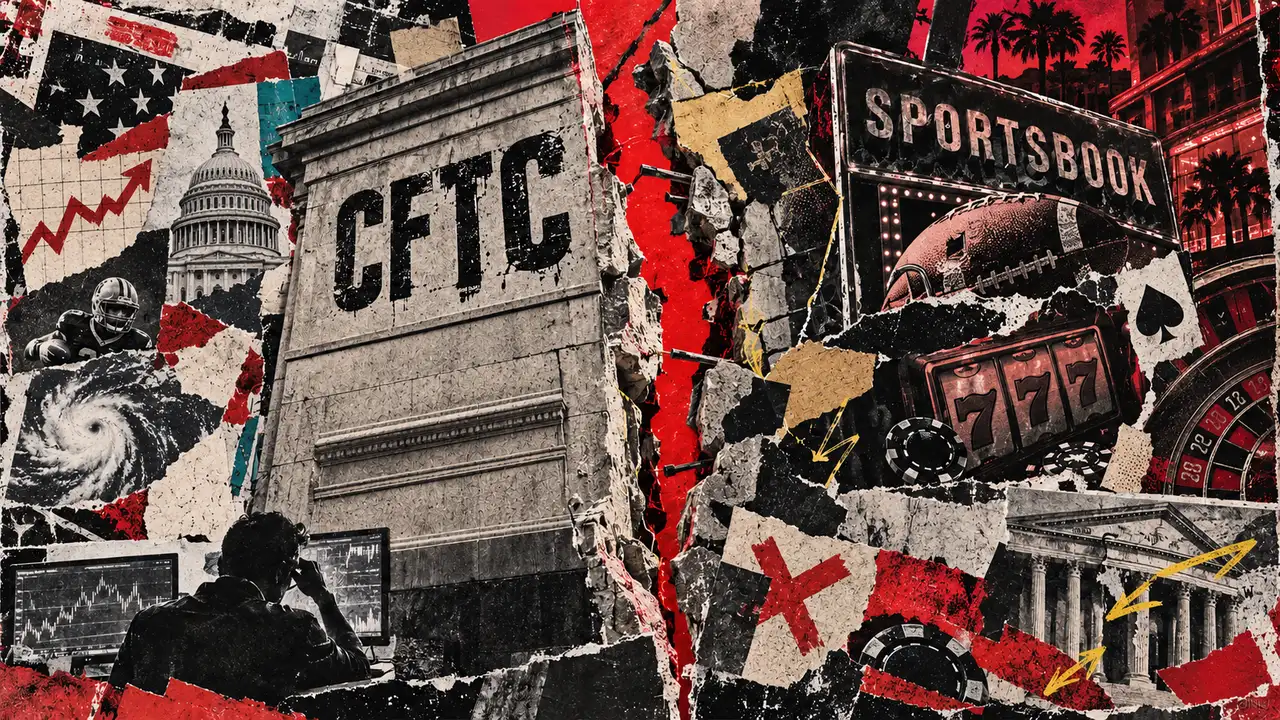
The Commodity Futures Trading Commission (CFTC) has taken a significant step toward clarifying the regulatory landscape surrounding event-based financial contracts and traditional gambling. On October 9, 2026, the agency announced two distinct actions: a proposed rule that would expressly classify sports and other event contracts as swaps, bringing them under the CFTC’s purview, and an interim final rule that codifies the exclusion of sportsbook and casino wagers from the definition of a swap. This dual approach aims to draw a sharper federal line between speculative financial instruments and outright gambling, though it leaves unresolved the complex interplay with state-level gambling regulations and the accessibility of these markets to the public.
The proposed rule regarding event contracts targets a broad spectrum of predictable outcomes, encompassing sports competitions, political elections, cultural events, and even weather-related phenomena. CFTC Chairman Michael S. Selig underscored the agency’s assertion that these products fall within its exclusive jurisdiction as defined by the Commodity Exchange Act. This classification is critical because, while appearing familiar to those engaged in betting, event contracts operate under a distinct regulatory framework. Typically, these contracts allow traders to purchase "yes" or "no" positions on a future event, with a predetermined payout, often set at $1. The value of these contracts fluctuates based on the likelihood of the predicted outcome, offering avenues for both risk hedging and speculative investment. The distinction is often highlighted by the platforms that offer them; for instance, exchanges focused on prediction markets, like Polymarket, facilitate the trading of these outcome-based contracts, whereas sportsbooks, such as Cloudbet, deal in odds-based wagers. The CFTC’s proposal is not yet final, and the agency is actively soliciting public comment, with a 30-day window for submissions following its publication in the Federal Register.
In parallel, the CFTC’s announcement of an interim final rule regarding casino wagers aims to solidify its long-standing position that traditional gambling products, including those offered by sportsbooks and casinos, are outside the scope of the "swap" definition. This exclusion, according to the CFTC, takes effect immediately upon publication in the Federal Register. Like the event-contract proposal, this interim rule also includes a 30-day comment period. While the precise dates of Federal Register publication remain pending, the October 9 announcements signal the agency’s intent to formalize this regulatory division.
Historical Context of Regulatory Ambiguity
The need for such clarification stems from a history of regulatory ambiguity and evolving market practices. For years, platforms have emerged offering contracts tied to real-world events, blurring the lines between financial derivatives and betting. The Commodity Exchange Act grants the CFTC authority over "swaps," which are broadly defined to include derivative contracts based on commodities, securities, or other indices. The interpretation of whether a contract predicting the outcome of a football game, for example, constitutes a commodity or a wager has been a persistent point of contention.
In 2013, the CFTC issued guidance on "event contracts," stating that such contracts could be deemed legal if they met specific criteria: a reasonable basis for the determination of the outcome, a fixed payout, and a limited number of participants. However, the application of this guidance has been complex, particularly as prediction markets gained traction and began to incorporate a wider array of event types, including those closely resembling traditional sports betting.
The emergence of decentralized prediction markets, often built on blockchain technology, further complicated the regulatory picture. These platforms, which allow users to bet on the outcome of various events, operate with varying degrees of transparency and oversight, prompting regulators to consider how to apply existing frameworks or develop new ones. The CFTC’s actions represent an effort to provide a clearer regulatory roadmap, distinguishing between instruments that might serve legitimate hedging or speculative purposes and those that are primarily designed for gambling.
Timeline of Key Developments
- Pre-2026: A period of regulatory ambiguity where prediction markets and event contracts operated in a gray area, with the CFTC’s 2013 guidance offering a framework but not definitive clarity for all scenarios.
- September 25, 2026: The Sixth Circuit Court of Appeals issues a ruling on preliminary-injunction appeals involving Kalshi, a prediction-market operator. The court held that Kalshi’s sports-event contracts did not meet the statutory definition of a swap. Crucially, it also ruled that, even if they were considered swaps, the Commodity Exchange Act did not preempt Ohio’s or Tennessee’s gambling laws. This ruling highlighted the dual challenge for operators: establishing a product’s classification and navigating state-level regulations.
- October 9, 2026: The CFTC announces its proposed rule to classify event contracts as swaps and its interim final rule to exclude casino wagers from the swap definition.
- Post-October 9, 2026: The CFTC opens 30-day comment periods for both the proposed rule and the interim final rule. The final effective dates for these regulations will be contingent on their publication in the Federal Register and the subsequent review of public comments.
Supporting Data and Market Trends
The market for prediction markets and event-based contracts has seen significant growth in recent years, driven by increased interest in alternative investments and speculative opportunities. While precise figures for the U.S. market are difficult to isolate due to the fragmented nature of reporting and the involvement of offshore platforms, global revenue in the sports betting market alone is projected to reach hundreds of billions of dollars annually. Prediction markets, while smaller, represent a rapidly expanding segment. Platforms like Kalshi have reported substantial increases in trading volume, particularly around major political events and sporting championships.
The appeal of these markets lies in their ability to offer insights into public sentiment and future probabilities. For example, the trading activity on a contract predicting the outcome of an election can serve as a real-time indicator of voter sentiment, distinct from traditional polling methods. Similarly, in sports, prediction markets allow for a more nuanced form of engagement beyond simply betting on a winner, potentially including outcomes like total points scored or specific player performances.
However, the growth of these markets has also attracted scrutiny from consumer protection advocates and financial regulators concerned about the potential for fraud, market manipulation, and the impact on vulnerable individuals. The CFTC’s intervention is partly a response to these concerns, seeking to ensure that markets operate with integrity and transparency.
Broader Impact and Implications
The CFTC’s bifurcated approach has significant implications for various stakeholders. For prediction-market operators, the proposed classification as swaps could bring them under a more stringent regulatory regime, requiring compliance with rules related to trading, clearing, and reporting. This could lead to increased operational costs but also potentially enhance the legitimacy and investor confidence in these markets. The inclusion of event contracts as swaps could also pave the way for greater integration with traditional financial markets, potentially leading to more sophisticated hedging and investment strategies.
Conversely, the explicit exclusion of sportsbook and casino wagers from the swap definition reinforces their status as gambling activities, subject to state and local regulations. This distinction could create a clearer separation for investors and consumers, helping them understand the regulatory framework under which they are operating.

However, the unresolved issue of state-law preemption remains a critical hurdle. The Sixth Circuit’s ruling in the Kalshi case, which suggested that the Commodity Exchange Act does not automatically preempt state gambling laws, underscores this complexity. Even if prediction-market contracts are deemed swaps under federal law, operators may still face significant challenges in gaining nationwide access if individual states maintain their own prohibitions on gambling. This could lead to a patchwork of regulations, with some states allowing access to these contracts while others restrict it, mirroring the current landscape of online sports betting.
Reactions from Stakeholders
Advocacy groups like Better Markets have expressed strong opinions on the CFTC’s actions. Benjamin Schiffrin, securities-policy director at Better Markets, argued in an October 9 statement that sports event contracts are fundamentally enabling sports betting and should therefore remain subject to state gambling laws. This perspective suggests that the CFTC’s move to classify them as swaps might be an overreach or an attempt to circumvent existing state-level consumer protections.
On the other hand, proponents of prediction markets often emphasize their role as tools for risk management and price discovery, distinct from pure gambling. They argue that the CFTC’s oversight would bring much-needed legitimacy and stability to these markets, fostering innovation and investor participation. The comment periods for both rules will likely see robust engagement from industry participants, legal experts, and consumer advocates, offering a diverse range of perspectives on the proposed regulatory framework.
Analysis of Regulatory Strategy
The CFTC’s strategy of proposing one rule and enacting another as an interim final rule suggests a pragmatic approach to addressing a complex and rapidly evolving market. By proposing the inclusion of event contracts as swaps, the agency signals its intent to assert jurisdiction over a growing segment of financial activity. The open comment period allows for thorough consideration of potential impacts and industry feedback.
Simultaneously, the interim final rule excluding casino wagers provides immediate clarity on the CFTC’s stance regarding traditional gambling. This rapid action aims to prevent further regulatory confusion and potential arbitrage opportunities that might arise from the ambiguity surrounding these products.
However, the fundamental challenge of federal versus state authority in gambling regulation persists. The CFTC’s actions primarily define what constitutes a "swap" under federal law. They do not, by themselves, grant or deny access to these markets within individual states. The ongoing legal battles, such as the one involving Kalshi, will continue to shape the broader accessibility of event contracts and prediction markets across the United States. The ultimate outcome will likely depend on a combination of federal regulatory clarity, ongoing judicial interpretations, and the evolving legislative landscape at the state level. This regulatory tug-of-war ensures that the boundary between financial innovation and traditional gambling will remain a dynamic and closely watched area for years to come.