James Watt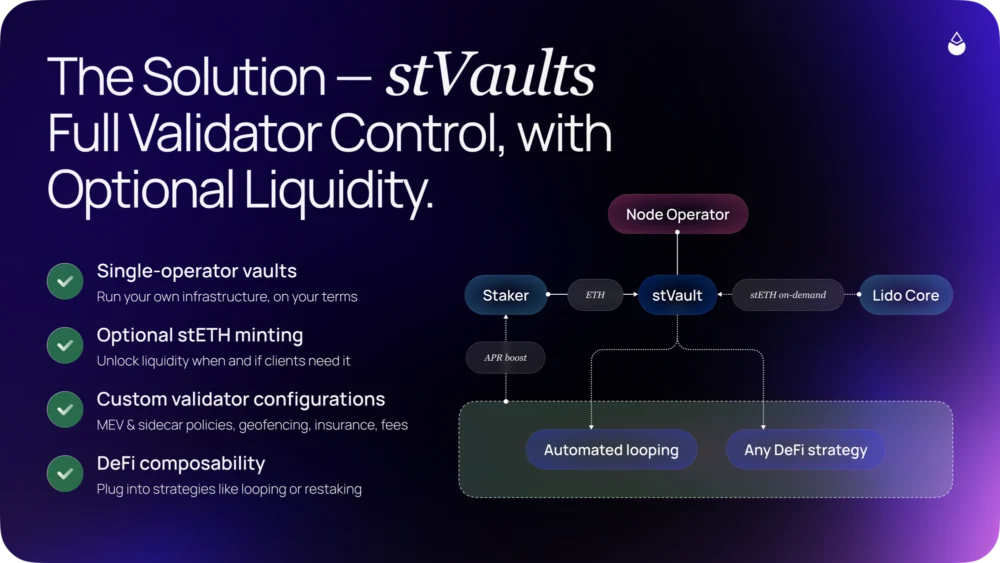
Lido Finance, a leading liquid staking protocol, has officially launched Lido V3 on the Ethereum mainnet, marking a significant evolution in the decentralized finance (DeFi) landscape. This latest iteration introduces stVaults, a novel modular staking primitive designed to offer unparalleled flexibility and customization for a diverse range of stakers, from institutional investors to specialized node operators and Layer 2 (L2) ecosystems. The launch follows an extensive period of rigorous validation, including multiple public testnets, comprehensive security reviews, and a controlled mainnet soft-launch, underscoring Lido’s unwavering commitment to security and open software principles.
Background: The Evolution of Ethereum Staking and Lido’s Pioneering Role
The transition of Ethereum from a Proof-of-Work (PoW) to a Proof-of-Stake (PoS) consensus mechanism, commonly known as "The Merge" in September 2022, fundamentally reshaped how participants secure the network and earn rewards. Staking ETH directly requires locking up a minimum of 32 ETH and operating a validator node, a process that can be technically demanding and capital-intensive. More critically, direct staking historically came with significant illiquidity, as staked ETH was locked for an indefinite period until withdrawals were enabled post-Merge, and even now, withdrawals are subject to network-wide queues.
It was against this backdrop that liquid staking protocols emerged, with Lido Finance quickly establishing itself as the dominant player. Lido’s core offering, stETH (staked ETH), provides users with a liquid token representing their staked ETH plus accumulated rewards. This innovation liberated staked capital, allowing stakers to participate in the broader DeFi ecosystem – using stETH as collateral, for lending, or in liquidity pools – without forfeiting their staking rewards or facing the constraints of withdrawal queues. Lido’s success is evident in its market penetration, currently commanding over 30% of the total staked ETH, making stETH a cornerstone of the DeFi economy.
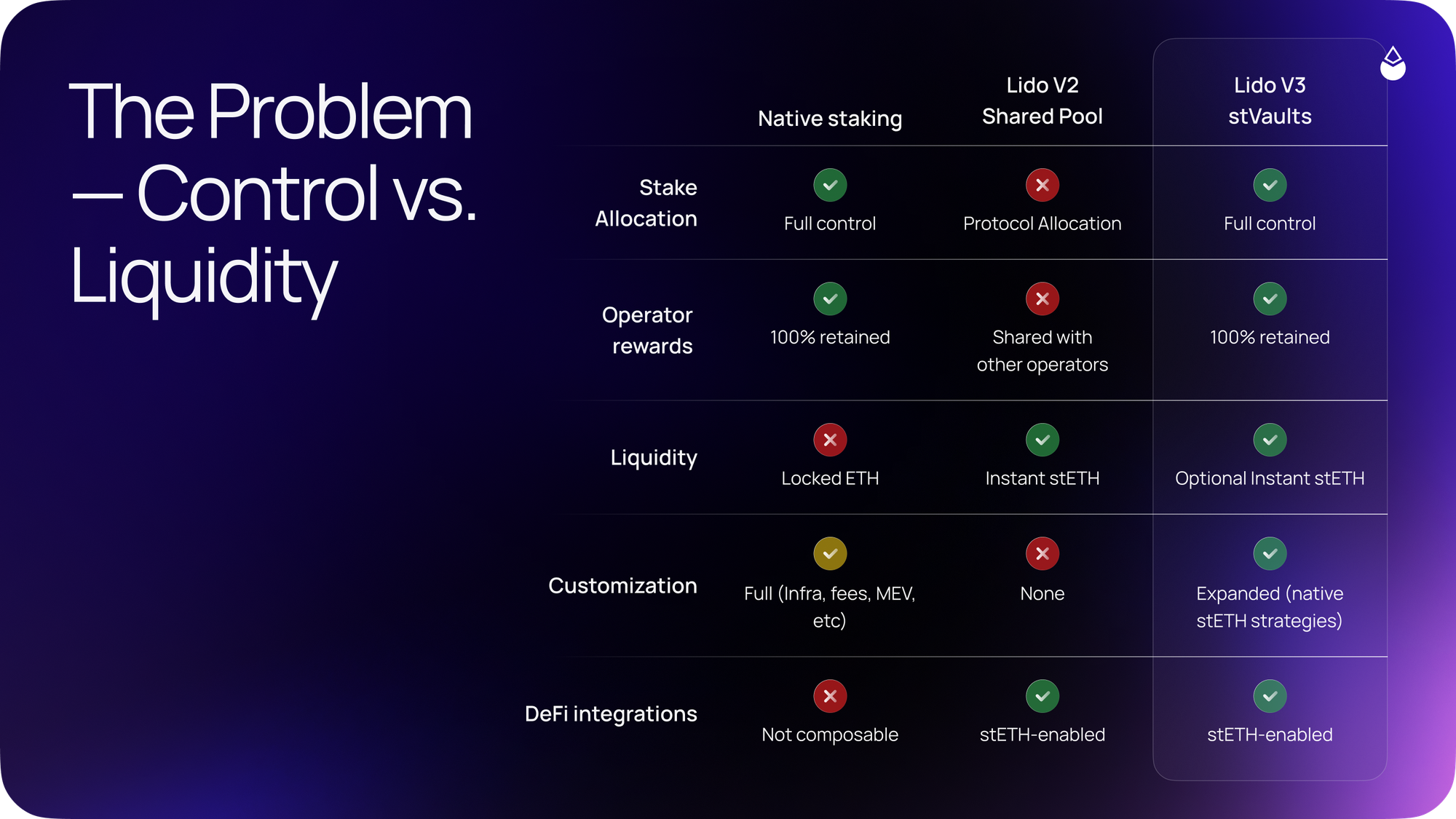
However, despite the immense utility of pooled liquid staking, a structural trade-off persisted for certain stakers. They were forced to choose between the broad liquidity and simplicity of a pooled model like Lido Core, or the bespoke control and tailored configurations of solo staking, which often came with significant illiquidity and operational overhead. This dilemma particularly affected institutional entities and specialized operators requiring specific risk parameters, compliance features, or differentiated service offerings. Lido V3, with its introduction of stVaults, directly addresses this critical market gap.
The Genesis of stVaults: Addressing a Critical Market Gap
The development journey of Lido V3 and stVaults has been a deliberate and meticulous process, emphasizing a security-first approach characteristic of critical blockchain infrastructure. The design and validation phase spanned over a year, involving a collaborative effort from Lido contributors, security researchers, and the broader community.
The timeline for Lido V3’s rollout can be broadly categorized:
- Early 2024: Initial conceptualization and architectural design of stVaults, focusing on modularity and security primitives.
- Mid-2024: Development and internal testing phases, followed by the deployment on multiple public testnets (e.g., Goerli, Sepolia). These testnets allowed developers and potential users to interact with the stVaults contracts in a simulated environment, stress-testing functionalities and identifying potential vulnerabilities.
- Late 2024: Engagement of leading blockchain security firms for multiple independent security audits. These audits rigorously reviewed the smart contract code, identifying and remediating any potential exploits or design flaws. The audit reports were made public, fostering transparency and community confidence.
- Early 2025: A phased mainnet soft-launch, where a limited number of early adopter partners and trusted entities began utilizing stVaults in a controlled production environment. This crucial step provided real-world performance data and allowed for final adjustments before a full public release.
- January 2026: Official public launch on the Ethereum mainnet, making stVaults available to the broader ecosystem.
This rigorous, multi-stage validation process was designed to ensure that Lido V3 delivers the same high standards of security and durability that have characterized the Lido protocol since its inception.
Unpacking stVaults: A New Paradigm for Composable Staking Infrastructure
stVaults fundamentally transform Lido from a single pooled liquid staking product into a versatile, composable staking infrastructure. At its core, an stVault allows for significant customization while retaining access to the profound network effects and liquidity of stETH. This means stakers can now dictate parameters such as:
- Operator Selection: Choose specific node operators to stake with, enabling preferences based on performance, geographic location, or ethical considerations.
- Policies and Fees: Define custom operational policies, reward distribution logic, and fee structures tailored to their specific business models or compliance requirements.
- Risk Parameters: Implement bespoke risk management strategies, including specific rebalancing triggers or exposure limits.
Crucially, despite this level of customization, stVaults maintain connectivity to stETH’s shared liquidity layer. This ingenious design resolves the long-standing dilemma between bespoke control and liquid utility, empowering any team or entity to build a staking business leveraging the most powerful liquidity primitive in DeFi.
"Lido V3 represents a pivotal moment for Ethereum staking," stated a lead Lido contributor. "We’ve evolved beyond a single-product offering to provide a foundational layer for diverse staking businesses. stVaults are not just about more options; they’re about empowering innovation and expanding the addressable market for liquid staking, particularly for those who previously found the pooled model insufficient for their needs."
Implications for Institutional Adoption: Bridging the Gap to Traditional Finance
The institutional appetite for digital assets, and particularly for yield-bearing assets like staked ETH, has been steadily growing. However, traditional financial institutions, asset managers, and corporate treasuries operate under stringent regulatory frameworks and possess unique operational requirements that often clashed with the existing liquid staking models. These requirements typically include:
- Dedicated Infrastructure: A need for segregated validator infrastructure for enhanced security, compliance, and auditing.
- Custom Risk Management: Specific risk profiles, diversification strategies, and the ability to dictate risk parameters.
- Transparent Reporting: Granular, auditable performance and operational reporting for regulatory and internal oversight.
- Jurisdictional Compliance: Adherence to specific regulatory mandates that might require particular operator types or geographical distribution.
- Liquidity Management: The avoidance of long exit queues and illiquidity risk that are incompatible with treasury management and fund redemption cycles.
Traditional staking models frequently failed to meet these sophisticated demands. stVaults directly address these challenges by enabling segregated vault structures linked to dedicated validator infrastructure, while still offering the option for stETH liquidity. This hybrid approach allows institutions to achieve institution-grade staking controls without being forced to choose between customization and liquidity.
Early deployments of stVaults underscore this new design space. For example, a prominent digital asset fund is reportedly leveraging stVaults to establish a compliant, segregated staking solution that meets its internal risk mandates and external regulatory obligations. Another example involves a corporate treasury deploying stVaults to manage its ETH holdings, ensuring predictable liquidity for operational needs while still generating staking yield through a dedicated validator set.
"The introduction of stVaults by Lido is a game-changer for institutional participation in Ethereum staking," commented Sarah Chen, Head of Digital Asset Strategy at a major investment firm. "The ability to customize operator selection, implement specific risk policies, and maintain stETH liquidity finally provides the necessary infrastructure for regulated entities to engage with liquid staking at scale, without compromising on security or compliance. This unlocks significant capital previously sidelined due to structural limitations."
Empowering Node Operators: From Commoditized Service to Differentiated Products
Lido V3 also fundamentally alters the business case for Node Operators within the Lido ecosystem and beyond. In the pre-stVaults era, operators primarily had two choices: either join Lido’s pooled validator set, where their services were largely commoditized and differentiated primarily by uptime, or run independent solo staking operations, which entailed significant business development and liquidity challenges.
stVaults create a vibrant new market for operator-led products. Node operators can now develop and offer specialized vaults mapped to their unique validator infrastructure, complete with customized operational policies and service level agreements. This enables them to compete on factors beyond just price or generic performance, such as:
- Specialized Infrastructure: Offering enterprise-grade hardware, geographically distributed validators, or carbon-neutral operations.
- Enhanced Reporting: Providing granular, transparent performance and attestation reporting directly to institutional clients.
- Premium Services: Bundling staking with additional services like custody, insurance, or advisory.
A notable early adopter is P2P.org, a leading staking provider, which is building dedicated stVaults specifically for institutional clients. These vaults will link directly to P2P.org’s validator operations, allowing for deep customization and transparent performance reporting, thereby strengthening their institutional offering. This foundational flexibility also supports a broader range of products, from conservative, risk-averse staking exposures to more advanced, curator-driven DeFi vault strategies built around stETH.
"stVaults empower node operators like never before," said a representative from a leading validator network. "We can now move beyond being a backend service to offering truly differentiated, front-facing products. This allows us to leverage our expertise in infrastructure and security to build tailored solutions that resonate with specific client segments, especially those with stringent requirements."
Accelerating Innovation: Strategy Flexibility and Builder Tooling
Beyond institutional and operator benefits, stVaults significantly expand the design space for staking strategies and lower the barrier to entry for developers. The modularity of stVaults allows for the creation of innovative products such as:
- stETH Yield-Backed Fixed Income Products: Building structured products that offer predictable returns by leveraging the underlying stETH yield.
- Risk-Optimized Staking Portfolios: Developing sophisticated portfolios that dynamically allocate ETH to different stVaults based on specific risk appetites and performance objectives.
- Institutional DeFi Strategies: Crafting complex DeFi strategies for institutions that integrate staking yield with other decentralized protocols, while maintaining control over underlying assets.
Accompanying this strategic flexibility is a robust "DeFi Wrapper" toolkit, specifically designed to reduce the time-to-market for teams launching user-facing staking products. This low-code deployment solution includes:
- Smart Contracts: Pre-audited and customizable smart contract templates for various vault configurations.
- SDKs (Software Development Kits): Tools to easily integrate stVault functionalities into existing applications.
- UI Components: Reusable user interface elements to quickly build intuitive front-ends for staking products.
Builders can choose to utilize pre-integrated curated strategies, accelerating product development without the need to build complex curation logic from scratch, or integrate custom strategies to achieve unique competitive advantages in specific market segments. This comprehensive toolkit is set to democratize access to sophisticated staking product development.
Embedded Staking for Layer 2 Solutions: Unlocking Native Yield
The modularity of stVaults also paves the way for a transformative shift in how staking yield is integrated into Layer 2 (L2) ecosystems. As Ethereum scales through L2s, a significant amount of ETH is bridged to these networks, often sitting idle. This represents a missed opportunity for yield generation and ecosystem incentives.
With stVaults, L2s can now seamlessly route bridged ETH into staking, utilizing the resulting yield to support ecosystem incentives, liquidity programs, or even protocol revenue, all without introducing new, cumbersome user journeys. This approach treats staking as a fundamental piece of infrastructure – a yield-bearing base layer that protocols can integrate directly, rather than a standalone action users must explicitly take.
Linea, a leading L2 solution, is an early mover in this direction. Their integration with Lido V3 demonstrates how staking can become an intrinsic part of L2 network economics, providing native yield to users and protocols while preserving familiar user flows and enhancing overall capital efficiency within the L2 environment. This pattern is crucial for the sustainable growth of L2s, enabling them to offer competitive yields and attract more capital into their ecosystems.
"The integration of stVaults on L2s like Linea is a pivotal step towards a more capital-efficient and composable blockchain ecosystem," noted an L2 ecosystem lead. "By embedding native staking yield directly into Layer 2s, we can unlock new economic models, incentivize participation, and provide users with passive income streams without forcing them to bridge back to mainnet or engage in complex DeFi strategies. This makes L2s even more attractive and functional."
Market Impact and Future Outlook
Lido V3’s launch and the introduction of stVaults are poised to have a profound impact on the Ethereum staking landscape and the broader DeFi ecosystem. By transforming liquid staking from a singular product category into a versatile infrastructure, Lido is facilitating:
- Increased Institutional Participation: Opening doors for traditional finance with compliant, customizable, and liquid staking solutions.
- Innovation for Node Operators: Empowering operators to build differentiated products and expand their business models.
- Enhanced Capital Efficiency: Enabling L2s and other protocols to integrate native yield, fostering more robust and economically viable ecosystems.
- Accelerated Product Development: Providing builders with tools and flexibility to rapidly deploy new staking-focused products.
To encourage early adoption and innovation, Lido contributors have announced an early adopter campaign. Until March 31st, 2026, the Lido Infrastructure fee for identified stVaults with a Total Value Exceeding 250 ETH will be reduced from 1% to 0%. This promotional period aims to incentivize developers and institutions to explore and build upon the new stVaults primitive. Interested parties are encouraged to contact the stVaults team and refer to the official documentation for more details on this campaign.
Lido V3 solidifies Lido’s position not just as a liquid staking provider, but as a critical infrastructural layer for the entire Ethereum ecosystem. By offering unparalleled modularity and control, stVaults are set to catalyze a new wave of innovation, drive broader adoption of staked ETH, and ultimately contribute to the long-term security and decentralization of the Ethereum network. The future of staking is no longer a binary choice between liquidity and control; with stVaults, it is a spectrum of possibilities.
Builders and teams interested in leveraging this new primitive can access comprehensive resources through the stVaults Documentation Center and the Lido V3 Whitepaper, which provides in-depth details on key concepts such as Reserve Ratios, risk tiers, and forced rebalancing. The era of composable, customized staking has truly begun.