James Watt
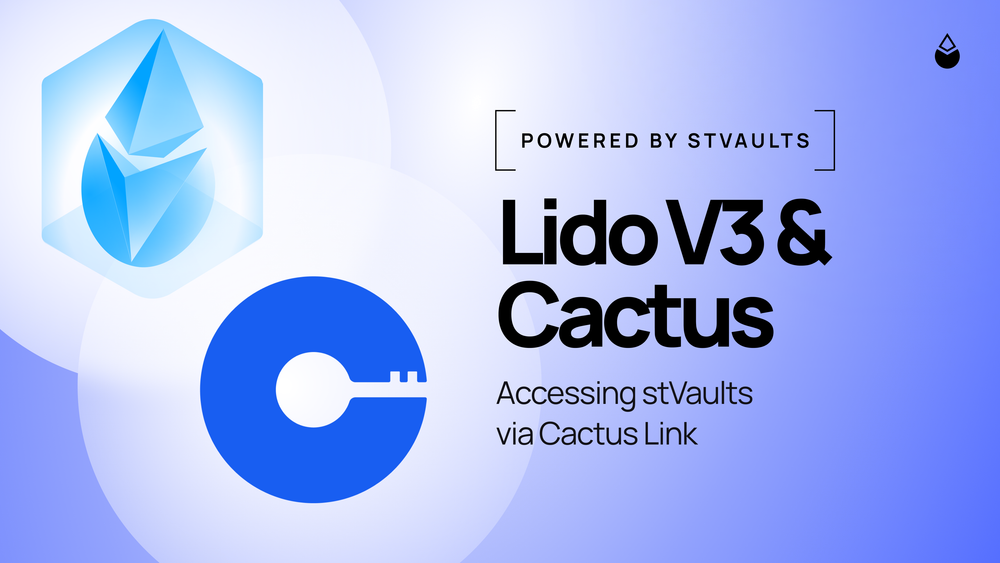
Cactus Custody, a leading institutional digital asset custodian, has officially announced its support for Lido V3 stVaults through its innovative DeFi connector, Cactus Link, marking a significant milestone in bridging traditional finance with decentralized ecosystems. This integration empowers Cactus Custody’s extensive client base to seamlessly create and manage dedicated stVaults directly from their existing custody accounts, offering unprecedented control and customization over their Ethereum staking operations. The move underscores a growing trend of institutional-grade solutions emerging within the decentralized finance (DeFi) space, addressing critical needs for security, compliance, and operational flexibility.
The integration is particularly notable given the increasing institutional interest in staking as a yield-generating strategy within the cryptocurrency market. Lido Protocol, a dominant force in liquid staking, developed stVaults as a modular staking infrastructure designed specifically for large staking entities, including investment funds, asset managers, ETFs, and ETPs. Unlike traditional pooled staking models, stVaults introduce a single-operator architecture, granting institutions granular control over key parameters such as validator choice, fee structures, infrastructure providers, and even geographical or jurisdictional preferences for their staking operations. Crucially, this dedicated approach does not sacrifice liquidity, as stVaults retain the option for on-demand liquidity through stETH minting, a critical feature for institutional treasuries and portfolio managers.
A Deep Dive into the Integration: Cactus Link and stVaults Functionality
The technical underpinning of this integration relies on Cactus Link, a browser extension designed to function similarly to a standard hot wallet but with the enhanced security protocols of an institutional custody solution. The setup process is streamlined, requiring just two primary steps for vault owners to connect their Cactus Custody accounts. Once connected, institutional clients gain comprehensive capabilities for managing their stVaults. This includes essential day-two operations such as supplying or withdrawing ETH, minting or repaying stETH, continuously monitoring vault health, triggering rebalancing operations, initiating vault closures, and executing emergency procedures as needed.
For administrators, a crucial security measure involves whitelisting the specific stVaults smart contract addresses before any interaction can commence. This pre-approval mechanism reinforces the security posture, ensuring that all on-chain actions are directed only to verified and approved contracts. The full setup instructions and address lists are meticulously detailed in the Cactus Custody user guide and the Qualified Custodians overview, providing a clear roadmap for institutional clients to onboard and operate their dedicated staking vaults securely.
This sophisticated operational flow caters specifically to vault owners – institutions that require the autonomy to establish and manage their own staking infrastructure without relinquishing the security and compliance assurances provided by a qualified custodian. Cactus Custody emphasizes that support for stVaults may vary depending on jurisdiction, entity type, and onboarding scope, advising teams to confirm availability and policy settings with their dedicated Cactus account managers prior to vault creation.
The Rise of Institutional Staking and Liquid Staking
The burgeoning institutional interest in staking is driven by several factors, including the attractive yields offered by proof-of-stake networks like Ethereum, the opportunity to participate in network security, and the desire to diversify digital asset portfolios. Ethereum’s transition to Proof-of-Stake (the Merge) significantly enhanced its appeal to institutional investors by offering a more energy-efficient and potentially more scalable blockchain. Staking, in essence, allows holders of ETH to lock up their assets to support the network’s operations and, in return, earn rewards.
However, direct staking often comes with a trade-off: locked capital. This is where liquid staking protocols like Lido have revolutionized the landscape. Lido allows users to stake their ETH and receive stETH (staked ETH) in return, which is a liquid, yield-bearing token representing their staked ETH plus accumulated rewards. stETH can then be used across various DeFi protocols, providing liquidity and additional yield opportunities that would otherwise be inaccessible with locked native ETH. This innovation has been pivotal in driving broader adoption of staking, especially among entities requiring capital efficiency.
The market for liquid staking has seen exponential growth. Lido, launched in December 2020, quickly became the largest liquid staking protocol, commanding a significant share of the total staked Ethereum. Its success lies in simplifying the staking process and mitigating the illiquidity risk. As of early 2026, the total value locked (TVL) in liquid staking protocols across various blockchains has surpassed tens of billions of dollars, with Ethereum leading the charge. This growth trajectory highlights the increasing demand for accessible and liquid staking solutions, a demand that stVaults further refines for the institutional segment.
Cactus Custody: A Pillar of Institutional Trust
Cactus Custody, an institutional digital asset custody solution under the umbrella of BIT (formerly Matrixport), has positioned itself as a crucial infrastructure provider in the evolving digital asset landscape. Founded in February 2019, the platform has rapidly expanded its services, safeguarding digital assets across more than 60 blockchain ecosystems for a diverse clientele exceeding 400 institutional clients. This includes a wide array of financial entities such as investment funds, asset managers, cryptocurrency exchanges, over-the-counter (OTC) providers, payment platforms, mining pools, and institutional participants in the DeFi space.
The credibility and trustworthiness of Cactus Custody are underpinned by its robust regulatory compliance and stringent security attestations. The firm holds a Hong Kong Trust or Company Service Provider (TCSP) license, a testament to its adherence to strict regulatory standards within a major financial hub. Furthermore, it possesses a Bhutan Gelephu Mindfulness City Authority (GMCA) Financial Services Licence (FSL), indicating a proactive approach to expanding its regulated operational scope. Beyond licensing, Cactus Custody has achieved SOC 1 Type II and SOC 2 Type II attestations from Deloitte, covering its comprehensive custody operations. These independent audits provide critical assurance regarding the design and operating effectiveness of the company’s internal controls related to security, availability, processing integrity, confidentiality, and privacy of client data.
Cactus Custody’s architectural design combines the best of both worlds: hardware security module (HSM)-backed cold storage for maximum asset protection and an institutional-grade multi-party computation (MPC) offering. This hybrid approach provides clients with the flexibility to choose between qualified-custodian models, where the custodian maintains control over private keys, and self-custody-style configurations, where clients retain a higher degree of direct control over their assets through MPC technology while still leveraging the custodian’s secure infrastructure. This blend of security, flexibility, and regulatory compliance makes Cactus Custody a preferred partner for institutions navigating the complexities of digital asset management.
Addressing Institutional Needs: Control, Security, and Liquidity
The introduction of stVaults directly addresses a long-standing challenge for institutions participating in staking: the "control-versus-liquidity" tradeoff. While pooled staking offers ease of access and liquidity through tokens like stETH, it often means institutions cede control over critical operational aspects. StVaults fundamentally shifts this paradigm.
With stVaults, institutions can deploy dedicated, customizable vaults, effectively creating their own private staking infrastructure within the Lido ecosystem. This level of customization allows them to:
- Choose Validators: Institutions can select their preferred validator operators, ensuring alignment with their internal risk profiles, geographical mandates, or compliance requirements. This contrasts sharply with pooled staking, where validator selection is typically opaque or beyond the individual staker’s control.
- Define Fee Terms: Direct negotiation and configuration of fee structures become possible, allowing institutions to optimize their yield generation and manage costs more effectively.
- Control Infrastructure: The ability to specify infrastructure parameters provides an added layer of control and resilience, catering to the diverse operational needs of large-scale entities.
- Geographical and Jurisdictional Parameters: For global institutions, the ability to define where their validators operate can be crucial for meeting regulatory obligations or internal policy guidelines regarding data sovereignty and operational domicile.
- MEV Routing and Insurance Mandates: Maximizing Extractable Value (MEV) routing strategies can be customized to align with institutional preferences, while the option to configure specific insurance mandates provides an additional layer of risk mitigation tailored to their specific risk appetites.
This granular control is not just about preference; it’s about meeting stringent internal risk management frameworks, compliance mandates, and operational policies that are standard practice in traditional finance. By providing a framework where these requirements can be met within a decentralized staking environment, stVaults significantly lowers the barrier for large institutions to engage with DeFi in a compliant and controlled manner.
Technical Architecture and Operational Flow
The seamless operation of stVaults through Cactus Link is a testament to thoughtful design and robust engineering. The browser extension acts as a secure conduit, enabling vault owners to initiate and approve on-chain transactions directly from their familiar custody interface. This eliminates the need for complex key management or interaction with multiple, disparate platforms, streamlining the institutional user experience.
Beyond initial setup, the platform provides comprehensive tools for ongoing management. Real-time monitoring of vault health is critical, allowing institutions to track performance, rewards, and potential issues promptly. The ability to trigger rebalancing ensures optimal asset allocation and risk management within the vault. Furthermore, clearly defined emergency procedures are in place, providing a structured response mechanism for unforeseen events, a crucial component for institutional-grade operations.
Security remains paramount. While the stVaults framework offers enhanced control, standard Ethereum staking risks, such as slashing (penalties for validator misbehavior) and smart contract vulnerabilities, still apply. To mitigate these, Lido V3 contracts have undergone rigorous audits by leading blockchain security firms. Additionally, Lido maintains an active bug bounty program, incentivizing ethical hackers to identify and report vulnerabilities, further strengthening the protocol’s resilience. Operational controls are also in place to reduce human error and malicious activity. However, Lido clearly states that while these measures are intended to reduce risks, they do not eliminate underlying protocol or market risks, and additional risks may remain or be unidentified.
For institutions, a key advantage is that stVaults can be operated within a familiar security model, where on-chain actions are gated by existing Cactus Custody policies, leveraging multi-signature approvals and transaction limits. This aligns with standard institutional practices, providing a crucial layer of comfort and control. Despite these safeguards, teams are strongly advised to conduct their own thorough due diligence on smart-contract, operational, and regulatory risks, and ensure all internal approvals and monitoring systems are robustly in place before deploying a live stVault.
Regulatory Framework and Compliance
The regulatory landscape for digital assets is continuously evolving, and the compliance efforts of entities like Cactus Custody are instrumental in fostering institutional adoption. The possession of licenses like the Hong Kong TCSP and Bhutan GMCA FSL signifies a commitment to operating within established legal frameworks, which is non-negotiable for traditional financial institutions. These licenses typically entail stringent requirements concerning capital adequacy, anti-money laundering (AML) and know-your-customer (KYC) procedures, risk management, and client asset segregation.
The SOC 1 Type II and SOC 2 Type II attestations further bolster Cactus Custody’s reputation for security and operational integrity. SOC 1 reports focus on controls relevant to an entity’s financial reporting, while SOC 2 reports evaluate controls related to security, availability, processing integrity, confidentiality, and privacy. Achieving these attestations from a globally recognized firm like Deloitte provides independent assurance that Cactus Custody’s systems and processes meet high industry standards, a critical factor for institutional due diligence.
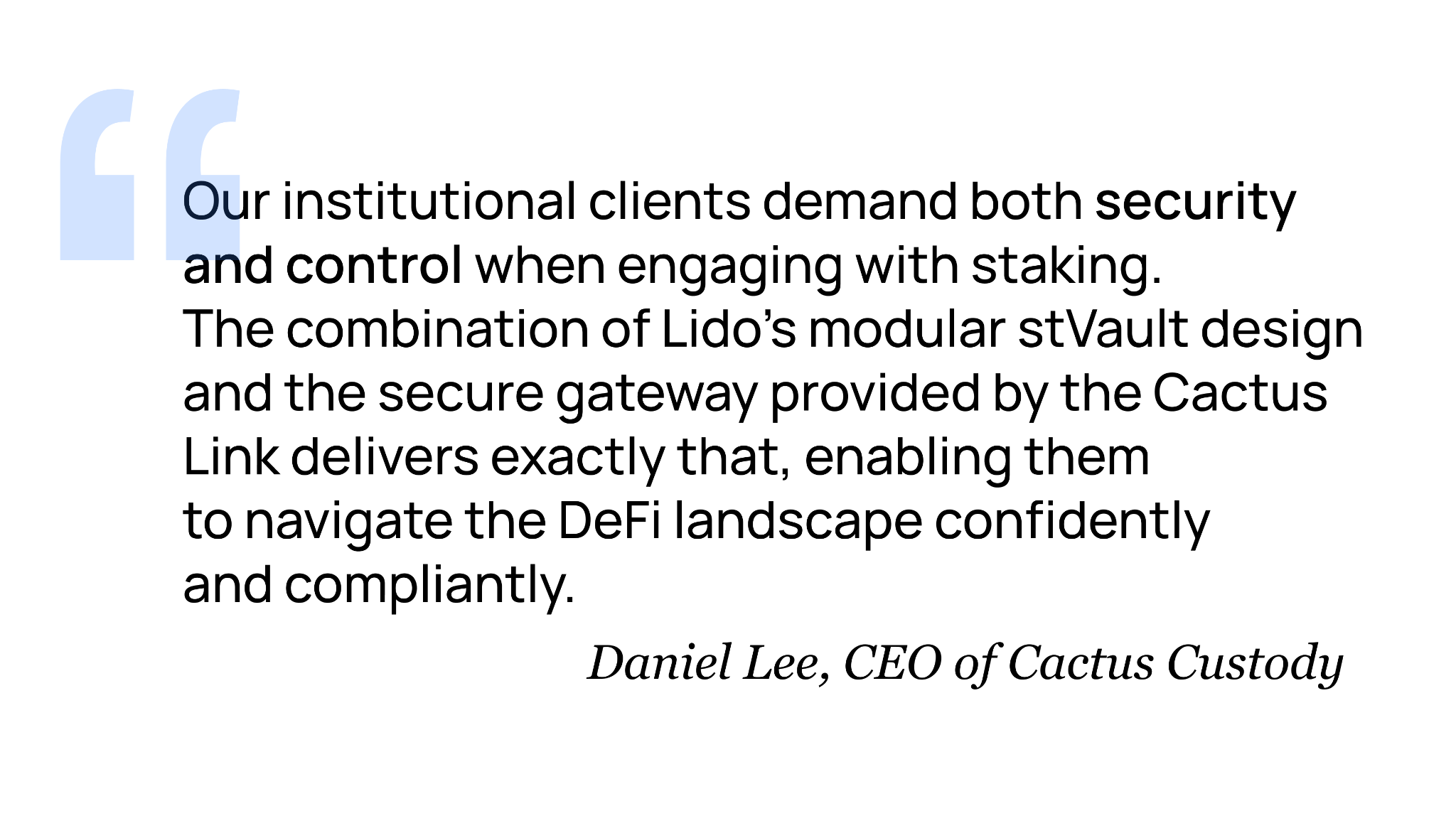
This strong regulatory and compliance posture is not merely a bureaucratic hurdle but a foundational requirement for institutional engagement in DeFi. By providing a regulated and audited environment, Cactus Custody enables institutions to participate in innovative protocols like Lido stVaults while adhering to their own internal compliance mandates and external regulatory obligations. This de-risks participation for institutions, paving the way for broader capital flows into the decentralized economy.
Strategic Implications for the DeFi Ecosystem
The integration of Cactus Custody and Lido V3 stVaults holds significant strategic implications for the broader DeFi ecosystem. Firstly, it represents a powerful validation of DeFi’s maturation and its increasing readiness for institutional capital. As more qualified custodians offer secure and compliant pathways to DeFi protocols, the institutional "seal of approval" grows stronger, potentially attracting a new wave of capital and participants.
Secondly, it highlights a crucial evolution in institutional engagement with digital assets. Beyond simply holding cryptocurrencies as speculative investments, institutions are now seeking sophisticated strategies to generate yield and manage assets within the decentralized economy. Solutions like stVaults cater directly to this demand, moving institutions from passive holding to active participation.
Thirdly, this development could intensify competition among digital asset custodians. As DeFi capabilities become a standard expectation, custodians will need to continuously innovate and integrate with leading protocols to remain competitive. This could lead to a more robust and interconnected ecosystem, benefiting all participants.
Finally, for Lido Protocol, this integration solidifies its position as a leading institutional-friendly liquid staking solution. By partnering with a reputable custodian like Cactus Custody, Lido enhances its credibility and accessibility for institutional clients, further cementing its market leadership and driving deeper decentralization of Ethereum staking.
Looking Ahead: The Future of Institutional Digital Assets
The collaboration between Cactus Custody and Lido Protocol is a clear indicator of the direction the digital asset industry is heading. The demand for institutional-grade infrastructure that blends security, compliance, and control with the innovation and yield opportunities of DeFi is accelerating. As traditional financial institutions increasingly explore blockchain technology, the need for robust, regulated, and flexible solutions will only grow.
The ability for large entities to tailor their staking operations, manage risk effectively, and maintain liquidity while leveraging the security of a qualified custodian represents a significant step forward. It suggests a future where the lines between traditional finance and decentralized finance become increasingly blurred, with hybrid solutions serving as the bridge. This ongoing convergence is expected to drive further innovation, improve market efficiency, and ultimately lead to a more mature and accessible digital asset ecosystem for all participants. Institutions interested in exploring these advanced staking capabilities are encouraged to engage directly with the Lido Institutional team for detailed discussions and tailored solutions.