James Watt
The highly anticipated Q3 2025 VaNOM (Validator Node Metrics) report from Lido is now live, offering a comprehensive overview of the protocol’s significant advancements in decentralization, security, and operational efficiency within the Ethereum staking ecosystem. This quarter has marked a pivotal period for Lido, showcasing robust growth in permissionless staking, a strategic expansion of Distributed Validator Technology (DVT) across its modules, and a sustained commitment to consensus client diversity and advanced proposer mechanisms.
Bolstering Decentralization: Permissionless Modules Hit Capacity
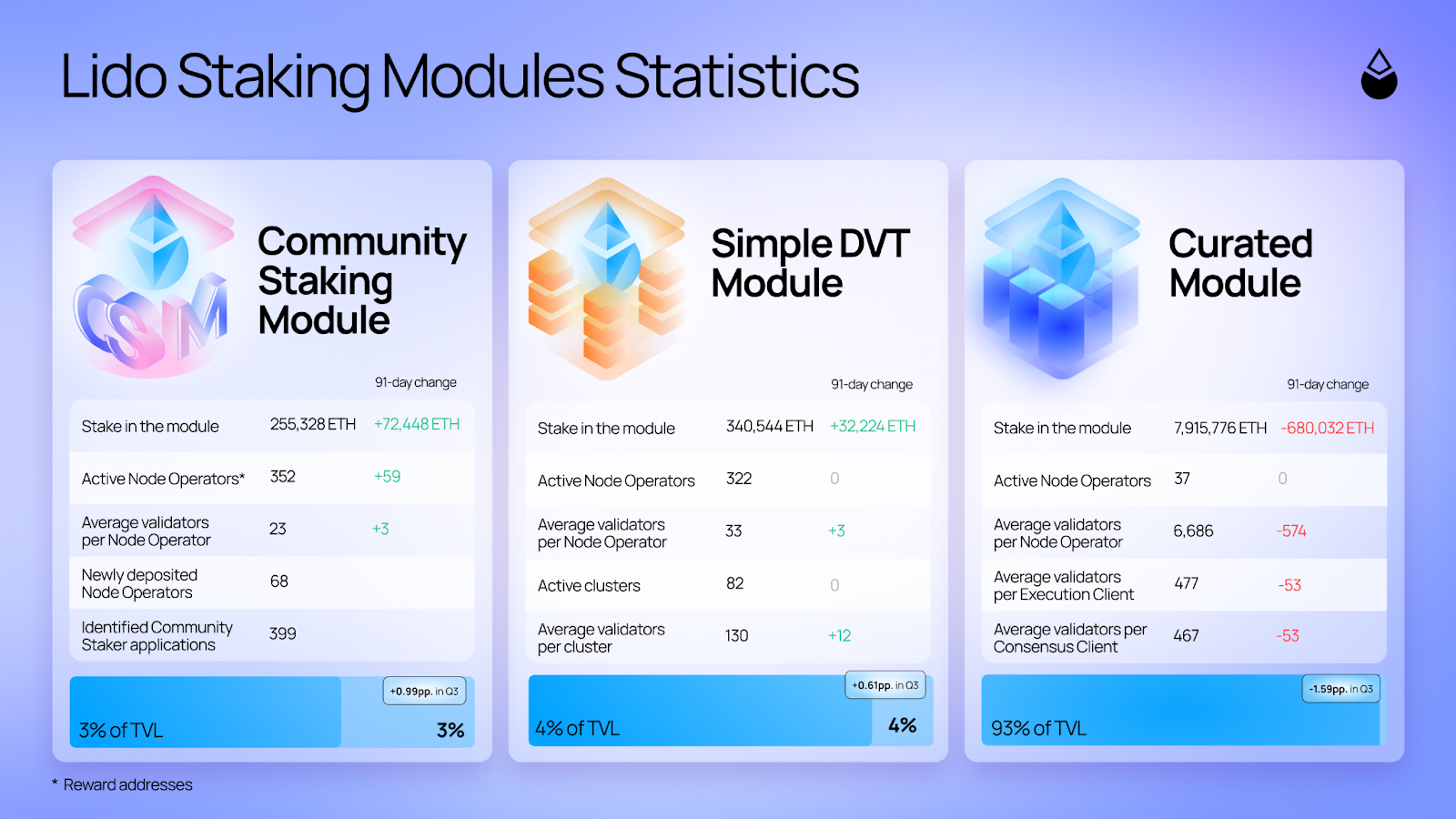
A cornerstone of Lido’s strategy for a more robust and decentralized Ethereum lies in empowering diverse node operators. In Q3 2025, Lido’s permissionless staking initiatives reached significant milestones, with both the Simple DVT Module and the Community Staking Modules hitting their predefined stake share limits. The Simple DVT Module achieved its 4% limit, while the Community Staking Module reached its 3% threshold. Collectively, these two decentralized modules now account for approximately 600,000 staked ETH within the Lido protocol.
As of October 1, 2025, this impressive volume represented a substantial 1.67% of the total Ethereum stake, which stood at an estimated 35.9 million ETH at the close of Q3. At an approximate average ETH price of $3,500 during the quarter, these modules collectively manage an impressive $2.1 billion worth of staked Ethereum. This achievement underscores Lido’s continuous progress toward diversifying its node operator set and fostering permissionless participation, directly aligning with Ethereum’s core ethos of decentralization. The rapid uptake in these modules demonstrates a strong community demand for accessible and diversified staking opportunities, validating Lido’s strategic focus on broadening validator participation.
The Rise of Distributed Validator Technology (DVT) Across Lido
Distributed Validator Technology (DVT) is a transformative innovation designed to enhance the security, resilience, and decentralization of validator operations. By allowing multiple parties to collaboratively operate a single validator key, DVT mitigates the risks associated with single points of failure, such as slashing events due to downtime or misconfigurations, and improves overall network fault tolerance. Historically, within the Lido protocol, DVT adoption through solutions like Obol, SafeStake, and the SSV Network was primarily confined to the Simple DVT and Community Staking Modules. These modules served as crucial testing grounds, demonstrating the reliability and efficiency of DVT in a production environment.
The success and proven stability of DVT in these permissionless settings paved the way for a significant strategic expansion. Recognizing the immense benefits of DVT for the entire protocol, Lido contributors proposed extending its usage to the Curated Module. This groundbreaking proposal, which sought to enable operators in the Curated Set to opt into intra-operator DVT setups, underwent a rigorous discussion process on the Lido Research Forum. It ultimately received overwhelming approval from LDO tokenholders during the June 2025 voting slot. This pivotal decision marked a key step towards further protocol decentralization and significantly enhanced fault tolerance across Lido’s largest staking segment.
Following this landmark vote, the third quarter of 2025 saw a rapid acceleration in DVT integration. As of October 1, 2025, a total of 547,968 ETH, equivalent to 17,124 validators across the entire Lido protocol, are now powered by Obol, SafeStake, and SSV Network DVT implementations. This represents a remarkable 57.65% quarter-over-quarter rise from the 10,862 validators utilizing DVT in Q2 2025, showcasing the rapid and successful rollout of this critical technology.
A Strategic Shift: DVT Expands to the Curated Module
The integration of DVT into the Curated Module was a carefully planned and executed process, beginning with extensive testing on the Hoodi testnet to ensure seamless migration and operational stability. Q3 2025 witnessed the successful migration of the first five Curated Node Operators: A41, Blockscape, Ebunker, RockX, and Stakin. These prominent operators collectively transitioned 4,900 validators, representing 156,800 ETH, to Obol and SSV Network setups. This initial wave of adoption within the Curated Module is a testament to the technology’s readiness and the operators’ commitment to best practices.
"The expansion of DVT to the Curated Module is a monumental step for Lido and the broader Ethereum ecosystem," stated a Lido DAO Contributor, who preferred to remain anonymous to speak freely about technical implementations. "It signifies our unwavering commitment to decentralization and resilience, moving beyond theoretical discussions to tangible, on-chain implementations that strengthen the security posture of staked ETH. The successful migration by our Curated Node Operators demonstrates their dedication to pioneering advanced staking infrastructure."
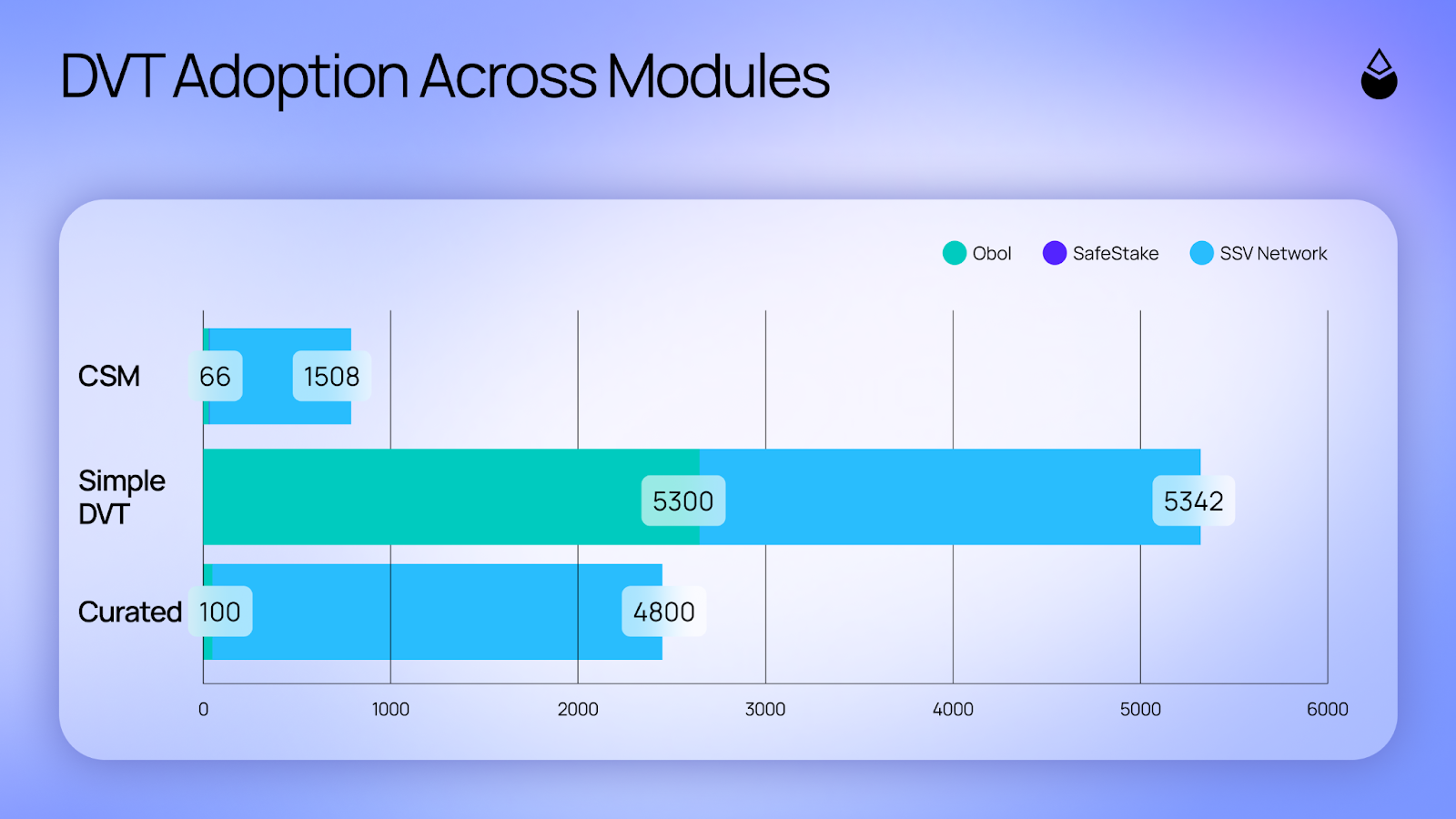
Beyond the Curated Module, DVT adoption continued its strong trajectory in the other modules. In the Simple DVT Module, the number of validators utilizing Obol setups increased by 80 to 5,300, while SSV Network setups grew by 1,087 to 5,342. These validators are run by 217 and 229 operators, respectively, indicating a broad base of participation. Within the Community Staking Module (CSM), where DVT usage is entirely voluntary, adoption also expanded significantly, with an additional 332 validators now leveraging the SSV Network. Obol support in the CSM also saw growth, with 66 validators across eight operators now utilizing its services. SafeStake, exclusively used in the CSM, maintained a stable eight validators operated by four distinct entities.
This widespread adoption of DVT across all Lido staking modules — from the permissionless Simple DVT and Community Staking Modules to the Curated Module — unequivocally demonstrates DVT’s growing prevalence and importance within the Lido validator setup. This collective increase in DVT utilization is a clear reflection of Lido’s sustained progress toward building a more decentralized, diversified, and robust validator network, thereby enhancing the overall security and stability of Ethereum.
Enhancing Network Resilience: Consensus Client Diversity
Consensus Layer (CL) client diversity is a critical factor in maintaining the health and resilience of the Ethereum network. An over-reliance on a single CL client can introduce supermajority risks, where a bug or vulnerability in that dominant client could jeopardize the finality of the entire chain. Lido has consistently championed client diversity, and the Q3 2025 VaNOM report highlights significant strides in this area, particularly within the Curated Module.
The adoption of Obol and SSV Network DVT setups within the Curated Module has directly contributed to expanding CL client diversity, thereby reducing the probability of supermajority and finality risks. Starting Q3 2025, these DVT-powered setups support 5,900 Curated Module validators. Specifically, 1.94% of these validators, or 4,800, now operate via SSV Network setups, while 100 validators utilize Obol, which has recently begun ramping up its presence and is expected to see increased adoption in subsequent quarters.
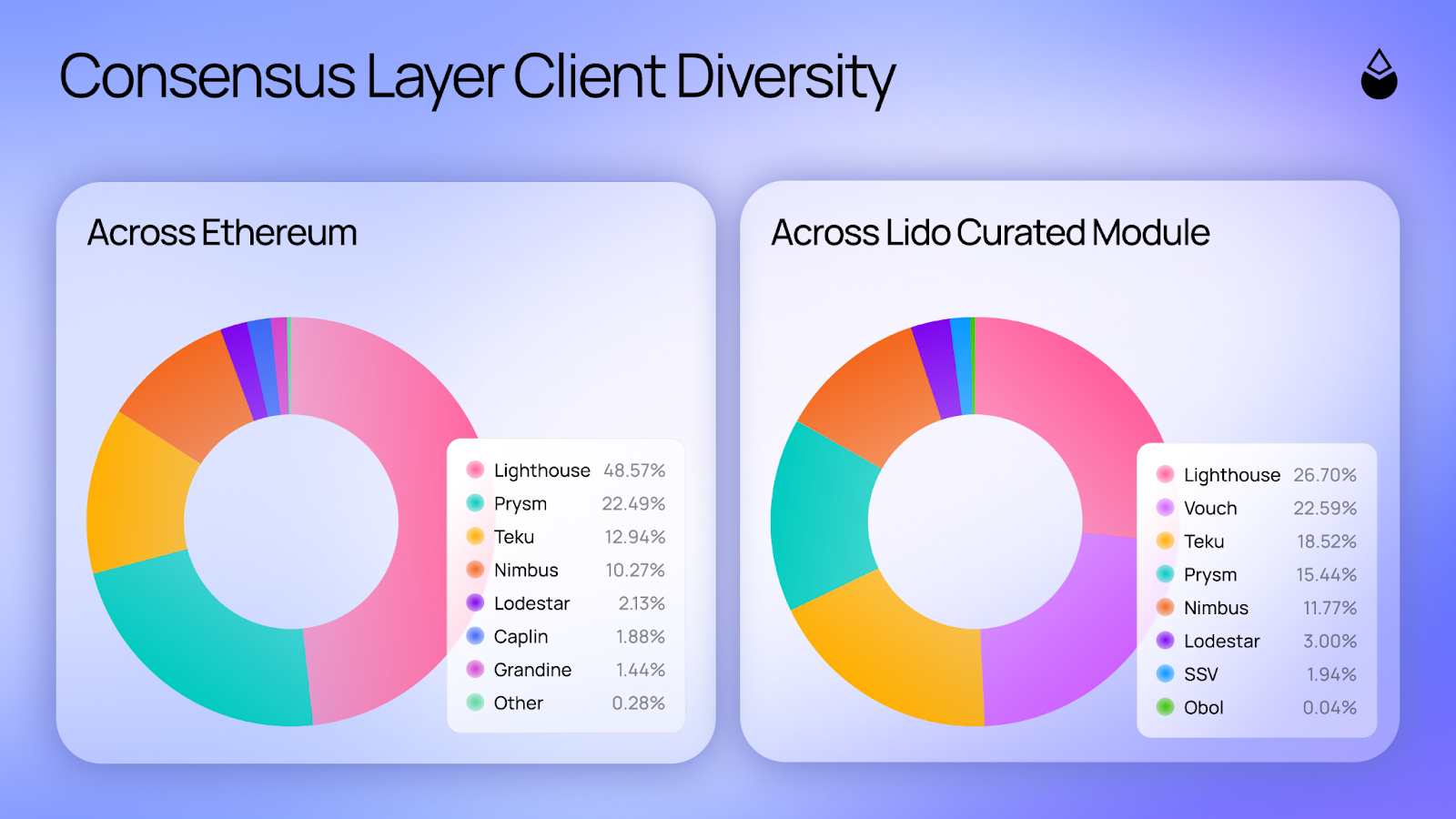
Beyond DVT-related client setups, Vouch, a validator client developed by Attestant, remains a crucial component in Lido’s diversification strategy. Designed for flexibility and security, Vouch is compatible with multiple Beacon Nodes, providing additional options for node operators. It is now actively used by 22.59% of Curated Module validators, further contributing to a balanced client distribution.
When comparing Lido’s Curated Module client distribution to the broader pan-Ethereum CL client landscape, a clear difference emerges. While Lighthouse remains the dominant client across Ethereum, accounting for 48.57% (an increase from 47.96% in Q2), Lido’s Curated Module maintains a significantly more balanced distribution. For instance, while precise figures for other clients within Lido’s Curated Module were not explicitly detailed, the report implies a strategic distribution that consciously avoids over-reliance on any single client. This proactive approach ensures that a potential issue with one client would not lead to a catastrophic network-wide failure.
"Lido’s deliberate efforts in fostering CL client diversity are commendable and crucial for Ethereum’s long-term stability," commented Dr. Anya Sharma, a leading blockchain researcher. "By actively encouraging the use of multiple clients and integrating DVT solutions that inherently promote diversification, Lido is setting a benchmark for responsible staking pool management. This commitment directly mitigates systemic risks and strengthens the foundational security of the entire network."
This consistent diversification across Lido’s Curated Module is a direct result of the Node Operators’ commitment to client diversity and fault-tolerance, aimed at mitigating supermajority and correlated failure risks. By fostering balanced usage across multiple CL clients, Lido continues to strengthen Ethereum’s overall health and network resilience, setting a high standard for the staking industry.
Optimizing Block Production: Auxiliary Proposer Mechanisms Utilization
The evolution of Ethereum’s block production landscape necessitates the adoption of sophisticated tools to enhance efficiency, reliability, and flexibility. The Auxiliary Proposer Mechanisms (APM) framework within Lido is designed to enable the protocol to safely explore and integrate these emerging technologies, all while upholding its core principles of decentralization and security. These mechanisms are vital for unlocking potential rewards for stakers and generating new efficiencies for Node Operators, making them an indispensable part of Ethereum’s evolving architecture.
The Q3 2025 VaNOM report provides insights into how Node Operators in the Curated Module are adopting various available infrastructure setups. A prime example is Proposer-Builder Separation (PBS), a critical design pattern that decouples the role of building transaction blocks from proposing them. This separation is fundamental in preventing transaction censorship at the network level and promoting fairness in block rewards, addressing concerns around Maximal Extractable Value (MEV).
MEV-Boost, the most widely adopted implementation of PBS, is currently utilized by approximately half of Lido’s validators. Its widespread adoption highlights the importance placed on optimizing block rewards and promoting a more equitable transaction ordering process. Beyond MEV-Boost, other APM implementations are gaining traction within the Lido protocol. Vouch, the validator client from Attestant, is leveraged by 22.6% of operators, further demonstrating the diverse toolset employed. Additionally, Commit Boost’s PBS Module is utilized by 19% of operators, indicating a growing preference for advanced block production strategies.
Interestingly, while Consensus Layer clients offer native support for direct interaction with the MEV Boost Protocol, this functionality is currently used by only 2.8% of Lido validators. This lower adoption rate is attributed to its more limited functionality compared to the robust MEV-Boost sidecar setup, which offers greater flexibility and performance.
The pie chart illustrating APM utilization reflects Lido contributors’ conscientious and strategic approach to adopting these mechanisms. It underscores a commitment to ensuring that as Ethereum’s proposer infrastructure continues to evolve, the Lido protocol remains at the forefront of innovation without compromising on safety, ethical considerations, or the integrity of the network. This balanced approach allows Lido to leverage cutting-edge technology while maintaining its reputation as a secure and reliable staking provider.
Industry Reactions and Expert Analysis
The Q3 2025 VaNOM report has garnered positive reactions from across the blockchain industry, with analysts highlighting Lido’s proactive stance on critical network infrastructure. "Lido’s Q3 report paints a clear picture of a protocol not just growing in scale, but also maturing in its commitment to Ethereum’s foundational principles," noted a senior analyst at a prominent crypto research firm. "The significant ramp-up in DVT adoption, particularly within the Curated Module, showcases a strategic foresight that directly addresses scalability and security concerns inherent in large-scale staking. This move significantly de-risks Lido’s operations and, by extension, a substantial portion of staked ETH."
Representatives from DVT providers have also expressed enthusiasm. "We are thrilled to see the continued and accelerated adoption of Obol DVT within the Lido ecosystem," stated a spokesperson for Obol. "Lido’s integration of DVT into its Curated Module, following thorough testing, is a powerful validation of the technology’s readiness and its capacity to enhance validator resilience and decentralization at scale. We anticipate this trend will inspire other major staking protocols to follow suit, leading to a more robust Ethereum network overall." Similarly, SSV Network highlighted the growing number of validators utilizing their solution, underscoring the demand for shared, fault-tolerant validator operations.
The emphasis on client diversity and auxiliary proposer mechanisms is also seen as a positive indicator for Ethereum’s long-term health. "The focus on diversifying consensus clients and judiciously implementing APMs like MEV-Boost is critical for preventing centralization at the protocol level," explained a decentralization advocate. "Lido, as a major player, has a responsibility to lead by example, and this report demonstrates a clear understanding of that responsibility. These efforts contribute to a healthier, more censorship-resistant, and ultimately more resilient Ethereum."
Paving the Way Forward: Lido’s Vision for 2026
The advancements detailed in the Q3 2025 VaNOM report are merely a precursor to a series of ambitious improvements planned for the Lido Validator Set as the protocol heads into 2026. A significant development already underway is the Community Staking Module (CSM) v2 upgrade, which went live on the Ethereum mainnet on October 2, 2025, just after the close of the reporting period. This upgrade is set to expand the CSM’s stake share limit to 5%, providing even more room for permissionless growth.
CSM v2 also introduces differentiated parameters for various Node Operator (NO) types, allowing for greater flexibility and tailored participation. Crucially, it enables the optional Identified Community Staker (ICS) framework, a significant milestone in Lido’s roadmap. The ICS framework is designed to empower a broader array of independent operators to participate in Ethereum validation, further democratizing access to staking and enhancing the network’s decentralization. Upcoming VaNOM reports are expected to reflect these transformative changes across CSM-related metrics and validator charts, providing granular insights into their impact.
The continuation of DVT adoption within the Curated Module remains a high priority, following commitments made by the CM Node Operators on the Lido Research Forum. This ongoing integration will further strengthen validator resilience and diversity within this critical set, building upon the successful Q3 migrations.
Looking further ahead, the forthcoming Lido V3, Staking Router v3, and Curated Module v2 upgrades are poised to collectively reshape how Node Operators engage with the protocol. These comprehensive upgrades aim to expand flexibility, improve modularity, and set the stage for the next phase of Ethereum staking evolution. Lido V3, in particular, is anticipated to introduce architectural enhancements that will optimize the protocol’s performance and scalability, while Staking Router v3 will likely streamline the process for new operators to join and manage their staking activities more efficiently. Curated Module v2 is expected to refine the governance and operational frameworks for its node operators, ensuring continued alignment with decentralization goals.
As always, Lido DAO contributors will continue their diligent work in refining the protocol’s metrics and dashboards. This commitment ensures that as Lido’s complexity grows and its operations expand, data-driven accountability remains at the forefront, providing transparency and clarity to the community. Stakeholders and interested parties are encouraged to stay tuned for the next VaNOM update and, in the interim, explore the Lido Node Operator Portal and Validator Set Updates for monthly insights into the protocol’s ongoing developments and the health of its validator set.