James Watt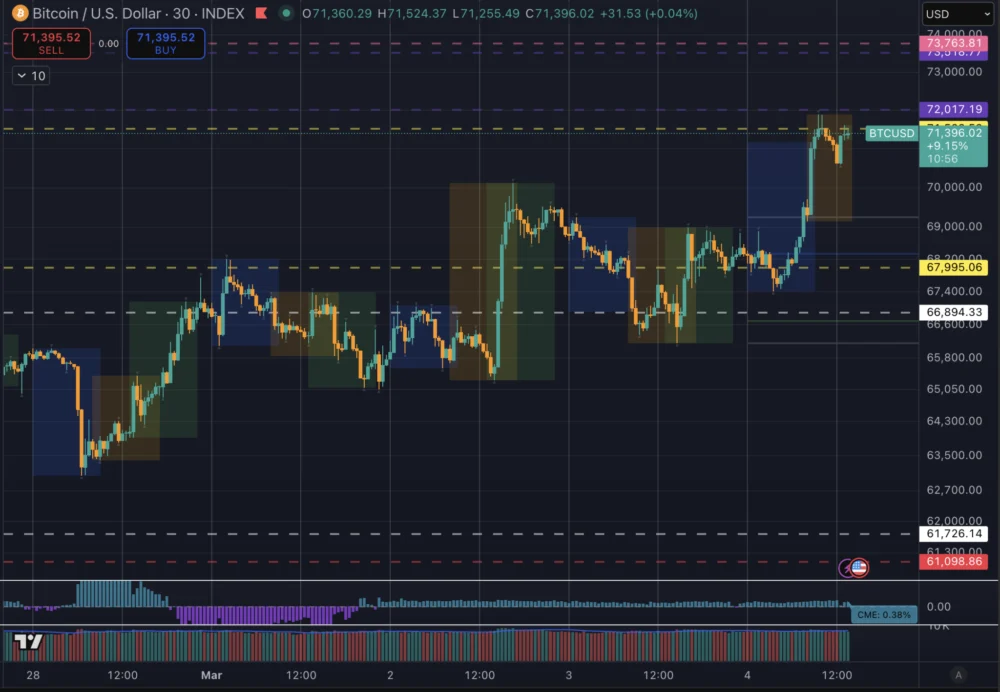
In a move that defied traditional market correlations, Bitcoin accelerated during the Asian trading window, touching the $72,000 mark for the first time since February 8. The digital asset had spent the preceding weeks oscillating within a defined corridor of $60,000 to $70,000. Analysts noted that the sudden break toward the upside occurred precisely when many investors expected a downward correlation with traditional equities. This divergence raises critical questions regarding Bitcoin’s evolving role as a "release valve" during localized financial shocks and its decoupling from traditional tech-heavy equity indices during periods of extreme volatility.
A Chronology of the Market Disruption
The volatility began in earnest on March 3, 2026, as geopolitical tensions in the Middle East intensified, leading to immediate concerns over energy security. South Korea, a nation that imports nearly all of its petroleum, saw its market stability erode as the price of Brent crude hovered near $83 per barrel, with risk premiums climbing on fears of a shipping disruption in the Strait of Hormuz.
By the morning of March 4, the KOSPI opened significantly lower, and the selling pressure intensified throughout the session. By midday, the index had triggered multiple circuit breakers as the decline surpassed 10%. The South Korean Won (KRW) simultaneously faced intense pressure, weakening toward a critical psychological threshold of 1,500 per U.S. dollar. This dual-pronged attack on equities and currency forced institutional asset managers to rebalance portfolios rapidly, often leading to "forced selling" of liquid blue-chip stocks to cover margin calls and currency hedge requirements.
While the equity market was in a state of freefall, Bitcoin’s price action remained resilient. At approximately 2:00 PM Seoul time, as the KOSPI reached its session lows, Bitcoin broke through the $71,000 resistance level. Within an hour, it touched $72,000, driven by what market observers describe as a combination of short-covering and a flight toward non-sovereign assets. This sequence of events highlighted a rare "Asia-first" shock where the traditional funding sources—equities and local fiat—were abandoned in favor of alternative liquidity rails.
The Macroeconomic Catalyst: Energy and FX Sensitivity
The severity of the South Korean selloff is fundamentally rooted in the country’s specific macroeconomic profile. South Korea is one of the world’s most significant energy importers, bringing in approximately 2.6 million barrels of crude oil per day. According to data from the Energy Information Administration (EIA), over 60% of these imports originate from the Middle East. Any disruption to shipping lanes or a spike in the geopolitical risk premium directly translates into higher costs for the Korean industrial sector.
The impact of rising energy costs on the South Korean economy is quantifiable. With a Gross Domestic Product (GDP) of approximately $1.917 trillion, the nation is highly sensitive to the "energy tax" imposed by rising oil prices. Financial analysis suggests that a sustained $10-per-barrel increase in oil prices results in roughly $9.5 billion in additional gross import costs annually, or about 0.5% of GDP. A more severe $30-per-barrel spike would represent a $28.5 billion hit, roughly 1.5% of GDP.

Furthermore, the depreciation of the won compounds this issue. Because oil is priced in U.S. dollars, a weaker won means that Korean companies must pay more in local currency terms for the same volume of energy. This "double whammy" of rising commodity prices and a falling currency erodes corporate margins and fuels inflation expectations, prompting investors to exit the market regardless of the underlying strength of the semiconductor or automotive export cycles.
Bitcoin’s Divergent Path: Market Structure and Positioning
Bitcoin’s move to $72,000 during this period of turmoil must be analyzed through the lens of internal market mechanics rather than simple narrative-driven "safe haven" buying. For much of early 2026, Bitcoin had been characterized by a defensive market structure. On-chain data from Glassnode indicated that the $60,000 to $70,000 range had become a zone of heavy consolidation, where traders were more focused on ETF flow trends and derivatives exposure than on broader macro developments.
The surge during the Asian session was likely amplified by three factors:
- Short Liquidations: As Bitcoin breached $71,000, traders who had positioned for a range-bound market or a downward move in sympathy with equities were forced to close their positions, creating a "short squeeze" effect.
- The "Won Premium": When a local currency like the South Korean Won devalues rapidly, local demand for Bitcoin often spikes as a hedge against further fiat depreciation. This can lead to the "Kimchi Premium" expanding, where Bitcoin trades at a higher price on Korean exchanges than on global platforms, pulling the global spot price higher.
- Liquidity Preferences: In a period of "forced de-risking," investors often seek assets that are not tied to a specific nation’s energy balance sheet or localized banking system. While Bitcoin is often treated as a high-beta risk asset, its lack of direct exposure to Middle Eastern shipping lanes or South Korean corporate margins allowed it to serve as a neutral liquidity destination.
Official Responses and Market Safeguards
The South Korean government and financial regulators moved quickly to address the market instability. The Financial Services Commission (FSC) and the Bank of Korea issued joint statements emphasizing that the country’s economic fundamentals remain sound, citing a record annual current account surplus of $123 billion in 2025. Despite these assurances, the sheer velocity of the selloff required the implementation of trading halts.
The activation of circuit breakers on the KOSPI was a necessary measure to prevent a disorderly spiral, yet these halts can sometimes exacerbate liquidity issues. When investors cannot exit positions in the equity market, they may look to other liquid markets—including cryptocurrency—to raise cash or hedge their exposure. In this instance, the liquidity in the crypto market remained robust, allowing for the price discovery that pushed Bitcoin to its new monthly high.
International observers have noted that while the current account surplus provides a macro cushion, it does not prevent short-term volatility driven by geopolitical fear. Market analysts expect the Bank of Korea to monitor the won-dollar exchange rate closely, with the possibility of direct intervention if the currency remains under pressure near the 1,500 level.
Broader Implications and Future Scenarios
The divergence between the KOSPI and Bitcoin serves as a case study for future market shocks. It suggests that the correlation between crypto and equities is not a fixed law but a variable that depends on the nature of the stressor. As the market digests these events, three potential scenarios emerge for the coming weeks:

Scenario 1: Stabilization and Technical Rebound
If geopolitical tensions in the Middle East ease and oil prices stabilize, the risk premium on the South Korean market may fade. In this case, the 18.4% drop would be viewed as an overreaction driven by leverage. Bitcoin might see a cooling-off period as the "panic bid" recedes, potentially returning to its $60,000–$70,000 range as the market refocuses on U.S. ETF inflows and interest rate expectations.
Scenario 2: Protracted Energy Crisis
Should oil prices remain elevated or shipping disruptions become a reality, South Korea will remain on the front line of the economic fallout. The continued pressure on the won and corporate earnings could lead to a prolonged bear market for the KOSPI. In this environment, Bitcoin may continue to attract interest as a non-correlated asset, provided that global liquidity remains sufficient to support the crypto ecosystem.
Scenario 3: Global Deleveraging
The most significant risk is that the "Asia-first" shock triggers a broader global deleveraging event. If international investors who use the KOSPI as a proxy for global tech demand begin a wholesale exit from risk assets, the initial divergence seen on March 4 could vanish. In a "dash for cash" scenario, even Bitcoin could face selling pressure as it becomes a source of liquidity for margin-called investors elsewhere in their portfolios.
Conclusion
The events of March 4, 2026, have highlighted the fragile nature of global market correlations. The historic 12.06% collapse of the KOSPI serves as a reminder of how quickly energy dependency and currency stress can dismantle an equity market, even one backed by strong export data. Conversely, Bitcoin’s jump to $72,000 underscores its growing independence during specific types of regional crises.
Traders and policymakers alike will be watching several key indicators in the days ahead: the Brent crude level, the KRW/USD exchange rate, and the persistence of Bitcoin’s price floor above $70,000. While a single session does not rewrite the history of financial markets, the decoupling observed today provides a glimpse into a future where digital assets and traditional benchmarks may no longer move in lockstep when the world’s energy and currency markets are under duress.