Nila Kartika Wati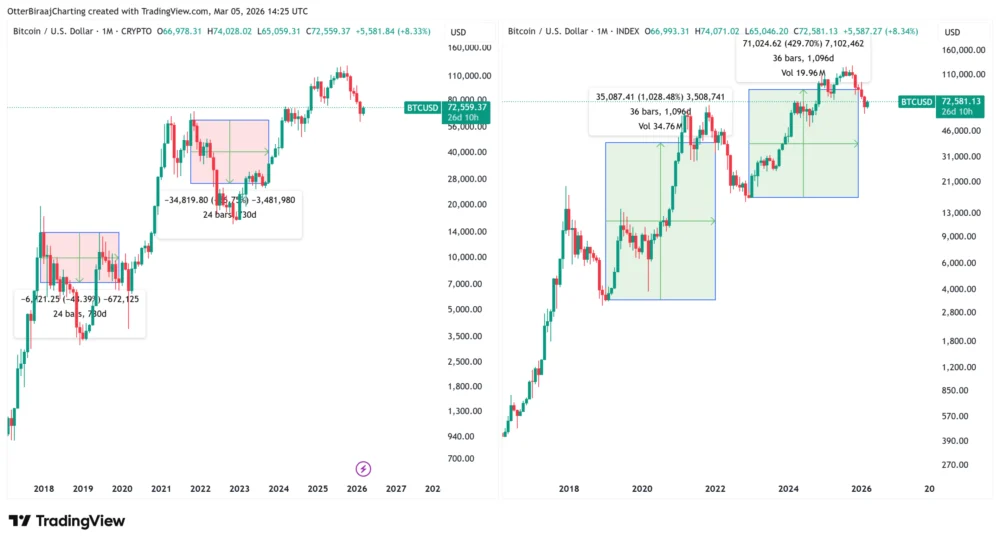
Bitcoin (BTC) often faces scrutiny from some investors and mainstream financial commentators who highlight its notorious volatility, particularly its steep double-digit drawdowns that can severely punish those who buy near market peaks. This perception of extreme risk, however, is increasingly challenged by robust on-chain and historical market data, which suggests that the investment outcome for Bitcoin holders can dramatically improve with an extended time horizon. Far from being merely a speculative asset, Bitcoin’s long-term performance metrics reveal a consistent pattern where patience and strategic accumulation during bear markets have historically transformed significant short-term losses into substantial long-term gains.
Unpacking Bitcoin’s Volatility: A Tale of Two Holding Periods
Since its inception, Bitcoin has been characterized by pronounced market cycles, marked by euphoric rallies followed by sharp corrections. While these cycles can deter new investors and test the resolve of existing holders, a closer examination of historical data since 2017 reveals a critical insight: the duration of an investment profoundly impacts its profitability. Investors who entered the market near previous cycle highs often experienced significant paper losses, sometimes exceeding 40%–50%, within the subsequent two years. This period of intense pressure typically coincides with bear markets, where negative sentiment and price depreciation dominate headlines.
However, the narrative shifts dramatically when these positions are held for longer periods, specifically beyond three years. Data consistently demonstrates that many of these initial positions, once deep in the red, eventually turned profitable, underscoring the resilience and long-term appreciation trend inherent to Bitcoin’s market dynamics. Conversely, investors who demonstrated the foresight and fortitude to accumulate BTC during bear-market lows have historically been rewarded with triple-digit percentage returns, often within similar two-to-three-year timeframes, capturing the most significant upward price expansion. These findings are not merely anecdotal but are supported by sophisticated on-chain valuation metrics that help identify these stronger accumulation zones, guiding investors toward more opportune entry points.
Chronology of Cycles: Highs, Drawdowns, and Eventual Recovery
Bitcoin’s performance across its distinct market cycles offers a compelling illustration of how entry timing and holding periods dictate investment outcomes. The long-term performance, while appearing highly volatile over shorter two-year windows, shows a remarkable transformation when positions are extended to three years or more.

The 2017 Peak and Subsequent Bear Market:
The bull run of 2017 was a watershed moment for Bitcoin, culminating in an all-time high near $20,000 in December of that year, largely driven by surging retail interest and the nascent ICO boom. Investors who bought near this market peak faced a brutal reckoning as the market entered a protracted bear phase in 2018. Within two years of their entry, by late 2019, these investors would have witnessed a staggering 48.6% loss on their initial investment. The "crypto winter" of 2018-2019 was characterized by widespread capitulation, negative media coverage, and a significant exodus of less committed participants. Yet, for those who maintained their conviction and extended their holding period to three years, through late 2020, that very same position not only recovered its losses but generated a substantial 108.7% gain. This period saw Bitcoin rebound significantly, fueled by renewed institutional interest and the anticipation of its next halving event.
The 2021 Peak and the Subsequent Correction:
A similar trajectory unfolded in the subsequent market cycle. Following a powerful rally driven by increased institutional adoption, mainstream corporate interest, and unprecedented liquidity injections into the global financial system, Bitcoin reached new all-time highs, surpassing $69,000 in November 2021. Buyers entering near this elevated level also experienced significant drawdowns as the market corrected throughout 2022. After two years, by late 2023, these investors recorded losses of approximately 43.5%. However, consistent with the previous cycle, extending the holding period to the third year, into late 2024, saw this same entry point turn profitable, yielding a 14.5% profit. This recovery, while less dramatic than the 2017-2020 rebound in percentage terms, still underscores the tendency for Bitcoin to recover and appreciate over longer timeframes.
The Power of Accumulating at Bear Market Lows:
In stark contrast to entries near market highs, positions initiated during bear market lows have historically generated significantly larger returns.
- The 2019 Bottom: Following the 2018 bear market, Bitcoin found a bottom around $3,200 in December 2018/January 2019. Investors who bought close to this 2019 bottom were rewarded handsomely. Their positions produced returns of an astounding 871% after two years (by early 2021) and an even more remarkable 1,028% after three years (by early 2022). This period saw Bitcoin surge past its previous all-time high, driven by the increasing awareness of its scarcity and potential as a digital store of value.
- The 2022 Cycle Low: The most recent bear market saw Bitcoin bottom out around $15,500 in late 2022, amidst a confluence of macroeconomic headwinds, interest rate hikes, and industry-specific crises. Buy positions initiated near this period have already generated substantial returns, approximately 465% after two years (by late 2024) and about 429% after three years (projected for late 2025). This demonstrates the consistent pattern of strong recoveries from periods of peak pessimism and undervaluation.
Collectively, this historical data paints a clear and consistent picture: while two-year windows expose investors to significant drawdowns when entries occur near cycle highs, three-year holding periods have historically moved most initial entries into positive territory. More importantly, strategic entries during bear market bottoms consistently capture the strongest price expansions across both two- and three-year holding periods, highlighting the immense advantage of accumulating during periods of market distress.
On-Chain Intelligence: Guiding Bottom Entries with Realized Price
Beyond historical price charts, sophisticated on-chain valuation metrics provide invaluable tools for identifying these optimal accumulation zones. One such metric, Bitcoin’s realized price, offers a unique perspective on the market’s true cost basis. The realized price measures the average acquisition price of all Bitcoin currently in circulation, based on the price at which each coin last moved on the blockchain. Unlike the spot price, which reflects current market sentiment, the realized price offers a more fundamental valuation, indicating the aggregate cost basis of the network.
During deep market drawdowns and bear markets, Bitcoin’s spot price frequently falls toward or even below its realized price, signaling periods where the average investor is holding coins at a loss. These moments of market-wide unrealized losses often coincide with capitulation events, marking potential cycle lows.

The concept is further refined by the shifted realized price, which smooths the metric forward and more clearly highlights these stronger value zones. These realized price bands have historically served as reliable indicators for long-term accumulation ranges since 2015. When Bitcoin’s price trades within or below these bands, it often suggests a period of undervaluation relative to the network’s aggregate cost basis, presenting a compelling opportunity for long-term investors.
Currently, Bitcoin’s realized price sits near $55,000, while the shifted realized price hovers around $42,000. Historically, price recoveries initiated from these valuation bands have consistently ushered in multi-year rallies. This behavior connects directly with the earlier return data: investors who accumulated near bear-market lows typically entered the market when the price traded around or below these crucial on-chain valuation bands, positioning themselves for the subsequent bullish expansions. The consistency of this pattern underscores the utility of on-chain analysis in making data-driven investment decisions, moving beyond mere speculation.
Institutional Validation: The Case for Long-Term Bitcoin Allocation
The insights derived from historical market cycles and on-chain data are not confined to the realm of crypto-native analysts; they are increasingly being validated by institutional research. Bitwise, a leading cryptocurrency asset manager, has conducted extensive studies highlighting the strategic benefits of allocating a portion of a traditional investment portfolio to Bitcoin, particularly with a long-term perspective.
Matt Hougan, Chief Information Officer at Bitwise, has publicly cited research demonstrating that adding Bitcoin to a traditional 60/40 portfolio (60% equities, 40% bonds) significantly increased both cumulative and risk-adjusted returns across every three-year period studied. This finding is particularly impactful for traditional finance, suggesting that Bitcoin, despite its volatility, can act as a powerful diversifier due to its relatively uncorrelated returns with traditional asset classes. The study indicated a remarkable 93% "win rate" across two-year periods when Bitcoin was included, with a roughly 5% allocation producing the strongest balance of risk and reward for the overall portfolio. This suggests that even a modest, strategically chosen allocation to Bitcoin can enhance portfolio performance without disproportionately increasing overall risk, especially when viewed over multi-year horizons.
A separate, more comprehensive Bitwise review, analyzing Bitcoin data from July 2010 through February 2026, further solidified the argument for long-term holding. This extensive analysis revealed a dramatic reduction in the probability of loss with increasing holding periods:
- Day traders historically faced a significant 47.1% chance of incurring losses, underscoring the high-risk nature of short-term speculation.
- For one-year holding periods, the probability of being underwater still stood at a considerable 24.3%.
- However, when Bitcoin was held for three years, the probability of loss plummeted to a mere 0.7%.
- Extending the horizon to five years saw the risk drop further to an almost negligible 0.2%.
- Remarkably, across ten-year holding periods, the probability of incurring a loss reached zero, indicating that every ten-year period in Bitcoin’s history has been profitable for holders.
These findings from institutional research provide compelling evidence that Bitcoin’s short-term price fluctuations, while often dramatic, tend to normalize and yield positive returns for patient investors. The data strongly advocates for a long-term investment strategy, shifting the narrative from market timing to time in the market.

Broader Impact and Implications for Investors
The consistent patterns observed in Bitcoin’s market cycles and validated by on-chain metrics and institutional research carry significant implications for both retail and institutional investors. Firstly, they challenge the prevailing perception of Bitcoin as an overly risky, purely speculative asset, repositioning it as a potentially valuable component of a diversified, long-term investment portfolio. The data suggests that for those with the capacity for a multi-year investment horizon, the risks associated with Bitcoin’s volatility are substantially mitigated, and the potential for significant returns is amplified.
Secondly, these insights underscore the limitations of short-term trading strategies in a volatile asset like Bitcoin. While day traders and short-term speculators face a high probability of loss, those who adopt a "hodling" (holding on for dear life) strategy, particularly when initiated during periods identified as accumulation zones by on-chain metrics, are historically far more likely to realize substantial profits. This reinforces the idea that patience, rather than precise market timing, is a crucial virtue in navigating the cryptocurrency landscape.
Furthermore, the increasing acceptance and validation of Bitcoin’s long-term value proposition by established financial institutions like Bitwise signal a broader maturation of the asset class. As more traditional investors and financial advisors become aware of these data-driven insights, the integration of Bitcoin into mainstream portfolio construction is likely to accelerate. The emergence of spot Bitcoin Exchange-Traded Funds (ETFs) in major markets further democratizes access to Bitcoin, allowing a wider array of investors to participate in its long-term growth story without the complexities of direct custody.
In conclusion, while Bitcoin’s journey has been marked by pronounced price swings and periods of intense scrutiny, a comprehensive analysis of its historical performance and underlying on-chain data reveals a powerful truth: time is a critical ally for the Bitcoin investor. The data unequivocally demonstrates that extended holding periods, especially when combined with strategic accumulation during bear market lows, have historically transformed perceived risks into significant rewards, solidifying Bitcoin’s potential as a compelling long-term asset in the evolving global financial landscape. As the asset class continues to mature, understanding these fundamental dynamics will be paramount for investors seeking to navigate its unique opportunities and challenges.