James Watt
The digital asset landscape witnessed a significant evolution with the recent announcement from Kiln, a leading institutional staking and yield infrastructure provider, confirming its integration with Lido V3 stVaults. This strategic collaboration is poised to redefine institutional participation in Ethereum staking, offering a sophisticated blend of liquidity, performance optimization, and compliance-ready transparency previously unavailable to large-scale asset managers, custodians, exchanges, and fintech platforms. The introduction of stVaults, backed by Kiln’s robust infrastructure, addresses long-standing compromises in the liquid staking market, charting a new course for how institutions can engage with the Ethereum network’s proof-of-stake mechanism.
A Deep Dive into Kiln’s Institutional Offering and stVaults
Kiln has established itself as a critical infrastructural layer within the blockchain ecosystem, catering specifically to the nuanced demands of institutional entities. Its core mandate involves providing scalable, secure, and high-performing staking and yield solutions for a diverse clientele ranging from traditional finance firms exploring digital assets to native crypto custodians and exchanges. By becoming an approved node operator for Lido V3, Kiln is now directly powering the validators that underpin stVaults. This crucial role enables institutional ETH stakers and existing stETH holders to leverage Kiln’s enterprise-grade infrastructure while retaining access to the unparalleled liquidity offered by stETH.
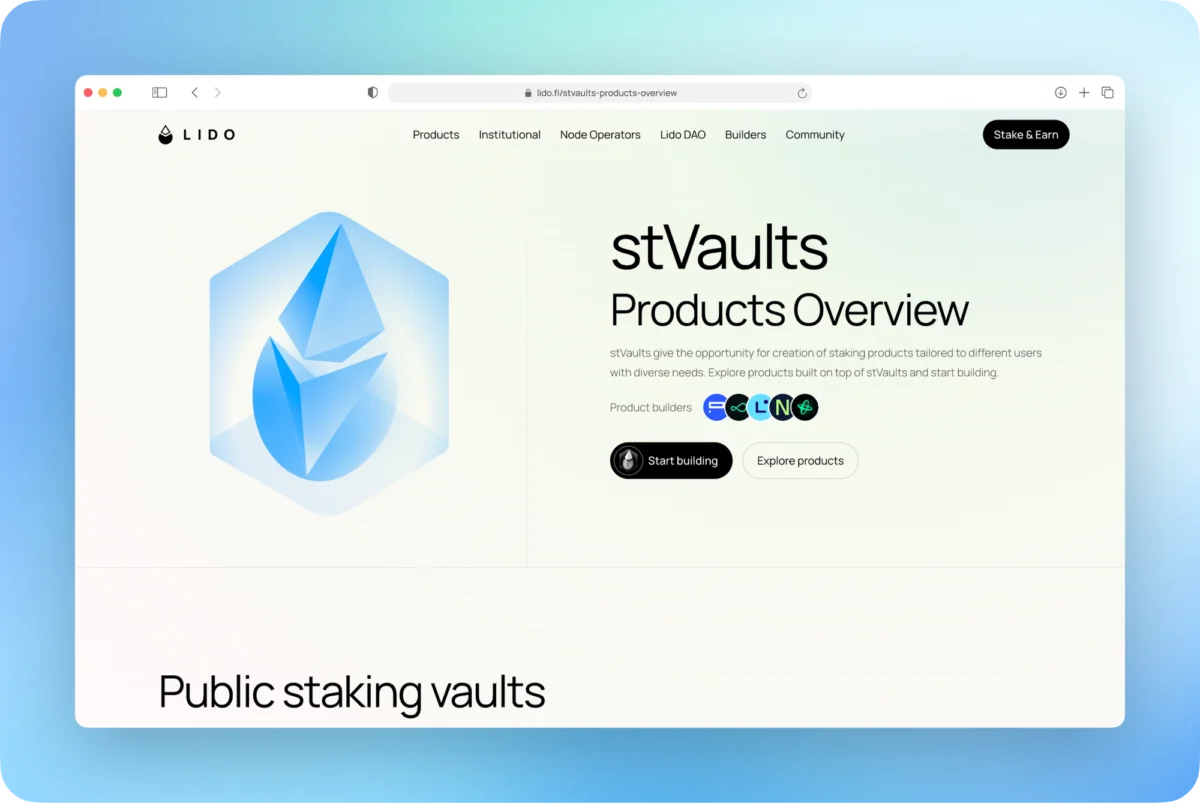
The stVaults architecture is a testament to the ongoing innovation within the decentralized finance (DeFi) space, specifically designed to meet the rigorous operational, security, and regulatory requirements of institutional players. Kiln’s approach is predicated on delivering scalable staking solutions accompanied by robust performance guarantees, streamlined operational workflows, and transparent, compliance-ready reporting. This focus on institutional-grade infrastructure positions Kiln and stVaults as a cornerstone for the next wave of institutional adoption in the Ethereum ecosystem.
The Evolving Landscape of Ethereum Staking: Background Context
Ethereum’s transition to a Proof-of-Stake (PoS) consensus mechanism, culminating in "The Merge" in September 2022 and subsequent upgrades like "Shapella" which enabled withdrawals in April 2023, fundamentally reshaped its economic model. Staking became the primary mechanism for network security and block validation, rewarding participants with ETH. However, this shift introduced new challenges, particularly for institutional investors.
Initially, direct staking on the Ethereum network required participants to lock up 32 ETH per validator, which, while offering direct control and potential for higher individual performance, rendered the capital illiquid. This illiquidity presented a significant hurdle for institutions managing large portfolios, as it constrained capital efficiency and limited strategic flexibility. The need for liquid alternatives quickly became apparent, leading to the proliferation of liquid staking protocols.
Lido Finance emerged as the dominant player in this nascent sector, offering a solution that allowed users to stake any amount of ETH and receive stETH (staked ETH) in return. stETH is a liquid derivative that represents staked ETH and its accumulated rewards, allowing users to participate in DeFi protocols, trade it, or use it as collateral, thereby solving the liquidity problem. As of early 2024, Lido commanded a significant portion of the total ETH staked, with its Total Value Locked (TVL) often exceeding $20 billion, underscoring its pivotal role in the liquid staking economy. However, while traditional liquid staking solutions like Lido offered liquidity, they typically involved staking across a broad pool of anonymous operators, which averaged validator performance and removed direct operator choice, a critical requirement for many institutional asset managers.
Addressing Institutional Hurdles: The Initial Approach & Limitations Revisited
For a considerable period, institutional ETH staking presented a difficult trade-off. On one hand, direct staking provided control over operator selection and the potential for optimized validator outcomes, but at the cost of capital liquidity. On the other hand, traditional liquid staking protocols granted liquidity through tokens like stETH, but at the expense of operator choice and an averaging of validator performance across a diverse and often opaque pool of operators.
This compromise severely restricted institutional flexibility. Platforms, asset managers, and even some sophisticated retail aggregators found themselves unable to combine the crucial elements of liquidity with performance-driven operator selection. This limitation often hindered the development of advanced, staking-native yield strategies that sought to remain deeply rooted in Ethereum’s fundamental economics rather than venturing into the higher-risk frontier of broader DeFi applications. The inability to attribute performance to specific operators, coupled with a lack of granular reporting, also posed significant challenges for compliance and auditability – non-negotiable requirements for regulated entities.
Lido V3 and stVaults: A Paradigm Shift for Institutional Staking
The advent of Lido V3 and its stVaults architecture represents a significant leap forward, effectively dismantling the historical trade-off between liquidity and control. This innovative framework allows institutions to maintain liquidity and composability within the broader DeFi ecosystem without sacrificing granular control over validator selection and performance attribution.
- Operator Choice with Liquidity: stVaults uniquely enable ETH to remain staked on Kiln-operated validators, allowing institutions to select a trusted and high-performing operator. Critically, this choice is now paired with the optional minting of stETH, providing unprecedented liquidity. This means institutions can deploy capital with a chosen operator, benefit from their operational excellence, and still have the flexibility to access immediate liquidity via stETH if needed, effectively eliminating the traditional dilemma.
- Performance-Driven Institutional Staking: Kiln has consistently demonstrated above-average validator performance through its enterprise-grade infrastructure, rigorous monitoring, and proactive management. By coupling this proven performance with the liquidity of stETH, stVaults empower institutions to achieve superior risk-adjusted staking outcomes. Unlike pooled liquid staking models where individual operator performance is averaged out, stVaults allow clients to directly benefit from Kiln’s optimized validator operations, translating to potentially higher yields and improved capital efficiency.
- Isolation, Transparency & Compliance Alignment: A cornerstone of institutional adoption is the demand for robust reporting, clear attribution, and auditability. stVaults address this by offering vault-level isolation, meaning each institution’s staked ETH is logically separated and attributable on-chain. This provides the granular reporting clarity and operational control that institutional clients require, significantly bolstering their compliance frameworks and simplifying audit processes. This level of transparency is vital for meeting regulatory obligations and internal risk management protocols.
Kiln’s Role and Technical Integration: Ensuring Enterprise-Grade Security and Uptime
Kiln’s participation in Lido V3 as an approved node operator is a testament to its operational prowess and commitment to security. The company operates a sophisticated network of enterprise-grade validators specifically designed to back stVault deployments. The integration process is meticulous, ensuring that all ETH associated with these vaults is staked through Kiln’s institutional validator infrastructure.
The architecture allows for stETH minting to be optional, providing institutions with maximum flexibility. Regardless of whether stETH is minted, Kiln assumes full responsibility for all validator monitoring, performance management, and operational overhead. This comprehensive service model frees institutional clients from the complexities of running their own validators, allowing them to focus on their core business objectives. The setup benefits from a multi-layered security approach, including robust hardware security modules (HSMs), geographically distributed data centers, active-active redundancy, and continuous threat monitoring. This combination ensures that institutions can confidently access liquid staking functionality with strong guarantees around security, uptime, and performance differentiation, critical factors for managing billions in assets.
Market Impact and Strategic Implications: Unlocking New Avenues for Institutional Capital
The launch of Kiln’s stVaults within the Lido V3 framework is expected to have far-reaching implications for the institutional adoption of Ethereum staking. By making high-performing, liquid institutional staking broadly accessible without compromising simplicity or trust, Kiln is enabling a new class of financial products. Platforms and asset managers can now offer meaningfully improved ETH staking outcomes compared to traditional pooled models, while crucially keeping yield generation anchored to the fundamental economics of staking, rather than introducing additional DeFi or lending risks.
This development is particularly relevant for wallets, fintech companies, and larger institutional platforms that rely on Kiln as a trusted infrastructure provider. stVaults empower these partners to distribute liquid, performance-driven staking products directly backed by Kiln’s superior validator operations. This de-risks liquid staking for regulated entities, opens up new avenues for asset managers to generate yield on their ETH holdings, and potentially shifts market dynamics by attracting a significant influx of institutional capital that was previously hesitant due to liquidity or control concerns. The ability to select operators, ensure transparent attribution, and maintain liquidity is a powerful combination that aligns perfectly with the evolving needs of sophisticated investors.
Expert Commentary and Stakeholder Reactions
Industry leaders have lauded this advancement as a pivotal moment for institutional engagement with decentralized finance. "The integration of Kiln with Lido V3 stVaults represents a significant milestone in bridging the gap between traditional finance and the decentralized world," stated Laszlo Szabo, CEO of Kiln. "Institutions have long sought a solution that combines the best of both worlds: the performance and control of direct staking with the liquidity and composability of liquid staking. stVaults, powered by Kiln’s battle-tested infrastructure, deliver exactly that, enabling a new era of compliant and efficient institutional participation in Ethereum’s staking economy."
Similarly, representatives from the Lido community have expressed optimism about the broader implications for decentralization and ecosystem health. "Lido V3 was designed with modularity and institutional needs in mind," commented a core contributor to Lido Finance, who preferred to remain anonymous given the decentralized nature of the project. "Kiln’s deployment of stVaults is a prime example of how our protocol can be leveraged to cater to diverse requirements, fostering greater institutional adoption while maintaining the core principles of decentralization and security. This innovation will not only attract more capital but also strengthen the overall resilience and integrity of the Ethereum network."
Future Outlook: A New Standard for Institutional Staking
The collaboration between Kiln and Lido V3 stVaults is setting a new standard for institutional staking. It marks a clear progression from generalized, pooled staking solutions to highly customizable, performance-optimized, and compliance-aligned offerings. This evolution is critical for the long-term growth and stability of the Ethereum ecosystem, as it paves the way for deeper integration with traditional financial markets.
As the digital asset space continues to mature, the demand for sophisticated, secure, and transparent solutions will only intensify. stVaults, with their unique combination of liquidity, operator choice, and verifiable performance, are positioned to be a cornerstone of this future. They promise to unlock unprecedented opportunities for institutional investors to participate actively and profitably in the Ethereum network, ensuring that yield generation remains anchored to the robust fundamentals of staking rather than speculative DeFi ventures. The journey towards a more inclusive and efficient institutional staking landscape has taken a monumental step forward.