Nila Kartika Wati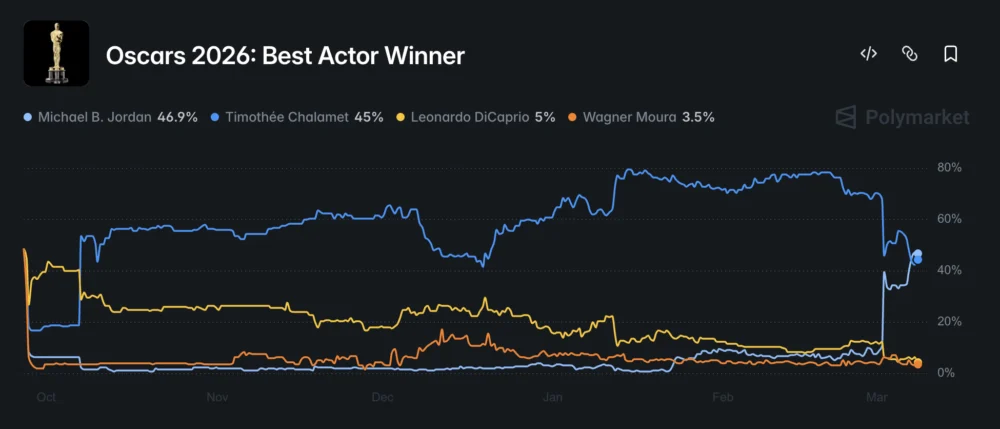
Actor Michael B. Jordan has dramatically shifted the landscape of the 2026 Academy Awards’ Best Actor race, vaulting past erstwhile favorite Timothée Chalamet on the prominent prediction market platform Polymarket. Jordan’s odds for securing the coveted golden statuette have surged by more than 400% since March 1, positioning him as the leading contender just a week ahead of the official awards ceremony. This unexpected shift not only highlights the dynamic nature of awards season but also underscores the growing influence of prediction markets in public forecasting, even as these platforms face an intensifying gauntlet of regulatory challenges within the United States.
A Sudden Surge: Jordan’s Ascent to the Top
The dramatic recalibration of expectations for Michael B. Jordan’s Oscar prospects follows his recent triumph at the Actor Awards, formerly recognized as the prestigious Screen Actors Guild (SAG) Awards. Last week, the acclaimed star of the upcoming vampire horror film "Sinners" clinched the Best Actor award at this significant industry precursor, signaling a potent wave of momentum. His performance as twin brothers Smoke and Stack Moore in the 2025 feature "Sinners" has evidently resonated deeply with his peers, as evidenced by the Actor Awards victory, which is often considered a strong indicator for Academy recognition due to the substantial overlap in voting bodies.
Prior to this win, the narrative largely favored Timothée Chalamet, nominated for his role in "Marty Supreme," a fictional drama film depicting the life of a dedicated table tennis player. Chalamet had held a comfortable lead on Polymarket until Saturday, reflecting widespread anticipation for his performance and his consistent critical acclaim. However, Jordan’s recent victory has demonstrably altered trader sentiment, demonstrating the immediate impact of major industry accolades on prediction market dynamics.
As of the latest available data, Polymarket traders now place Michael B. Jordan’s probability of winning Best Actor at approximately 47%. Chalamet, though displaced from the top spot, remains a formidable contender, trailing closely with 45% odds. The field is rounded out by other distinguished actors: Leonardo DiCaprio holds 5%, Wagner Moura 4%, and Ethan Hawke 1%. This distribution of probabilities on Polymarket, which has seen over $5.6 million in trading volume for the Best Actor market alone, offers a real-time, financially incentivized consensus on the likely outcome. The Academy of Motion Picture Arts and Sciences awards show is scheduled to air on March 15, intensifying the speculation as the final votes are cast and tallied.
The Roles that Define the Race: "Sinners" vs. "Marty Supreme"
Understanding the shift in odds requires a closer look at the performances under consideration. Michael B. Jordan’s dual role as twin brothers Smoke and Stack Moore in "Sinners" presents a unique and demanding acting challenge. Playing two distinct characters, especially in a genre as specific as vampire horror, often allows actors to showcase immense range and technical skill. Such performances, when executed with critical acclaim, frequently capture the attention of Academy voters who appreciate transformative and complex portrayals. Jordan, known for his charismatic and intense performances in films like "Creed" and "Black Panther," appears to be stretching his artistic boundaries significantly with "Sinners," potentially signaling a career-defining turn that the Actor Awards has already validated. The genre itself, while not traditionally an Oscar magnet, can be overcome by an exceptional performance that transcends its conventional limitations.
Conversely, Timothée Chalamet’s nomination for "Marty Supreme" positions him in a different, though equally challenging, dramatic territory. Portraying a table tennis player in a fictional drama suggests a role demanding subtlety, physical precision, and a deep emotional core. Chalamet, a darling of independent and mainstream cinema, has consistently impressed critics with his nuanced portrayals in films such as "Call Me By Your Name" and "Dune." His performance in "Marty Supreme" is expected to be another showcase of his particular brand of introspective intensity. However, the nature of the role might be perceived as less overtly "transformative" than Jordan’s dual character work, a factor that can sometimes sway Academy voters.

The other nominees also bring significant weight to the category. Leonardo DiCaprio, a perennial Oscar favorite and past winner, is known for his immersive and powerful performances. His consistent excellence means he can never be counted out. Wagner Moura, celebrated for his intense portrayals, particularly in "Narcos," could be a dark horse if his nominated performance resonates powerfully. Ethan Hawke, a respected veteran known for his thoughtful and often understated work, represents a different kind of critical darling. Each nominee’s past work and the specific nature of their current roles contribute to the complex calculus of the Best Actor race.
Polymarket: A Glimpse into the Future of Forecasting
Polymarket operates as a decentralized prediction market platform where users can wager on the outcome of future events, ranging from political elections and economic indicators to cultural phenomena like the Oscars. By allowing participants to buy "shares" in a particular outcome, the platform aggregates collective wisdom, translating it into probabilities. These probabilities are often considered more accurate than traditional polls because participants are incentivized financially to predict correctly, leading to a more efficient information market. The high trading volume of over $5.6 million in the Best Actor market alone underscores the significant interest and capital flowing into these predictions, suggesting that many view these markets as a reliable, if speculative, barometer of public and expert sentiment.
The platform’s ability to swiftly reflect shifts in sentiment, as demonstrated by Jordan’s sudden rise, showcases its potential as a real-time forecasting tool. Unlike static polls, prediction markets continuously update their odds based on new information and trading activity, providing a dynamic snapshot of perceived probabilities. This immediacy and responsiveness make them increasingly relevant in fields where accurate foresight is valuable, from financial markets to political campaigns and, evidently, awards season.
Navigating the Regulatory Minefield: Polymarket’s U.S. Ambitions
While Polymarket’s forecasting prowess is increasingly evident, its operations within the United States remain mired in significant regulatory uncertainty. The platform, which has global reach, began opening its application for select, waitlisted U.S. users in December 2025, with a broader rollout of a U.S.-regulated platform anticipated later in 2026. This phased re-entry into the U.S. market follows previous regulatory challenges that saw the platform scale back its American operations.
The core of the issue lies in the classification and oversight of prediction markets. U.S. state-level regulators frequently contend that these platforms constitute illegal gambling under their jurisdiction, arguing that event contracts fall within their purview. Polymarket, however, maintains that its event contracts are financial instruments akin to commodity futures and should therefore be regulated exclusively by the federal Commodity Futures Trading Commission (CFTC), not by individual states. This dispute sets the stage for a critical legal battle that could define the future of prediction markets in the U.S.
In a significant move in February 2026, Polymarket initiated a lawsuit against the Commonwealth of Massachusetts. The platform’s legal challenge directly confronts the state-level gambling regulator, asserting that it lacks the authority to oversee prediction markets. Polymarket’s argument hinges on the premise that the Commodity Exchange Act (CEA) grants sole regulatory authority over such instruments to the CFTC. This lawsuit is not merely a localized dispute; its outcome could establish a pivotal legal precedent, determining whether prediction markets are subject to a uniform federal regulatory framework or a fragmented patchwork of state and federal oversight. A ruling in Polymarket’s favor could significantly streamline its U.S. expansion and provide much-needed clarity for the entire industry. Conversely, a loss could embolden state regulators and complicate future operations.
Further complicating the regulatory landscape, Polymarket and another prominent prediction market platform, Kalshi, are grappling with increased scrutiny in Nevada. A federal judge recently rejected arguments put forth by these platforms that the CEA and the CFTC’s authority preempt state regulators from exercising oversight over prediction markets. This ruling in Nevada creates a challenging precedent, suggesting that state-level intervention might be permissible even where federal bodies have some jurisdiction. The divergence in legal interpretations across states underscores the urgent need for a definitive federal framework or clearer judicial guidance.

Financial Horizons and the Quest for Legitimacy
Amidst these regulatory headwinds, both Polymarket and Kalshi are reportedly engaged in preliminary discussions for new fundraising rounds. These discussions suggest ambitious targets, with both companies eyeing valuations of approximately $20 billion each – a figure that would roughly double their most recent valuations. The Wall Street Journal reported on Friday, citing sources familiar with the matter, that these negotiations are still in their early stages and there is no guarantee that deals will materialize or that the targeted valuations will be secured.
Such elevated valuations, if achieved, would signify immense investor confidence in the long-term potential of prediction markets, despite the immediate regulatory hurdles. Investors are likely betting on the eventual clarity of the U.S. regulatory environment and the inherent utility of these platforms in aggregating information and providing accurate forecasts. The ability to attract such significant capital amidst legal battles speaks to the perceived disruptive potential of prediction markets to revolutionize how information is valued and traded.
The success of these fundraising efforts is intrinsically linked to the resolution of the regulatory quagmire. A clearer path to operating legally and broadly within the U.S. would undoubtedly enhance investor appeal and justify higher valuations. Conversely, continued legal uncertainty and fragmented oversight could temper investor enthusiasm and hinder growth.
Broader Implications: The Future of Forecasting and Entertainment
The Oscar race, particularly the Best Actor category, serves as a compelling microcosm for understanding the broader implications of prediction markets. For the entertainment industry, these platforms offer a fascinating, real-time barometer of buzz and potential outcomes, influencing everything from awards campaigns to marketing strategies. For the public, they provide an engaging and often more accurate alternative to traditional punditry.
The ongoing legal battles, particularly the Massachusetts lawsuit, represent a critical juncture for the entire prediction market industry. The outcome will likely determine the operational freedom and growth trajectory of these platforms in the U.S. If federal preemption is upheld, it could pave the way for a more unified and robust prediction market ecosystem. If state oversight is affirmed, platforms may face a complex and costly compliance landscape, potentially hindering innovation and access.
Ultimately, the confluence of Michael B. Jordan’s surging Oscar odds and Polymarket’s high-stakes regulatory challenges paints a vivid picture of innovation pushing against established legal frameworks. As the Academy Awards approach, the world will be watching not only to see who takes home the Best Actor Oscar but also to discern the future trajectory of the platforms that are increasingly shaping our understanding of probable outcomes. The saga of prediction markets is a testament to the enduring tension between technological advancement, financial opportunity, and the imperative of regulatory oversight.