admin
admin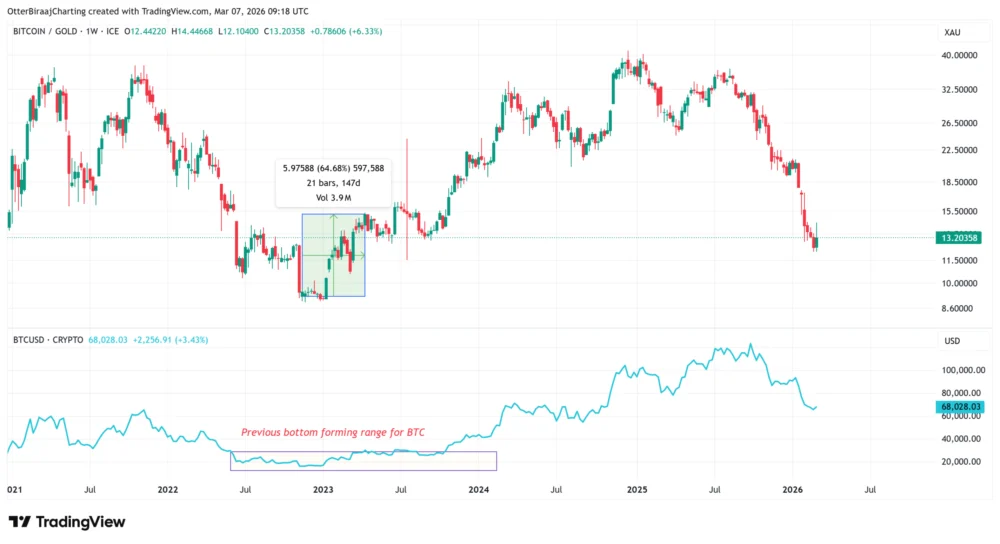
The global financial landscape is witnessing a notable divergence in capital allocation as Bitcoin exchange-traded funds (ETFs) return to a net positive flow while the longstanding dominance of gold ETFs begins to show signs of exhaustion. After nine consecutive months of consistent inflows, gold-backed investment vehicles are experiencing a cooling period, even as the price of the precious metal remains near historic highs. This shift occurs against a backdrop of stabilizing Bitcoin sentiment, leading market analysts to suggest that a fundamental rotation between the world’s two primary "store of value" assets may be underway.
According to the latest market data, the 30-day net flow for Bitcoin ETFs transitioned from a substantial $1.9 billion outflow on February 6 to a net inflow of $273 million by March 6. This reversal highlights a renewed appetite for digital assets among institutional and retail investors alike. Conversely, the gold market, which enjoyed a record-breaking start to 2025, is now grappling with significant liquidations. On a single Wednesday in early March, the SPDR Gold Shares (GLD)—the world’s largest gold-backed ETF—recorded a $3 billion outflow. This figure represents the largest single-day withdrawal from the fund in more than two years and followed a 4.4% decline in gold prices, the most aggressive sell-off since January 30.
The Great Rotation: Analyzing ETF Flow Dynamics
To understand the significance of these shifting flows, analysts often look beyond the total dollar value of assets under management and focus instead on "native units." This metric measures the actual quantity of the underlying asset—Bitcoin or ounces of gold—held by the funds, effectively stripping away the "noise" created by daily price fluctuations. When measured in these terms, the divergence between the two assets becomes even more pronounced.
Between February 6 and March 6, Bitcoin ETF balances saw a net increase of 4,021 BTC. This is a sharp contrast to the prior 30-day period, which saw a net decrease of 42,275 BTC. During the same window, gold ETF holdings plummeted from 1.4 million ounces to approximately 621,100 ounces. This drastic reduction in physical gold holdings suggests that investors are not merely reacting to price volatility but are actively rebalancing their portfolios.
Joe Consorti, Head of Growth at Horizon, noted that the current market behavior suggests an "anticipated risk-off to risk-on rotation." Consorti observed that while gold appears to be stalling, Bitcoin is positioning itself to overtake gold’s percentage growth as the United States economy shows signs of acceleration. As risk sentiment improves, the capital that sought refuge in gold during the geopolitical and inflationary scares of 2024 and 2025 appears to be seeking higher-beta returns in the cryptocurrency market.
A Historical Pattern: Why Gold Rallies Often Precede Bitcoin Recoveries
The current market dynamic is not without historical precedent. In a comprehensive "2026 Look Ahead" report published in late December 2025, Fidelity Digital Assets analyst Chris Kuiper highlighted that gold and Bitcoin frequently take turns leading the market. In 2025, gold delivered a staggering 65% return, marking its fourth-largest annual gain since the abandonment of the gold standard in 1971.

Kuiper’s analysis suggests that gold may be entering the late stages of its leadership cycle. Historically, when gold reaches a point of exhaustion after a massive rally, Bitcoin often emerges as the primary beneficiary of the next wave of capital. "With gold shining in 2025, it would not be surprising if Bitcoin takes the lead next," Kuiper stated, pointing to the cyclical nature of these two non-sovereign assets.
However, historical data also suggests that this rotation is rarely instantaneous. A technical analysis of the Bitcoin-to-gold ratio reveals that after Bitcoin’s market bottom in 2022, it took approximately 147 days—or roughly 21 weeks—for the digital asset to establish a sustained trend of outperformance against gold. Currently, the Bitcoin-to-gold ratio is trading within a consolidation zone that mirrors the patterns seen during the 2022–2023 rotation phase. This suggests that while the momentum is shifting, the market may remain in a transitionary period for several more weeks before a clear Bitcoin-led trend is solidified.
Macroeconomic Catalysts: Deficits, Geopolitics, and Neutral Assets
The competition between Bitcoin and gold is unfolding within a complex macroeconomic environment characterized by persistent fiscal deficits in the United States, escalating trade tensions, and heightened geopolitical instability. Both assets serve as "neutral stores of value"—assets that exist outside the traditional fiat monetary system and are not the liability of any single government or central bank.
The ongoing conflict involving Israel and Iran has played a dual role in shaping market demand. Traditionally, such geopolitical stressors drive investors toward gold as a safe-haven asset. This was a primary driver of gold’s 2025 rally. However, as the conflict persists, Bitcoin is increasingly viewed through a similar lens. Its borderless, permissionless nature makes it an attractive alternative for those seeking to protect wealth in regions affected by sanctions or banking instability.
Furthermore, the U.S. fiscal trajectory remains a significant concern for long-term investors. With the national debt continuing to climb and interest payments becoming a larger portion of the federal budget, the debasement of the U.S. dollar remains a central theme. While gold has traditionally been the hedge of choice against currency devaluation, the younger generation of investors and an increasing number of institutional players are viewing Bitcoin as a "faster" version of the same trade.
Institutional Sentiment and the "Risk-On" Shift
The shift in ETF flows also reflects a broader change in investor psychology. The massive $18.7 billion inflow into gold ETFs in January 2025, followed by another $5.3 billion in February, represented a "flight to safety." This was the strongest two-month start to a year on record for gold. However, the $3 billion outflow in March indicates that many of these investors are now taking profits, satisfied with the 65% gains achieved over the previous year.
As these investors exit gold positions, they are looking for the next growth engine. If the U.S. economy continues to show resilience and inflation remains within a manageable (albeit elevated) range, the environment becomes conducive to "risk-on" assets. Bitcoin, with its fixed supply and increasing institutional adoption through ETF wrappers, is the natural destination for this liquidity.

Macroeconomist Lyn Alden has expressed a long-term bullish outlook for the digital asset, stating that she expects Bitcoin to outperform gold over the next two to three years. Alden’s thesis rests on the idea that Bitcoin’s structural scarcity and its role as a burgeoning financial network provide it with a higher ceiling for growth than physical gold, which is primarily a passive store of value.
Implications for the Broader Financial Market
The rotation from gold to Bitcoin ETFs has significant implications for the broader financial ecosystem. First, it validates the role of Bitcoin ETFs as a legitimate and highly liquid vehicle for institutional rebalancing. The ease with which $3 billion can move out of GLD and hundreds of millions can flow into Bitcoin products like IBIT or FBTC demonstrates a maturing infrastructure that can handle large-scale capital shifts.
Second, the divergence suggests that the "digital gold" narrative is gaining more than just theoretical traction. For years, proponents of Bitcoin argued that it would eventually eat into gold’s market capitalization. The current data, showing gold holdings declining while Bitcoin holdings rise in native units, provides some of the most tangible evidence to date that this cannibalization may be occurring.
Finally, the shift signals a potential change in the correlation between crypto and traditional assets. If Bitcoin begins to decouple from the broader tech sector and instead trades more in relation to the gold cycle—albeit with higher volatility—it could change how portfolio managers approach diversification.
Conclusion: A New Chapter in the Store-of-Value Debate
As the first quarter of 2026 progresses, the financial world is watching closely to see if the recent ETF flow data marks the beginning of a multi-year trend or a temporary fluctuation. The exhaustion of gold’s nine-month inflow streak, combined with the largest daily outflow in years, suggests that the "gold era" of 2025 may be giving way to a "Bitcoin era" in 2026.
While gold remains a foundational asset for central banks and conservative portfolios, the momentum has clearly shifted toward the digital frontier. With historical patterns, technical indicators, and macroeconomic drivers all aligning, Bitcoin appears poised to reclaim its position as the leading alternative asset. Investors, however, are cautioned to remain mindful of the consolidation phases and the inherent volatility that accompanies such a significant transition in global capital flows. The coming months will be critical in determining whether Bitcoin can truly sustain its lead and redefine the concept of a safe haven in a digital age.