admin
admin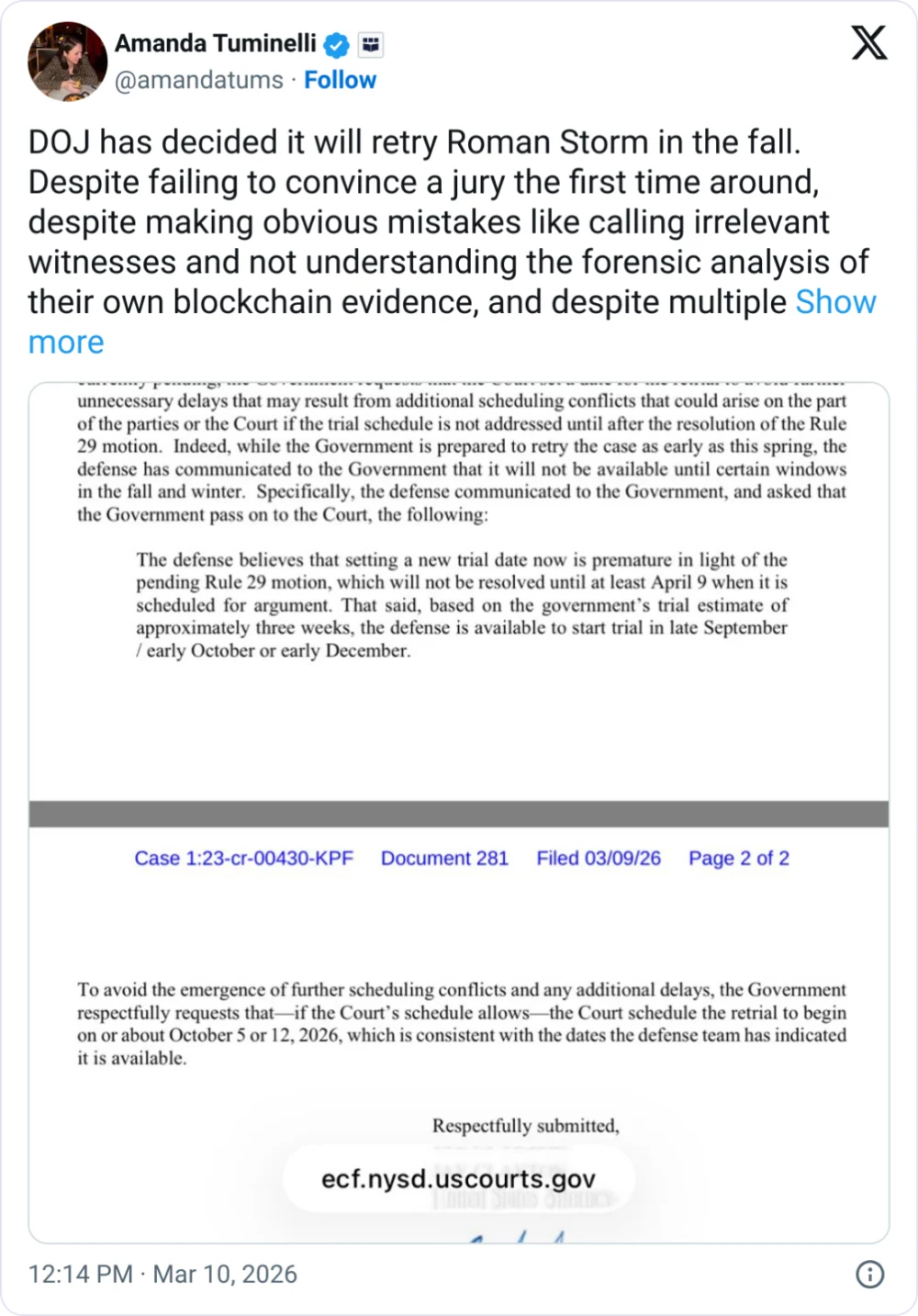
In a significant escalation of the legal battle surrounding decentralized finance (DeFi) and privacy-enhancing software, federal prosecutors in the Southern District of New York (SDNY) have officially requested a retrial of Roman Storm, the co-founder of the controversial cryptocurrency mixer Tornado Cash. The move follows a previous trial in late 2024 where a jury was unable to reach a unanimous verdict on two of the three primary charges brought against the developer. In a letter addressed to U.S. District Judge Katherine Polk Failla on Monday, U.S. Attorney for Manhattan Jay Clayton formally moved to set a new trial date, signaling the government’s determination to secure a conviction on the remaining counts of conspiracy to commit money laundering and conspiracy to violate the International Emergency Economic Powers Act (IEEPA).
The request marks a pivotal moment in a case that has sent shockwaves through the global software development and cryptocurrency communities. At the heart of the dispute is the question of whether creators of open-source, decentralized protocols can be held criminally liable for the illicit activities of third-party users who interact with their code. While the government views Tornado Cash as a tool intentionally designed to facilitate criminal activity, Storm and his supporters argue that the case represents an overreach of executive power that threatens the fundamental principles of software development and digital privacy.
The Legal Landscape and Proposed Timeline
According to the filing submitted by U.S. Attorney Clayton, the government is proposing that the retrial begin on or around October 5 to 12, 2026. The prosecution expects the proceedings to last approximately three weeks. This proposed timeline reflects a complex negotiation between the Department of Justice (DOJ) and Storm’s legal team. While the government expressed readiness to proceed as early as the spring of 2025—specifically between March and May—Storm’s defense attorneys indicated they would not be available until late 2026, citing scheduling conflicts and the need for extensive preparation.
The push for a retrial comes after a partial verdict was reached in August 2024. At that time, the jury convicted Storm of one count: conspiring to operate an unlicensed money-transmitting business. However, the jury remained deadlocked on the two more severe charges: conspiracy to commit money laundering and conspiracy to violate U.S. sanctions. Under U.S. law, a deadlocked jury, or "hung jury," allows the prosecution the option to retry the defendant on those specific counts.
The stakes for Storm are exceptionally high. In public statements following the news of the retrial request, Storm noted that the two pending counts carry a combined maximum sentence of up to 40 years in federal prison. "A jury already couldn’t agree this was criminal," Storm posted on the social media platform X. "But the SDNY prosecutors want to keep trying with the hope of getting a different answer."
Background: The Rise and Fall of Tornado Cash
Tornado Cash was launched in 2019 as a non-custodial privacy solution built on the Ethereum blockchain. It utilized zero-knowledge proofs to allow users to sever the on-chain link between a source address and a destination address, effectively "mixing" funds to provide financial anonymity. While the developers marketed the tool as a way for legitimate users to protect their privacy in a transparent ledger environment, the service quickly became a focal point for law enforcement.
The situation reached a breaking point in August 2022, when the U.S. Treasury Department’s Office of Foreign Assets Control (OFAC) took the unprecedented step of sanctioning the Tornado Cash smart contracts. OFAC alleged that the mixer had been used to launder more than $7 billion in virtual currency since its inception. A significant portion of these funds, approximately $455 million, was linked to the Lazarus Group, a state-sponsored hacking collective from the Democratic People’s Republic of Korea (DPRK).
The sanctions were controversial because they targeted a set of autonomous software protocols rather than a specific person or entity. This led to a series of legal challenges from privacy advocates and crypto firms, who argued that the government did not have the authority to sanction "code." Despite these challenges, the DOJ moved forward with criminal indictments against Storm and his co-founder, Roman Semenov, in August 2023. A third co-founder, Alexey Pertsev, was arrested in the Netherlands and was subsequently convicted of money laundering by a Dutch court in May 2024, receiving a 64-month prison sentence.
The Prosecution’s Theory vs. the Defense’s Argument
The SDNY’s case against Storm rests on the theory that he and his co-founders did more than just write code; they allegedly operated a business that they knew was being used by criminals and North Korean hackers. Prosecutors argue that the developers maintained a level of control over the protocol through administrative keys and the user interface, and that they failed to implement required Anti-Money Laundering (AML) and Know Your Customer (KYC) procedures.
In contrast, Storm’s defense team, led by Waymaker LLP, has consistently argued that Tornado Cash is a decentralized, open-source protocol that the developers did not control once it was deployed. They contend that Storm cannot be held responsible for the independent actions of users who utilized the immutable smart contracts. In October 2024, Storm’s lawyers filed a motion for acquittal on the unlicensed money-transmitting charge, arguing that the government failed to prove he had the specific intent to assist bad actors.

This motion remains a significant hurdle in the current proceedings. U.S. Attorney Clayton’s letter acknowledged that Storm’s lawyers believe setting a new trial date is premature until the acquittal motion is resolved. Judge Failla is scheduled to hear oral arguments on that motion in early April 2025. If the judge grants the acquittal, it could fundamentally undermine the government’s remaining charges.
Supporting Data and Evidence Challenges
The first trial revealed several points of contention regarding the evidence presented by the government. Legal observers and industry advocates have criticized the prosecution’s handling of blockchain forensics. Amanda Tuminelli, the Chief Legal Officer at the DeFi Education Fund, expressed disappointment in the DOJ’s decision to retry the case, citing what she described as "obvious mistakes" made during the first trial.
"Despite failing to convince a jury the first time around, despite calling irrelevant witnesses and not understanding the forensic analysis of their own blockchain evidence… the SDNY will retry Roman Storm," Tuminelli stated.
The complexity of the evidence is a major factor in the trial’s duration and the deadlock of the previous jury. Proving "conspiracy" in a decentralized environment requires showing a "meeting of the minds" between the developers and the illicit users. The defense has argued that there is no evidence of direct communication or agreement between Storm and groups like Lazarus. Furthermore, the defense has pointed to data suggesting that the vast majority of Tornado Cash transactions were for legitimate privacy purposes, such as protecting consumer spending habits or making confidential donations.
Shifting Regulatory Perspectives
The decision to pursue a retrial comes at a time of shifting rhetoric within the U.S. government regarding cryptocurrency mixers. Earlier this month, a report submitted by the U.S. Treasury to Congress acknowledged for the first time that there are "legitimate uses" for crypto mixers. The report noted that some individuals use these services to maintain privacy in their consumer spending, a significant departure from previous government messaging that often equated mixing services solely with criminal intent.
Adding another layer of complexity is a memo issued in April 2024 by U.S. Deputy Attorney General Todd Blanche. The memo stated that the Justice Department "is not a digital assets regulator" and indicated that the agency would "no longer pursue litigation or enforcement actions that have the effect of superimposing regulatory frameworks on digital assets." Storm and his supporters have pointed to this memo as a sign of inconsistency within the DOJ, arguing that the prosecution of Tornado Cash developers is exactly the type of "superimposed regulatory framework" the memo warned against.
Broader Implications for the Tech Industry
The outcome of the Roman Storm retrial will likely set a major precedent for the future of the software industry, particularly for those working in the "privacy tech" space. If the government succeeds in securing a conviction for money laundering based on the creation of open-source code, it could create a "chilling effect" on developers worldwide.
Industry analysts suggest that such a precedent would force developers to vet every potential user of their software or risk criminal liability—a task that is technically impossible for decentralized protocols. This has led many to view the Storm case as a battle over the First Amendment right to publish code as speech.
Furthermore, the case highlights the ongoing tension between national security interests and individual privacy rights. While the government’s goal of cutting off funding to rogue states like North Korea is a clear priority, the methods used—targeting the developers of privacy tools—remain a point of intense ethical and legal debate.
Conclusion and Next Steps
As the legal community awaits Judge Failla’s decision on the motion for acquittal in April, the prospect of a late 2026 retrial looms large over the DeFi sector. The SDNY’s persistence in this case underscores the high priority the U.S. government places on regulating the intersection of cryptocurrency and illicit finance, even when the targets are software developers rather than the actual perpetrators of the underlying crimes.
For Roman Storm, the path ahead involves years of continued legal uncertainty and the potential for a life-altering prison sentence. For the broader crypto industry, the case remains a litmus test for the viability of decentralized privacy in the United States. The upcoming arguments in April and the subsequent scheduling of the retrial will be closely monitored by legal experts, privacy advocates, and technologists globally, as the final verdict will likely define the boundaries of developer liability for decades to come.