James Watt
The primary indicator of this burgeoning stress appeared in the perpetual futures market, a derivative instrument unique to crypto that allows traders to speculate on price movements without an expiration date. Unlike traditional futures, which converge with the spot price as they approach maturity, perpetuals use a "funding rate" mechanism to stay tethered to the underlying asset’s market value. When the funding rate turns negative, it indicates that short sellers are in the majority and are willing to pay a premium to long holders to maintain their bearish positions. On Feb. 28, 2026, Bitcoin’s perpetual funding rate plummeted to approximately -6%, marking one of the most aggressive bearish tilts observed in over a quarter of trading.
The Mechanics of a Bearish Regime
To understand the gravity of a -6% funding rate, one must examine the state of the market’s "plumbing." Funding rates typically hover in positive territory during neutral or bullish phases, reflecting a general preference for long exposure. A shift into deep negative territory suggests not just a lack of buyers, but an active, aggressive effort to profit from—or hedge against—downside movement.
Simultaneously, Bitcoin-denominated open interest (OI) showed a steady climb. Since the start of the year, the total number of outstanding derivative contracts rose from 113,380 BTC to 120,260 BTC. This rise in open interest while funding was deeply negative is a critical distinction. In many sell-offs, open interest drops as traders are liquidated or voluntarily close their positions, indicating a "flush" of leverage. However, rising open interest coupled with negative funding signifies that new capital is entering the market specifically to take short positions or to establish downside hedges.
This combination created a "crowded trade" scenario. By early March, the market was heavily skewed toward the downside, with a massive amount of leverage backing these bearish bets. While such a setup often precedes a "short squeeze"—a rapid price increase triggered by shorts being forced to buy back their positions—it also reflects a genuine, fundamental fear among market participants regarding the broader economic environment.
Chronology of a Macro Collision
The timeline of the past two weeks reveals a market that was bracing for impact long before the official data arrived.
Late January to Mid-February 2026: Bitcoin open interest begins a steady ascent. Despite price fluctuations, the "fuel" in the system—leverage—accumulates, as traders anticipate a volatility catalyst.
Feb. 28, 2026: The funding rate hits a local nadir of -6%. This "bleak signal" suggests that the cost of holding short positions has reached an extreme, indicating that traders are either desperate for protection or highly confident in a coming crash.
March 1–5, 2026: The market enters a period of high-tension equilibrium. Bitcoin prices remain suppressed, but the negative funding persists. This is the "pressure gauge" phase, where the market is no longer rewarding shorts with new lows, yet the shorts refuse to exit, creating a coiled-spring effect.
March 6, 2026: The U.S. Bureau of Labor Statistics (BLS) releases the February nonfarm payrolls (NFP) report. The data reveals a contraction of 92,000 jobs, far below analyst expectations, while the national unemployment rate climbs to 4.4%.
The Labor Market Catalyst
The U.S. jobs report acted as the spark for the accumulated "fuel" in the Bitcoin derivatives market. A loss of 92,000 jobs in a single month is a significant macro event that alters the trajectory of Federal Reserve policy and investor risk appetite.

In a traditional financial context, a weak jobs report is a double-edged sword. On one hand, it signals economic cooling, which may lead the Federal Reserve to pause interest rate hikes or even consider cuts to stimulate growth. This typically causes government bond yields to fall and can be bullish for "hard assets" like gold and Bitcoin. On the other hand, if the data is seen as a harbinger of a hard landing or a recession, investors often flee "risk-on" assets in favor of the safety of the U.S. dollar.
For Bitcoin, which exists at the intersection of a technology play and a monetary hedge, this macro ambiguity is resolved through the lens of leverage. Because the market was already "leaning" short, the immediate reaction to the jobs report was filtered through existing positions. When the data hit, the initial uncertainty caused a sharp repricing across all asset classes. In the crypto markets, this translated into immediate volatility as the "crowded room" of short sellers suddenly faced a shifting narrative.
Liquidations: The Final Scoreboard
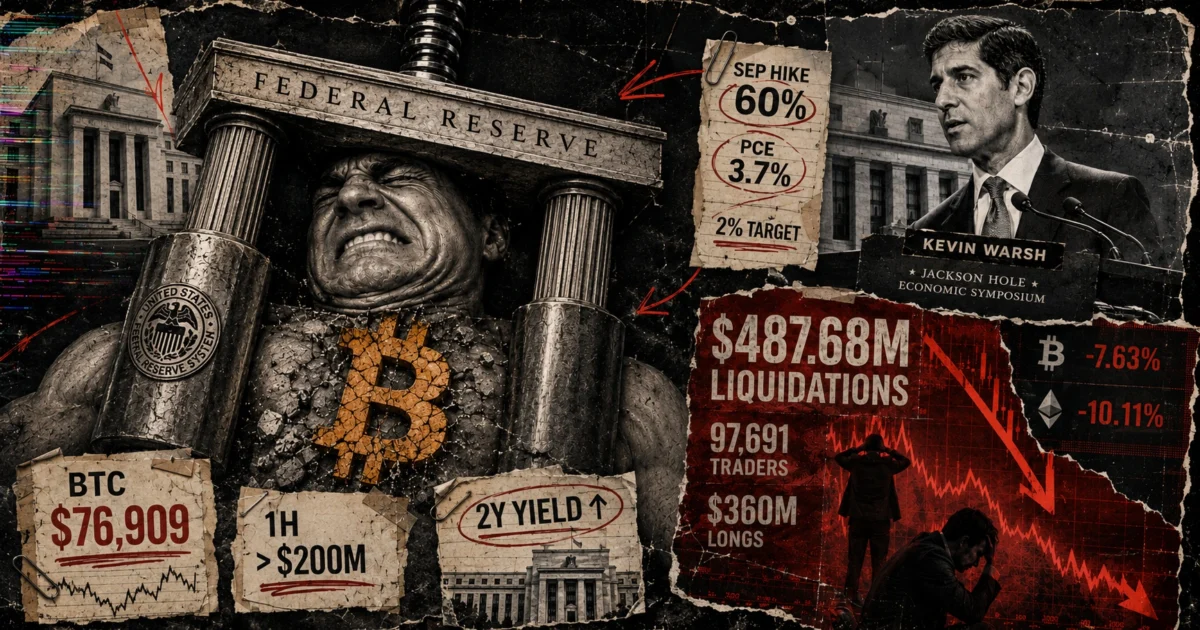
As the macro data was absorbed, the focus shifted from funding rates to liquidations. Liquidations represent the moment when the market’s positioning is no longer optional. When a trader’s margin is exhausted, the exchange automatically closes the position, creating a feedback loop of buying (in the case of short liquidations) or selling (in the case of long liquidations).
During the week of the jobs report, the market saw a "flush" on both sides. Initially, the negative funding regime suggested that shorts were the most at risk. If the macro news were interpreted as "bad news is good news" (meaning a weak economy leads to lower interest rates), a price spike would have triggered a massive short squeeze. Conversely, if the news deepened the "risk-off" sentiment, any remaining longs would be forced to liquidate as the price hit new lows.
The data suggests that the move was not entirely orderly. High-velocity liquidations in both directions indicated that the market had entered a state where neither the bulls nor the bears had sufficient breathing room to navigate the volatility. This "clearing of the books" is a necessary, albeit painful, process that resets the market’s leverage levels, allowing for more stable price discovery in the following weeks.
Institutional Hedging vs. Retail Speculation
A critical enrichment to this analysis is the distinction between the types of participants driving these signals. The rise in BTC-denominated open interest suggests institutional involvement. Professional desks often use perpetual futures to hedge spot holdings. For example, an institutional fund holding $100 million in Bitcoin might open a corresponding short position in the futures market to protect against a potential macro-driven drawdown.
When these institutions hedge, they are less concerned with the "carry cost" of negative funding and more concerned with capital preservation. This explains why negative funding can persist even when a short squeeze seems imminent. Retail traders, by contrast, are often the ones seeking to "trade the trend." When retail follows the trend into a crowded trade, they provide the liquidity that eventually gets harvested during a liquidation event.
Broader Implications for the Crypto Market
The events of early March 2026 underscore a fundamental shift in the cryptocurrency landscape. Bitcoin is no longer an isolated asset class moving on its own internal idiosyncratic cycles. It has become a primary vehicle for expressing views on global liquidity and economic health.
The fact that derivatives gave the "best explanation" of the week’s stress suggests that investors looking for signals should spend as much time analyzing the "internal" data of the exchanges—funding, OI, and liquidations—as they do the "external" data of the macroeconomy. The "bleak signal" of Feb. 28 was not a prophecy of a price crash, but a diagnosis of market anxiety.
Looking forward, the persistence of the 4.4% unemployment rate and the contraction in payrolls will likely keep the Bitcoin market on edge. If the Federal Reserve shifts toward a more dovish stance in response to the labor data, the "fuel" of high open interest could eventually ignite a sustained move higher. However, if the economic weakness translates into a broader corporate earnings recession, the "downside hedges" seen in the funding rates may prove to have been a prudent, rather than a panicked, response.
In conclusion, the derivatives market acted as a pressure gauge that reached its limit just as a major external force—the U.S. jobs report—pushed the needle. The resulting volatility was the sound of that pressure being released. For the disciplined investor, these signals serve as a reminder that in a world of high leverage and instant information, the most important story is often not the price itself, but the cost and volume of the bets being placed behind the scenes.