admin
admin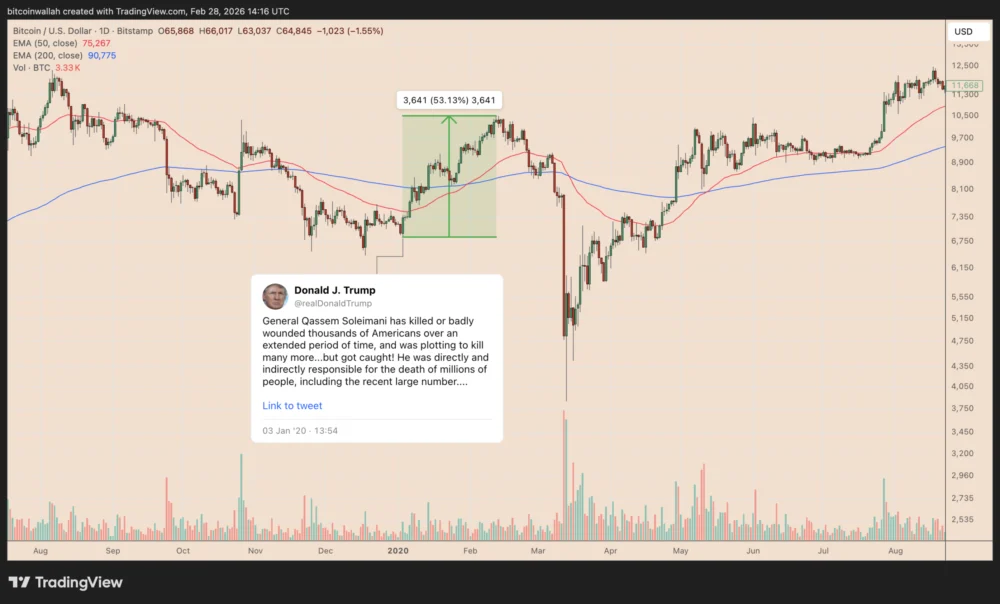
Bitcoin (BTC) is currently pacing toward its most significant weekly performance since September 2025, effectively decoupling from traditional risk assets amidst a volatile global landscape defined by escalating conflict between Israel and Iran and broader economic uncertainty in the United States. As of mid-March 2026, the primary cryptocurrency has demonstrated a resilient 7% climb over a seven-day period, reaching a valuation of approximately $70,625. This upward trajectory stands in stark contrast to the benchmark S&P 500 index, which retreated by 1.60% over the same timeframe, signaling a rare divergence where digital assets are being treated as a potential hedge against geopolitical instability rather than purely speculative vehicles.
The catalyst for this recent surge appears to be a combination of aggressive corporate treasury strategies and sustained institutional demand through exchange-traded products. Data provided by STRC.LIVE indicates that a prominent corporate entity, referred to as "Strategy," has potentially amassed significant capital to bolster its Bitcoin holdings. Through at-the-market (ATM) sales of its STRC instrument—an income-paying exchange-traded vehicle—the firm is estimated to have raised enough liquidity to purchase upwards of 11,000 BTC this week alone. At current market valuations, this represents a capital injection of approximately $776 million, providing a massive floor for the asset’s price despite the "risk-off" sentiment prevailing in legacy markets.
The STRC Mechanism and Corporate Accumulation Strategies
The STRC instrument has become a pivotal component of the modern Bitcoin ecosystem, functioning as a bridge between traditional capital markets and the digital asset space. Strategy’s model involves issuing shares of STRC when the instrument trades at or above its $100 par value. This premium allows the firm to dilute shares effectively to raise cash, which is then immediately converted into Bitcoin. This "flywheel" effect has proven effective in previous cycles; notably, in the preceding week, the firm successfully acquired 17,994 BTC, valued at roughly $1.28 billion at the time of purchase.

Internal data reveals that approximately 30% of that massive allocation was funded directly through STRC sale proceeds. The ability of such entities to weaponize equity demand into direct spot market pressure has fundamentally altered the liquidity dynamics of Bitcoin. When traditional investors seek yield-bearing instruments linked to the crypto economy, they inadvertently provide the dry powder necessary for these firms to remove large quantities of BTC from the circulating supply. This institutional "HODLing" strategy reduces sell-side pressure, even when geopolitical headlines would typically trigger a flight to cash or gold.
Sustained ETF Inflows Amidst Middle East Tensions
Complementing the corporate accumulation is the continued dominance of U.S.-based spot Bitcoin ETFs. Despite the heightened tensions between Israel and Iran, which have historically pushed investors toward safer harbors, Bitcoin ETFs recorded a five-day streak of net inflows totaling $767 million. This consistent demand suggests that the institutional "wall of money" expected since the 2024 ETF approvals has matured into a stable, predictable force.
Market analysts observe that the demographic of Bitcoin buyers is shifting. While retail investors may still react emotionally to news of missile strikes or diplomatic breakdowns, the programmatic buying associated with ETFs and corporate treasuries provides a stabilizing influence. The $767 million in weekly inflows reflects a growing consensus among fund managers that Bitcoin may serve as "digital gold"—an asset with a fixed supply that is theoretically immune to the inflationary pressures often associated with wartime spending and government deficit expansion.
A Chronology of Bitcoin’s Geopolitical Resilience
To understand the current market behavior, one must look at the historical precedent of Bitcoin’s performance during periods of intense international conflict. While the immediate reaction to "black swan" events is often a brief price liquidation, the subsequent recoveries have historically been aggressive.

January 2020: The US-Iran Flashpoint
Following the targeted killing of Iranian General Qasem Soleimani, global markets initially shuddered. Bitcoin experienced a flash drop as investors sought the liquidity of the U.S. Dollar. However, within days, the narrative shifted toward Bitcoin as a non-sovereign store of value. The asset ultimately rallied more than 50% in the weeks following the event, outperforming almost every traditional asset class.
February 2022: The Invasion of Ukraine
The onset of the Russia-Ukraine war saw a similar pattern. An initial "dump" occurred as the world braced for a massive shift in European security. Nevertheless, as sanctions were imposed and the fragility of the traditional banking system was exposed in conflict zones, Bitcoin surged. The asset delivered a 40% price rally in the aftermath, as it became clear that decentralized networks provided a necessary utility for those caught in the crossfire of geopolitical maneuvering.
June 2025: Israel-Iran Escalation
More recently, in June 2025, Israel’s strikes on Iranian infrastructure caused an immediate dip in the BTC price. Yet, the market flipped bullish almost immediately, gaining 25% over the subsequent two months. Each of these instances reinforces the "geopolitical stress test" theory, where Bitcoin’s value proposition as a borderless, censorship-resistant asset is validated by the very crises that threaten traditional financial stability.
Technical Analysis: The Conflict Between Macro Targets and Bear Flags
While the fundamental and historical data points toward further gains, technical analysts remain cautious. A "bear flag" formation has appeared on the daily charts, suggesting the potential for a "bull trap." A bear flag occurs when a price rises within a narrow, ascending parallel channel following a sharp downtrend. If the price breaks below the lower boundary of this channel, it often leads to a continuation of the previous bearish trend.

As of Saturday, March 14, 2026, Bitcoin showed signs of exhaustion near the $72,750 level. This price point is significant because it aligns with the 50-day exponential moving average (EMA), a technical level that often acts as a ceiling during corrective phases. If the bear flag plays out according to textbook patterns, the measured downside target could be as low as $51,000. This would represent a significant correction, potentially flushing out over-leveraged long positions before any further move toward the elusive $100,000 milestone.
Conversely, macro-economic models remain overwhelmingly bullish. Several prominent analysts argue that the current price action is merely a consolidation phase before an escalation toward six figures. These models point to the "halving" cycles and the decreasing "liquid supply" on exchanges as the primary drivers that will eventually override short-term technical patterns like the bear flag.
Broader Economic Implications and the Path to $100,000
The divergence between Bitcoin and the S&P 500 is perhaps the most critical development for the asset’s long-term thesis. For much of its history, Bitcoin has traded as a "high-beta" version of the Nasdaq, rising and falling with tech stocks. However, the current decoupling suggests that Bitcoin is beginning to carve out its own niche in the global macro environment.
If Bitcoin continues to rise while the S&P 500 falls, it may attract a new wave of capital from traditional "60/40" portfolio managers who are looking for uncorrelated assets. The geopolitical backdrop acts as a catalyst for this transition. As investors witness the weaponization of finance and the volatility of fiat currencies during times of war, the appeal of a mathematically guaranteed, decentralized ledger grows.

Furthermore, the role of "Strategy" and other corporate giants cannot be understated. By treating Bitcoin as a primary reserve asset, these companies are effectively "shorting" the dollar while "longing" the future of digital scarcity. If more corporations follow the STRC model of raising capital to acquire BTC, the resulting supply shock could make the $100,000 target a reality much sooner than the technical charts might suggest.
Conclusion: A Market at a Crossroads
Bitcoin is currently at a critical juncture. On one hand, the asset is passing its most recent geopolitical stress test with flying colors, buoyed by hundreds of millions of dollars in institutional inflows and strategic corporate buying. On the other hand, the specter of a technical breakdown remains, with the $51,000 level serving as a reminder of the asset’s inherent volatility.
The coming weeks will be decisive. Should Bitcoin break and hold above the 50-day EMA at $72,750, it would likely invalidate the bear flag and open the door for a run toward new all-time highs. However, if the geopolitical situation stabilizes and the "fear trade" unwinds, the market may see a temporary retracement as liquidity flows back into traditional equities. Regardless of the short-term price action, the events of March 2026 have further solidified Bitcoin’s status as a formidable player in the global financial arena, capable of thriving even when the world’s most established markets are under duress.