admin
admin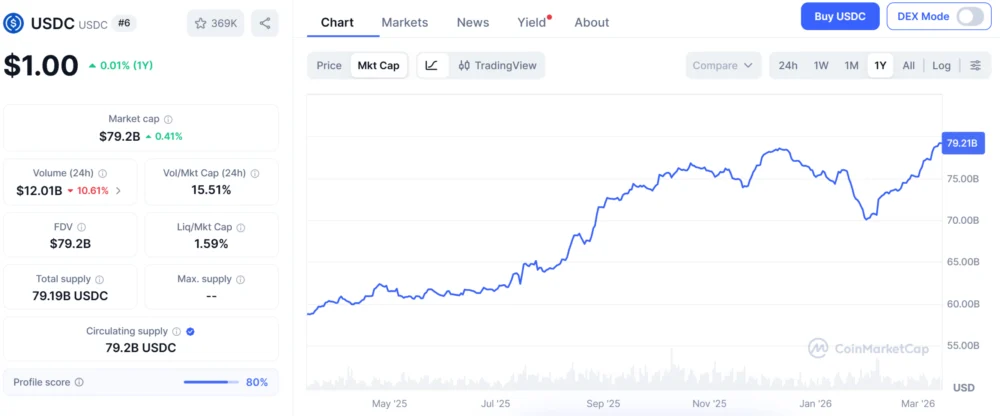
The market capitalization of the USDC stablecoin is rapidly approaching a historic threshold of $80 billion as a surge in demand across the Middle East, particularly within the United Arab Emirates (UAE), reshapes the landscape of digital asset liquidity. According to the latest data from CoinMarketCap, the circulating supply of USDC has climbed to approximately $79.2 billion, establishing a new all-time high for the dollar-pegged asset and eclipsing its previous peak of just under $79 billion recorded in December of last year. This aggressive expansion of the stablecoin’s supply—growing by nearly $10 billion since early February—signals a profound shift in global investor sentiment and a pivot toward regulated, dollar-equivalent digital assets during periods of regional economic volatility.
The acceleration of USDC’s growth has been particularly pronounced in recent weeks. In early February, the stablecoin’s market capitalization hovered around $70 billion, but by the beginning of March, it had surged to $75 billion. This trajectory suggests that billions of dollars in new capital are entering the ecosystem, with a significant portion of this liquidity originating from institutional and high-net-worth investors in the Gulf region. Analysts monitoring the flow of funds suggest that the primary driver behind this spike is not merely speculative trading, but a strategic move toward wealth preservation and capital flight from traditional markets that are currently facing headwinds.
Real Estate Turmoil and Capital Flight in the UAE
Rami Al-Hashimi, a Dubai-based financial analyst and market observer, has linked the recent USDC surge to a significant downturn in the United Arab Emirates’ real estate sector. In recent reports, Al-Hashimi noted that over-the-counter (OTC) trading desks in Dubai—traditionally the hubs for large-scale liquidations and acquisitions of digital assets—have struggled to keep pace with the overwhelming demand for USDC. This demand is reportedly being driven by investors who are liquidating traditional assets to move their capital into the digital ecosystem, seeking the relative stability of a US dollar-pegged instrument.
The catalyst for this shift appears to be a sharp correction in Dubai’s property market. Data from the DFM Real Estate Index, which monitors the performance of listed real estate and construction firms in Dubai, confirms a substantial sell-off. The index plummeted from a recent high of approximately 16,800 to roughly 11,516, representing a decline of 31%. Al-Hashimi characterized the situation as a period of "war panic" and "capital flight," suggesting that regional geopolitical tensions and economic uncertainty have prompted a "bleeding" of sellers in the property market.
In an effort to stimulate sales amidst this downturn, some property developers and private sellers in the UAE have begun accepting direct cryptocurrency payments. Reports indicate that real estate listings in Dubai are increasingly offering incentives for buyers willing to transact in Bitcoin (BTC) or USDC, with some sellers offering discounts ranging from 5% to 10% for digital asset settlements. This trend underscores a growing preference for liquid, borderless assets over illiquid physical real estate in a cooling market.
The Historical Context and Recovery of USDC
The current ascent of USDC to record highs marks a significant turnaround for the stablecoin, which is issued by the Boston-based firm Circle in partnership with Coinbase. The asset’s journey to this $80 billion milestone has not been without challenges. In early 2023, USDC faced a severe liquidity crisis following the collapse of Silicon Valley Bank (SVB), where Circle held a portion of the stablecoin’s cash reserves. During that period, USDC briefly lost its $1.00 peg, falling to roughly $0.88 on some exchanges, which triggered a wave of redemptions and saw its market cap shrink from over $55 billion to nearly $25 billion by late summer.
However, the subsequent recovery has been fueled by Circle’s commitment to transparency and a rigorous adherence to regulatory standards in the United States and Europe. By maintaining a reserve composed entirely of cash and short-dated US Treasuries, held in the custody of major financial institutions like BNY Mellon, USDC has repositioned itself as the "flight-to-quality" asset within the stablecoin market. The current surge reflects a restored confidence in the asset’s backing and its utility as a reliable medium for global value transfer.

Comparative Performance: USDC vs. USDT
While Tether (USDt) remains the dominant stablecoin by total market capitalization—currently sitting at approximately $184 billion—recent data suggests that USDC is beginning to outperform its primary competitor in terms of actual economic utility. A research note from the Japanese investment bank Mizuho highlighted a significant shift in "adjusted transaction volume," a metric that filters out automated trading and "wash" transactions to reveal genuine economic activity.
According to Mizuho, USDC recorded approximately $2.2 trillion in adjusted transaction volume year-to-date, significantly outpacing USDt’s $1.3 trillion. This gives USDC a 64% share of the combined adjusted transaction volume between the two leading stablecoins. Analysts suggest that this disparity arises from USDC’s prevalence in the decentralized finance (DeFi) ecosystem and its increasing use by institutional players who require the legal and regulatory clarity that Circle provides. While USDt remains the preferred liquidity pair for offshore exchanges and speculative trading, USDC is increasingly becoming the backbone of institutional settlements and cross-border payments.
Institutional Adoption and the Future of Global Payments
The broader implications of USDC’s growth extend beyond the Middle East. Financial heavyweights have recently voiced support for the role of stablecoins in the future of the global economy. Billionaire investor Stanley Druckenmiller and other prominent figures in the finance sector have suggested that stablecoins could form the backbone of global payments within the next decade. The ability to move value instantly, 24/7, without the delays and fees associated with the SWIFT banking network, is a value proposition that is becoming impossible for traditional finance to ignore.
Circle’s strategic focus on integration with traditional financial rails has also played a role in USDC’s expansion. The recent launch of BlackRock’s BUIDL fund, which utilizes USDC for subscriptions and redemptions, represents a landmark moment for the institutionalization of the asset. Furthermore, as the European Union’s Markets in Crypto-Assets (MiCA) regulation comes into full effect, USDC’s compliant structure positions it to capture a significant share of the European market, where unregulated stablecoins may face delisting from major exchanges.
Chronology of the Recent USDC Surge
To understand the velocity of the current market movement, a look at the timeline of the past quarter is essential:
- December 2023: USDC market cap hits a previous high of $78.9 billion before entering a period of stabilization.
- Early February 2024: Market cap sits at $70.1 billion; demand begins to climb as regional tensions in the Middle East escalate.
- Late February 2024: The DFM Real Estate Index begins its sharp descent, falling 15% in a two-week window.
- March 10, 2024: USDC supply expands to $75 billion; OTC desks in Dubai report record-breaking buy orders for stablecoins.
- March 20, 2024: Mizuho releases its report showing USDC leading in adjusted transaction volume, further boosting institutional confidence.
- Late March 2024: USDC supply reaches $79.2 billion, setting a new all-time high as capital flight from UAE real estate accelerates.
Regulatory and Economic Implications
The migration of capital from Dubai’s real estate into USDC highlights a critical evolution in how investors respond to regional crises. In previous decades, capital flight typically meant moving funds into Swiss bank accounts or physical gold. In the modern era, the speed and accessibility of stablecoins offer a more efficient alternative. However, this shift also presents challenges for regional regulators. The UAE’s Virtual Assets Regulatory Authority (VARA) has been proactive in creating a framework for digital assets, but the sudden exodus of capital from the property market into digital dollars could prompt a reevaluation of liquidity requirements for traditional financial institutions.
For the broader cryptocurrency market, the $80 billion milestone for USDC is a bullish indicator of liquidity. A higher stablecoin market cap generally correlates with increased "dry powder" on the sidelines, ready to be deployed into Bitcoin, Ethereum, or other digital assets once market conditions stabilize.
As USDC continues its upward trajectory, the focus will remain on whether this growth is sustainable or if it represents a temporary reaction to regional instability. With Circle reportedly preparing for an initial public offering (IPO) in the United States, the continued expansion and regulatory acceptance of USDC will be pivotal in determining the asset’s role in the next phase of the global digital economy. For now, the "digital dollar" is proving to be a vital sanctuary for investors navigating the turbulent waters of Middle Eastern finance and a cooling global property market.