Lina Irawan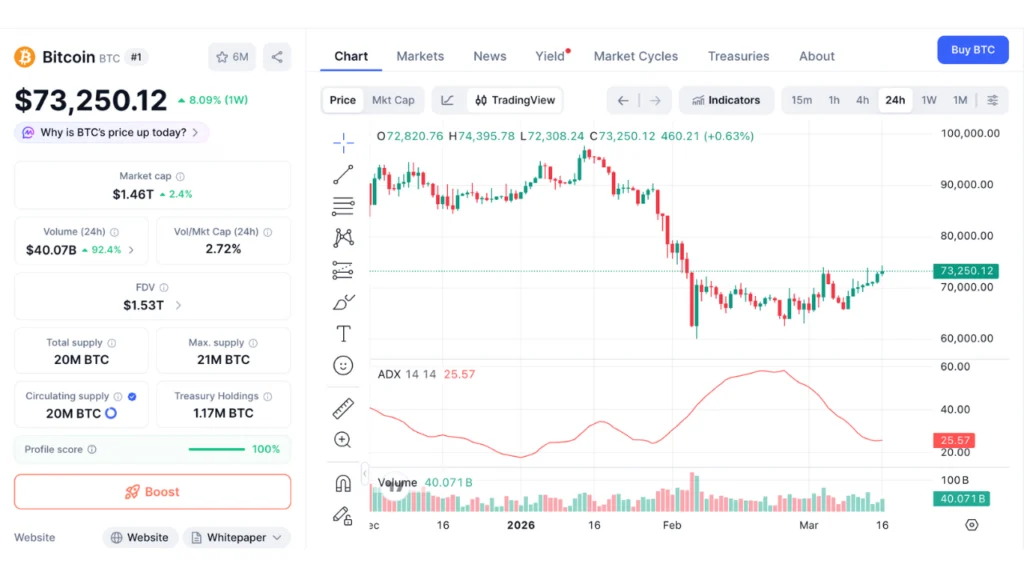
The cryptocurrency market is currently navigating one of its most extended periods of palpable pessimism in recent memory. Despite an overwhelming wave of negative sentiment that has gripped investor psychology, Bitcoin, the flagship digital asset, has demonstrated remarkable resilience, maintaining a robust price point. As of early March 2026, the Crypto Fear and Greed Index has plunged to exceptionally low levels, marking an unprecedented 38 consecutive days entrenched within the "Extreme Fear" zone. This sustained period of anxiety is reportedly the longest streak of its kind since the dramatic collapse of the Terra and Luna ecosystem in May 2022.
Concurrently, Bitcoin has defied the prevailing negative sentiment, successfully holding its ground above the critical $75,000 threshold and recently surging towards the $76,000 mark. This price strength is being attributed to a confluence of factors, including renewed inflows into cryptocurrency exchange-traded funds (ETFs), significant liquidations of short positions across derivatives markets, and a steady, albeit often understated, accumulation by institutional investors. This unusual dichotomy—deeply negative market sentiment juxtaposed with relatively strong price action for Bitcoin—is capturing the attention of analysts and investors worldwide, prompting a deeper examination of the underlying market dynamics.
Market Sentiment Plummets to Multi-Year Lows
The Crypto Fear and Greed Index serves as a widely followed barometer, designed to gauge the overall sentiment of investors within the digital asset market. This multifaceted indicator aggregates data from various sources, including market volatility, trading volume, social media sentiment, and search trends, to produce a score ranging from 0 to 100. Scores at the lower end of the spectrum signify investor apprehension and fear, while higher scores indicate growing optimism and a greater appetite for risk. A reading below 25 is conventionally categorized as "Extreme Fear," signaling that investors are exhibiting heightened caution, often hesitating to initiate new positions or expand existing ones in the cryptocurrency space.
Recent data reveals that the index has dipped as low as 8, a figure indicative of profound investor anxiety. This reading has remained consistently within the "Extreme Fear" zone for an unbroken stretch of 38 days. Market analyst Quinten Francois noted that this protracted period of fear is the longest sustained streak of extreme negative sentiment observed since the dramatic implosion of the Terra-Luna ecosystem in May 2022. That crisis, triggered by the algorithmic stablecoin UST’s de-pegging and subsequent collapse, sent shockwaves through the entire digital asset market, leading to a massive sell-off and the failure of numerous industry players. While the current sentiment echoes the pervasive pessimism of 2022, the underlying market conditions present a starkly different landscape.

A Divergent Downturn: Contrasting the 2022 Crisis with Current Pressures
The cryptocurrency market crash of 2022 was largely characterized by internal failures within the ecosystem itself. The collapse of TerraUSD (UST), an algorithmic stablecoin, resulted in the evaporation of billions of dollars in value and instigated a cascading effect across the industry. The subsequent liquidity crunch and the erosion of investor confidence led to the downfall of several prominent crypto firms, including exchanges and lending platforms.
In contrast, the current period of market caution appears to be influenced more significantly by broader macroeconomic and geopolitical factors rather than systemic vulnerabilities within the crypto sector. Several developments have contributed to this cautious environment:
- Persistent Inflationary Concerns: Global inflation rates have remained stubbornly high, prompting central banks worldwide to maintain or implement tighter monetary policies. This has led to increased borrowing costs and a general tightening of financial conditions, making investors more risk-averse.
- Geopolitical Tensions: Ongoing geopolitical conflicts and trade disputes have injected a substantial degree of uncertainty into the global economic outlook. Such uncertainties often lead investors to seek safer assets and reduce exposure to more volatile investments like cryptocurrencies.
- Shifting Interest Rate Expectations: Fluctuations in expectations regarding future interest rate hikes or cuts by major central banks have created volatility in financial markets. Uncertainty about the trajectory of monetary policy often leads to a "risk-off" sentiment, where investors favor capital preservation over aggressive growth strategies.
- Regulatory Scrutiny: Increased regulatory attention on the cryptocurrency industry in various jurisdictions, while potentially beneficial for long-term stability, has also introduced a degree of uncertainty and caution among investors as they await clearer regulatory frameworks.
These compounding pressures have fostered a pervasive "risk-off" environment, prompting investors to trim their exposure to volatile assets while they await greater clarity on the global economic and political landscape.
Bitcoin’s Surprising Price Resilience Amidst Market Fear
Despite the deeply entrenched negative sentiment reflected in the Fear and Greed Index, Bitcoin’s price has exhibited a notable degree of stability and even strength. After experiencing a brief dip towards the $60,000 region earlier in the year, the world’s largest cryptocurrency has staged a significant recovery. As of early March 2026, Bitcoin has been trading in the $73,000 to $74,000 range, demonstrating a remarkable ability to hold its ground.
More impressively, during its latest upward price movement, Bitcoin recorded an impressive streak of eight consecutive daily green candles. This marks its longest sustained period of gains since late 2020, a period that preceded a significant bull run. This price performance suggests that underlying demand for Bitcoin remains relatively robust, even as the sentiment among retail investors continues to be muted. Historically, such divergences between sentiment indicators and price action have often been observed during accumulation phases. This is a period when long-term investors, often institutions or sophisticated individuals, are gradually building their positions, unfazed by short-term market fluctuations or prevailing negative sentiment, while more speculative traders remain on the sidelines.

ETF Inflows Emerge as a Key Demand Catalyst
A primary driver behind Bitcoin’s recent price stabilization and upward momentum has been the resurgence of capital inflows into cryptocurrency exchange-traded funds (ETFs). Market data indicates that spot Bitcoin ETFs have experienced five consecutive trading days of net inflows, collectively attracting approximately $767 million in fresh capital during the past trading week. Beyond Bitcoin, Ethereum ETFs have also witnessed renewed investor interest, drawing in roughly $160 million in new investments.
The advent of institutional-grade ETFs has fundamentally altered the demand dynamics for digital assets since their introduction. Unlike many retail traders who might be more susceptible to short-term market sentiment, institutional investors typically operate with longer-term investment horizons. Their decision-making is often less influenced by the daily noise of market volatility or the fluctuations of sentiment indicators. Consequently, their sustained participation, particularly during periods of market fear, can serve as a crucial stabilizing force, providing a consistent source of demand that underpins asset prices.
Short Squeeze Dynamics Amplify Upward Price Momentum
Adding further impetus to Bitcoin’s recent price surge has been a wave of liquidations within the derivatives market. Over the preceding 24-hour period, more than $350 million worth of leveraged positions were liquidated, according to available derivatives market data. A significant portion of these liquidations originated from traders holding short positions, meaning they had bet on a continued decline in Bitcoin’s price. As Bitcoin’s price began to ascend, these traders were compelled to close their positions to mitigate mounting losses. This process necessitates the purchase of Bitcoin to cover their leveraged bets, a phenomenon known as a short squeeze. A short squeeze can create a powerful upward price spiral by injecting additional buying pressure into the market, amplifying the initial price rally.
Institutional Accumulation Re-enters the Spotlight
The narrative of institutional demand has also been bolstered by speculation surrounding potential new Bitcoin acquisitions by significant corporate entities. Michael Saylor, the executive chairman of MicroStrategy and a vocal advocate for Bitcoin as a corporate treasury asset, recently posted a cryptic message on social media, hinting at a possible further acquisition. While no official announcement has been made, some analysts have speculated that MicroStrategy might have accumulated between 30,000 to 40,000 BTC during the recent market dip. If confirmed, such a purchase would represent a substantial vote of confidence from institutional investors and a clear signal of their continued belief in Bitcoin’s long-term value proposition. Historically, large-scale accumulation by institutions during periods of market fear has played a pivotal role in shaping the long-term trajectory of the Bitcoin market, often preceding significant upward price movements.
On-Chain Data Presents a Nuanced Perspective
While price action and institutional flows paint a relatively strong picture, on-chain data offers a more nuanced view of the current market conditions. According to blockchain analytics platform Santiment, network activity saw a significant increase earlier in the year. Between mid-January and early February 2026, Bitcoin active addresses surged by 38%, reaching approximately 14.5 million, while Ethereum’s active addresses saw a substantial rise of 28%, hitting around 17.5 million. An increase in active addresses typically indicates growing organic demand and broader utilization of the network.

However, this surge in activity has since cooled. Bitcoin active addresses have since receded to around 12 million, and Ethereum’s active addresses have declined to approximately 15.5 million. This cooling suggests that some investors may be temporarily stepping back as the market enters a consolidation phase, waiting for clearer signals before re-engaging more actively.
Key Price Levels for Bitcoin Analysis
Despite the recent recovery, market analysts highlight several crucial technical levels that Bitcoin must navigate. The $75,000 to $75,500 range is widely regarded as a significant support zone. Maintaining prices above this level would reinforce the notion that the recent correction was merely a temporary reset within a broader, ongoing bullish cycle.
On the upside, resistance levels in the vicinity of $74,000 to $76,000 remain important. A decisive breakout above the $75,000 mark could potentially pave the way for Bitcoin to test the $80,000 level, according to various market analysts. However, some experts caution that the recent rally might represent a technical rebound rather than the definitive commencement of a sustained bull market. For a more robust long-term uptrend to materialize, the market will likely require continued consistent ETF inflows, a resurgence in network activity, and an improvement in the broader macroeconomic conditions.
Historical Precedents: What History Suggests After Periods of Extreme Fear
Extreme fear has been a recurring theme throughout Bitcoin’s history, often appearing during periods when the market is actively searching for a bottom. In numerous instances, prolonged periods of overwhelming pessimism have ultimately been followed by strong price recoveries. This pattern is deeply rooted in the psychological nature of financial markets. When sentiment reaches an extreme negative, it often signifies that a substantial number of potential sellers may have already exited their positions. As this selling pressure dissipates, prices can stabilize and begin a gradual upward trajectory as new buyers enter the market.
While sentiment indicators alone cannot definitively predict future price movements, they offer valuable insights into the collective emotional state of investors. The current environment—characterized by prolonged extreme fear, coupled with steady institutional inflows and resilient price levels—bears a striking resemblance to previous accumulation phases observed in past market cycles. This historical parallel suggests that even in the depths of pessimism, the seeds of a recovery may already be sown.

A Market Poised for its Next Catalytic Event
For the present moment, the cryptocurrency market appears to be in a transitional phase. Investors remain cautious, influenced by prevailing macroeconomic uncertainties, ongoing geopolitical tensions, and evolving expectations regarding global monetary policy. Simultaneously, the demonstrated resilience of Bitcoin’s price and the sustained return of institutional capital suggest that the underlying market structure remains fundamentally sound.
The trajectory of the current rally—whether it evolves into a new bull phase or continues to consolidate—will likely hinge on the emergence of the next significant market catalyst. For now, the striking contrast between 38 consecutive days of extreme fear and Bitcoin’s steadfast hold above the $75,000 mark underscores a familiar theme in cryptocurrency markets: sentiment often reaches its nadir precisely at the moment when the prevailing narrative is poised for a dramatic shift.