Lina Irawan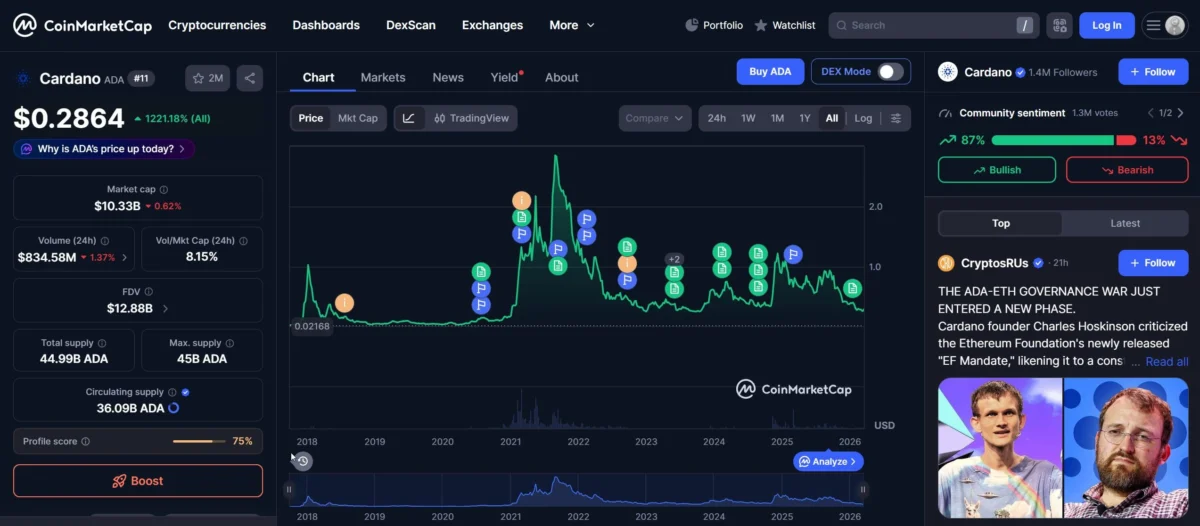
Cardano has steadily ascended the ranks of blockchain networks, establishing itself as a prominent platform for decentralized applications (dApps). Its native cryptocurrency, ADA, is currently demonstrating resilience within the top 10 tokens as the broader crypto market navigates a period of recovery. With significant user adoption and sustained market interest, Cardano appears to be performing optimally and is positioned for substantial future growth. This comprehensive analysis aims to illuminate the intricacies of Cardano, its operational mechanisms, the challenges it addresses, and its potential as an investment, providing a foundation for informed decision-making regarding ADA.
What is Cardano? A Foundation Built on Research
Cardano is a pioneering third-generation blockchain network engineered to surmount the inherent limitations in scalability, security, and sustainability that have characterized earlier blockchain iterations such as Bitcoin and Ethereum. The genesis of Cardano’s development was firmly rooted in rigorous academic, scientific, and peer-reviewed research, a departure from the more experimental approaches of its predecessors.
The initiative was co-founded by Charles Hoskinson and Jeremy Wood, both instrumental figures in the nascent Ethereum ecosystem before embarking on the ambitious endeavor to create Cardano. Their shared vision was to construct a blockchain network capable of methodical evolution, driven by evidence-based methodologies derived from the fields of computer science and cryptography. This academic-centric approach underscores Cardano’s commitment to a robust and verifiable development process.
In contrast to the energy-intensive proof-of-work (PoW) consensus mechanisms employed by networks like Bitcoin, Cardano operates on a sophisticated proof-of-stake (PoS) consensus protocol known as Ouroboros. This innovative design empowers network participants to validate transactions, generate new blocks, and maintain the security of the decentralized network without the substantial energy expenditure associated with PoW systems. This sustainability aspect is a cornerstone of Cardano’s appeal and long-term viability.
Addressing Blockchain’s Core Challenges: Scalability, Sustainability, and Interoperability
Cardano’s primary objective is to resolve critical limitations that have historically hampered the widespread adoption and efficacy of blockchain technology, particularly concerning scalability, sustainability, and interoperability. The network directly tackles issues such as exorbitant transaction fees and sluggish transaction speeds during periods of peak demand. This is achieved through its unique layered architecture and the Ouroboros PoS consensus mechanism, which offers a significantly more energy-efficient alternative to PoW.
This architectural design facilitates enhanced scalability without compromising network security. Cardano’s development roadmap includes solutions like Hydra, which promises to enable the processing of millions of transactions per second. By significantly reducing the environmental footprint associated with blockchain operations, Cardano’s PoS system offers a sustainable model for global adoption, differentiating it from more energy-consuming networks.
How Cardano Works: A Deeper Look at its Architecture and Consensus
Cardano’s operational framework is distinguished by its innovative two-layer architecture, a design choice that separates the network’s functions to optimize performance and flexibility.
Cardano’s Two-Layer Architecture:
This foundational aspect of Cardano’s design partitions the platform into two distinct, yet interconnected, layers: the Cardano Settlement Layer (CSL) and the Cardano Computation Layer (CCL).
The Cardano Settlement Layer (CSL) is primarily responsible for managing the transfer of ADA, the network’s native cryptocurrency. This includes facilitating transactions between wallets, calculating transaction fees, and ensuring the accurate recording of all financial movements on the blockchain. It acts as the ledger of record, maintaining the integrity of account balances across the entire Cardano network.
Conversely, the Cardano Computation Layer (CCL) is dedicated to the execution of smart contracts and the development of decentralized applications (dApps). This separation of concerns allows for the continuous evolution and upgrading of the smart contract platform without disrupting the core accounting functions of the settlement layer. This modular approach enhances the network’s adaptability and resilience.
Ouroboros — Cardano’s PoS Consensus Mechanism:
The security and integrity of the Cardano blockchain are underpinned by its proof-of-stake consensus mechanism, Ouroboros. Unlike PoW systems where participants, known as miners, compete by expending computational power to validate transactions and create new blocks, Ouroboros selects validators based on the amount of ADA tokens they hold or have delegated.

In this PoS model, ADA holders can actively participate in network security by delegating their ADA holdings to stake pools. These pools, operated by dedicated individuals or entities, are responsible for validating transactions, maintaining the decentralized nature of the network, and adding new blocks to the blockchain. This process incentivizes participation and network security through economic alignment.
Governance and Community Participation: A Decentralized Future
A pivotal element of Cardano’s operational ethos is its commitment to decentralized network governance. Rather than relying on a central authority to dictate protocol changes or upgrades, the Cardano ecosystem empowers its participants to influence the network’s future direction.
ADA, beyond its utility as a cryptocurrency, also functions as a governance token. Holders of ADA have the right to vote on proposals that shape the evolution of the Cardano platform. This community-driven governance model is designed to foster a self-sustaining blockchain ecosystem where the collective intelligence of its users guides its development over time, promoting long-term resilience and alignment with community interests.
How Staking Works on Cardano: Earning Rewards for Network Support
Staking is fundamental to Cardano’s network security model. As a PoS blockchain, it offers ADA holders a direct avenue to contribute to and benefit from the network’s operations. Instead of engaging in energy-intensive mining, users can delegate their ADA to stake pools.
When these stake pools successfully validate transactions and add new blocks to the Cardano blockchain, the participants who delegated their ADA to these pools are rewarded with additional ADA. These rewards are typically proportional to the amount of ADA delegated, providing a tangible incentive for users to support the network’s decentralized infrastructure. This staking mechanism encourages broad participation and decentralization.
What Is the ADA Token? The Engine of the Cardano Ecosystem
ADA is the native cryptocurrency of the Cardano blockchain and serves as the primary asset facilitating all operations within its ecosystem. It is the engine that powers transactions, enables staking, and underpins the network’s governance mechanisms. Like many other prominent digital assets in the blockchain space, ADA is also actively traded on global cryptocurrency markets.
The Cardano protocol has established a capped total supply of 45 billion ADA. As of recent data, approximately 35 billion ADA are currently in circulation, indicating a substantial portion of the total supply has been issued. ADA holders play a crucial role by delegating their coins for staking, thereby contributing to the maintenance of the decentralized network and the validation of transactions. In return for this crucial support, they receive ADA rewards, creating a symbiotic relationship between users and the network.
ADA Token Price & Market Performance: Navigating the Crypto Landscape
The price of ADA is subject to the dynamic fluctuations characteristic of the broader cryptocurrency market. As of recent reporting, the price has hovered around the $0.28 mark, reflecting relatively modest movements in the preceding 24 hours as the market seeks stabilization.
Current market sentiment and expert price predictions for Cardano generally lean towards cautious optimism. Community discussions frequently highlight the network’s ongoing developmental milestones, the expanding Cardano ecosystem of dApps, and its steadfast commitment to peer-reviewed research. Concurrently, traders remain attuned to overarching market momentum and the rate of adoption across various decentralized applications, factors that are anticipated to significantly influence ADA’s future price trajectory. The market’s response to Cardano’s technological advancements and its ability to attract a critical mass of users and developers will be key determinants of its performance.
What Makes Cardano Different from Other Blockchains? A Comparative Analysis
Cardano’s distinctiveness stems from its foundational principles, architectural design, and developmental methodology, setting it apart from established blockchain networks like Ethereum and Bitcoin.
Cardano vs. Ethereum:
| Feature | Cardano | Ethereum |
|---|---|---|
| Launch Year | 2017 | 2015 |
| Founders | Charles Hoskinson and Jeremy Wood | Vitalik Buterin and others |
| Blockchain Type | Third-generation blockchain focused on scalability and research | Second-generation blockchain platform |
| Consensus Mechanism | Proof-of-stake (Ouroboros) | Transitioned from Proof-of-Work to Proof-of-Stake |
| Architecture | Two-layer architecture (Settlement Layer, Computation Layer) | Single-layer execution environment |
| Native Cryptocurrency | ADA | Ether (ETH) |
| Development Approach | Peer-reviewed academic and scientific research | Community-driven, open experimentation, and faster iteration |
| Ecosystem Size | Growing ecosystem with expanding dApps | Large and mature ecosystem with extensive DeFi and dApp presence |
| Scalability Focus | Layered architecture and future upgrades like Hydra | Layer 2 scaling solutions (Rollups), sharding planned |
| Energy Efficiency | Inherently high due to PoS | Significantly improved post-Merge (transition to PoS) |
While Ethereum boasts a larger and more established ecosystem of developers and dApps, Cardano differentiates itself through its rigorous, research-driven development cycle and a layered architecture designed for enhanced scalability and sustainability from the outset. The transition of Ethereum to Proof-of-Stake has brought it closer to Cardano in terms of energy efficiency, but Cardano’s foundational design has always prioritized this aspect.
Cardano vs. Bitcoin:
| Feature | Cardano | Bitcoin |
|---|---|---|
| Launch Year | 2017 | 2009 |
| Primary Purpose | Smart contract platform, dApp infrastructure, and financial services | Digital store of value, peer-to-peer electronic cash system |
| Consensus Mechanism | Proof-of-stake (Ouroboros) | Proof-of-work mining |
| Energy Consumption | Significantly lower | Higher due to Proof-of-Work |
| Native Cryptocurrency | ADA | Bitcoin (BTC) |
| Maximum Supply | 45 billion ADA | 21 million BTC |
| Smart Contracts | Built-in, robust support | Limited native support, requires additional layers or sidechains |
| Governance | Community-driven via ADA holders | Informal governance among developers and miners |
| Ecosystem Focus | Expanding dApps, DeFi, and broader utility | Primarily secure monetary transfers and store of value |
The fundamental difference lies in their intended purpose. Bitcoin was designed as a digital store of value and a decentralized medium of exchange, prioritizing security and immutability. Cardano, on the other hand, was conceived as a platform for building and running smart contracts and decentralized applications, aiming for greater functionality, scalability, and sustainability. Cardano’s PoS consensus mechanism inherently offers a far more energy-efficient alternative to Bitcoin’s energy-intensive PoW mining.
The Future of the Cardano Ecosystem: Strategic Growth and Development
The Cardano ecosystem is poised for significant advancements in the coming years. Founder Charles Hoskinson has characterized 2026 as a critical juncture, a "do-or-die" period for the network’s sustained growth and widespread adoption. The Cardano platform is actively pursuing accelerated adoption of decentralized finance (DeFi) solutions. Proposals are on the table to allocate approximately 70 million ADA from the network’s treasury to fund critical infrastructure upgrades and facilitate stablecoin integration across the Cardano network. This strategic allocation of resources underscores a commitment to enhancing the platform’s financial capabilities and attracting greater participation in its DeFi ecosystem.
On the technical front, upcoming upgrades such as Ouroboros Leios are designed to substantially increase throughput on the Cardano blockchain while preserving its energy-efficient proof-of-stake design. These enhancements are anticipated to support a greater volume of decentralized applications and fortify Cardano’s competitive standing among leading smart contract platforms. The emphasis on incremental, research-backed development aims to build a robust and scalable foundation for future innovation.
Conclusion: Evaluating Cardano and ADA as an Investment
For potential investors, ADA, as Cardano’s native cryptocurrency, presents opportunities through staking, participation in network governance, and engagement with the burgeoning Cardano ecosystem. While the project’s commitment to a research-driven development approach and its focus on sustainability are compelling strengths, prospective investors must carefully consider the inherent volatility of the cryptocurrency market, the pace of adoption trends, and the broader cycles of the crypto economy before making investment decisions.
Cardano’s methodical, evidence-based approach, while potentially slower than more agile development cycles, aims to build a more resilient and secure blockchain for the long term. Its success will ultimately be determined by its ability to attract developers, foster innovation, and achieve widespread user adoption for its growing array of decentralized applications and services.
FAQs
Is Cardano a good investment?
ADA exhibits potential as a long-term investment due to its continuous upgrades and energy-efficient design. However, it carries significant risks associated with market volatility and intense competition within the blockchain space. Whether it constitutes a "good" investment hinges on an individual’s risk tolerance, as cryptocurrency investments are inherently speculative.
What makes Cardano different from other blockchains?
Unlike older networks such as Bitcoin or early versions of Ethereum, Cardano employs a two-layer architecture that separates the Cardano Settlement Layer from the Cardano Computation Layer. Furthermore, it utilizes the Ouroboros proof-of-stake consensus mechanism, which allows ADA holders to participate in network validation without reliance on a central authority. This design prioritizes scalability, security, and sustainability from its inception.
Is Cardano better than Ethereum?
Ethereum currently boasts a larger developer ecosystem and higher adoption rates for decentralized applications. Cardano, conversely, places a strong emphasis on peer-reviewed academic research, energy-efficient proof-of-stake, and a layered architecture designed to improve scalability and reduce transaction fees. The determination of which platform is "better" depends on individual priorities: Ethereum for established DeFi activity and a vast dApp landscape, or Cardano for its long-term, research-driven development and focus on foundational robustness.
Where is the best place to buy Cardano (ADA)?
ADA can be purchased on most major centralized and decentralized cryptocurrency exchanges, including Binance, Kraken, Coinbase, Bybit, Minswap, and Splash. It is advisable to research how to buy Cardano effectively to avoid common errors, such as sending ADA to an incorrect network. Always ensure that the chosen exchange is reputable, offers secure storage solutions, and complies with the regulatory guidelines applicable to your region.
What exactly does Cardano do?
Cardano enables developers to create smart contracts, execute financial transactions at low fees, and participate in a decentralized network governed by ADA holders. Its research-driven methodology aims to construct a self-sustaining blockchain ecosystem that provides a scalable and secure foundation for a wide range of global applications.
What wallet should I use for storing ADA?
For ADA holders, official and recommended wallet options include the Daedalus wallet, a full-node desktop wallet providing comprehensive control, and the Yoroi wallet, a lightweight and user-friendly option. These wallets facilitate secure storage of ADA, participation in the staking process, and interaction with smart contracts. It is crucial to use wallets that support Cardano’s network governance features and to diligently protect private keys.