James Watt
The Imperative of Decentralization in Ethereum Staking
Lido, as a leading liquid staking protocol on Ethereum, plays a critical role in the network’s health and security. The core principle driving Lido’s development is the commitment to decentralization, which is paramount for mitigating risks such as single points of failure, censorship, and potential collusion. Ethereum’s proof-of-stake mechanism relies on validators to propose and attest to blocks, and the diversity of these validators—in terms of their client software, geographical location, and underlying infrastructure—directly impacts the network’s robustness. The VaNOM report serves as a transparent accountability mechanism, tracking these vital metrics and demonstrating Lido DAO’s ongoing efforts to foster a more distributed and resilient staking ecosystem. By continuously refining its staking modules and operator frameworks, Lido aims not only to secure its own protocol but also to contribute meaningfully to Ethereum’s long-term stability and censorship resistance.
Key Milestones and Strategic Shifts in Q4 2025
The fourth quarter of 2025 was a period of intense activity and strategic evolution for the Lido protocol. In late September, a cornerstone change was approved by LDO tokenholders, significantly impacting the Community Staking Module (CSM). This pivotal decision increased the CSM’s stake share limit from 3% to 5%, a move designed to facilitate greater permissionless participation in Lido’s validator set. This governance approval was swiftly followed by the mainnet activation of the CSM v2 upgrade and the formal introduction of the Identified Community Staker (ICS) framework. These initiatives were not merely technical updates but strategic enhancements aimed at broadening access and reducing structural barriers for independent operators, thereby directly fostering a more diverse and decentralized operator composition within both the Lido protocol and the broader Ethereum network.
Further solidifying its commitment to decentralization, the Lido DAO also approved a module capacity adjustment for the Simple DVT Module (SDVTM) in December. The target stake share for this module was increased from 4% to 4.3%. This adjustment was critical for addressing an allocation bottleneck, ensuring that the module could maintain its stake cap while simultaneously completing validator allocations to clusters that had not yet reached their approved capacity. This proactive measure guarantees operational continuity and prevents the underutilization of approved cluster infrastructure, aligning with the protocol’s strategic roadmap for integrating Distributed Validator Technology (DVT).
Expanding the Operator Landscape: Community and Simple DVT Modules
The impact of the new CSM framework was immediately evident. By January 1, 2026, the ICS framework had gained significant traction, with 482 applications evaluated, 345 approved, and 220 operators officially claiming their ICS status. The appeal of ICS lies in its tailored conditions and transparent eligibility criteria, which collectively lower the barrier to entry for truly independent operators. These enhanced validation parameters include a 6% reward share for the first 16 validators, deposit priority for the initial 10 validators, a reduced bond requirement for the first validator, lower removal fees, and more flexible performance thresholds compared to standard permissionless CSM operators. This comprehensive package has demonstrably attracted a new wave of participants, fostering a more grassroots approach to staking.
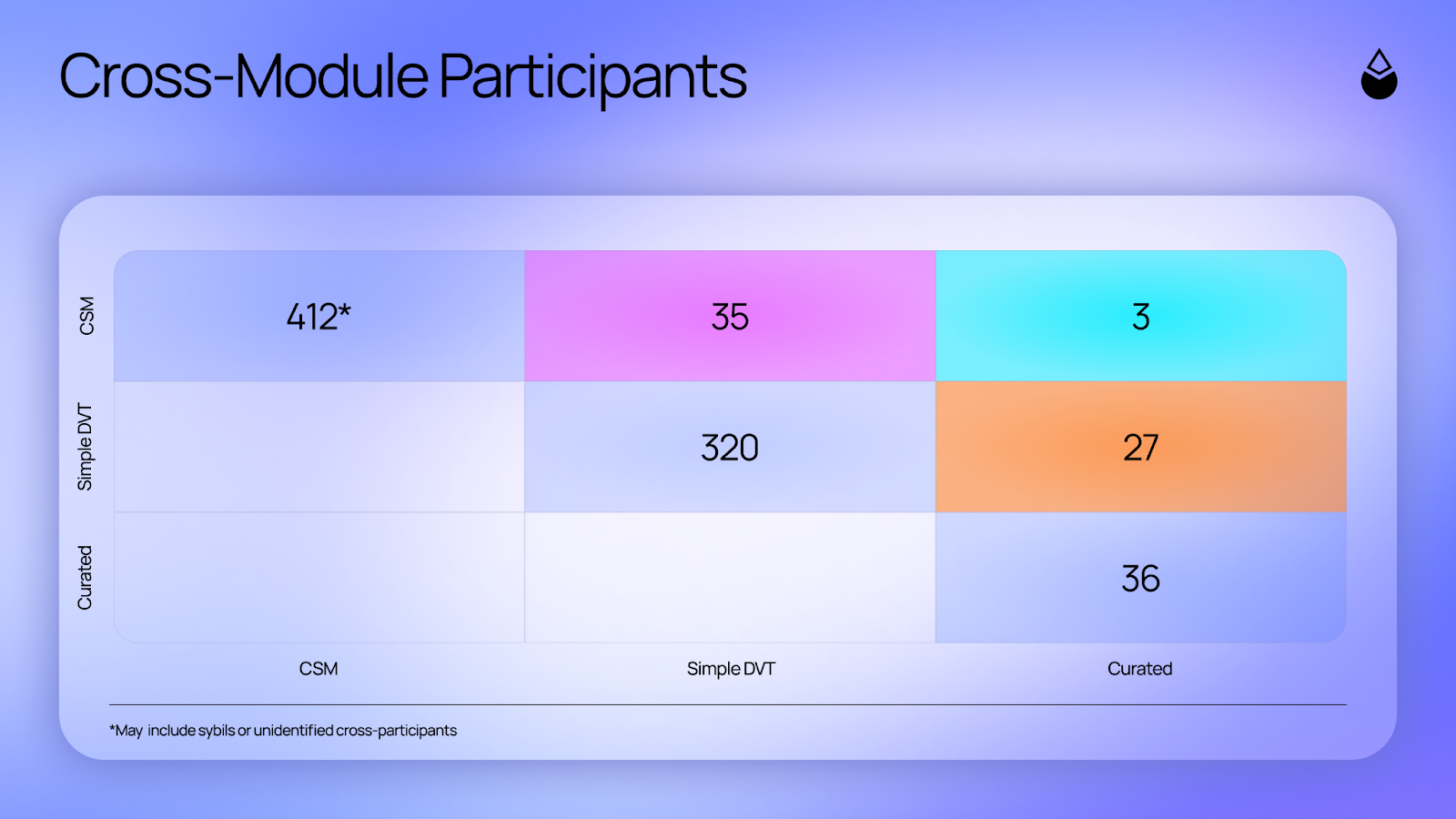
Following renewed deposit inflows, the CSM rapidly reached its new 5% stake share limit in December, reflecting a robust 29.35% quarter-over-quarter (QoQ) growth. Annually, the module added an impressive 377,664 ETH, underscoring strong community interest and demand for permissionless validator participation. The operator composition within the CSM remains predominantly independent, with 345 out of 412 active operators (83.74%) qualifying under the ICS operator type. Additionally, 35 operators participate across both the CSM and the Simple DVT Module, while three Curated Node Operators (P2P, Stakely, and Launchnodes) also operate within the CSM, demonstrating a healthy cross-pollination of operational expertise.

The Simple DVT Module also saw substantial progress. By the end of 2025, all 70 Regular clusters and 10 Super Clusters within the SDVTM became fully allocated. This represented an additional 80 Obol and 38 SSV Network validators compared to Q3, bringing the module to its governance-approved allocation and accounting for 4.0% of the Lido protocol. These decentralized modules—CSM and SDVTM—collectively represented nearly 800,000 ETH by January 1, 2026, equating to 2.2% of total Ethereum stake. This marks a 0.53 percentage point increase from Q3 2025 and a nearly threefold increase from the end of 2024, showcasing measurable and accelerated progress in diversifying the Lido validator set throughout the year.
Refining the Core: The Curated Module’s Evolution
December also brought notable strategic adjustments within the Curated Module (CM), Lido’s largest staking module. A41, a long-standing node operator, announced its decision to wind down node operations across all networks. In response, the Lido DAO approved the request to reduce A41’s validator limit to zero, enabling the protocol to efficiently process exits through the validators they previously ran. This move highlights the dynamic nature of the operator set and the DAO’s ability to adapt to changing circumstances while maintaining network stability.
Concurrently, Pier Two, which previously operated 3,766 validators, was allocated an additional 3,200 validators, bringing its total to 6,966 by year-end. This increase strategically brought Pier Two’s validator count in line with other operators in the Curated Module, significantly improving stake distribution balance within the module. This proactive rebalancing effort is critical for mitigating concentration risk, even within a curated set.
By the close of 2025, the Curated Module exhibited an exceptionally balanced distribution, reflected in a Gini coefficient of 0.001 and an HHI (Herfindahl-Hirschman Index) of 0.0278. These metrics, which measure statistical dispersion and market concentration respectively, indicate a near-equal stake allocation among participating Node Operators. Each of the 36 active Curated Node Operators was managing approximately 6,967 validators. This balanced distribution collectively accounted for approximately 0.71% of total Ethereum validators, remaining well below the 1% soft cap defined in the Lido Scorecard and Operator Set Strategy. This achievement represents a structural improvement in stake distribution within the Curated Module. While it remains the largest Lido Staking Module, its internal allocation now demonstrates significantly reduced concentration risk and stronger alignment with the protocol’s long-term decentralization objectives.
Bolstering Network Resilience: Client Diversity Initiatives

Lido’s commitment to Ethereum’s overall resilience is perhaps most evident in its sustained focus on validator set client diversity. The Lido validator set consistently maintains a balanced distribution across both Consensus Layer (CL) and Execution Layer (EL) clients. While distribution naturally varies by module design and operator composition, the broader picture confirms that Lido maintains a stronger client balance than the pan-Ethereum average. This proactive approach is crucial for reducing correlated failure risks—where a bug in a widely used client could jeopardize network finality—and contributing to Ethereum’s overall robustness.
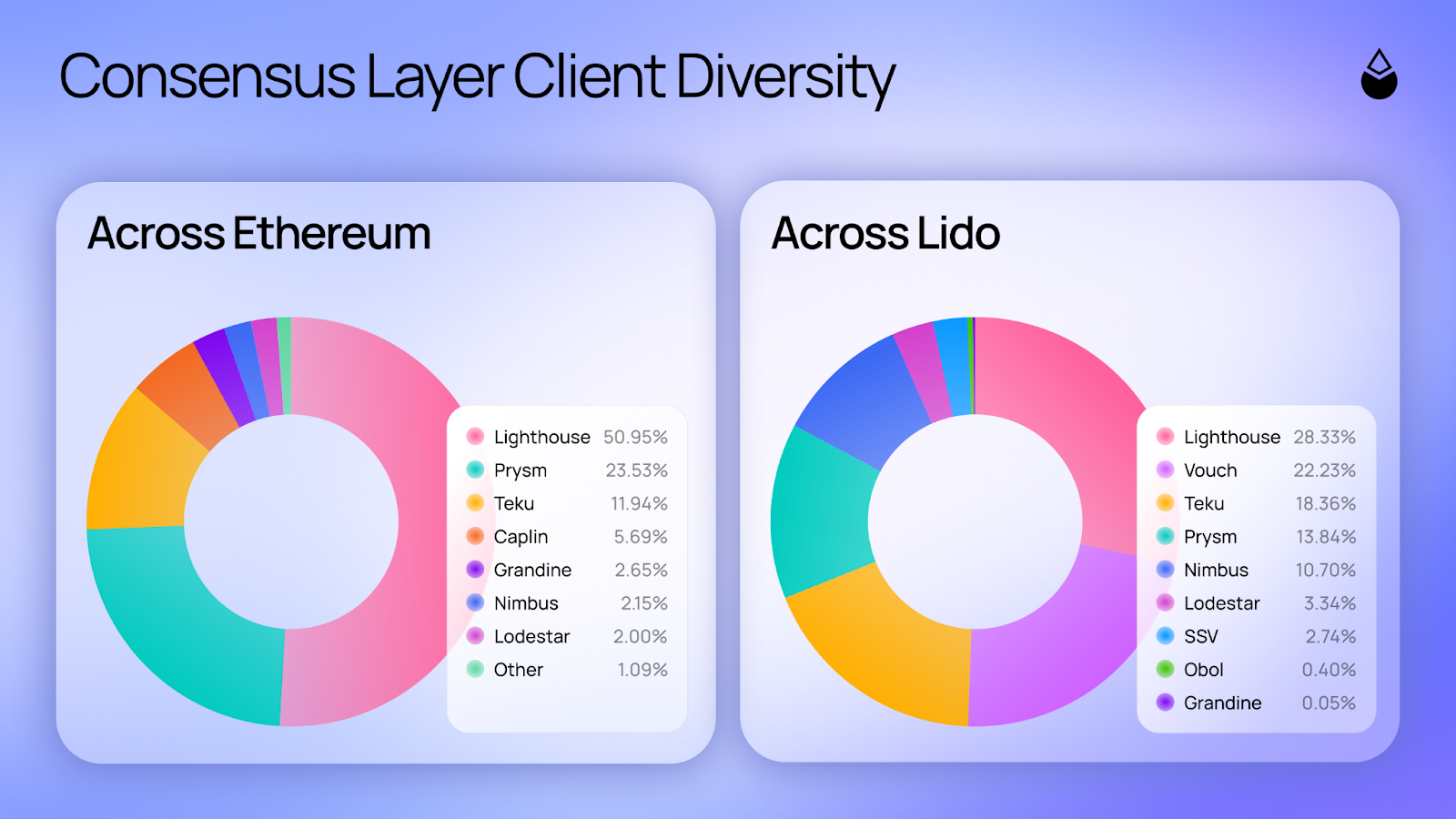
Compared to the broader CL landscape, where Lighthouse remains dominant at 50.95% (a 5.03 percentage point increase year-over-year), Lido validators reflect a more meaningfully distributed profile. Within the protocol, no Beacon Node (BN) client exceeds 33% of the validators. This strategic cap is vital for mitigating supermajority and finality risks that can arise from excessive client concentration. Furthermore, multi-node setups now represent more than a quarter of Lido validators (27.86%), marking a significant 4.72 percentage point increase, largely driven by the adoption of DVT within the Curated Module. At the module level, the Curated and Community Staking Modules strike the best balance, with the most popular CL clients, Lighthouse and Nimbus, accounting for 27.53% and 35%, respectively. While Lighthouse continues to lead in the SDVTM with 52.63% of validators, this figure represents a 3.87 percentage point decrease from the past year, indicating a gradual shift towards greater diversity even within this module.
Improving EL client diversity has been a sustained focus for Lido DAO contributors and Node Operators since the Merge in Q3 2022. Since then, deliberate efforts—both from Node Operators’ operational choices and governance-driven initiatives—have steadily reduced dependency on any single dominant client. As minority clients stabilized and matured post-Merge, Node Operators expanded their Lido Execution Layer configurations accordingly. This process became increasingly transparent in early 2024, when Curated Node Operators began publicly sharing their commitments on the Lido Research Forum to further reduce majority client exposure. Two years later, the impact of these concerted efforts is clearly measurable: across the Curated Module, no EL client holds a supermajority. Erigon, for instance, remains low at 0.6%, a 3 percentage point decrease compared to the end of 2024, following earlier rotations by Figment and Stakely toward Reth, Geth, and Nethermind. The top five EL clients are also consistently represented across both the CSM and Simple DVT modules. In Simple DVT, Nethermind remains the most widely used client at 54.51%, a 6.61 percentage point decrease compared to year-end 2024. In CSM, Nethermind accounts for 60%, followed by Geth (21%), Besu (14%), Reth (3%), and Erigon (1%). While Nethermind retains a leading position in the decentralized Staking Modules, the broader EL landscape across the Lido validator set remains multi-client, largely thanks to the Curated set, which operates 91.09% of the protocol stake, where distribution is more structurally balanced with four EL clients meaningfully active. The heatmap illustrating validator distribution across EL and BN client combinations further highlights real-world operator preferences and compatibility trends. The observed diversity across these pairings further reduces correlated client risks and strengthens the robustness of the Lido validator ecosystem.
The Rise of Distributed Validator Technology (DVT)
Distributed Validator Technology (DVT) emerged as a transformative force in 2025, with its adoption accelerating across all Lido Staking Modules. By the end of the year, DVT was powering 22,233 validators, representing 711,456 ETH. This marks an astounding 537,792 ETH increase year-over-year, or over four times growth, underscoring the technology’s rapid integration and strategic importance. In total, Lido DVT-powered validators now account for 1.99% of the total Ethereum stake, making a meaningful protocol-level contribution to Ethereum’s resilience through diversified, DVT-based infrastructure.
A major driver of this growth was the accelerated adoption of Obol and SSV Network within the Curated Module, following Lido DAO approval of intra-operator setups. Expanding DVT adoption by extending it beyond Lido’s decentralized modules into its largest staking module significantly strengthens fault tolerance and represents a structural enhancement to Lido’s validator architecture. As a result, combined DVT utilization across Curated validators reached 3.45%, with continued testing and staged mainnet adoption expected to further increase this share.

Within the Simple DVT Module, all 70 Regular clusters and 10 Super Clusters became fully allocated by the end of 2025. Compared to Q3, this represented an additional 80 Obol and 38 SSV Network validators, bringing the module to its governance-approved allocation and accounting for 4.0% of the Lido protocol. The Community Staking Module also saw meaningful expansion in voluntary DVT adoption. Compared to Q3, 1,249 additional validators (+78.45%) adopted Obol or SSV Network solutions. Among CSM operators who reported their infrastructure choices, 35.38% utilize DVT-based setups. While SafeStake, a DVT solution used exclusively within the CSM, announced its cessation of operations, its footprint was limited to 4 operators running 8 validators, resulting in no material impact on overall DVT adoption. In 2025, DVT became a widely adopted operational choice among Lido Node Operators of different types. Beyond its internal impact, Lido’s growing DVT adoption contributes to broader ecosystem-level validation of distributed validator infrastructure. By deploying DVT across multiple Staking Modules, Lido helps stress-test implementations under real economic conditions and production workloads. Collectively, the protocol’s DVT share stands at 8.36%, strengthening Lido’s contribution to a more decentralized, diversified, and robust Ethereum validator ecosystem.
Underlying Infrastructure: A Foundation for Stability
The robustness of Lido’s validator set is also reflected in its underlying infrastructure. As of the end of 2025, Lido Node Operators collectively utilized 658 nodes, marking a 14.6% increase over the year. Simultaneously, validator density—the number of validators per node—declined by 14.5%. This shift reflects a structural improvement in operational risk management: fewer validators per node reduce correlated downtime risk in the event of hardware or hosting failures, contributing to stronger validator-level resilience across the Lido protocol.

Within the Curated Module, Public Cloud remained the most widely used hosting option at 47.7%, though its share decreased by 3.8 percentage points year-over-year from 50.5%. This shift corresponds to an increase in dedicated servers, which grew to 26.44% (+4.04 percentage points) in Q4 2025. Provider diversity remained stable overall, with notable shifts: AWS’s share declined by 5.2 percentage points, while Hetzner increased by 2.2 percentage points and Google Cloud by 1.2 percentage points. This measured rebalancing suggests that Lido Node Operators are proactively diversifying hosting exposure rather than concentrating further within major cloud providers, a positive signal from a decentralization and operational risk perspective.
A similar reduction in Public Cloud reliance occurred within the Simple DVT Module, where cloud usage declined by 4.22 percentage points to 12.9% by the end of Q4 2025. Dedicated servers remained the dominant infrastructure choice at 60.67%. Home nodes (9.00%) and Colo setups (8.44%) remained stable quarter-over-quarter, representing the continued participation of independent solo and community stakers within the Simple DVT Module. In the CSM, Home nodes remained the most common hosting choice, underscoring the module’s permissionless and community-oriented focus. At the same time, a modest increase in Managed Servers (7.81%) and Public Cloud usage (3.21%) reflects participation from professional staking providers attracted by competitive staking terms. Reducing validator density per machine, diversifying cloud exposure, and maintaining meaningful participation across home, colo, and dedicated environments collectively reduce correlated failure domains within the Lido validator set, enhancing the protocol’s overall robustness.
Geographic Dispersion: A Global Footprint

Geographic distribution plays a critical role in validator decentralization, reducing regulatory concentration risk, improving network liveness under localized disruptions, and strengthening Ethereum’s censorship resistance assumptions. The VaNOM report provides a unified view of validator distribution across all Lido staking modules, with self-reported data for the Community Staking Module.
Within the Curated Module, the overall geographic footprint remained stable throughout 2025. Germany and the United States continued to host the largest number of validators, with 48,402 and 32,397 respectively. While both jurisdictions saw a modest decline in validator counts, their relative leadership remained unchanged. The most notable growth was observed in Australia, where the validator count nearly doubled following the additional allocation to Pier Two. This expansion meaningfully increased Asia-Pacific representation within the Curated Set, contributing to broader geographic dispersion. Overall, while the Curated Module still reflects a concentration in historically strong validator regions, incremental shifts indicate gradual rebalancing rather than consolidation.
Geographic distribution within the Simple DVT Module remained broadly stable across Europe, the Americas, and the Asia-Pacific regions, as clusters scaled toward their target validator capacities. Germany and Finland accounted for a meaningful share of validators, but the distribution remained multi-regional. The United States, United Kingdom, France, and Singapore continued to be well represented, while several previously underrepresented jurisdictions expanded their presence as clusters matured. Among CSM operators who reported infrastructure locations, the top ten jurisdictions were: United States (38.8%), Germany (10.9%), United Kingdom (6.6%), Canada (4.3%), Netherlands (3.9%), France (3.3%), Australia (2.7%), Singapore (2.6%), Finland (2.2%), and Switzerland (2.0%). Given that reporting is voluntary, these figures likely underrepresent the total geographic dispersion. Nevertheless, the data suggests continued expansion of the validator footprint beyond traditional infrastructure hubs. Across 2025, Lido’s validator set maintained multi-regional representation while gradually expanding into new jurisdictions, thereby bolstering Ethereum’s global presence and resilience.

Looking Forward: Strategic Vision for 2026 and Beyond
Zooming out, 2025 marked a continued evolution of the Lido validator set, defined by a concerted and comprehensive approach to decentralization. Progress was achieved not through isolated minor improvements but through coordinated advancements across all modules: expanded permissionless participation via the CSM, the successful integration of DVT across Curated operators, more equitable stake distribution within the largest staking module, improved client diversity, reduced infrastructure density per machine, and enhanced geographical distribution. Taken together, these changes reflect a validator ecosystem that is not only more performant but also more distributed across operators, infrastructure, geographies, and software implementations, significantly strengthening Lido’s contribution to Ethereum’s long-term resilience.
Looking ahead to 2026, further diversification is anticipated on multiple fronts. The proposed design of CMv2 (Curated Module v2) introduces the ability to create multiple sub-operator profiles of different types under a single entity. These include Decentralization Operators, Extra Effort Operators, and Intra- and Multi-Operator DVT Clusters. These configurations are meticulously designed to support individual Node Operator contributions that specifically enhance decentralization and broader ecosystem robustness, all while maintaining stringent risk controls through calibrated bond requirements and performance guardrails. Simultaneously, a potential future expansion of the CSM toward a 10% stake share, alongside continued growth in the number of operators qualifying for the Identified Community Staker (ICS) type, is expected to further broaden permissionless participation and integrate more independent operators into the Lido validator set.

As always, Lido DAO contributors will continue to refine the protocol’s metrics and dashboards to reflect its growing complexity and ensure data-driven accountability. Stakeholders are encouraged to explore the latest Q4 2025 VaNOM dashboard for detailed insights, revisit previous reporting periods, and stay tuned for upcoming updates. For ongoing monthly insights into the evolution of the Lido validator set, the Validator Set Updates section of the operator portal provides a continuous stream of information, reaffirming Lido’s unwavering commitment to transparency and decentralized governance.