James Watt
Bitcoin is currently testing a significant patch of technical and psychological resistance as the global economic landscape becomes increasingly complex, placing the leading digital asset at a critical crossroads. As of mid-April 2026, the market price is exerting upward pressure toward the $75,000 threshold, a level characterized by heavy on-chain selling and a concentration of short-liquidation clusters. This price action unfolds against a backdrop of heightened anticipation for two major United States economic data releases that are expected to dictate whether Bitcoin can achieve a sustained breakout above the $78,100 mark or if it will be forced back into a deeper consolidatory phase.
According to a comprehensive market report released on April 15, 2026, by the blockchain analytics firm Glassnode, the current market setup is defined by a measurable level of tension between short-term holders and long-term structural resistance. On-chain metrics reveal that the Short-Term Holder Supply in Profit currently stands at 43.2%. While this indicates a significant portion of recent buyers are in the green, it remains notably below the 54.2% threshold that has historically signaled the exhaustion of bear market rallies. This discrepancy suggests that while there is technical room for further price appreciation, the momentum is being tempered by strategic profit-taking.
Technical Resistance and the True Market Mean
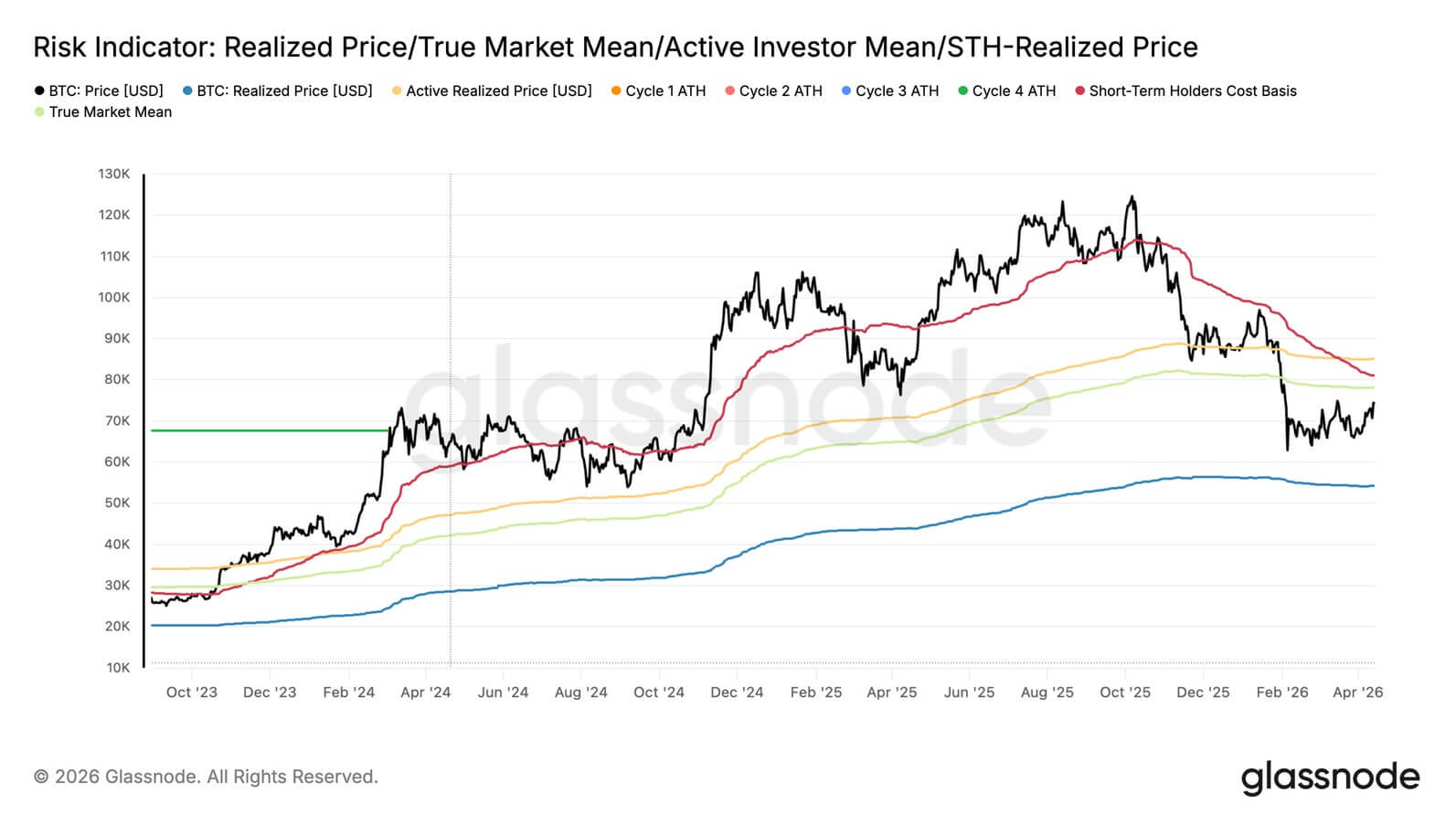
The current market move is being described by analysts as a relief rally within an ongoing bear market structure. For Bitcoin to transition into a definitive recovery phase, it must overcome the "True Market Mean," which Glassnode currently identifies at $78,100. This specific metric represents the average acquisition cost of actively transacted coins, excluding dormant or lost supply, and serves as a primary ceiling for the current cycle.
Trading below this $78,100 level places Bitcoin within what is referred to as the "bear market value zone." Historically, this zone is consistent with a market that is still processing the aftermath of a downturn and working through a transition toward a sustainable bull trend. A successful reclaim and hold above this level would fundamentally alter the tone of the current rally, shifting the narrative from a temporary bounce to a structural trend reversal. Conversely, a rejection at this level would likely confirm the persistence of the bear market structure.
Immediately below the True Market Mean, Bitcoin is navigating a "decision zone" between $74,000 and $76,000. This area is heavily populated with short-liquidation clusters—points where traders betting against the price are forced to buy back their positions, potentially accelerating upward moves. However, this zone has also acted as a site where recent rallies have repeatedly stalled, as sellers use the liquidity provided by liquidations to exit their own positions.
The Macroeconomic Headwinds: Inflation and the Federal Reserve
The technical challenges facing Bitcoin are compounded by a macroeconomic environment that has ceased to provide the "easy" tailwinds seen in previous years. Official data from March 2026 has reinforced the Federal Reserve’s cautious stance on monetary policy. The Consumer Price Index (CPI) rose 3.3% year-over-year, with the core CPI—which excludes volatile food and energy prices—holding at 2.6%. Perhaps most significantly, the energy index surged by 10.9% within a single month, reflecting the impact of ongoing geopolitical tensions in the Middle East.

The Producer Price Index (PPI) also showed signs of persistent pipeline pressure, rising 0.5% month-over-month and 4.0% year-over-year. These figures, combined with a labor market that added 178,000 jobs in March while maintaining an unemployment rate of 4.3%, have removed any immediate urgency for the Federal Reserve to pivot toward interest rate cuts. The Fed’s March statement explicitly noted that uncertainty regarding the economic outlook remains elevated, particularly concerning the potential for geopolitical events to disrupt domestic pricing and hiring.
In April 2026, overall economic activity in the U.S. expanded at a modest pace, but the "wait-and-see" posture adopted by many firms has limited capital investment. Rising fuel and input costs have broadened beyond the energy sector, tightening financial conditions and raising the bar for risk assets like Bitcoin to sustain a conviction-led breakout.
Global Financial Stability and Growth Forecasts
The International Monetary Fund (IMF) has added a global perspective to this local friction in its April 2026 World Economic Outlook. Under an assumption of limited regional conflict, the IMF forecasts that global growth will slow to 3.1% in 2026 and 3.2% in 2027. Simultaneously, global inflation is expected to tick higher, creating a "stagflationary" shadow that weighs on investor sentiment.
The IMF’s Global Financial Stability Report further highlights that since late February, stock prices have faced downward pressure while bond yields have climbed. This environment of rising interest rate expectations and energy-driven inflation has tightened overall financial conditions. For Bitcoin, which often thrives in environments of high liquidity and easing monetary policy, these tighter conditions represent a formidable barrier to clearing on-chain resistance levels.
Derivatives and Market Sentiment Indicators
An analysis of derivative markets provides further insight into the cautious nature of the current rally. While the spot cumulative volume delta (CVD) has shown improvement, the buying pressure is largely led by Binance, suggesting stronger participation from offshore and retail traders rather than U.S.-based institutional investors. This is corroborated by activity on Coinbase, which has lagged behind, indicating a lack of institutional follow-through at these price levels.
Data from the Chicago Mercantile Exchange (CME) and U.S.-based Spot Bitcoin ETFs show that while open interest and Assets Under Management (AUM) are beginning to rebuild, they remain below their previous highs. This trend is consistent with a market characterized by cautious re-engagement rather than aggressive accumulation.
The options market currently reflects a defensive posture:
- Implied Volatility: One-month implied volatility is hovering around 42.6%.
- 25-Delta Skew: The skew is tilted toward puts, indicating that traders are paying a premium for downside protection.
- Gamma Exposure: A large pocket of negative gamma exists near the $75,000 strike price. This suggests that as the price approaches $75,000, market makers who are short calls may need to hedge their positions by buying the underlying asset, which could mechanically amplify upside volatility—though such moves are often short-lived.
Timeline of Key Market Catalysts
The remainder of April 2026 features two pivotal dates that will likely determine the medium-term trajectory for Bitcoin:
- April 21, 2026: The Census Bureau will release the March Advance Monthly Retail report. This will serve as a critical barometer for consumer demand. A softer-than-expected retail number could suggest that high energy costs are finally dampening consumer spending, potentially providing the Fed with a reason to soften its hawkish tone.
- April 28–29, 2026: The Federal Open Market Committee (FOMC) will meet to decide on interest rates. The subsequent policy statement and press conference will either confirm the current "wait-and-see" approach or introduce new complexities based on the latest inflation and employment data.
Future Scenarios: The Bull vs. The Bear Case
The market is currently weighing two distinct futures for Bitcoin based on the interaction between on-chain supply and macroeconomic data.
The Bull Case:
For the bullish scenario to materialize, Bitcoin must clear the $74,000–$76,000 short-liquidation cluster with high volume. This would require a broadening of demand, specifically an uptick in Coinbase and ETF participation to absorb the profit-taking from short-term holders. A macro catalyst, such as a soft retail sales report or a Fed meeting that eases yield expectations, would provide the necessary "risk-on" environment to challenge and reclaim the $78,100 True Market Mean.
The Bear Case:
The bearish scenario assumes that macroeconomic friction will arrive before new demand can materialize. If retail sales remain firm or the FOMC adopts a more hawkish tone, financial conditions will likely tighten further. In this event, Bitcoin is expected to fail at the $74,000–$76,000 resistance zone, leading to a spike in the realized profit/loss ratio as investors exit positions. This would shift the focus back to downside support levels. Glassnode identifies the densest liquidation cluster between $63,000 and $65,000, a zone that has historically absorbed price probes and where long liquidation exposure is currently highest.
Conclusion and Structural Outlook
The current technical setup for Bitcoin is one of high stakes and narrow margins. While the asset has shown resilience by pushing toward $75,000, the lack of institutional conviction and the presence of significant overhead supply suggest that the market is not yet out of the woods. Glassnode’s analysis emphasizes that until Bitcoin can reclaim the Short-Term Holder Cost Basis, currently situated near $81,600, the medium-to-long-term bias remains tilted toward the downside.
As the market approaches the final weeks of April, the interplay between sticky inflation, geopolitical uncertainty, and on-chain seller exhaustion will reach a boiling point. Investors are advised to watch the $78,100 level as the ultimate "line in the sand" for a regime shift, while keeping a close eye on the $63,000 support floor should the macro environment continue to deteriorate. In the current climate, Bitcoin’s path to recovery is no longer a matter of simple price action, but a complex negotiation with the broader global economy.