James Watt
Investors are funneling capital into leveraged exchange-traded funds (ETFs) at a record-breaking pace, transforming the current Bitcoin risk-on cycle into a definitive trial of whether speculative appetite can endure a landscape of accelerating inflation and retreating expectations for Federal Reserve monetary easing. As of May 15, Bitcoin is trading near the $81,000 mark, positioning the digital asset at a critical technical juncture. According to the latest market intelligence from Glassnode, the cryptocurrency is hovering within striking distance of a $86,900 resistance ceiling, while remaining precariously close to a $76,900 support floor. The outcome of this narrow range-bound trading is expected to dictate the trajectory of the broader digital asset market for the remainder of the year.
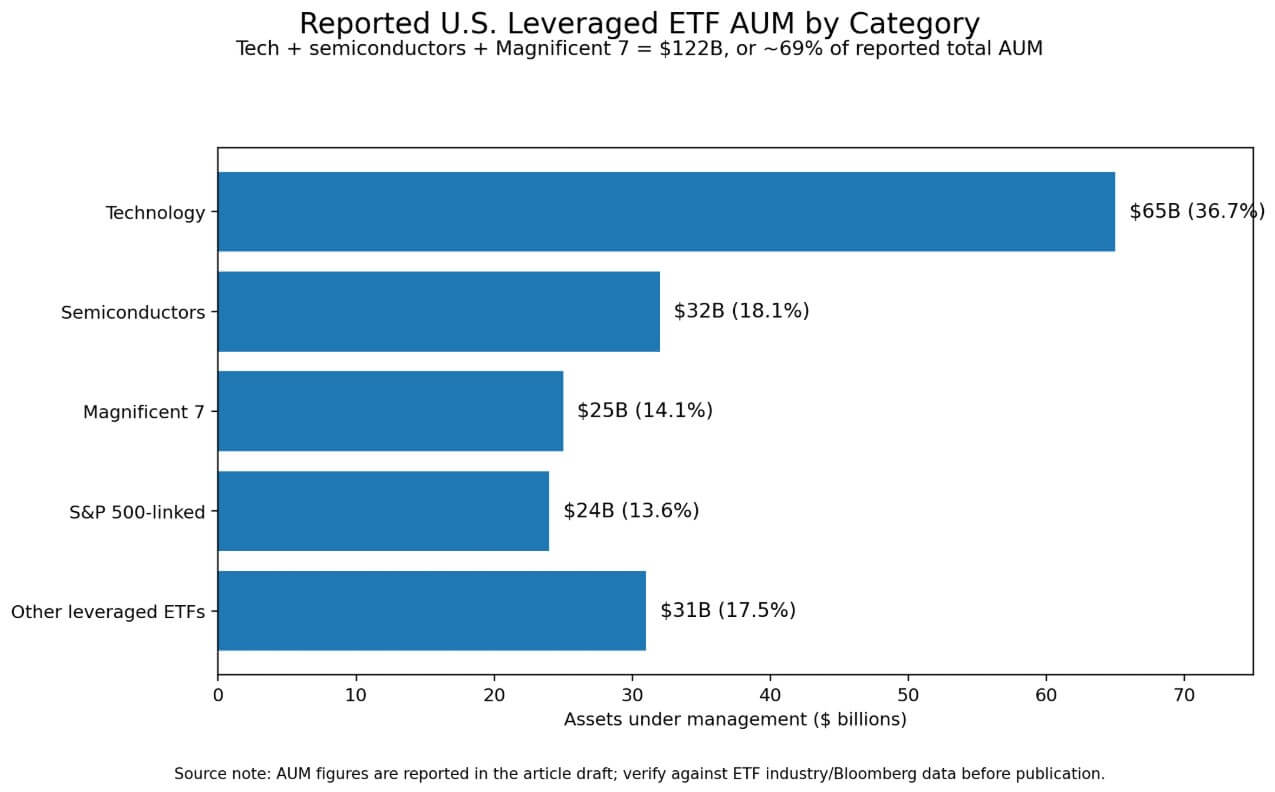
The scale of the current speculative boom is underscored by the massive growth in U.S.-listed leveraged ETF assets under management (AUM), which have reportedly reached a staggering $177 billion. This figure represents a $45 billion surge since the market bottomed in March, signaling an aggressive return to high-stakes trading strategies among both institutional and retail participants. The concentration of this capital is particularly noteworthy; technology-linked funds now command approximately $65 billion in AUM, followed by semiconductor-focused products at $32 billion and "Magnificent 7" linked instruments at $25 billion. Collectively, these sectors represent roughly 69% of the total leveraged ETF market. When S&P 500-linked leveraged funds are added to the tally—accounting for another $24 billion—it becomes clear that investors are heavily betting on the continued dominance of the post-2020 growth complex.
The Convergence of Tech, AI, and Digital Assets
The current market regime treats Bitcoin not as an isolated alternative asset, but as an extension of the broader technology, artificial intelligence, and liquidity complex. As speculative capital becomes increasingly concentrated in growth equities and semiconductors, the excess often spills over into high-beta assets. Despite its maturation, Bitcoin continues to qualify as a primary destination for this "spillover" liquidity. However, the reliance on leveraged products introduces a double-edged sword to price discovery.
Leveraged ETFs are designed to target 2x or 3x daily returns, a mechanism that requires fund managers to buy into strength and sell into weakness to maintain fixed leverage ratios. This rebalancing process amplifies momentum in both directions. The 34% increase in AUM since March suggests that the market is currently "leaning" into the long side, creating a scenario where a sudden reversal could be exacerbated by forced deleveraging. The durability of this risk appetite is now being tested by a macroeconomic environment that is shifting from a narrative of "imminent rate cuts" to one of "persistent inflation."
Macroeconomic Headwinds: The Return of Inflationary Pressure
The bullish momentum in both equities and Bitcoin is facing a formidable challenge from the latest data released by the Bureau of Labor Statistics. Headline inflation recently rose by 0.6% on a month-over-month basis, bringing the year-over-year CPI to 3.8%—a notable acceleration from the 3.3% recorded in March. Core CPI, which excludes the volatile food and energy sectors, rose 0.4% for the month and 2.8% annually, suggesting that underlying price pressures remain "sticky" and resistant to the Federal Reserve’s previous tightening efforts.

The primary catalyst for this inflationary resurgence is energy. Gasoline prices surged 5.4% in April alone and are up 28.4% compared to the previous year. The broader energy index has climbed 17.9% annually, driven largely by geopolitical tensions. Brent crude oil prices have hovered near $104.90, with ongoing supply risks involving the Strait of Hormuz creating a persistent floor for energy costs. High energy prices act as a regressive tax on consumers and keep the threat of "stagflation"—a combination of stagnant growth and high inflation—looming over the market.
For Bitcoin, this macro backdrop is historically bearish. Higher inflation limits the Federal Reserve’s ability to inject liquidity into the system or lower interest rates. During its April 29 meeting, the Fed held its target rate range at 3.50% to 3.75%, opting for a "wait-and-see" approach. However, market sentiment has shifted dramatically. Traders are now pricing in a 71.5% probability that the Fed will maintain these restrictive rates through the end of 2026. Financial institutions like UBS have even pushed their projections for the first interest rate cut into March 2027.
The Treasury Yield Impact and the Cost of Opportunity
The "higher for longer" interest rate narrative has pushed the U.S. 10-year Treasury yield to an 11-month high of approximately 4.484%. Some analysts are now projecting a move toward 5% if CPI data does not show a meaningful cooling in the coming months. Rising real yields present a structural headwind for Bitcoin because they increase the opportunity cost of holding non-yielding assets. Furthermore, high yields tend to strengthen the U.S. dollar, which historically exerts downward pressure on the risk premium associated with cryptocurrencies.
The disconnect between market pricing and economic reality is further evidenced by diverging consumer data. The University of Michigan’s consumer sentiment index plunged to a record low of 49.8 in April, reflecting the exhaustion of household budgets under the weight of high prices. Conversely, the Conference Board Consumer Confidence Index edged up to 92.8, suggesting a divide between how consumers feel about their current finances and their outlook on the labor market.
While the labor market remains relatively resilient, there are signs of softening beneath the surface. April payrolls rose by 115,000, and the unemployment rate held at 4.3%. However, the number of individuals working part-time for economic reasons rose by 445,000 to a total of 4.9 million. Initial jobless claims and continuing claims have also seen marginal increases. This combination of reheating inflation and a softening labor market puts the Federal Reserve in a difficult position, as it removes the traditional justification for monetary easing.
Technical Analysis: Glassnode’s Support and Resistance Zones
In this volatile environment, technical levels are serving as the primary guideposts for traders. Glassnode’s May 13 analysis identifies $76,900 as the immediate support level for Bitcoin, a figure derived from the 30-day cost basis of market participants. This level represents the average price at which recent buyers entered the market; a dip below this would put a significant portion of short-term holders "out of the money," potentially triggering a wave of panic selling.
On the upside, $86,900 stands as the formidable resistance ceiling. This level is tied to the accumulation range observed between November and February. A decisive breakout above $86,900 would signal that speculative demand is strong enough to absorb the overhead supply and overpower the headwinds created by the Fed’s restrictive policy. At the current price of approximately $82,000, Bitcoin is effectively in a "no man’s land," sitting roughly 6.5% below resistance and 5.7% above support.
Glassnode researchers have observed that while Bitcoin’s recovery above $80,000 is a constructive sign, the actual capital inflows into the network are weaker than those seen in previous bull market expansions. Historically, every major Bitcoin breakout has been accompanied by—or preceded by—a shift toward monetary easing. The current rally is unique in that it is attempting to sustain itself through leveraged speculative tailwinds rather than a fresh injection of central bank liquidity.
Strategic Implications and Future Outlook
The market is currently facing two primary scenarios. In the bullish outcome, Bitcoin holds its support at $76,900 and successfully breaches the $86,900 resistance. Such a move would indicate that the "risk-on" appetite in the technology and semiconductor sectors is potent enough to decouple from traditional macro fears. If the 10-year Treasury yield stabilizes and spot ETF inflows accelerate, Bitcoin could clear its prior accumulation zones and move toward new all-time highs. This would represent a triumph of speculative liquidity over fundamental monetary constraints.
In the bearish outcome, a rejection at the $86,900 level followed by a loss of the $76,900 support would signal that liquidity constraints have finally overwhelmed the market. If CPI remains hot and the 10-year yield moves toward 5%, the resulting tightening of financial conditions would likely force a massive de-leveraging event. Given the $177 billion currently tied up in leveraged equity ETFs, any sharp decline in tech stocks would likely see Bitcoin sold off as a source of liquidity, as cross-asset correlations typically tighten during periods of market stress.
The current leverage boom and the resurgence of inflation are symptoms of the same underlying economic uncertainty. Investors are reaching for amplified returns in a "hot" economy, even as the central bank signals that the era of "easy money" is not returning anytime soon. Bitcoin remains at the epicenter of this contradiction. The coming weeks of price action within the $76,900 to $86,900 range will likely determine whether the digital asset can redefine itself as a resilient risk-on leader or if it remains a hostage to the Federal Reserve’s fight against inflation.