James Watt
Bitcoin’s recent retreat below the $80,000 threshold serves as a stark reminder of the bond market’s enduring influence over the cryptocurrency sector. Despite significant legislative progress in the United States, where lawmakers recently advanced a pivotal regulatory bill, the gravitational pull of rising Treasury yields has effectively reclaimed control of digital asset trading. As of the most recent market data, Bitcoin was trading at approximately $79,083, representing a decline of more than 3% following a series of unsuccessful attempts to maintain support above the $82,000 mark. This price action underscores a shift in market regime where macroeconomic factors are once again superseding industry-specific milestones.
The reversal in Bitcoin’s price trajectory occurred shortly after the Senate Banking Committee provided a favorable vote for the CLARITY Act, a piece of legislation viewed by many as a cornerstone for future market-structure regulation. While such a policy breakthrough would typically catalyze a sustained rally by reducing regulatory uncertainty, the market reaction was characterized by analytical firm Santiment as a classic "buy the rumor, sell the news" event. Traders who had positioned themselves in anticipation of the committee’s approval used the actual announcement as an opportunity to exit positions, leading to a liquidity drain that was exacerbated by a sharp move in the fixed-income markets.
The Resurgence of the Bond Market and the Risk-Free Rate
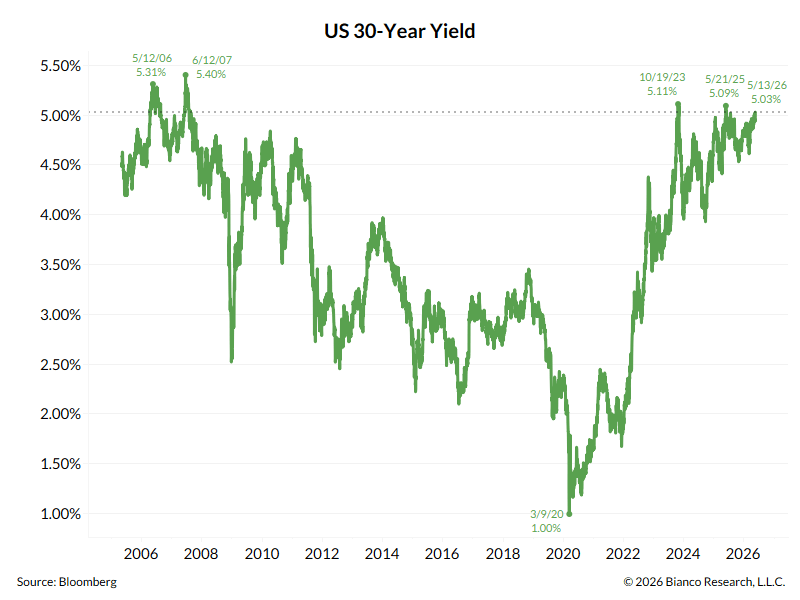
The primary driver behind the cooling of crypto sentiment appears to be the aggressive ascent of U.S. Treasury yields. For the first time since mid-2025, the 10-year Treasury yield breached the 4.5% level, while the 30-year yield surged toward 5.1%. Financial historians and analysts, including Jim Bianco of Bianco Research, have noted that the long-term bond is currently hovering just basis points away from a 19-year high. This movement in the "risk-free rate" has profound implications for speculative assets like Bitcoin, which do not offer an inherent yield.

When government debt offers a guaranteed return of 4.5% to 5%, the "hurdle rate" for investing in volatile assets increases significantly. Investors demand a higher expected return to compensate for the risk of holding digital assets compared to the safety of U.S. sovereign debt. Nicolai Sondergaard, a research analyst at Nansen, noted that the current environment is compressing the risk premium for Bitcoin. As real rates rise, the opportunity cost of holding non-yielding assets becomes burdensome for institutional portfolios. The structural sensitivity of Bitcoin to the real rate environment suggests that until yields stabilize or retreat, the digital asset may struggle to attract the marginal buyer necessary to break through heavy resistance levels.
Institutional Retreat: Record ETF Outflows and Spot Market Fatigue
The impact of rising rates is most visible in the cooling demand for U.S. spot Bitcoin exchange-traded funds (ETFs). These vehicles, which were the primary engine of Bitcoin’s rally in early 2024, are now seeing their most significant period of capital flight. Data from SoSoValue indicates that these funds are on track for weekly outflows exceeding $700 million, the largest such retreat since the initial weeks following their launch in January.
This withdrawal of institutional capital removes a critical pillar of support. Since their inception, spot ETFs have provided a regulated conduit for pension funds, hedge funds, and retail investors to gain exposure to Bitcoin. The current exodus suggests that the institutional "smart money" is recalibrating its exposure in favor of the higher yields available in the debt market. Lacie Zhang, a research analyst at Bitget Wallet, emphasized that the relative appeal of government debt has fundamentally altered the institutional allocation strategy. With yields at multi-decade highs, the volatility of Bitcoin becomes less palatable for treasury managers seeking stable returns.
The weakness in the ETF sector is mirrored by deteriorating liquidity in the spot market. According to CryptoQuant, the Cumulative Volume Delta (CVD)—a measure of the net difference between buying and selling volume—has seen a sharp decline across major trading venues. In March, Binance and Coinbase recorded monthly averages of $50 million and $30 million in net buying volume, respectively. Those figures have now plummeted to approximately $6.5 million and $5.7 million. This drop in volume indicates a thinning of the buyer base, leaving the market vulnerable to sudden price drops and reducing the probability of a successful breakout above the $82,000 resistance zone.
Legislative Milestones vs. Macroeconomic Reality
The advancement of the CLARITY Act was intended to be the catalyst for the next leg of the bull market. By moving market-structure legislation closer to a full Senate floor vote, Washington appeared to be signaling a new era of cooperation with the digital asset industry. The bill aims to provide a clear framework for stablecoin issuance and the distinction between securities and commodities in the crypto space. However, the timing of the bill’s progress coincided with a worsening macroeconomic backdrop, rendering the legislative victory insufficient to drive prices higher.
In addition to the pressure from the bond market, geopolitical tensions have added a layer of uncertainty. The ongoing friction between Iran and the United States continues to weigh on global risk appetite. While President Donald Trump had initially characterized the conflict as a short-term engagement, the lack of a swift resolution has fueled concerns regarding energy prices and long-term inflation. Inflationary fears, in turn, keep Treasury yields elevated as investors price in the possibility that the Federal Reserve will maintain high interest rates for a longer duration than previously anticipated.
The Growth of Tokenized Treasuries and Stablecoin Rotations
While Bitcoin faces headwinds, other sectors of the blockchain ecosystem are thriving precisely because of the high-interest-rate environment. The market for tokenized U.S. Treasuries has experienced explosive growth, reaching a record valuation of $15.35 billion. This represents a 70% increase in just under five months, according to data from Token Terminal.
Marcin Kazmierczak, co-founder of RedStone, observed that the ability to access 4%+ yields on-chain has created a "programmable cash loop" that traditional banks are now attempting to emulate. Products like BlackRock’s BUIDL and Franklin Templeton’s BENJI allow institutions to earn government-backed yields while maintaining the 24/7 settlement and composability of decentralized finance (DeFi). This shift suggests that capital is not necessarily leaving the blockchain entirely; rather, it is rotating from volatile assets like Bitcoin into "on-chain cash" and yield-bearing instruments that track the bond market.

Analysis of "smart money" wallets by Nansen supports this trend. There has been a measurable increase in stablecoin holdings among sophisticated investors over the last two weeks. This behavior indicates a defensive posture, where traders are staying liquid and waiting for a clearer signal before redeploying capital into directional bets. The preference for stablecoins over Bitcoin highlights the market’s current lack of conviction in a near-term recovery.
Technical Outlook and the Long-Term Hedge Case
From a technical perspective, Bitcoin is currently situated in a precarious pivot zone. It remains below its 200-day moving average, a key indicator used by institutional traders to determine the long-term trend. For the bullish narrative to regain momentum, Bitcoin would likely need to see a sustained recovery in ETF inflows or a cooling of the 10-year Treasury yield. Without these catalysts, analysts warn that the price could remain range-bound between the upper $70,000 support level and the $82,000 resistance.
Despite the immediate bearish pressure, the long-term investment thesis for Bitcoin remains centered on its role as a non-sovereign, fixed-supply asset. Analysts at Bitunix suggest that the very forces currently pressuring the price—rising U.S. deficits and debt issuance—could eventually serve as the ultimate advertisement for Bitcoin. If investors continue to lose confidence in the sustainability of sovereign debt, the demand for "hard money" outside of the traditional financial system is expected to grow.
In conclusion, the current market environment reflects a sophisticated tug-of-war between crypto-native progress and global macroeconomic forces. While the CLARITY Act represents a significant step toward legitimacy for the industry, it is currently being overshadowed by a bond market that offers the most competitive yields in nearly two decades. For Bitcoin to reclaim its upward trajectory, it must navigate a landscape where the cost of capital is no longer negligible, and where institutional investors are increasingly looking to the safety of Treasuries—both traditional and tokenized—to anchor their portfolios. The coming months will likely be defined by whether Bitcoin can reassert its narrative as a "digital gold" hedge or if it will continue to trade as a high-beta proxy for global liquidity.