Lina Irawan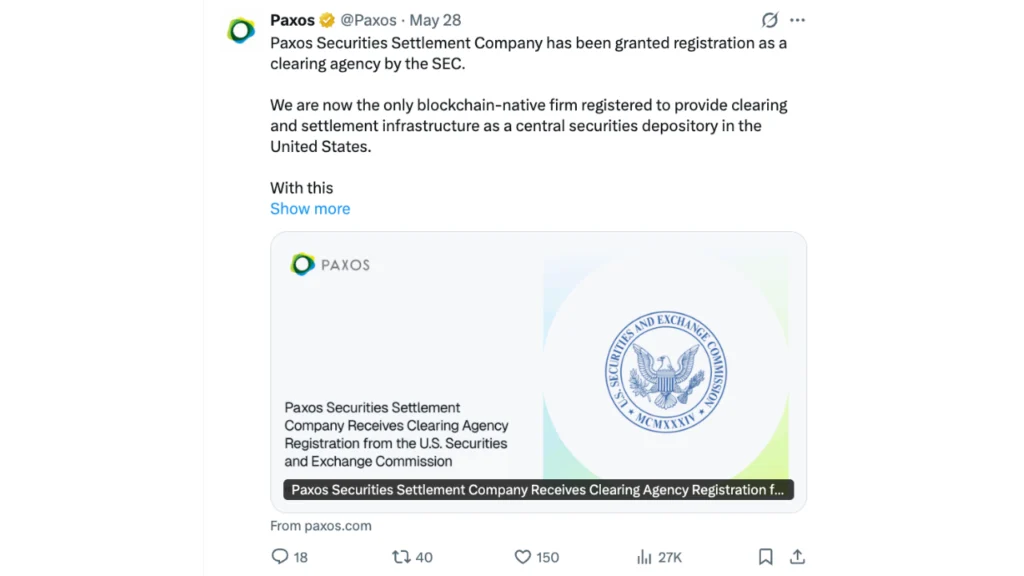
In a transformative development poised to reshape the architecture of American financial markets, Paxos has achieved a significant regulatory milestone, securing federal authorization to operate as a clearing and settlement provider for U.S. equities utilizing blockchain technology. This landmark registration designates Paxos Securities Settlement Company, LLC (PSSC), a subsidiary of the prominent stablecoin and blockchain infrastructure firm, as the first blockchain-native entity to be recognized by the U.S. Securities and Exchange Commission (SEC) as a central securities depository (CSD) for traditional equities. The approval, granted under Section 17A of the Securities Exchange Act of 1934, positions Paxos as a direct challenger to the decades-long dominance of the Depository Trust & Clearing Corporation (DTCC) in the post-trade landscape.
This historic achievement represents the culmination of a seven-year journey of engagement and development with the SEC, underscoring the intricate regulatory path for innovative financial technologies seeking integration into established market infrastructures. Charles Cascarilla, CEO and co-founder of Paxos, highlighted the extensive collaboration, noting that the groundwork was laid as early as 2019 with a no-action letter that permitted Paxos to commence development of a live settlement pilot. This pilot, initiated in February 2020, successfully demonstrated the viability of blockchain-based infrastructure for clearing and settling U.S. equities on a daily basis. The program engaged major global financial institutions, including Bank of America, Credit Suisse, and Societe Generale, validating the potential of distributed ledger technology to support same-day settlement within a robust regulatory framework while simultaneously driving down operational costs.
While the SEC’s order classifies the current registration as temporary, this development is monumental. It signifies a crypto-native firm operating not on the periphery of regulated financial markets, but directly within its core infrastructure. This integration represents a paradigm shift, moving beyond the conceptual exploration of blockchain in finance to its practical, regulated application in one of the world’s most significant capital markets.
The Genesis of a Seven-Year Regulatory Endeavor
The path to this SEC registration was arduous and protracted, a testament to the inherent conservatism and rigorous oversight governing the securities industry. Paxos’s proactive approach began with a strategic engagement with the SEC, seeking regulatory clarity and guidance. The 2019 no-action letter was a crucial early step, allowing the company to test its blockchain-based settlement system in a controlled environment. This pilot program was instrumental in gathering empirical data and demonstrating the technology’s capabilities to regulators and industry participants alike.
The pilot’s success was not merely theoretical. It involved the actual clearing and settlement of U.S. equities, processing real-world transactions for some of the largest names in global finance. This hands-on experience provided invaluable insights into the operational demands, risk management requirements, and regulatory compliance necessary for such a system. The participation of institutions like Bank of America, Credit Suisse, and Societe Generale lent significant credibility to Paxos’s claims about the efficiency and reliability of its blockchain solution. These early adopters, known for their stringent due diligence processes, would not have participated without a high degree of confidence in the technology and Paxos’s commitment to regulatory compliance. The pilot effectively served as a proof of concept, showcasing that blockchain technology could not only match but potentially exceed the performance and efficiency of legacy settlement systems, all while adhering to the stringent requirements of U.S. securities law.

The significance of a temporary registration should not be understated. It represents a measured, phased approach by the SEC, allowing for ongoing monitoring and evaluation. However, it is a clear signal of the regulator’s willingness to embrace technological innovation when accompanied by robust compliance and risk mitigation strategies. For Paxos, this approval transitions their efforts from a development and pilot phase to a fully regulated operational capacity, marking a pivotal moment for the firm and the broader adoption of blockchain in institutional finance.
Understanding the Mechanics of Blockchain Settlement
To fully grasp the import of Paxos’s achievement, it is essential to understand the inefficiencies inherent in traditional securities settlement processes. In the contemporary equity markets, the execution of a stock trade can occur within milliseconds, a feat of technological speed. However, the actual legal transfer of ownership, known as settlement, has historically been a much slower and more complex affair. For decades, the U.S. market operated on a T+2 cycle, meaning trades were officially settled two business days after execution. While this cycle was shortened to T+1 in 2024, a significant lag still exists.
This extended settlement period is not merely an inconvenience; it introduces substantial operational friction and risk. The legacy infrastructure relies on a layered network of intermediaries, including central clearinghouses, custodians, and transfer agents. Each layer adds to the complexity and potential points of failure. Furthermore, during the settlement window, capital remains "trapped" as collateral, reducing overall liquidity and capital efficiency for market participants. More critically, this period exposes institutions to counterparty risk – the possibility that one party in a transaction will default before settlement is complete.
Paxos posits that blockchain technology fundamentally eliminates these structural delays and inherent risks. By leveraging a distributed ledger as the clearing rail, PSSC can facilitate the settlement of eligible securities on a same-day or near-instantaneous basis. This immediate finality of settlement has profound implications. It frees up significant amounts of capital that are currently tied up in collateral, enhancing liquidity across the financial system. Instead of building atop or layering onto existing, often cumbersome, legacy infrastructure, Paxos’s blockchain-native approach can bypass it entirely. This bypass is not just about speed; it’s about fundamentally re-architecting the post-trade process to be more efficient, secure, and capital-friendly. The distributed ledger ensures transparency and immutability, creating an auditable trail of transactions that can reduce disputes and enhance regulatory oversight.
A Strategic Platform for Institutional Finance
The timing of Paxos’s SEC registration is strategically opportune. The financial industry has witnessed a palpable shift in recent years, with the concepts of tokenized securities, on-chain settlement, and stablecoins moving from the fringes of financial discourse to the forefront of strategic planning. Major global banks, asset managers, and market infrastructure providers are actively investing in and exploring blockchain-based post-trade solutions. Regulatory clarity has consistently been identified as a primary obstacle to broader adoption, and Paxos’s achievement directly addresses this critical need.
Paxos has a well-established track record of navigating complex regulatory landscapes. The company already holds licenses from various prestigious regulatory bodies, including the Office of the Comptroller of the Currency (OCC) in the United States, the Monetary Authority of Singapore, and the Financial Supervisory Authority (FIN-FSA) in Europe. These existing credentials have enabled Paxos to build a robust platform that has attracted significant institutional partners. Companies such as PayPal, Mastercard, and Interactive Brokers leverage Paxos’s white-label infrastructure tools for various services, demonstrating the market’s appetite for their technology.

The new CSD designation empowers Paxos to offer a significantly more comprehensive suite of services. It allows them to bundle regulated stock clearing directly with their existing infrastructure offerings. This integrated approach presents a highly compelling proposition for traditional finance firms that are seeking to modernize their post-trade operations but are hesitant to undertake the immense task of building such capabilities from scratch. By providing a regulated, blockchain-native solution for clearing and settlement, Paxos offers a pathway to enhanced efficiency, reduced costs, and improved risk management, all within a compliant framework. This strategic positioning allows Paxos to serve as a crucial enabler for the broader digital transformation of institutional finance.
Challenging the Decades-Long Dominance of the DTCC
The Depository Trust & Clearing Corporation (DTCC) has long served as the linchpin of the U.S. post-trade infrastructure, processing trillions of dollars in securities transactions annually. For generations, it has been the bedrock upon which the efficiency and stability of American capital markets have rested. Consequently, challenging or displacing such an entrenched institution is not a task for the faint of heart, nor is it an undertaking that can be accomplished overnight. Paxos has astutely avoided framing its regulatory approval as a direct confrontation or a "declaration of war." Instead, the company is positioning its blockchain-based solution as a complementary and ultimately superior alternative that addresses the inherent limitations of legacy systems.
The structural advantages of blockchain settlement – its speed, capital efficiency, reduced counterparty risk, and lower operational overhead – present a genuine and compelling value proposition for the institutional participants who currently bear the costs and risks associated with legacy infrastructure. As these participants become increasingly comfortable with digital asset technologies and as regulatory frameworks continue to mature and provide greater clarity, the argument for on-chain settlement becomes increasingly difficult to dismiss. The DTCC itself is exploring and investing in blockchain technologies, suggesting an acknowledgment of the potential disruption and the need for evolution.
For Paxos, this SEC registration is far more than a regulatory victory; it is the commercial activation of years of dedicated effort. It provides the firm with a regulated gateway into one of the most critical layers of global securities trading. For the first time, Paxos possesses the federal authorization to leverage its innovative technology to offer a fundamentally different and potentially more efficient method of clearing and settling U.S. equities, setting the stage for a new era in financial market infrastructure. The long-term impact will likely involve a gradual integration of blockchain solutions, potentially leading to a hybrid model where legacy systems coexist with and are eventually augmented or replaced by more advanced distributed ledger technologies. This transition promises greater resilience, efficiency, and innovation within the global financial ecosystem.