James Watt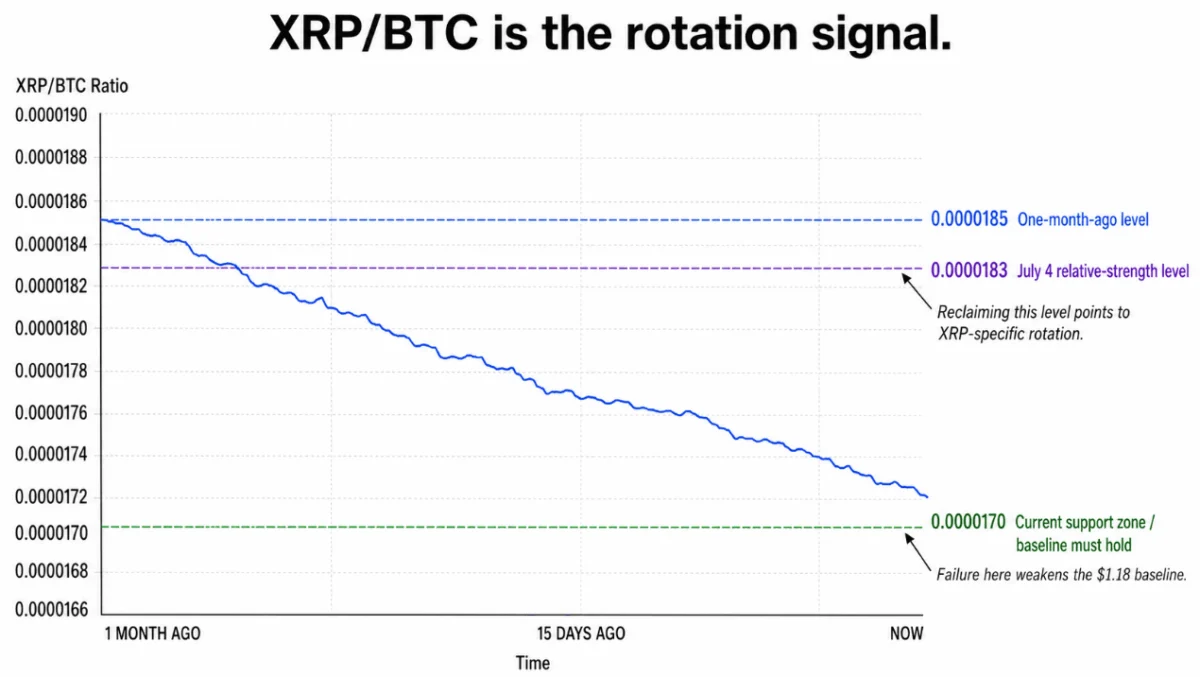
According to a detailed report released by Glassnode on July 15, 2026, reclaiming this cost basis is essential for the current market rebound to gain sustainable momentum. For XRP, the implications are profound. While the asset often follows Bitcoin’s broader price trajectory, its performance relative to the BTC/XRP ratio suggests that a successful Bitcoin breakout could trigger a disproportionate move for XRP, potentially pushing its valuation toward the $1.26 mark. This price target depends heavily on whether XRP can regain its strength against Bitcoin, reversing a month-long trend of underperformance.
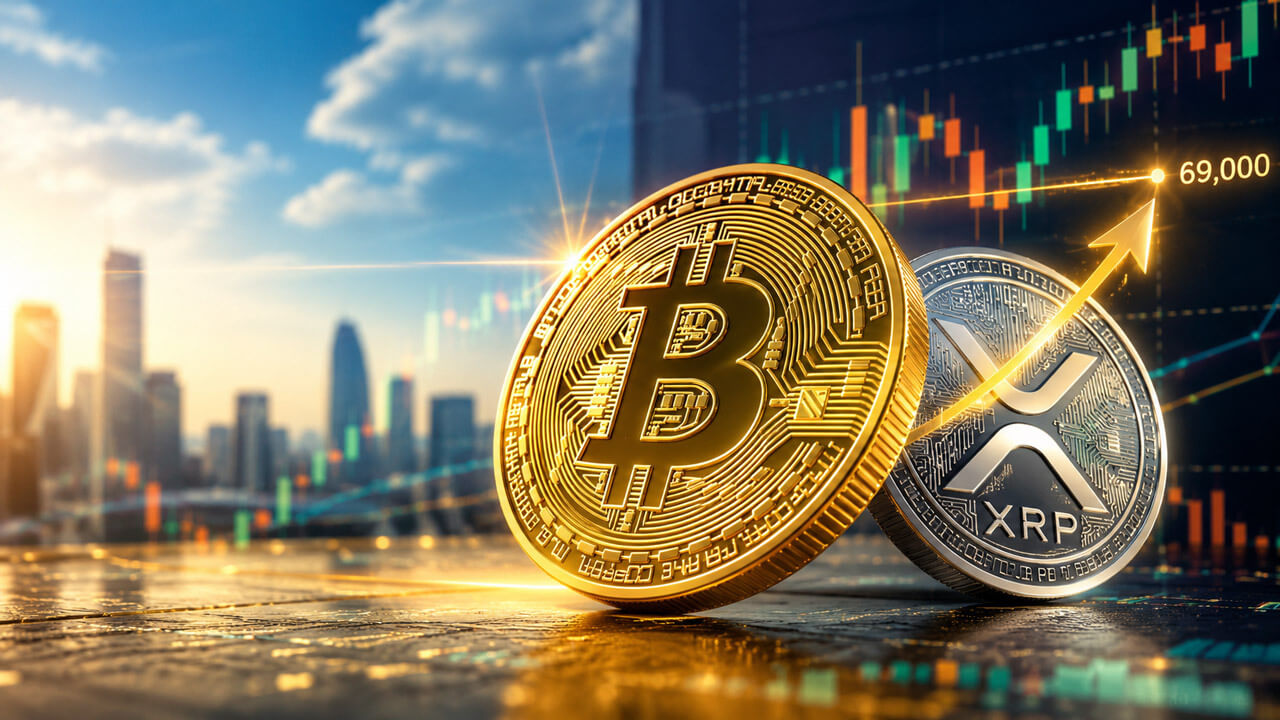
The Significance of the $69,000 Cost Basis
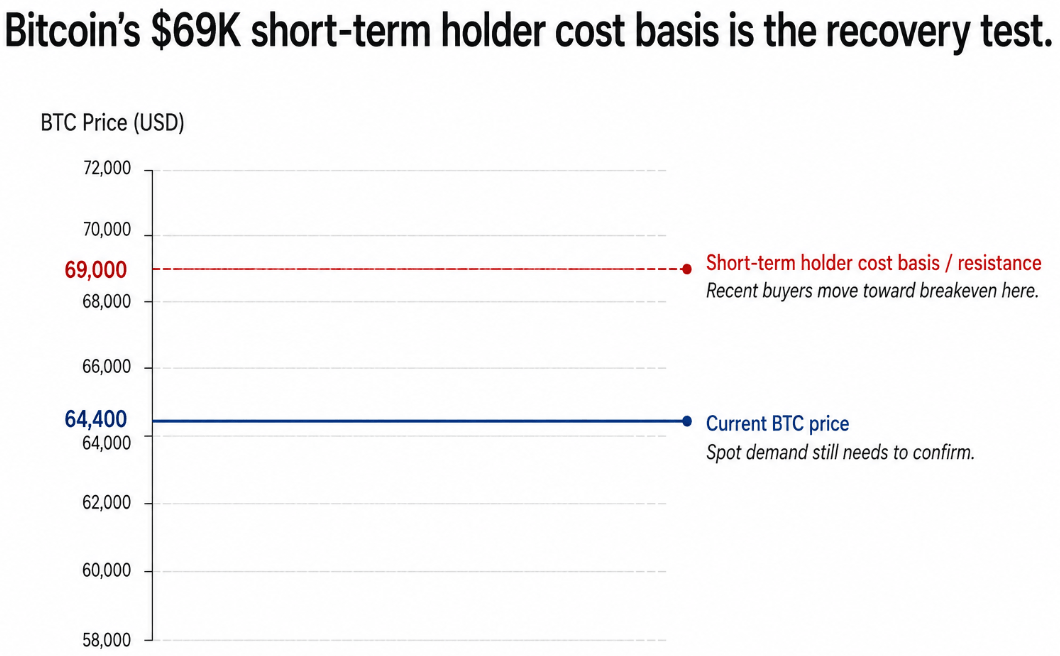
The $69,000 level is more than just a round number; it represents the financial frontier for a significant portion of the current market participants. When Bitcoin trades below the short-term holder cost basis, the majority of recent buyers are "underwater" or holding unrealized losses. This often leads to sell-side pressure as investors look to exit at breakeven. Conversely, when Bitcoin successfully breaches and holds above this level, it transforms from a resistance zone into a support floor, signaling a shift in market sentiment from fear to renewed accumulation.
Currently, Bitcoin is trading just below this critical juncture. Glassnode’s data indicates that while derivatives traders have begun unwinding their downside bets—suggesting a reduction in bearish conviction—spot market buying has yet to provide the definitive confirmation required for a breakout. The market is currently in a state of "wait-and-see," with liquidity concentrated around the $69,000 mark. A decisive move above this point would likely trigger a wave of short-covering and attract fresh institutional capital, providing the "beta" necessary for altcoins like XRP to thrive.
A Chronology of Recent Market Volatility
To understand the current outlook, it is necessary to examine the market’s trajectory over the preceding weeks. The early summer of 2026 was characterized by heightened volatility and a sharp "liquidation flush" that cleared out over-leveraged positions.
- June 30 – July 4, 2026: Bitcoin initiated a sharp rebound, gaining approximately 7.7%. During this same window, XRP displayed "high-beta" characteristics, surging by 11.3%. This outperformance meant XRP was moving roughly 1.47 times as fast as Bitcoin, a sign of strong speculative interest.
- July 4, 2026: The XRP/BTC ratio reached a local peak of 0.0000183. This was the strongest reading for XRP against the market leader in the current cycle, suggesting a brief rotation of capital into the Ripple-affiliated token.
- July 5 – July 15, 2026: Following the Fourth of July peak, XRP began to lose ground against Bitcoin. Even as XRP’s dollar price remained relatively stable around $1.09, its value relative to Bitcoin (the XRP/BTC ratio) slid from 0.0000185 to 0.0000171, a decline of nearly 8%.
- July 17, 2026: As of today, the broader crypto market has seen a 7-day gain of 1.5%, while XRP has lagged behind with a marginal gain of only 0.1%. This divergence highlights XRP’s current dependence on a Bitcoin-led market lift to break its local stagnation.
Analyzing the XRP/BTC Ratio: The Key to $1.26
The relationship between XRP and Bitcoin is the most accurate barometer for predicting XRP’s future price action. While dollar-denominated prices are influenced by inflation and fiat currency strength, the XRP/BTC ratio reveals where capital is actually flowing within the crypto ecosystem.
There are currently four primary scenarios for XRP based on Bitcoin’s interaction with the $69,000 level:
- The Failed Setup: If Bitcoin fails to reclaim $69,000 and instead rejects the level, XRP is likely to slip below its current ratio of 0.000017. In this bearish scenario, XRP would struggle to maintain the $1.18 level, confirming that it lacks the independent momentum to withstand a Bitcoin retracement.
- The Baseline Scenario: If Bitcoin reaches $69,000 but the XRP/BTC ratio remains stagnant at 0.0000171, XRP would mechanically rise to a range of $1.18 to $1.19. This would be a "passive" gain, driven entirely by Bitcoin’s rising tide rather than specific demand for XRP.
- The High-Beta Rebound: Should XRP repeat its early-July performance, where it moved 1.47 times as much as Bitcoin, a move to $69,000 for BTC would price XRP near $1.22. This would indicate that traders are once again using XRP as a high-leverage play on a Bitcoin recovery.
- The Rotation Case: The most bullish outcome involves a "capital rotation," where investors actively move funds from Bitcoin into XRP. If the XRP/BTC ratio recovers to its July 4 high of 0.0000183 while Bitcoin holds above $69,000, XRP would be priced between $1.25 and $1.26. This would represent a genuine trend reversal and a breakout from its monthly decline.
Macroeconomic Headwinds and Market Dominance
The path to $1.26 is not without external obstacles. The broader financial environment in 2026 has been defined by "higher for longer" interest rate expectations. Ten-year real yields in the United States are currently hovering near a yearly high of 2.4%. Historically, high real yields bolster the U.S. Dollar (DXY) and create a headwind for risk assets like cryptocurrencies.

Furthermore, Bitcoin dominance remains a formidable factor. Currently, Bitcoin accounts for 58.4% of the total $2.2 trillion crypto market capitalization. This high level of dominance suggests that liquidity is still heavily concentrated in the "flight to safety" asset (Bitcoin) rather than being distributed among altcoins. For XRP to achieve the "Rotation Case" of $1.26, market participants would need to see a stabilization in macro yields and a slight cooling of Bitcoin dominance, allowing capital to flow down the risk curve into major-cap altcoins.
Institutional and Analytical Perspectives
Market analysts suggest that the current price action in XRP is a reflection of a "wait-and-see" approach by institutional holders. Unlike the retail-driven pumps of previous cycles, the 2026 market is increasingly influenced by exchange-traded products and institutional liquidity.
"The XRP/BTC ratio is the signal the market is watching," noted one senior analyst at a major digital asset firm. "We are seeing a lot of trapped liquidity above the $1.20 mark for XRP. For the asset to clear that hurdle, it needs more than just a Bitcoin rally; it needs a narrative shift that encourages holders to stop selling into Bitcoin’s strength."
Glassnode’s observation that derivatives traders are unwinding downside bets is a positive sign, but it also implies that the market is "flat." Without a catalyst—be it a regulatory breakthrough, a major partnership announcement for Ripple, or a definitive Bitcoin breakout—XRP remains tethered to the market leader’s movements.
Broader Market Impact and Implications
The outcome of this technical test at $69,000 will likely set the tone for the remainder of the third quarter of 2026. If Bitcoin reclaims its cost basis and XRP moves toward $1.26, it would signal the start of a broader "altcoin season," where Ethereum, Solana, and other top-tier assets begin to outperform Bitcoin.
However, the risk of a "bull trap" remains. If Bitcoin touches $69,000 only to suffer a sharp rejection, the resulting liquidation of long positions could be severe for XRP, given its higher volatility. Investors are closely monitoring the 200-day moving average of the U.S. Dollar Index, which has held firm since May. A sudden spike in dollar strength could derail the crypto recovery regardless of on-chain cost basis metrics.
In summary, the roadmap for XRP is clear but conditional. The $1.18 to $1.19 range is the minimum expectation if Bitcoin hits $69,000. To reach the $1.26 target, XRP must do more than just follow Bitcoin; it must reclaim its status as a leader in the altcoin space by reversing its month-long slide against the BTC ratio. As of mid-July, the market sits at a crossroads, with the $69,000 cost basis serving as the ultimate arbiter of the next major trend.