James Watt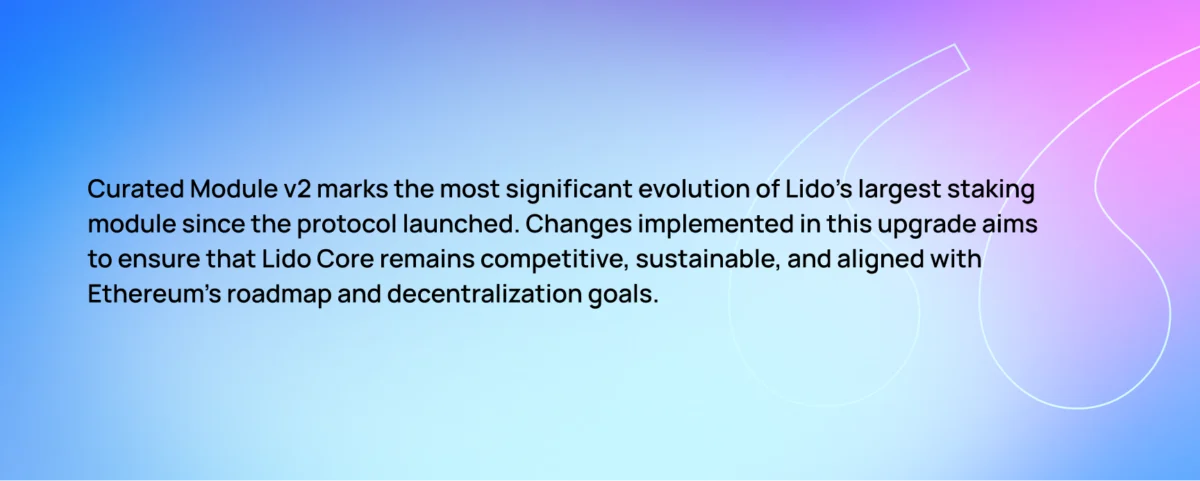
Lido Finance, a leading liquid staking protocol, has announced a significant upgrade to its core infrastructure, Lido Core, marking a pivotal moment in its ongoing evolution alongside the Ethereum network. This comprehensive protocol-level enhancement introduces major improvements across its staking modules, designed to bolster protocol health and sustainability, improve alignment with Ethereum’s long-term roadmap, and advance decentralization for the benefit of both Lido and the broader blockchain ecosystem. Importantly, this sophisticated upgrade requires no action from individual stakers, as all changes are handled entirely at the protocol level, ensuring a seamless transition for users.
Lido Core serves as the foundational liquid staking infrastructure of the Lido protocol, where user-deposited ETH is algorithmically distributed to validators managed by a diverse array of Node Operators (NOs) through various Staking Modules. This term was established to differentiate the protocol’s original architecture – a single pooled model – from newer, modular staking primitives like stVaults, which were launched as part of Lido V3 in December 2025. The latest upgrade builds upon this architecture, reinforcing Lido’s commitment to innovation and security in the liquid staking landscape. Isidoros Passadis, Chief of Staking at Lido Labs Foundation, emphasized the strategic imperative behind these changes, stating, "This update isn’t just about technical improvements; it’s about solidifying Lido’s role as a resilient and responsible actor in the Ethereum ecosystem. We are continuously adapting to Ethereum’s evolving landscape, ensuring that Lido remains at the forefront of secure and decentralized liquid staking."
Curated Module v2: Evolving the Cornerstone of Lido Staking

The Curated Module has been the bedrock of Lido’s validator set since the protocol’s inception in 2020, responsible for securing approximately 90% of all ETH staked within Lido Core as of July 2026. Recognizing the dynamic nature of Ethereum staking, Lido contributors have consistently worked to advance these modules, ensuring Lido Core remains synchronized with Ethereum’s developmental trajectory while safeguarding long-term protocol sustainability. Curated Module v2 (CMv2) represents the next significant leap in this evolutionary process. It introduces a market-driven operator economics framework, streamlines operational processes, incorporates new mechanisms, and defines dedicated Node Operator types, all geared towards empowering operators to further strengthen Ethereum’s decentralization. The introduction of CMv2 will be implemented in two distinct phases to ensure smooth adoption and minimize disruption.
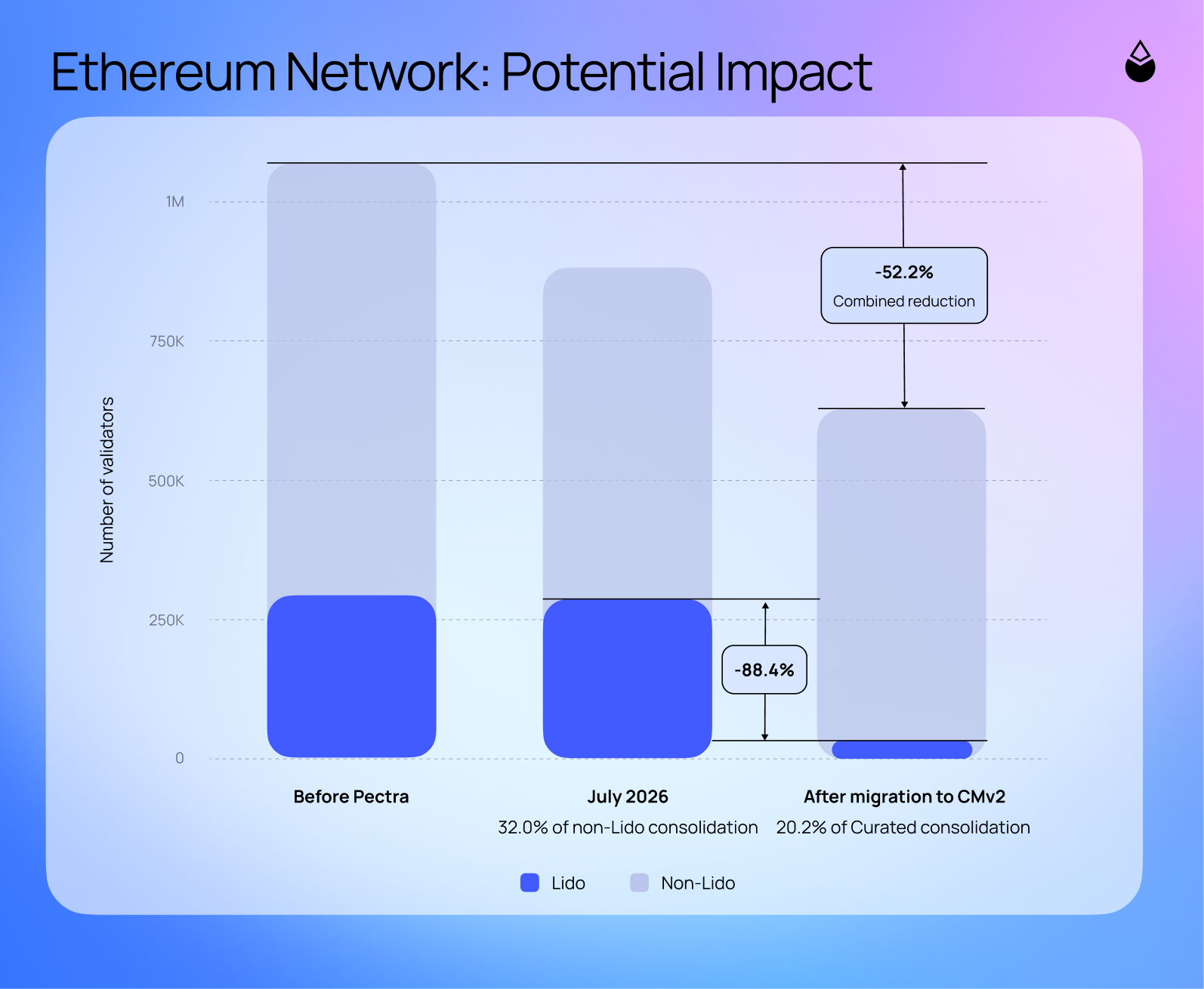
A key component of CMv2 is the native support for 0x02 Withdrawal Credentials (WC). The earlier Pectra upgrade on Ethereum introduced 0x02 WC and consolidation capabilities, allowing validators to significantly increase their maximum effective balance from 32 ETH to 2,048 ETH. While Lido initially rolled out 0x02 support with the launch of stVaults, CMv2 now extends this crucial capability to Lido Core’s largest staking module. This enables the large-scale migration of over 265,000 existing Curated Module validators from their legacy 0x01 WC to the more efficient 0x02 standard through validator consolidations.
This validator migration is projected to nearly double the share of ETH secured by compounding validators within Lido, increasing it from 32.06% to an impressive 52.21%. More broadly, this initiative is expected to reduce the total number of validators across the entire Ethereum network by roughly one third, decreasing from approximately 880,000 at the time of writing to an estimated 628,000 post-consolidations (without accounting for new validators or other network consolidations). The implications of this reduction are substantial: it is anticipated to meaningfully lower network congestion and specifically decrease Consensus Layer overhead, aligning the Lido protocol more closely with Ethereum’s overarching roadmap. Upon completion, this consolidation should reduce the number of attestation messages across the network by approximately 29% each epoch, contributing to a more efficient and scalable Ethereum.
Refining Node Operator Engagement: New Types and Incentives

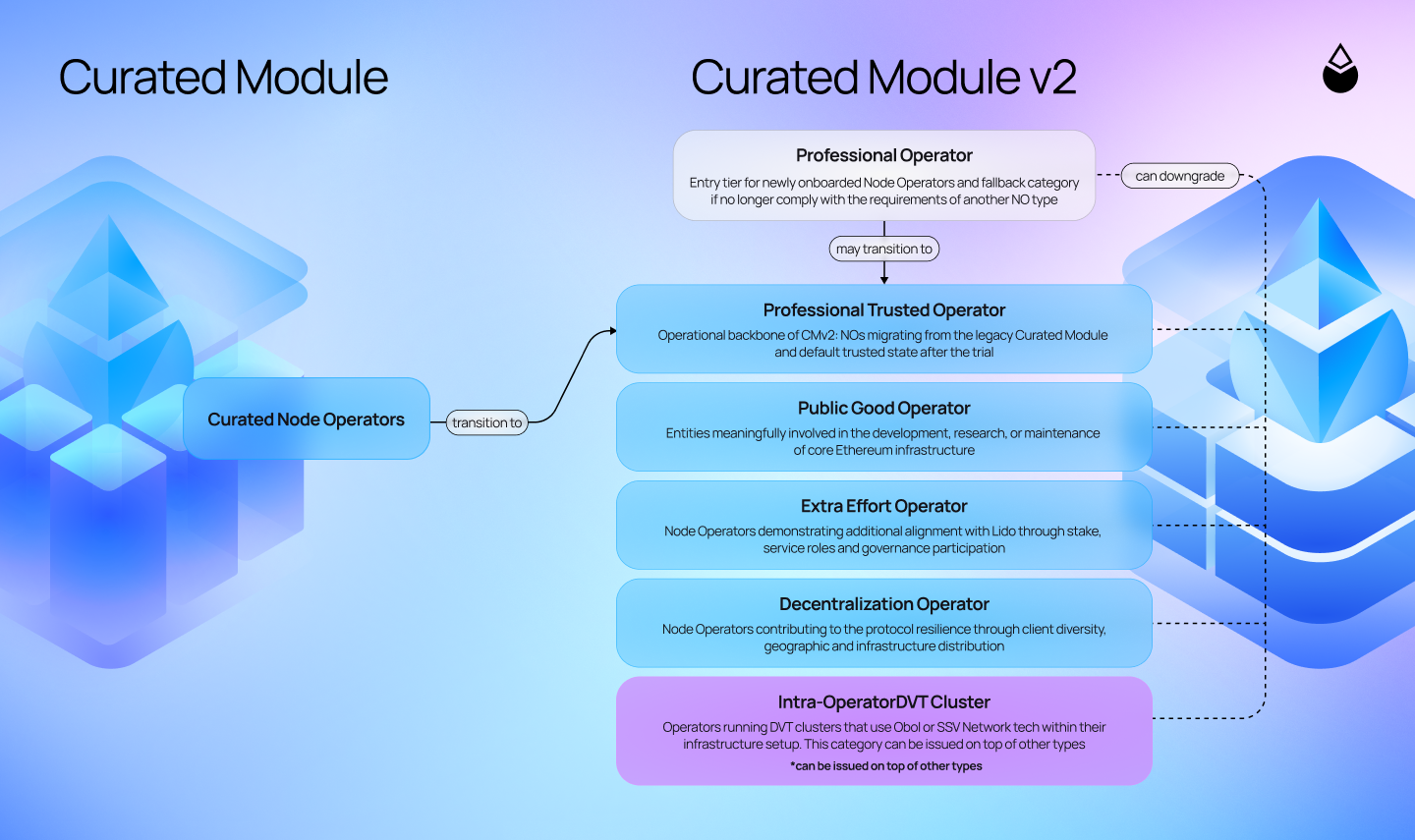
Beyond technical consolidation, CMv2 introduces a sophisticated operator classification system that acknowledges the diverse contributions of Curated Node Operators, moving beyond a one-size-fits-all model. The new Node Operator Type Framework enables the recognition of varying levels of contribution to protocol growth, infrastructure resilience, Ethereum public goods, and overall decentralization. This framework supports categories such as client teams, public-good builders, and other specialized operators, formalizing an approach Lido DAO has cultivated for years. These contributions are now directly reflected in the Curated Module v2 incentive structure, designed to ensure that both the Lido protocol and Ethereum continue to flourish synergistically.
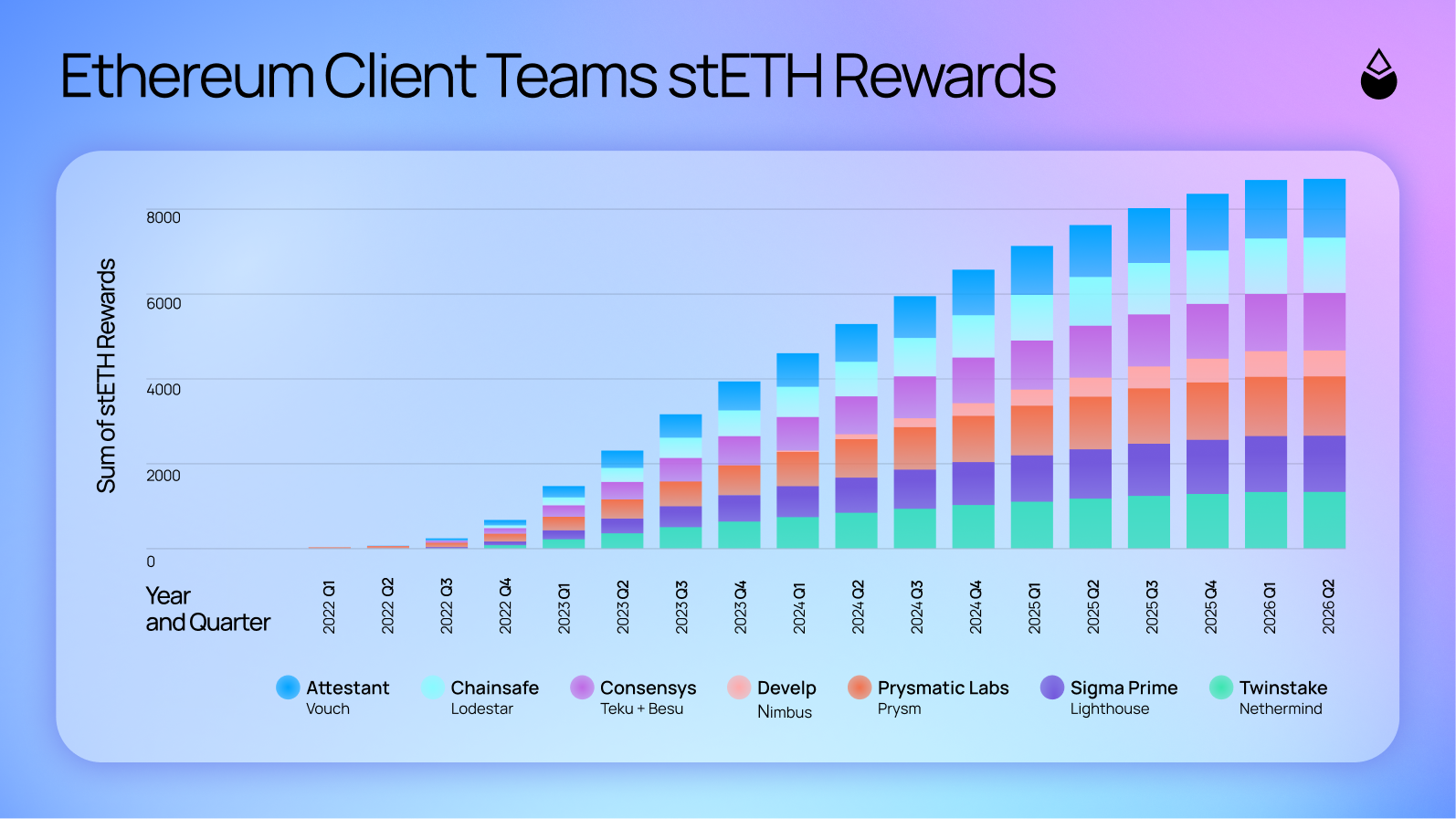
A tangible example of this commitment is Lido’s long-standing support for Ethereum client teams and public-good builders through participation in the Curated Module and LEGO grants. As of July 1, 2026, seven client teams have been onboarded as Curated Node Operators, collectively receiving 8,710 stETH (approximately $21 million) in cumulative rewards for operating validators on behalf of Lido stakers. This financial commitment underscores Lido’s dedication to fostering core Ethereum infrastructure development. Furthermore, improving client, geographic, and infrastructure diversity has remained a sustained focus for contributors and Node Operators since the Ethereum Merge. Coordinated efforts have steadily reduced the protocol’s reliance on any single client, geographic region, or cloud provider, thereby contributing to a more resilient and decentralized Ethereum network. By promoting balanced usage, Lido actively strengthens Ethereum’s overall health and network resilience, a progress transparently trackable via the Validator and Node Operator Metrics (VaNOM) dashboard.
Enhanced Accountability: Bonding and Penalty Mechanisms
The legacy Curated Module operated largely on a foundation of trust, where operator reputation served as the primary guarantee of alignment and reliability. Curated Node Operators were expected to maintain high performance standards and compensate stakers and the protocol for any losses incurred. As the staking ecosystem matures, Curated Module v2 elevates this alignment by introducing ETH-backed bonding and a comprehensive Penalty Framework. These mechanisms enable coverage in cases of operator underperformance, operational downtime, slashing events, or Execution Layer (EL) rewards violations. Rather than entirely replacing the existing reputation-based model, CMv2 complements it with these new bond-based security and accountability mechanisms. This hybrid approach better aligns operator behavior with the interests of stakers, significantly strengthening the robustness and trustworthiness of Lido Core.
Streamlined Governance and Simplified Node Operator Management
The previous design of the Curated Module necessitated on-chain votes even for routine administrative adjustments, such as updating an operator address. This often led to increased operational overhead and potential delays in responding to time-sensitive matters. Curated Module v2 addresses this by streamlining governance, permissioning routine operational updates and administrative tasks to Node Operators and the newly established Curated Module Committee (CMC), respectively. The DAO, however, retains ultimate authority over the composition of the Node Operator set and parameters related to Node Operators, maintaining the power to override or veto changes when necessary. This approach effectively reduces DAO overhead and reliance on cumbersome off-chain coordination, all while preserving essential security and oversight mechanisms. Aleksandra Gusakova, Lido Core Product Lead at Lido Labs Foundation, highlighted the significance of this shift: "This upgrade represents a critical step in making Lido Core more agile and efficient, allowing us to respond faster to network needs while ensuring the DAO’s strategic oversight remains paramount. It’s about building a sustainable and adaptable framework for the future."
Advancing Permissionless Staking with Lido CSM v3
Following 1.5 years of rigorous real-world battle-testing, the Community Staking Module (CSM) has emerged as a highly scalable and reliable avenue for permissionless staking. Today, it stands as the largest alternative to vanilla solo staking within the ecosystem, securing over 770,000 staked ETH across an estimated 335 active operators. This represents approximately 8.5% of Lido’s Total Value Locked (TVL) and 1.9% of the total network stake, underscoring its growing importance.
The evolution of Lido’s permissionless staking continues with the Lido Core upgrade, as CSM progresses to become even more resilient and operator-friendly. Alongside several under-the-hood technical optimizations, CSM v3 introduces primary new features for permissionless operators, including "Identified DVT Clusters" (IDVTC) and "Identified Community Stakers" (ICS). These new operator types offer different bonding requirements and reward structures, providing a more tailored and flexible approach to participation for diverse community stakers. To learn more about IDVTC and compare all available options, interested parties are directed to lido.fi/csm.
Strategic Shift: Winding Down Simple DVT Module Clusters
In a strategic recalibration, the 72 regular clusters within the Simple DVT Module (SDVTM) have been wound down following a recent Snapshot vote. The Simple DVT Module played a crucial role in advancing Distributed Validator Technology (DVT) adoption across both Lido and the broader Ethereum ecosystem. It facilitated a significant expansion of the number of participating Node Operators in Lido Core by more than 300, making Lido’s validator set substantially more diverse and decentralized during its operational period.
Operators from the wound-down clusters are provided with clear pathways to continue validating through Lido via the Community Staking Module (CSM). These options include joining an existing Identified DVT Cluster, forming a new Identified DVT Cluster, or transitioning to Identified Community Staker status. Furthermore, the Lido DAO has approved a comprehensive grant framework to recognize the invaluable contributions of operators who participated within the Simple DVT regular clusters, with detailed information available in the Research Forum post. It is important to note that Super Clusters, which comprise Advanced Node Operators and members of the Curated Module running larger validator sets, remain unaffected by this change and will continue operating as planned until their originally approved wind-down date. Their longer-term future, including potential migration to another staking module or an earlier wind-down, will be evaluated separately based on prevailing market conditions and future governance decisions.
Implications for Ethereum and the Broader Ecosystem
These collective upgrades to Lido Core carry significant implications for the entire Ethereum ecosystem. The consolidation of validators through CMv2’s 0x02 native support directly contributes to Ethereum’s scalability and efficiency by reducing network overhead and attestation load, aligning with the network’s long-term health. The refined Node Operator Type Framework and enhanced accountability mechanisms through bonding and penalties professionalize the staking landscape, mitigating risks and fostering greater trust within Lido’s validator set. The streamlined governance approach improves operational agility without compromising the DAO’s ultimate control.
The evolution of CSM v3 and the strategic pivot from the Simple DVT Module demonstrate Lido’s commitment to fostering a vibrant, permissionless staking environment while optimizing for efficiency and decentralization. By providing diverse pathways for participation and continuously adapting its infrastructure, Lido reinforces its position as a key player in shaping the future of decentralized finance and Ethereum’s proof-of-stake consensus. These efforts collectively aim to cultivate a more robust, decentralized, and sustainable staking ecosystem for Ethereum.
Looking Ahead: Implementation and Future Vision
The new Curated Module v2 is now live, with the stake migration from the legacy Curated Module slated to commence shortly. Given the current Ethereum activation queue, which can exceed 40 days, this migration process is expected to take a considerable amount of time. The original CM will remain available as a fallback during this period and will be gradually wound down as stake successfully migrates to CMv2.
Concurrently, the Identified DVT Clusters (IDVTC) operator type is also live, allowing the first eligible operators to claim this status. Applications for the next IDVTC assessment round are open, with a closing date of September 21. Applications for the Identified Community Staker (ICS) status will close earlier, on September 7, providing prospective operators ample time to prepare their applications and cluster formations. Further details and application portals for ICS and IDVTC can be found on csm.lido.fi/type. A comprehensive assessment calendar outlining all upcoming application deadlines through the end of 2026 is available on the Research Forum.
Lido’s ongoing commitment to innovation, decentralization, and alignment with Ethereum’s core principles positions it to continue playing a crucial role in the development and stability of the liquid staking market. These upgrades are not merely technical adjustments but a strategic reinforcement of Lido’s vision for a more resilient, efficient, and decentralized Ethereum.