admin
admin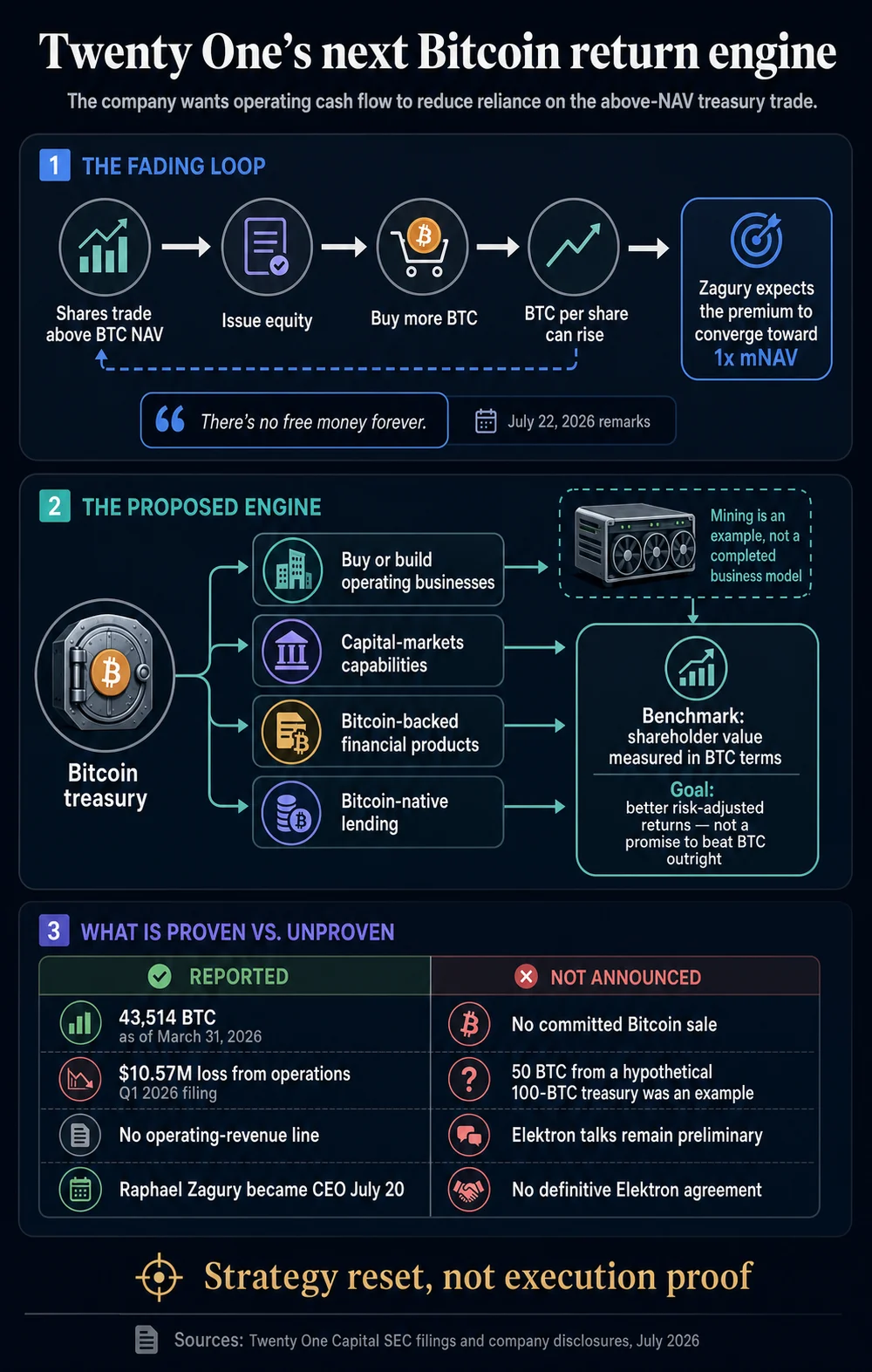
Raphael Zagury, the newly appointed chief executive officer of Twenty One Capital, a public company heavily invested in Bitcoin, has issued a stark warning regarding the sustainability of the current strategy employed by Bitcoin treasury firms. Zagury asserts that the model of issuing shares at a premium to net asset value (NAV) to acquire more Bitcoin is a temporary market anomaly and not a viable long-term strategy for generating shareholder returns. Instead, he proposes a fundamental shift towards building and acquiring cash-generating businesses that can operate synergistically with the company’s substantial Bitcoin holdings.
This strategic pivot, outlined in a recent SEC filing and detailed in a fireside chat on July 22, marks a significant departure from Twenty One Capital’s previous operational focus. Zagury’s vision emphasizes the creation of an "operating company model," where the company actively engages in revenue-generating activities. This includes exploring acquisitions of existing businesses, developing new ones, enhancing capital markets capabilities, creating innovative Bitcoin-backed financial products, and establishing a Bitcoin-native lending platform. A key performance indicator for any prospective acquisition or business venture will be its ability to demonstrate accretive returns when measured against Bitcoin itself.
The Unsustainability of Premium-Funded Bitcoin Acquisition
The core of Zagury’s argument rests on the notion that the practice of issuing equity at a valuation significantly exceeding the underlying Bitcoin assets is an unsustainable financial arbitrage. He describes this as a "temporary market dislocation," where investor enthusiasm for Bitcoin leads them to purchase shares of companies holding Bitcoin at a premium. While this strategy has allowed companies like Twenty One Capital to efficiently expand their Bitcoin reserves, Zagury believes that as more entities adopt this approach, the market premiums will inevitably converge towards a 1x NAV.
"There’s no free money forever," Zagury stated, underscoring the transient nature of such market inefficiencies. He acknowledged that premiums might re-emerge in the future, but stressed that relying solely on them for shareholder returns is a precarious proposition. The implication is that investors and companies alike must prepare for a future where the value proposition shifts from simply holding and acquiring Bitcoin through equity issuance to generating tangible operational profits.
A New Era of Operational Synergy and Bitcoin-Centric Growth
Twenty One Capital’s refreshed priorities, formally announced in May following Zagury’s appointment as CEO on July 20, signal a decisive move towards building a diversified financial services and technology company with Bitcoin at its core. The company’s strategic roadmap now includes:

- Acquisition and Development of Operating Businesses: Identifying and integrating businesses that can generate consistent cash flow and profits. These ventures are expected to complement the company’s Bitcoin holdings rather than simply relying on them for funding.
- Expansion of Capital Markets Capabilities: Enhancing the company’s ability to access and deploy capital effectively, potentially through new financial instruments and strategic partnerships.
- Development of Bitcoin-Backed Financial Products: Innovating in the creation of financial products that leverage Bitcoin as collateral or a foundational asset, catering to a growing demand for Bitcoin-integrated financial solutions.
- Creation of a Bitcoin-Native Lending Platform: Establishing a lending ecosystem built entirely on Bitcoin, allowing for the efficient and secure utilization of Bitcoin assets for borrowing and lending.
The overarching goal is to achieve "better risk-adjusted returns measured in Bitcoin." This means that any business venture undertaken by Twenty One Capital will be evaluated not just on its dollar-denominated profitability, but on its ability to increase the company’s Bitcoin holdings or enhance the value of its existing Bitcoin reserves relative to the inherent risks.
Leadership Transition and Strategic Realignment
Zagury’s ascension to the CEO position followed the resignation of Jack Mallers as chief executive and director on July 20. The company clarified that Mallers’ departure was amicable and unrelated to any internal disputes. Mallers is expected to continue his focus on Strike, a Bitcoin-focused payment application. Notably, Twenty One Capital has also ceased its pursuit of a potential combination with Strike, indicating a clear delineation of strategic interests.
This leadership change and subsequent strategic recalibration suggest a deliberate effort to steer the company towards a more robust and sustainable operational model, moving beyond the speculative growth driven by market premiums.
The Mining Analogy: A Blueprint for Cash Generation
To illustrate his proposed return engine, Zagury drew an analogy to Bitcoin mining. He compared the potential cash-generating capacity of mining operations to the role insurance played in Berkshire Hathaway’s capital allocation strategy. Just as Berkshire Hathaway’s insurance subsidiaries provided a steady stream of capital that could be reinvested across its diverse portfolio, Zagury envisions similar cash-generating businesses within Twenty One Capital providing the financial fuel for further growth and Bitcoin acquisition.
However, he was quick to temper expectations, acknowledging that Twenty One Capital has not yet established such a model and that its successful execution will be challenging. This candid assessment highlights the complexities of integrating operational businesses with a Bitcoin treasury strategy.

Outperforming Bitcoin: A Nuanced Objective
When questioned about whether Twenty One Capital aims to outperform Bitcoin, Zagury initially agreed, but then offered a more nuanced perspective. He suggested that achieving Bitcoin’s value with lower volatility could be considered a success. However, consistently beating Bitcoin over the long term would necessitate exceptional strategic opportunities or a willingness to take on what he termed "irresponsible leverage."
His ultimate framing of mining and other operating businesses is as a pathway to superior risk-adjusted returns. The critical shift in perspective is the emphasis on measuring shareholder value in Bitcoin terms, implying a long-term vision where the company’s success is directly tied to its ability to grow its Bitcoin holdings and the purchasing power of those holdings, rather than just nominal dollar gains.
Financial Snapshot and Future Outlook
As of its first-quarter filing on March 31, Twenty One Capital reported holding 43,514 BTC. The same filing indicated a lack of operating revenue, with a reported loss from operations totaling $10.57 million. This financial snapshot underscores the urgency and necessity of Zagury’s proposed shift towards building revenue-generating operations, as the company’s current financial performance does not yet reflect the envisioned cash-flow engine.
Zagury’s discussion of utilizing treasury assets for business acquisition was explicitly hypothetical. His example of exchanging 50 BTC from a hypothetical 100-BTC treasury for a cash-generating company served as a conceptual illustration rather than an announcement of an impending divestment. Similarly, a potential combination with Elektron Energy, a mining business with which Zagury has leadership ties, remains in the preliminary stages, with no definitive agreement secured and no assurance of future approval.
Twenty One Capital is therefore setting a more ambitious benchmark than simply accumulating Bitcoin through share issuance. The company’s future success will hinge on its ability to build and integrate businesses that demonstrably improve returns on a Bitcoin basis. Whether these operational ventures can indeed deliver better risk-adjusted returns remains an unproven strategy, a bold proposition rather than a documented outcome. The market will be closely watching Twenty One Capital’s execution of this ambitious new direction, as it seeks to redefine the playbook for Bitcoin-centric corporate finance.